

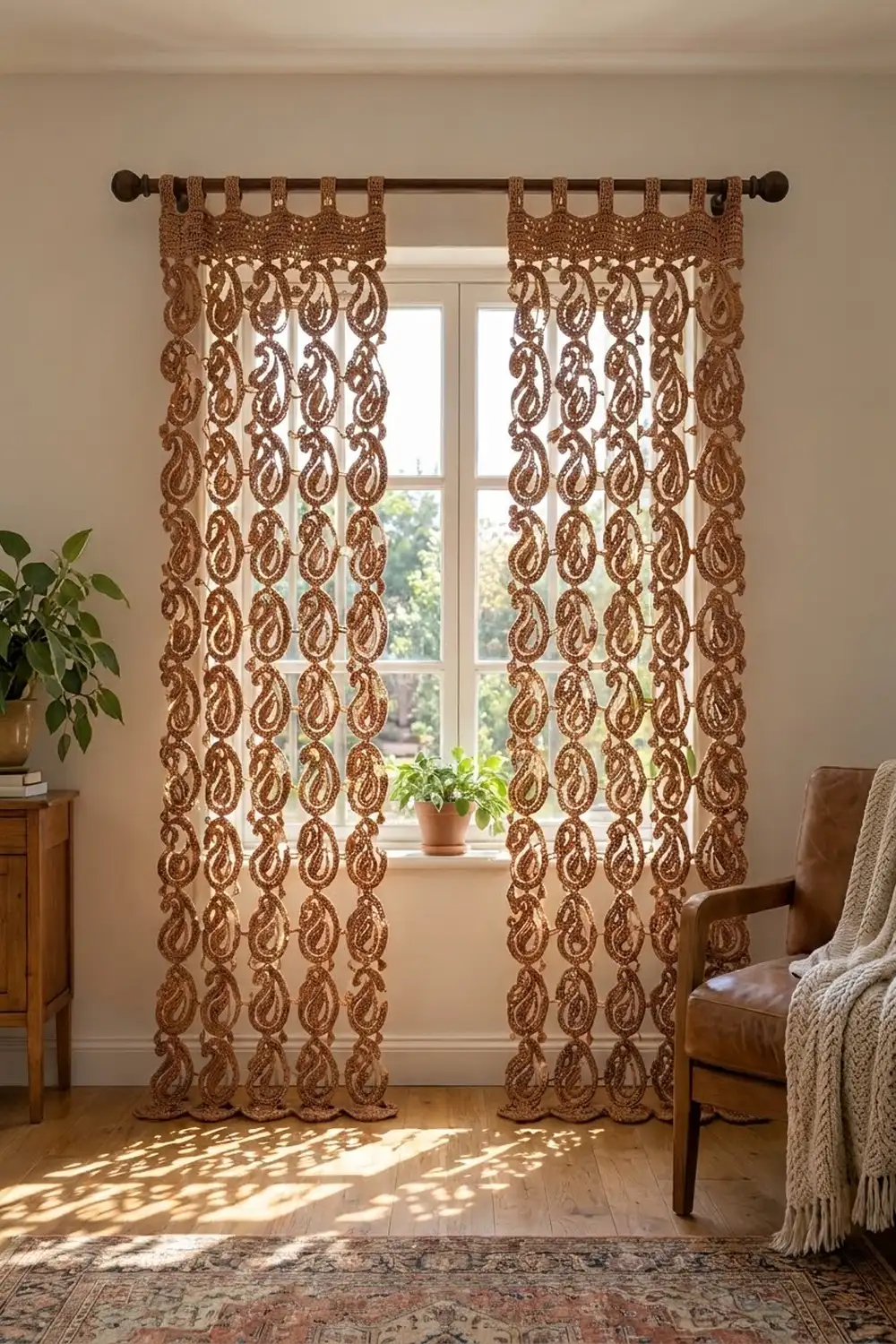
This curtain panel is made from small paisley motifs linked into a light, airy lace screen. Each paisley has a solid inner outline, an open channel of posts and an outer rim, with a curled tail at the top. Strands of motifs hang from a solid header band with tab tops that slide straight onto a curtain rod.
The sample uses one warm copper-brown shade in a smooth worsted-weight cotton. Light comes through the open channels and the gaps between strands and throws soft paisley shadows on the floor. The look is bohemian but tidy, because every motif is the same size and every link is the same length.
This pattern uses US crochet terms. One finished panel measures 25.5 in (64.8 cm) wide and 79 in (200.7 cm) long from the top of the tab loops to the bottom motif. The photo shows two panels, so make two for a matching pair.
Construction is simple. Each motif is worked in 3 rounds around a chain ring, and then a short curling tail is added. Each new motif links to the one above it as you finish it, which builds the strands. Short chain links tie the strands together side to side. Last, you work the header band in rows, add the tabs and hang the strands from it.
Finished Size and Construction
- Finished panel size: 25.5 in × 79 in (64.8 cm × 200.7 cm)
- Skill level: Intermediate
- Terminology: US
- Yarn weight: Worsted (#4), cotton or cotton blend
- Hook: US H-8 (5 mm)
- Number of pieces per panel: 72 paisley motifs plus 1 header band with 6 tabs
- Layout: 6 columns × 12 motifs
- Single motif size: 5 in tall × 3.5 in wide (12.7 cm × 8.9 cm)
- Motif grid before header (“border”): 24.75 in × 71 in (62.9 cm × 180.3 cm)
- Header depth: 4 in (10.2 cm), plus a 1 in (2.5 cm) hanging link and 3 in (7.6 cm) tab loops
Materials
Choose a smooth, firm worsted cotton or a cotton/nylon cord-style yarn. Smooth yarn shows the stitch outlines clearly and holds the curl better than a fuzzy acrylic. Cotton also hangs well and doesn’t stretch as much over time.
- Copper brown: 1,100 g, about 2,090 m (2,286 yd) per panel, based on 100 g / 190 m skeins.
- For the pair shown: 2,200 g, about 4,180 m (4,571 yd).
All quantities include a margin of about 15% for gauge differences and swatching.
Tools:
– US H-8 (5 mm) crochet hook
– Locking stitch markers (at least 4)
– Tapestry needle
– Measuring tape
– Blocking mats and rustproof pins
– Spray bottle
Abbreviations (US Terms)
- ch – chain
- sl st – slip stitch
- sc – single crochet
- hdc – half double crochet
- dc – double crochet
- sp(s) – space(s)
- st(s) – stitch(es)
- beg – beginning
- [ ] – repeat the bracketed steps the stated number of times
Special technique – Curl tail: a short strip of sc worked along a chain, with increases in the middle. The extra stitches on one edge make the strip curve into a hook shape.
Gauge and Checkpoints
Header gauge: 16 sc and 18 rows = 4 in (10.2 cm) in sc rows.
Motif gauge: 1 motif = 5 in × 3.5 in (12.7 cm × 8.9 cm), measured flat and including the curl.
Make one complete motif and block it before you start the rest. Check its size at each round:
- After Round 1: about 3 in long × 1.5 in wide (7.6 cm × 3.8 cm)
- After Round 2: about 4.5 in × 3 in (11.4 cm × 7.6 cm)
- After Round 3 and the curl: 5 in × 3.5 in (12.7 cm × 8.9 cm)
If your motif is too big: go down a half size to a 4.5 mm hook. If it is too small: go up to a 5.5 mm hook. Being off by 0.25 in (0.6 cm) per motif adds up to 3 in (7.6 cm) over the 12-motif length, so it is worth checking now.
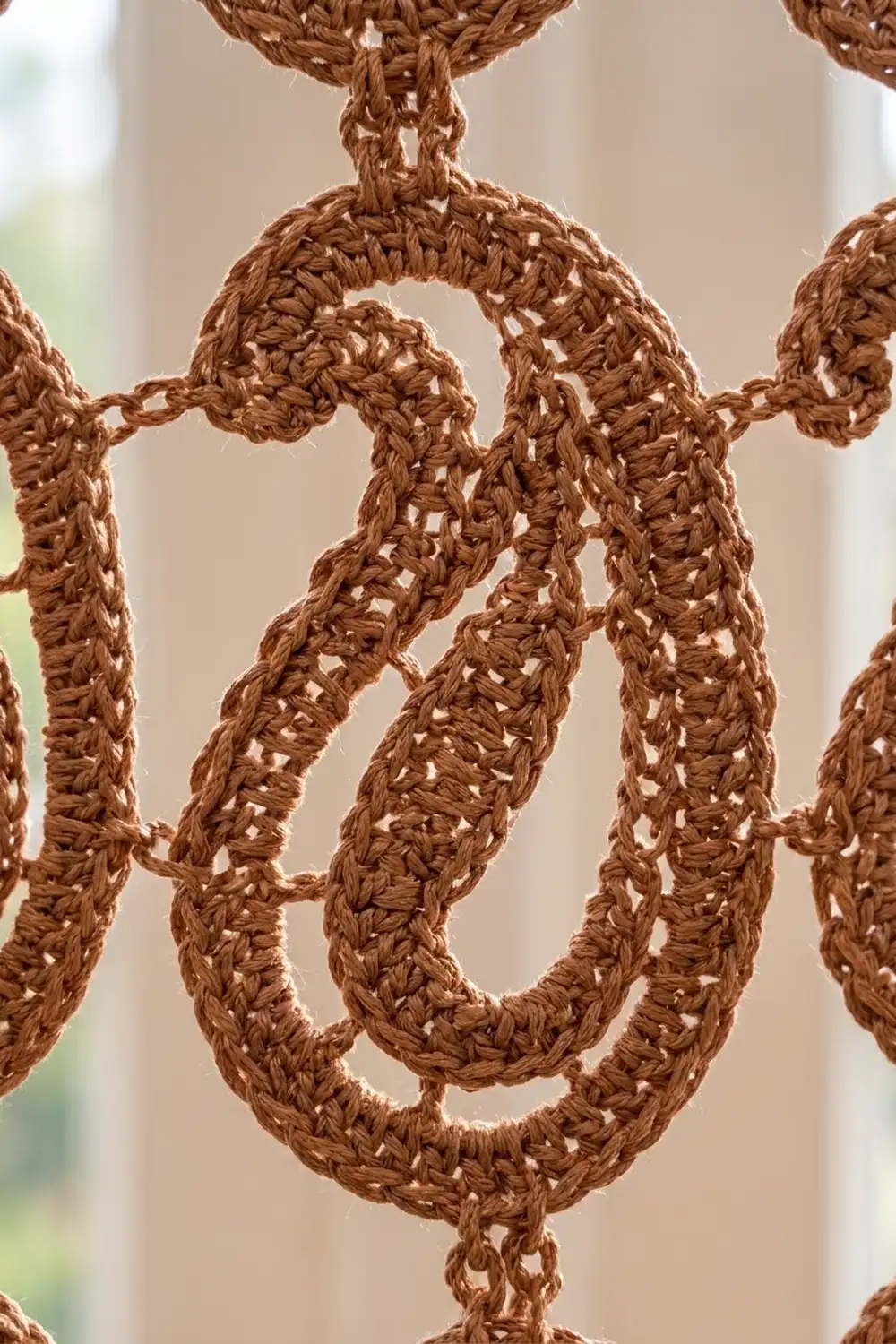
Paisley Motif (make 72 per panel)
The motif is worked in joined rounds. Every round starts and ends at the narrow point of the teardrop.
Round 1 (inner outline): Ch 32 and join with a sl st to the first ch to form a ring, taking care not to twist. Ch 1, then work into the chains as follows:
– sc in the same ch as the join and in the next 5 ch (6 sc)
– hdc in the next 6 ch
– [2 dc in the next ch, dc in the next ch] 4 times (12 dc)
– hdc in the next 6 ch
– sc in the next 6 ch
Join with a sl st to the first sc.
Round 1 total: 36 sts. The 12 sc gather around the join to form the point, and the 12 dc make the rounded end.
Round 2 (open channel): Ch 5 (counts as dc + ch 2) and skip the next st. Then [dc in the next st, ch 2, skip the next st] 17 times. Join with a sl st to the 3rd ch of the beg ch-5.
Round 2 total: 18 dc and 18 ch-2 sps. This round makes the lacy channel between the inner outline and the outer rim.
Round 3 (outer rim – conversion round): Ch 1. Work in this order:
1. sc in the first dc, then 2 sc in the next ch-2 sp
2. [sc in the next dc, 2 sc in the next ch-2 sp] 5 times
3. [sc in the next dc, 3 sc in the next ch-2 sp] 6 times (the rounded end)
4. [sc in the next dc, 2 sc in the next ch-2 sp] 6 times
Join with a sl st to the first sc.
Round 3 total: 18 sc (1 per dc) + 36 sc (2 per sp) + 6 extra sc (rounded end) = 60 sc.
Number the Round 3 stitches from the join. Sc 1 is the point and sc 31 is the center of the rounded end. Place markers in sc 19 and sc 43. These are the side join stitches, each 12 stitches from the bottom center.
Curl tail: Do not fasten off. Ch 13, then work back along the chain:
– sc in the 2nd ch from the hook and in the next 3 ch
– 2 sc in each of the next 4 ch
– sc in the next 4 ch
Sl st into sc 1 at the base.
Curl total: 16 sc over 12 ch (12 sc worked 1 per ch + 4 extra).
Bend the strip toward one side so the tip touches the outer rim about 1 in (2.5 cm) below the point. Tack it in place with a few small stitches. Bend every curl toward the same side.
For the first motif in each column only: fasten off, leaving a 12 in (30.5 cm) tail.
For every other motif: keep the yarn attached and make the link described under Joining.
Make All Pieces
Make 72 motifs for one panel (144 for the pair). They are all the same copper brown.
Text layout grid for one panel (C = column, M = motif, | = link):
HEADER BAND (102 sts, 6 tabs)
 |    |    |    |    |    |
C1   C2   C3   C4   C5   C6
M1 - M1 - M1 - M1 - M1 - M1
 |    |    |    |    |    |
M2 - M2 - M2 - M2 - M2 - M2
 ...  (12 rows of motifs)  ...
M12- M12- M12- M12- M12- M12
Vertical bars (|) are 4-ch links, about 1 in (2.5 cm). Dashes (-) are 3-ch links, about 0.75 in (1.9 cm).
Joining
Vertical links (join-as-you-go): After finishing the curl on motif 2 and each later motif, ch 4. Sl st into sc 31 (bottom center) of the motif above, then fasten off. Each column is made the same way, so you build 6 strands of 12 motifs each, with 11 links per strand.
Stitch-to-stitch logic: The link always runs from the point (sc 1) of the lower motif to the bottom center (sc 31) of the upper motif. That keeps every motif upright and lined up on one center line.
Horizontal links: Lay the 6 strands flat, right side up, with the motifs level across each row. Join new yarn in the right-hand marked side stitch of a motif in column 1. Ch 3 and sl st into the left-hand marked side stitch of the matching motif in column 2, then fasten off. Repeat between every pair of neighboring columns in all 12 rows. That makes 5 links per row and 60 links per panel.
Tension: Keep the link chains the same size as your motif chains. Links that are too tight will pucker the grid, and loose ones will let the strands sag apart.
Checkpoint:
– Width: 6 × 3.5 in + 5 × 0.75 in = 24.75 in (62.9 cm)
– Length: 12 × 5 in + 11 × 1 in = 71 in (180.3 cm)
Header Band and Tabs (Border)
Border gauge: 16 sc and 18 rows = 4 in (10.2 cm). Each column gets its own 17-stitch section of the header, which is 4.25 in (10.8 cm) wide. That matches the column pitch exactly: 3.5 in motif + 0.75 in link = 4.25 in.
Row 1: Ch 103. Sc in the 2nd ch from the hook and in each ch across. (102 sc)
Rows 2–18: Ch 1, turn, sc in each st across. (102 sc each row) Do not fasten off yet.
Why the math works: 6 columns × 17 sts per section = 102 sts, and 102 sts ÷ 4 sts per inch = 25.5 in (64.8 cm). No stitches are added at the seams between sections. The header is 0.75 in (1.9 cm) wider than the motif grid, which leaves about 0.375 in (1 cm) of ease at each side edge so the strands hang straight.
Tabs (make 6): Each tab sits over stitches 5–13 of its section in Row 18, so it is centered on stitch 9.
– Row 1: Join yarn in stitch 5 of the section, ch 1, sc in the same st and the next 8 sts. (9 sc)
– Rows 2–27: Ch 1, turn, sc across. (9 sc)
Fasten off, leaving a 16 in (40.6 cm) tail. Each tab is 6 in (15.2 cm) long and 2.25 in (5.7 cm) wide. Fold it to the back and whipstitch the last row along the top of the header. This makes a 3 in (7.6 cm) loop.
Hanging the strands: Join yarn in sc 1 at the base of the curl on the top motif of column 1. Ch 4 and sl st into stitch 9 of section 1 in the foundation row of the header, then fasten off. Repeat for columns 2–6, linking each one to stitch 9 of its own section.
Total length: 3 in tab loop + 4 in header + 1 in link + 71 in grid = 79 in (200.7 cm).
Final Blocking
- Weave in all ends, running each one through the solid rims rather than the open channels.
- Lay the panel flat on mats, face up.
- Pin the header to 25.5 in × 4 in (64.8 cm × 10.2 cm).
- Pin each column straight down, setting each motif to 5 in × 3.5 in (12.7 cm × 8.9 cm).
- Shape each curl with a pin through its tip.
- Spray until damp, but not soaking wet.
- Leave the panel to dry completely, then unpin it.
- Hang it and let it settle for 24 hours.
Final Quality-Control Checklist
- 72 motifs, each with 36 / 18 + 18 sps / 60 sts in Rounds 1–3
- Every curl bent toward the same side
- 66 vertical links of 4 ch each, and 6 hanging links
- 60 horizontal links of 3 ch each, all at sc 19 and sc 43
- Header measures 102 sts × 18 rows
- 6 tabs of 9 sts × 27 rows, each centered on stitch 9 of its section
- Panel measures 25.5 in × 79 in (64.8 cm × 200.7 cm)
Troubleshooting
- Motif cups: Round 2 is too tight. Loosen the ch-2 spaces or go up a hook size.
- Rim ruffles: Check that you worked exactly 6 groups of 3 sc in Round 3, not more.
- Curl lies flat: Tighten the increases and tack the tip more firmly.
- Strands drift sideways: Check that the vertical links go into sc 31 every time.
- Header wider than planned: Recheck your gauge and go down a hook size for the header only.
Care
Hand wash cool and dry flat, reshaping the curls while damp. Avoid wringing, since that stretches the links.
Final Notes
The measurement chain is:
– 1 motif = 5 in × 3.5 in (12.7 cm × 8.9 cm)
– 1 column section = 17 sts = 4.25 in (10.8 cm)
– Header = 6 sections = 102 sts = 25.5 in (64.8 cm)
– Length: 12 motifs + 11 links = 71 in (180.3 cm), plus the 1 in (2.5 cm) hanging link, 4 in (10.2 cm) header and 3 in (7.6 cm) tabs = 79 in (200.7 cm)
If your first motif matches gauge, every number after it falls into place.
Happy crocheting!