
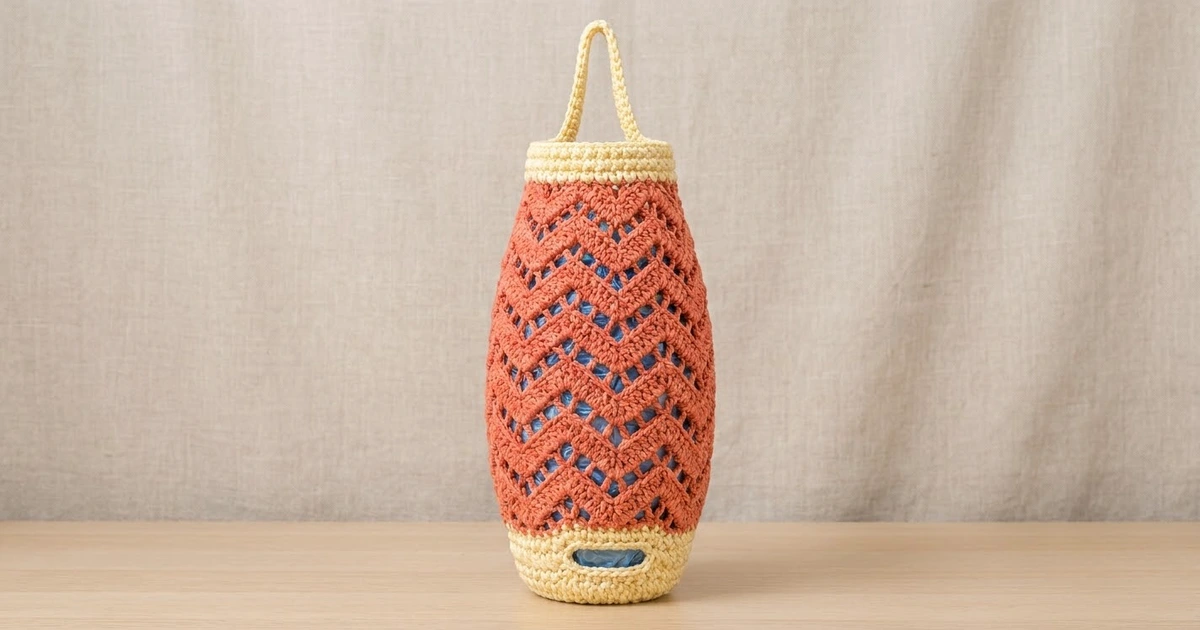
This hanging plastic bag holder brings a little color to the kitchen while it keeps grocery bags tidy. Its body is worked in a coral chevron lace, with solid zigzag rounds alternating with open eyelet rounds, so you can see the bags inside and know when it’s time to refill.
A cream base and a cream top band frame the coral. The base has a horizontal slot near the bottom for pulling out one bag at a time. A flat cream strap loops over a cabinet knob or hook. The overall look is warm and cottage-style, and the zigzags add a lot of movement for very simple stitches.
The pattern uses US crochet terms. The finished holder is about 16 in (40.6 cm) tall without the strap, 7.5 in (19.1 cm) wide laid flat across the body, and 6 in (15.2 cm) wide flat across the top band. The strap adds a loop that rises about 6 in (15.2 cm) above the rim.
It’s made in one piece, from the bottom up, in joined rounds. You’ll start with a flat circle of single crochet, turn it up into a cream wall that includes the slot, work the coral chevron body, level the zigzag top, and finish with a decreased cream band. The strap is worked in rows straight off the rim and sewn to the opposite side.
Finished Size and Construction
- Finished size: 16 in (40.6 cm) tall, plus a strap loop of about 6 in (15.2 cm)
- Body width (flat): 7.5 in (19.1 cm), so 15 in (38.1 cm) around
- Skill level: Easy-intermediate
- Terminology: US
- Yarn weight: Worsted (#4), cotton or cotton blend
- Hook: 5.0 mm (H-8)
- Number of pieces: 1 (strap worked onto the body)
- Layout: Single tube worked bottom-up in joined rounds
- Base diameter: 4.8 in (12.2 cm), 60 sts
- Size before top band: 15 in (38.1 cm) around, about 14.25 in (36.2 cm) tall
- Top band depth: 1.75 in (4.4 cm) of sc, plus the leveling round
Materials
Pick a smooth, firm worsted cotton. Cotton holds its shape when it’s full of bags and stands up to kitchen use. Acrylic works too, but the holder will be stretchier, and the slot may sag a little more.
- Color A, Cream: 90 g, about 144 m (base, top band, strap)
- Color B, Coral: 120 g, about 192 m (chevron body)
These amounts include a margin of about 15%, so you won’t run out if you swatch or have to rip out a round.
Tools:
– 5.0 mm (H-8) crochet hook
– 4 locking stitch markers
– Tapestry needle
– Scissors
– Measuring tape
– An empty 2-liter bottle or a rolled towel for blocking
Abbreviations (US Terms)
- ch – chain
- sl st – slip stitch
- sc – single crochet
- hdc – half double crochet
- dc – double crochet
- tr – treble crochet
- sc2tog – single crochet 2 together
- BLO – back loop only
- MR – magic ring
- sp – space
- st(s) – stitch(es)
- rnd(s) – round(s)
Special stitch – dc3tog (double crochet 3 together): *Yarn over, insert hook in next st or sp, yarn over and pull up a loop, yarn over and pull through 2 loops; repeat from * 2 more times (4 loops on hook), yarn over and pull through all 4 loops. This uses 3 sts and makes 1 st, forming the bottom point (valley) of each zigzag.
Counting note: In the chevron rounds, every ch-1 counts as 1 stitch. When the next round says “next 3,” work into each st or ch-1 sp in order.
Gauge and Checkpoints
Gauge: 16 sc and 18 rnds = 4 in (10.2 cm). In the chevron, 1 repeat (10 sts) = 2.5 in (6.4 cm) wide, and 2 rnds = 1 in (2.5 cm) tall.
Since this is a single piece, the base is your gauge swatch. Work Rnds 1–10 and measure before you go on.
Checkpoints:
– After Rnd 10: Base measures 4.8 in (12.2 cm) across.
– After Rnd 20: Cream wall stands 2.25 in (5.7 cm) tall.
– After Rnd 24: Coral section measures 2 in (5.1 cm) tall; one chevron repeat measures 2.5 in (6.4 cm) across.
– After Rnd 43: Coral section measures 11.5 in (29.2 cm) tall.
– After Rnd 52: Holder measures 16 in (40.6 cm) tall; top band is 6 in (15.2 cm) wide flat.
If your base is too big, go down to a 4.5 mm (7) hook. If it’s too small, go up to a 5.5 mm (I-9). Don’t add or remove stitches, because the 60-st count has to divide evenly into 6 chevron repeats.
Base (Color A, Cream)
Join every round with a sl st to the first sc. Ch 1 at the start of each round doesn’t count as a stitch.
Rnd 1: In a MR, 6 sc. Join. (6)
Rnd 2: 2 sc in each st around. (12)
Rnd 3: Sc in next st, 2 sc in next; rep from * around. (18)
Rnd 4: Sc in next 2, 2 sc in next; rep from * around. (24)
Rnd 5: Sc in next 3, 2 sc in next; rep from * around. (30)
Rnd 6: Sc in next 4, 2 sc in next; rep from * around. (36)
Rnd 7: Sc in next 5, 2 sc in next; rep from * around. (42)
Rnd 8: Sc in next 6, 2 sc in next; rep from * around. (48)
Rnd 9: Sc in next 7, 2 sc in next; rep from * around. (54)
Rnd 10: Sc in next 8, 2 sc in next; rep from * around. (60)
Checkpoint: 4.8 in (12.2 cm) across, lying flat without ruffling.
Cream Wall and Bag Slot
Rnd 11: Working in BLO, sc in each st around. (60) This makes a crisp fold where the base turns up into the wall.
Rnds 12–14: Sc in each st around. (60)
Rnd 15 (slot): Sc in next 25, ch 10, skip next 10 sts, sc in next 25. (50 sc + 10 ch = 60)
Rnd 16: Sc in each sc and in each ch. (60)
Rnds 17–20: Sc in each st around. (60)
The slot is 2.5 in (6.4 cm) wide. Fasten off Color A after Rnd 20. Checkpoint: the wall is 2.25 in (5.7 cm) tall.
Chevron Lace Body (Color B, Coral)
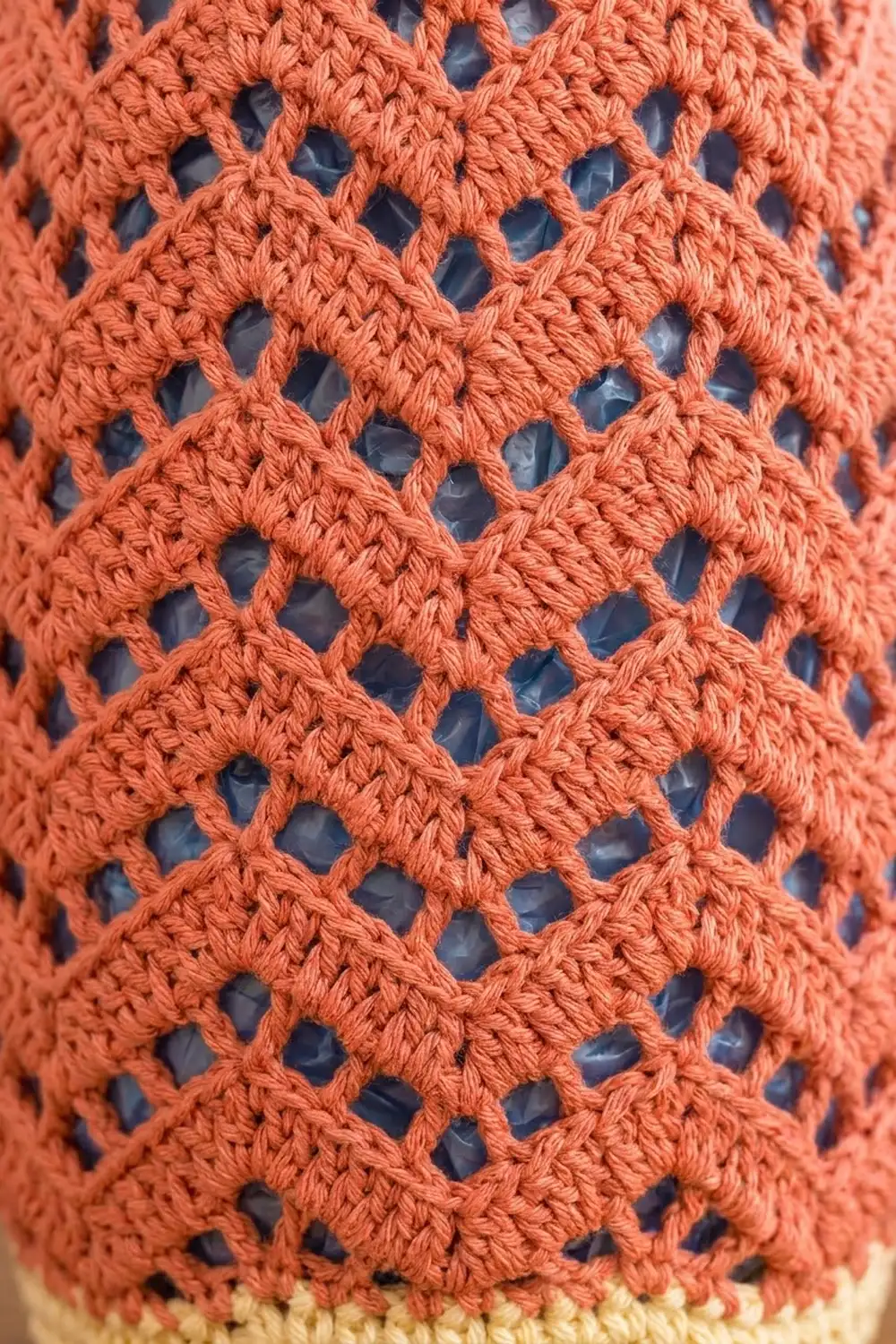
The body alternates a solid round (dc zigzag) with an eyelet round (the same zigzag with ch-1 spaces). Each round has 6 repeats of 10 sts, or 60 sts total. Every round starts at a peak, so the zigzags stack straight up.
Rnd 21 (set-up solid round): Join Color B with a sl st in any st. Ch 4 (counts as dc + ch 1), dc in same st, dc in next 3, dc3tog over next 3, dc in next 3, *(dc, ch 1, dc) in next st, dc in next 3, dc3tog over next 3, dc in next 3; rep from * 4 more times. Join with sl st to 3rd ch of beg ch-4. (6 repeats; 60 sts)
Rnd 22 (eyelet round): Sl st in next ch-1 sp, ch 4 (counts as dc + ch 1), dc in same sp, ch 1, skip next st, dc in next st, ch 1, skip next st, dc3tog over next 3, ch 1, skip next st, dc in next st, ch 1, skip next st, *(dc, ch 1, dc) in next ch-1 sp, ch 1, skip next st, dc in next st, ch 1, skip next st, dc3tog over next 3, ch 1, skip next st, dc in next st, ch 1, skip next st; rep from * 4 more times. Join to 3rd ch of beg ch-4. (Per repeat: 5 sts + 5 ch-1 = 10; 60 total)
Rnd 23 (solid round): Sl st in next ch-1 sp, ch 4 (counts as dc + ch 1), dc in same sp, dc in next 3, dc3tog over next 3, dc in next 3, *(dc, ch 1, dc) in next ch-1 sp, dc in next 3, dc3tog over next 3, dc in next 3; rep from * 4 more times. Join. (60)
Rnds 24–43: Alternate Rnd 22 and Rnd 23, ending with a solid round (Rnd 43). Even rounds are eyelet rounds, and odd rounds are solid rounds. (60 in every round)
Each peak is worked into the peak ch-1 sp below, and each dc3tog sits right over the dc3tog below. If a zigzag drifts, count back to the last peak.
Checkpoint: the coral section is 11.5 in (29.2 cm) tall across 23 rounds.
Top Band and Handle (Border)
On this piece, the border is the cream band at the rim plus the strap. Border gauge is the same as the base: 16 sc and 18 rnds = 4 in (10.2 cm).
Rnd 44 (leveling round): Change to Color A in the final sl st of Rnd 43. Ch 1, sc in same st, sc in next ch-1 sp, sc in next dc, hdc in next, dc in next 2, tr in next dc3tog, dc in next 2, hdc in next, *sc in next dc, sc in next ch-1 sp, sc in next dc, hdc in next, dc in next 2, tr in next dc3tog, dc in next 2, hdc in next; rep from * 4 more times. Join. (Per repeat: 3 sc + 1 hdc + 2 dc + 1 tr + 2 dc + 1 hdc = 10; 60 total)
The short stitches sit on the peaks and the tall ones fill the valleys, so the top edge comes out level.
Rnd 45 (decrease): Sc in next 3, sc2tog; rep from * 11 more times. Join. (12 repeats × 4 = 48)
Rnds 46–52:* Sc in each st around. (48)
Fasten off.
Per-side counts: Flattened, the body has 30 sts per side (60 ÷ 2), and the band has 24 sts per side (48 ÷ 2).
Why the math works: At 4 sts per inch, 48 sts makes 12 in (30.5 cm) around, or 6 in (15.2 cm) flat. The body is 15 in (38.1 cm) around, so the narrower rim tapers the top like a bottle and keeps bags from spilling out. The 12 decreases fall evenly, one in every 5 sts, so the band doesn’t pucker.
Marking the strap positions: Flatten the holder with the slot centered on the front. Place a marker in the 5 rim sts centered at each side fold. If your rounds haven’t drifted, these are Rnd 52 sts 10–14 and 34–38. The two groups are 24 sts apart, exactly half of 48.
Strap Row 1: Join Color A in the first marked st on one side. Ch 1, sc in same st and next 4. (5)
Rows 2–63: Ch 1, turn, sc in each st across. (5)
The strap is 1.25 in (3.2 cm) wide and 14 in (35.6 cm) long. Leave a 12 in (30.5 cm) tail. Keeping the strap untwisted, whipstitch Row 63 to the 5 marked sts on the opposite side, one strap st to one rim st.
Final Blocking
- Weave in all ends on the inside, following the stitch direction.
- Mist the holder lightly with water until it’s damp but not soaked.
- Slide it over an empty 2-liter bottle or a tightly rolled towel.
- Gently pull the chevron lengthwise until the coral section measures 11.5 in (29.2 cm) and the peaks are sharp.
- Pinch the slot open into an even oval, 2.5 in (6.4 cm) wide.
- Lay the strap flat and straighten its edges.
- Let dry completely, then remove the form.
Final Quality-Control Checklist
- Base lies flat at 4.8 in (12.2 cm) across
- BLO fold is visible all the way around Rnd 11
- Slot is 2.5 in (6.4 cm) wide with no gaps at the ends
- Each chevron round has exactly 6 peaks and 6 valleys
- Peaks and valleys line up vertically from Rnd 21 to Rnd 43
- Rim is level after Rnd 44
- Top band measures 6 in (15.2 cm) flat
- Strap is untwisted and securely sewn on both sides
- Total height is 16 in (40.6 cm)
Troubleshooting
Base ruffles: Your tension is loose for the increases. Go down a hook size or tighten up the 2-sc increases.
Base cups before Rnd 11: Your tension is too tight. Go up a hook size for Rnds 1–10.
Zigzags lean or spiral: You’ve probably missed the sl st into the peak ch-1 sp at the start. Every round must begin in that sp.
Stitch count off in an eyelet round: You’ve likely skipped a ch-1 when counting. Each ch-1 counts as a stitch in the next round.
Slot stretches too wide: Work Rnd 16 a little tighter across the 10 ch, or sc around the slot edge from the inside.
Rim is wavy after Rnd 44: Check that each tr sits in a dc3tog and each center sc sits in a peak ch-1 sp.
Strap stretches: Cotton relaxes when it’s carrying weight. Shorten the strap to 55 rows, or add a sl st along each long edge.
Care
Hand wash in cool water and lay flat or dry over a bottle to keep the shape. Avoid the dryer, which can shrink cotton and blur the chevron points.
Final Notes
Here is how the measurements build from start to finish: a 60-st base at 4.8 in (12.2 cm), a 2.25 in (5.7 cm) cream wall with a 2.5 in (6.4 cm) slot, an 11.5 in (29.2 cm) chevron body in 6 repeats of 2.5 in (6.4 cm), and a 48-st top band that is 6 in (15.2 cm) wide flat. Together these make a 16 in (40.6 cm) holder with a 14 in (35.6 cm) strap. If the base and the first two chevron rounds measure right, the rest will too.
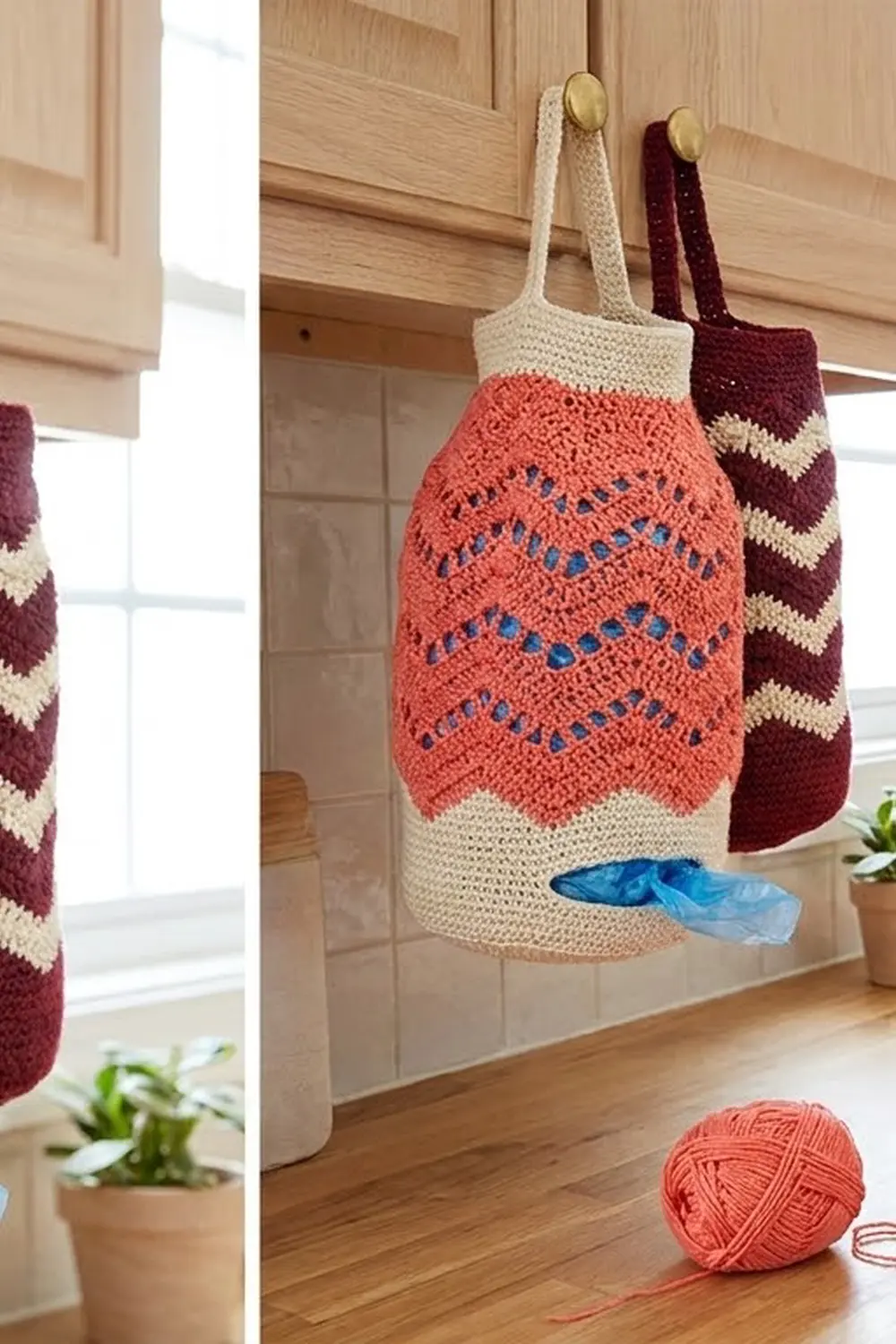
For a second holder, try a deep berry body with a cream solid round every few rounds for striped zigzags.
Happy crocheting!