

The Coral Cove Hanging Basket is a sturdy oval caddy that hangs from a wooden ring. It holds two standard toilet paper rolls side by side, and it works just as well for washcloths, hair ties or small toys.
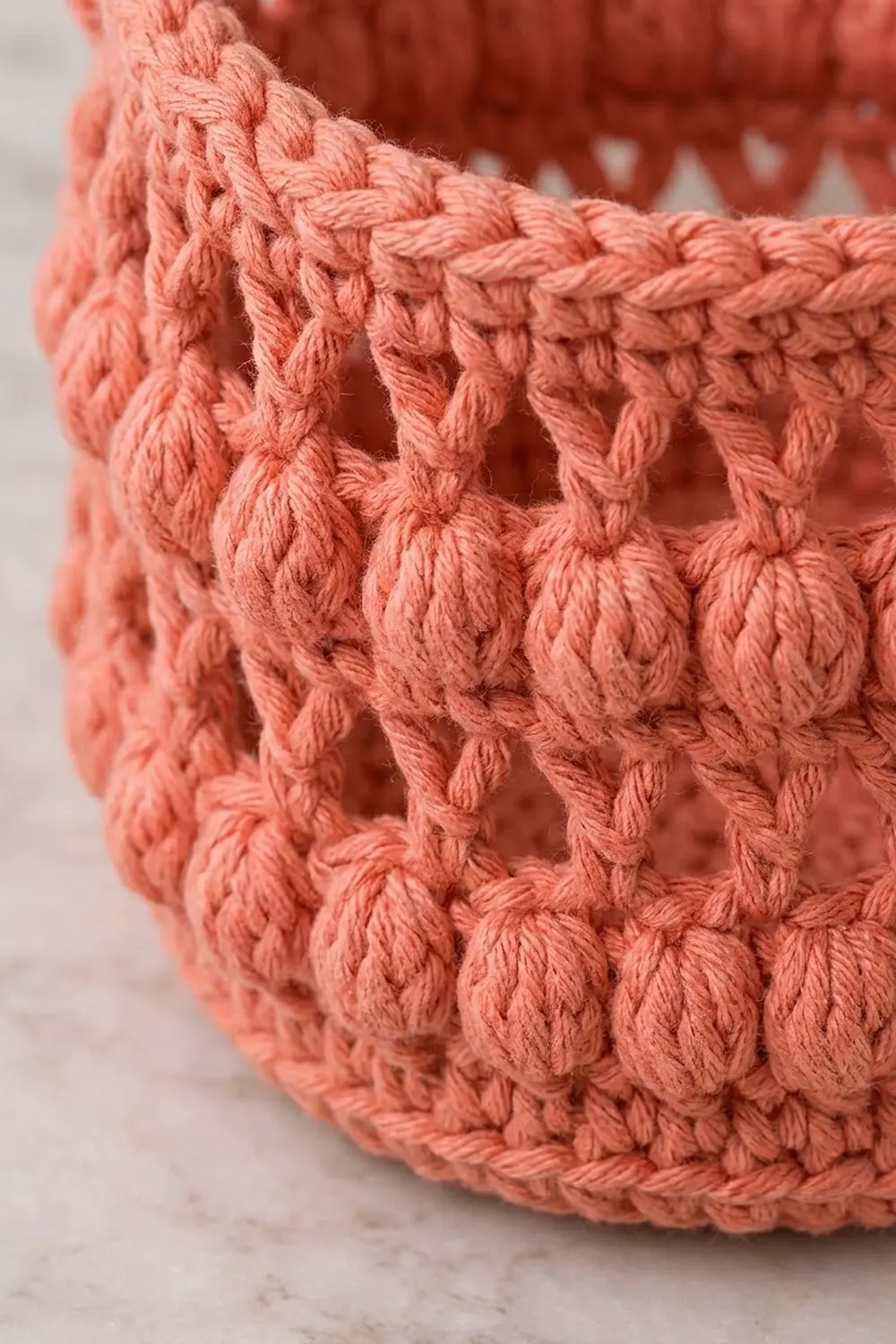
The whole basket is worked in one warm coral cotton. The texture comes from open V-stitch rounds alternating with rows of round, plump puff stitches, and a twisted reverse single crochet rim finishes the top edge. The look is soft and slightly vintage while staying practical.
This pattern uses US crochet terms. The finished basket measures about 10.5 in (26.7 cm) long, 5.75 in (14.6 cm) wide and 5.5 in (14.0 cm) tall. From the top of the ring to the bottom of the basket it hangs about 15 in (38.1 cm).
The construction is simple. You crochet a flat oval base in double crochet rounds, turn the wall up with a back-loop round, and work the textured walls in joined rounds without any shaping. Then you crochet two straight straps and sew them to the back rim and around a wooden ring.
Finished Size and Construction
- Finished size: 10.5 in (26.7 cm) long x 5.75 in (14.6 cm) wide x 5.5 in (14.0 cm) tall
- Hanging length: about 15 in (38.1 cm) including ring
- Skill level: Easy-Intermediate
- Terminology: US crochet terms
- Yarn weight: Worsted (#4) cotton or cotton blend
- Hook: 5.0 mm (H-8)
- Number of pieces: 3 crocheted pieces (1 basket, 2 straps) plus 1 wooden ring
- Layout: Oval basket with two straps rising from the back rim to one ring
- Base size: 10.5 in x 5.75 in (26.7 cm x 14.6 cm)
- Wall size before rim: 26.9 in (68.3 cm) around x 4.75 in (12.1 cm) tall
- Rim depth: 0.75 in (1.9 cm)
- Strap size: 1.4 in (3.6 cm) wide x 10 in (25.4 cm) long
Materials
Yarn: Use a smooth worsted-weight cotton or a cotton-acrylic blend. Cotton keeps the basket firm and gives the puffs clear definition. Avoid fuzzy or very stretchy yarns, because the walls will sag once they are loaded.
- Coral: 220 g, about 400 m (437 yd)
These quantities include a margin of about 15 percent for the gauge swatch and small tension differences.
Tools:
- 5.0 mm (H-8) crochet hook
- 1 wooden ring, 2.5 in (6.4 cm) outer diameter
- 4 stitch markers
- Tapestry needle
- Scissors
- Measuring tape
- Rustproof pins and a spray bottle for blocking
Abbreviations (US Terms)
- ch – chain
- sl st – slip stitch
- sc – single crochet
- dc – double crochet
- BLO – back loop only
- sp – space
- st(s) – stitch(es)
- rep – repeat
- rev sc – reverse single crochet (crab stitch)
Special stitches
- V-stitch (V-st): (dc, ch 1, dc) in the same stitch or space.
- Puff: (yarn over, insert hook in the space, yarn over, pull up a loop to 0.5 in / 1.3 cm tall) 4 times, giving 9 loops on the hook. Yarn over and draw through all 9 loops. Keep the loops even so the puff stays round.
- Reverse single crochet: Work sc from left to right (right to left if you crochet left-handed) into the next stitch along. This twists each stitch into a rope-like edge.
Gauge and Checkpoints
Gauge: 14 dc and 7 rounds = 4 in (10.2 cm), and 14 sc and 16 rows = 4 in (10.2 cm), both in the hook size used for the basket.
Crochet the base first and treat it as your test piece. The base sets the circumference of the whole basket, so it is the most important measurement.
Checkpoints:
- After Round 1: about 6 in (15.2 cm) long x 1.1 in (2.8 cm) wide
- After Round 3: about 8.3 in (21.1 cm) long x 3.4 in (8.6 cm) wide
- After Round 5: 10.5 in (26.7 cm) long x 5.75 in (14.6 cm) wide, lying flat
- After Round 14: walls about 4.75 in (12.1 cm) tall
- After Round 17: walls 5.5 in (14.0 cm) tall
- Each strap: 1.4 in (3.6 cm) wide x 10 in (25.4 cm) long
If the base is too big: go down half a hook size and start again.
If the base is too small: go up half a hook size.
If the base cups or ruffles: see Troubleshooting before continuing.
Basket Base
Worked in joined rounds with the right side facing. The beginning ch-2 does not count as a stitch. Join each round with a sl st to the first dc.
Foundation: Ch 21.
Round 1: 6 dc in 3rd ch from hook (first curved end), dc in next 17 ch, 6 dc in last ch (second curved end). Rotate and work along the opposite side of the foundation chain: dc in next 17 ch. Join. (46 sts: 6 + 17 + 6 + 17)
Round 2: Ch 2, 2 dc in each of next 6 sts, dc in next 17 sts, 2 dc in each of next 6 sts, dc in next 17 sts. Join. (58 sts: 12 + 17 + 12 + 17)
Round 3: Ch 2, [dc in next st, 2 dc in next st] 6 times, dc in next 17 sts, [dc in next st, 2 dc in next st] 6 times, dc in next 17 sts. Join. (70 sts: 18 + 17 + 18 + 17)
Round 4: Ch 2, [dc in next 2 sts, 2 dc in next st] 6 times, dc in next 17 sts, [dc in next 2 sts, 2 dc in next st] 6 times, dc in next 17 sts. Join. (82 sts: 24 + 17 + 24 + 17)
Round 5: Ch 2, [dc in next 3 sts, 2 dc in next st] 6 times, dc in next 17 sts, [dc in next 3 sts, 2 dc in next st] 6 times, dc in next 17 sts. Join. (94 sts: 30 + 17 + 30 + 17)
Lay the base flat and check it against the Round 5 checkpoint. The two 17-stitch straight sides stay the same on every round, and all the growth happens on the curved ends. That keeps the base a true long oval.
Basket Walls
Continue in joined rounds with no increases. Every wall round holds 94 stitches.
Round 6 (turning round): Ch 1, sc in BLO of each st around. Join to first sc. (94 sc)
The unworked front loops form a crisp ridge on the outside, and the wall turns straight up.
Round 7: Ch 1, sc in each st around. Join. (94 sc)
Round 8 (V-st round): Ch 4 (counts as dc and ch-1), dc in same st as join, skip next st, V-st in next st, skip next st; rep from * around. Join with sl st to 3rd ch of beginning ch-4. (47 V-sts: 94 dc + 47 ch-1 sps)*
Round 9 (puff round): Sl st into first ch-1 sp, ch 2 (does not count), puff in same sp, ch 1, puff in next ch-1 sp, ch 1; rep from * around. Join to top of first puff. (47 puffs + 47 ch-1 sps = 94 sts)*
Round 10 (V-st round): Sl st into next ch-1 sp, ch 4 (counts as dc and ch-1), dc in same sp, V-st in next ch-1 sp; rep from * around. Join to 3rd ch of beginning ch-4. (47 V-sts)*
Each V now sits between two puffs, which creates the open lattice.
Round 11: Rep Round 9. (47 puffs)
Round 12: Rep Round 10. (47 V-sts)
Round 13: Rep Round 9. (47 puffs)
Round 14: Rep Round 10. (47 V-sts)
Checkpoint: The walls measure about 4.75 in (12.1 cm) from the Round 6 ridge. You should see three rows of puffs and four open V-stitch rounds.
Straps (Make 2)
Worked flat in rows.
Foundation: Ch 6.
Row 1: Sc in 2nd ch from hook and in each ch across. (5 sc)
Rows 2–40: Ch 1, turn, sc in each st across. (5 sc)
Fasten off and leave a 16 in (40.6 cm) tail for sewing. Each strap measures 1.4 in (3.6 cm) x 10 in (25.4 cm). Lay the two straps side by side. If one is longer, add or remove a row so they match exactly.
Make All Pieces
All pieces are coral.
- Basket (base and walls in one piece): 1
- Straps: 2
- Wooden ring: 1 (purchased)
Layout, back view:
            ( ring )
            /      \
     strap /        \ strap
          /          \
   [ ======= back rim of basket ======= ]
   [  curve |  17-st back wall  | curve ]
Border (Top Rim)
Border gauge: 14 sc = 4 in (10.2 cm), the same as the walls.
The rim converts the V-stitch round back into a solid edge with exactly 94 stitches. Count the stitches by section: 17 on the back wall, 30 on each curved end and 17 on the front wall (17 + 30 + 17 + 30 = 94). These sections line up with the base.
Round 15 (conversion round): Sl st into first ch-1 sp, ch 1, 2 sc in same sp, 2 sc in each remaining ch-1 sp around. Skip the dc stitches and the gaps between V-sts. Join. (47 sps x 2 sc = 94 sc)
Round 16: Ch 1, sc in each st around. Join. (94 sc: 17 back wall + 30 end + 17 front wall + 30 end)
Round 17: Ch 1, rev sc in each st around. Join. (94 rev sc) Fasten off and weave in the end.
Why the math works: The base finished at 94 stitches, Rounds 6–7 kept 94, and every V-stitch or puff round holds 47 repeats. Working 2 sc in each of the 47 spaces brings the rim back to 94 stitches. Since 94 sc at 14 sc per 4 in measures 26.9 in (68.3 cm), the rim matches the base circumference and the walls stand straight.
Joining: Attaching the Straps and Ring
Lay the basket flat and choose the back wall. Place one stitch marker at each spot where the 17-stitch straight back wall meets a curved end. That puts the markers about 4.9 in (12.4 cm) apart.
- Position the straps: Center the bottom of one strap over each marker on the inside of the basket. Let the strap overlap the wall by 1 in (2.5 cm), which covers Rounds 15–17 and the top of Round 14.
- Sew stitch to stitch: Using the strap tail, whipstitch the 5 stitches of the strap’s bottom edge to the 5 matching stitches of Round 15. Then whipstitch both long edges of the overlap down through Rounds 15–17. Go through the strap and both loops of each wall stitch.
- Add the ring: Bring both straps up so they angle toward each other. Pass the top of each strap through the ring from front to back and fold it down by 1.25 in (3.2 cm), which is 5 rows. Sew the folded end to the strap with a second length of yarn.
- Tension: Pull each stitch snug but not tight. The rim should stay smooth with no puckers where the straps join.
Size checkpoint: Each strap shows about 7.75 in (19.7 cm) between the rim and the ring. Hang the basket from the ring. The rim should sit level, and the total drop should be about 15 in (38.1 cm).
Final Blocking
- Weave in all remaining ends along the inside of the solid sc rounds.
- Lightly mist the whole basket with water until it is damp but not wet.
- Stuff the basket firmly with a towel or two toilet paper rolls wrapped in plastic so the walls stand upright.
- Shape the oval with your hands so the two curved ends match and the long walls are straight.
- Gently round each puff with your fingertips.
- Pin the straps flat on a towel at 10 in (25.4 cm) long if they twisted while sewing.
- Let everything dry completely before you remove the stuffing.
Final Quality-Control Checklist
- The base lies flat at 10.5 in x 5.75 in (26.7 cm x 14.6 cm).
- Every wall round counts 94 stitches or 47 repeats.
- The Round 6 ridge runs evenly around the outside.
- There are three puff rounds and four V-stitch rounds, and all puffs line up neatly.
- The rim lies smooth, measures 26.9 in (68.3 cm) around and has no gaps.
- Both straps match at 10 in (25.4 cm).
- The straps are sewn securely, and the rim hangs level.
- All ends are woven in and invisible.
Troubleshooting
The base cups upward: Your round height is short compared with your stitch width. Loosen the dc or go up half a hook size.
The base ruffles: Your stitches are taller than the gauge. Go down half a hook size, or check that you didn’t add extra increases.
The curved ends look pointed: The increases are stacking. In Rounds 4 and 5 you can move the increase to the middle of each repeat to soften the curve. Stitch counts stay the same.
The walls flare outward: Your puffs are too loose. Pull each puff loop to a consistent 0.5 in (1.3 cm), and check that each V round still has 47 V-sts.
The rim is wavy: Make sure Round 15 has exactly 2 sc per space and no stitches between V-sts.
The basket tilts when hanging: One strap is longer, or the straps sit off-center. Re-measure and resew.
Care
Hand wash in cool water with mild soap, gently press out the water, reshape the basket and dry it flat or stuffed. Don’t tumble dry, because it can shrink the cotton and flatten the puffs.

Final Notes
The whole basket follows one measurement chain. A 94-stitch base at 10.5 in x 5.75 in (26.7 cm x 14.6 cm) sets a 26.9 in (68.3 cm) circumference. The walls keep 94 stitches (or 47 repeats) up to 4.75 in (12.1 cm). The rim returns to 94 sc and finishes at 5.5 in (14.0 cm) tall, and two 10 in (25.4 cm) straps carry it from a 2.5 in (6.4 cm) ring. If you check your base first, everything else falls into place.
Happy crocheting!