
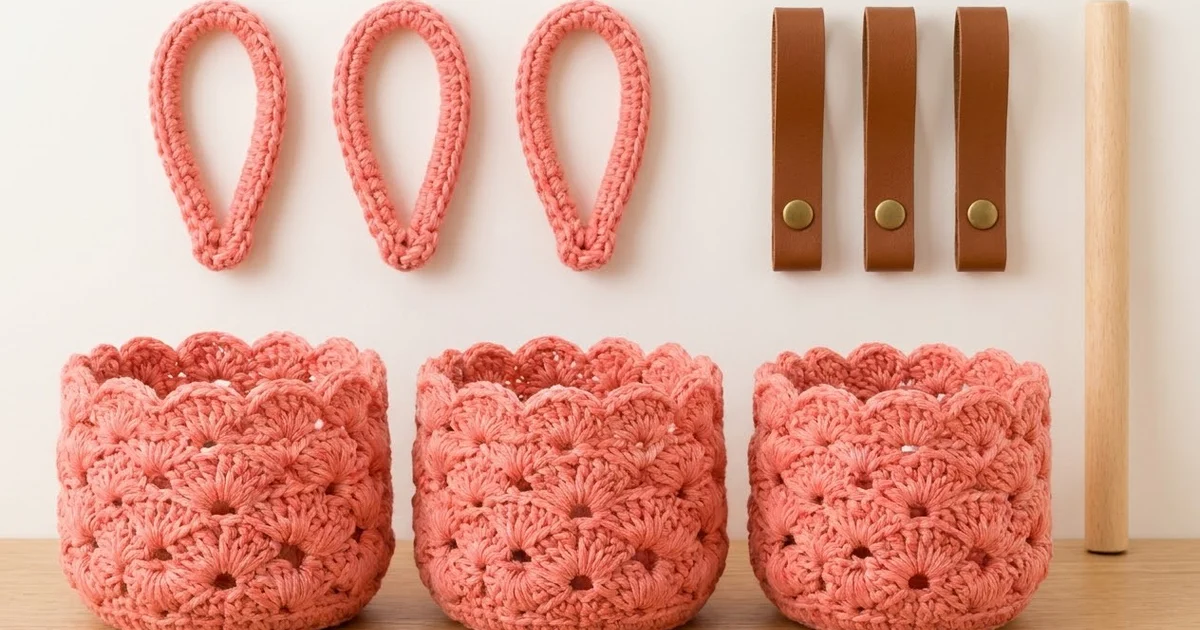
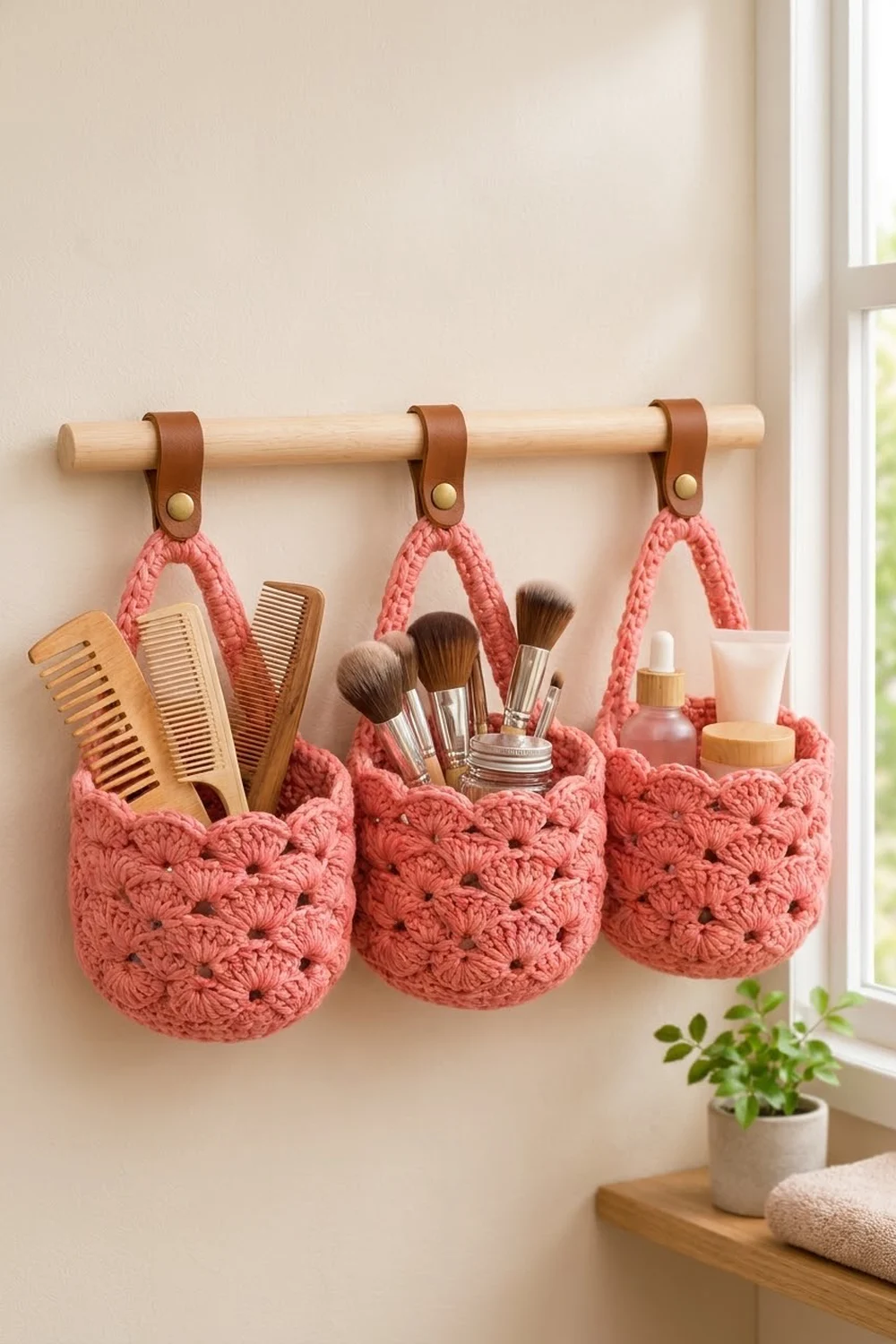
These three small coral baskets hang side by side from a wooden dowel. Each one has a solid round base, a wall of staggered shell stitches and a soft scalloped rim. They look sweet and a little vintage. They work well in a bathroom, on a vanity wall or by a desk to hold brushes, combs, pens and small bottles.
The baskets use just one color, a warm salmon coral in bulky cotton. Brown leather straps with brass snaps and a natural wood dowel finish the set. This pattern uses US crochet terms throughout.
Each finished basket measures about 5.5 in (14.0 cm) across and 4.5 in (11.4 cm) tall. The handle loop rises about 2 in (5.1 cm) above the rim.
Construction is simple. First you crochet a flat single crochet circle for the base. One back-loop round turns the corner, four rounds of offset shells build the wall, and two border rounds make the scallops. A short slip-stitch strip becomes the handle, which you sew to the back rim. You make three baskets in total and hang them on the dowel with leather straps.
Finished Size and Construction
- Finished size (one basket): 5.5 in (14.0 cm) diameter x 4.5 in (11.4 cm) tall
- Skill level: Easy to Intermediate
- Terminology: US crochet terms
- Yarn weight: Bulky (#5) cotton
- Hook: 6.0 mm (US J-10)
- Number of pieces: 3 baskets + 3 handles (plus 3 leather straps and 1 dowel, purchased)
- Layout: 3 baskets in one horizontal row, 6 in (15.2 cm) apart center to center
- Base size: 5.5 in (14.0 cm) diameter, 54 stitches around
- Height before border: 3.75 in (9.5 cm)
- Border depth: 0.75 in (1.9 cm)
- Overall hanging width: about 17.5 in (44.5 cm) across the three baskets, on a 20 in (50.8 cm) dowel
Materials
Yarn advice: Choose a smooth, round bulky (#5) cotton or cotton-blend yarn with about 100 m per 100 g. Cotton holds the basket shape and shows the shell texture clearly. Acrylic will work, but the walls will be softer and may need extra blocking.
- Coral (one color only): 220 g, about 220 m (240 yd)
- About 60 g (60 m) per basket, including its handle
These amounts include about 20% extra to cover your gauge swatch and small differences in tension.
Tools and hardware:
- 6.0 mm (US J-10) crochet hook
- Tapestry needle
- 1 stitch marker
- Scissors and measuring tape
- 3 leather straps with snap closures, about 1 in (2.5 cm) wide and 6 in (15.2 cm) long
- 1 wooden dowel, 0.75 in (1.9 cm) thick and 20 in (50.8 cm) long
- 2 small wall hooks or a cord for hanging the dowel
- Spray bottle and a round container about 5.5 in (14.0 cm) across for blocking
Abbreviations (US Terms)
- ch – chain
- sl st – slip stitch
- sc – single crochet
- dc – double crochet
- BLO – back loop only
- MR – magic ring
- st(s) – stitch(es)
- sk – skip
- rep – repeat
- Rnd – round
Special stitches:
- Shell: 5 dc in the same stitch.
- Scallop: 7 dc in the same stitch.
- Half shell: at the start of a round, ch 3 (counts as 1 dc), then work 2 dc in the same stitch. At the end of that round, work 2 more dc in that stitch to complete the 5-dc shell.
Gauge and Checkpoints
Base gauge: 12 sc and 13 rounds = 4 in (10.2 cm) with a 6.0 mm hook.
Shell gauge: 3 shell repeats (18 sts) = 6 in (15.2 cm) wide; 4 shell rounds = 3.5 in (8.9 cm) tall.
Make one complete base first and use it as your test piece. Checkpoints:
- After Rnd 3 (18 sts): about 2 in (5.1 cm) across
- After Rnd 6 (36 sts): about 3.75 in (9.5 cm) across
- After Rnd 9 (54 sts): 5.5 in (14.0 cm) across, lying flat
- After Rnd 14 (wall complete): 3.75 in (9.5 cm) tall from the table
- After Rnd 16 (border): 4.5 in (11.4 cm) tall
If your base is too big: switch to a 5.5 mm hook. If it is too small: switch to a 6.5 mm hook. If the base ruffles, your tension is too tight. If it cups, your tension is too loose. Change your hook rather than the stitch counts, because the shell repeat needs exactly 54 stitches.
Basket Base
Make a MR.
Rnd 1: Ch 1, 6 sc in ring. Pull the ring closed and place a marker in the first st. (6 sts)
Work in a continuous spiral for Rnds 2–9. Move the marker up each round.
Rnd 2: 2 sc in each st around. (12 sts)
Rnd 3: Sc in next st, 2 sc in next st; rep from * around. (18 sts)
Rnd 4: Sc in next st, 2 sc in next st, sc in next st; rep from * around. (24 sts)
Rnd 5: Sc in next 3 sts, 2 sc in next st; rep from * around. (30 sts)
Rnd 6: Sc in next 2 sts, 2 sc in next st, sc in next 2 sts; rep from * around. (36 sts)
Rnd 7: Sc in next 5 sts, 2 sc in next st; rep from * around. (42 sts)
Rnd 8: Sc in next 3 sts, 2 sc in next st, sc in next 3 sts; rep from * around. (48 sts)
Rnd 9: Sc in next 7 sts, 2 sc in next st; rep from * around. Sl st into the next st to smooth the step. (54 sts)
Staggering the increases keeps the circle round instead of hexagonal. Check the base: it should lie flat and measure 5.5 in (14.0 cm) across.
Basket Wall
Rnd 10 (turning ridge): Ch 1, sc in BLO of each st around. Sl st to the first sc. (54 sts: 54 worked 1-per-stitch + 0 added)
This round turns the edge upward and leaves a neat ridge around the bottom.
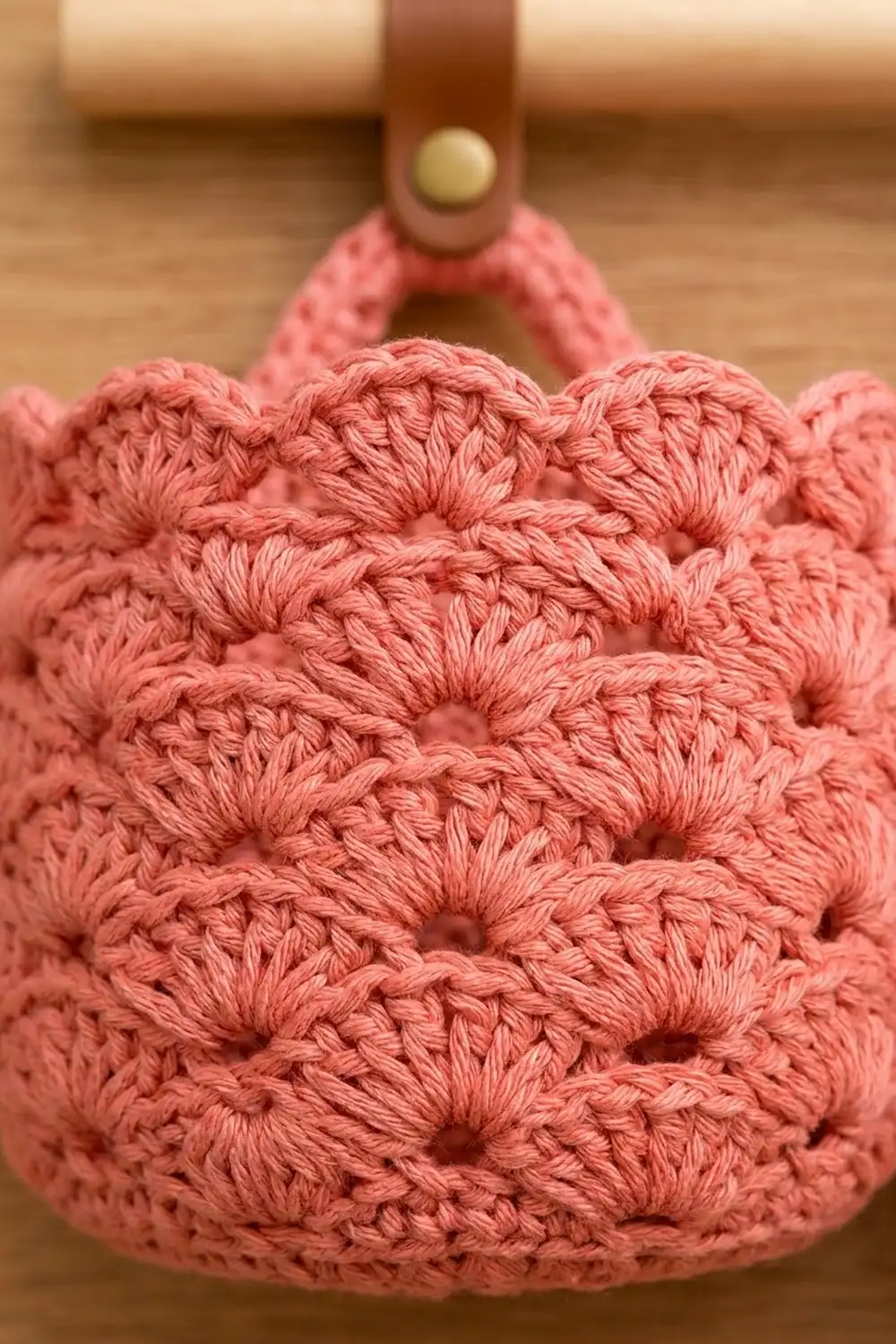
Rnd 11 (Shell Round A): Ch 1, sc in the same st as the join. Sk 2 sts, shell in next st, sk 2 sts, sc in next st; rep from * 7 more times. Sk 2 sts, shell in next st, sk 2 sts, sl st to the first sc. (9 shells + 9 sc = 54 sts)
Rnd 12 (Shell Round B): Ch 3 (counts as dc), 2 dc in the same st (half shell). Sk 2 dc, sc in the center (3rd) dc of the next shell, sk 2 dc, shell in the next sc; rep from * 7 more times. Sk 2 dc, sc in the center dc of the last shell, sk 2 dc. Work 2 dc in the same st as the beginning ch-3 to complete the half shell. Sl st to the top of the ch-3. (9 shells + 9 sc = 54 sts)
Each new shell sits on a sc from the round below, so the shells shift over by half a repeat. This creates the staggered fish-scale look, with a small eyelet at the foot of each shell.
Rnd 13 (Shell Round A, offset): Ch 1, sc in the top of the ch-3 (the center of the split shell). Sk 2 dc, shell in the next sc, sk 2 dc, sc in the center dc of the next shell; rep from * 7 more times. Sk 2 dc, shell in the next sc, sk 2 dc, sl st to the first sc. (9 shells + 9 sc = 54 sts)
Rnd 14 (Shell Round B): Work as Rnd 12. (9 shells + 9 sc = 54 sts)
Checkpoint: the wall is now 3.75 in (9.5 cm) tall and the circumference is still 18 in (45.7 cm). The sides should stand straight up without flaring. Go straight on to the Border section before you add a handle.
Handles (Make 3)
Ch 22.
Row 1: Sc in 2nd ch from hook and in each ch across. Turn. (21 sc)
Row 2: Ch 1, sl st in each st across. (21 sl sts)
Fasten off and leave a 12 in (30.5 cm) tail for sewing. The strip should measure 7 in (17.8 cm) long and about 0.5 in (1.3 cm) wide. The slip stitch row makes it firm so it won’t stretch under weight.
Make All Pieces
For the full set, make:
- Coral: 3 baskets (Rnds 1–16 each) and 3 handles
Layout on the dowel (seen from the front):
|----4 in----|----6 in----|----6 in----|----4 in----|
[ dowel 20 in / 50.8 cm ................................ ]
             S1           S2           S3
          [Basket 1]   [Basket 2]   [Basket 3]
S = leather strap. The straps sit 4 in (10.2 cm) in from each end of the dowel and 6 in (15.2 cm) apart, center to center.
Joining (Handles to Baskets)
The baskets are not joined to each other; each one hangs on its own. In this pattern, joining means sewing each handle to its basket, after the border is finished.
- Choose the back of the basket, where the round joins are, so they face the wall.
- Fold the handle strip in half to form a teardrop loop.
- On the inside of the back wall, place the two ends 6 sts apart at the rim. At 3 sts per inch, that is 2 in (5.1 cm).
- Overlap each end 1 in (2.5 cm) down into the wall, over Rnds 14–16.
- Whipstitch each end in place, going through both the handle and the wall stitches. Sew around all four edges of each overlap.
Keep your sewing firm but flat. If you pull too hard, the rim will pucker. If you sew too loosely, the handle will tip forward.
Size checkpoint: the loop should rise about 2 in (5.1 cm) above the rim, and its legs should be 2 in (5.1 cm) apart at the base.
Border (Scalloped Rim)
Border gauge: 3 sc = 1 in (2.5 cm); one scallop (6 sts) = 2 in (5.1 cm) wide and 0.5 in (1.3 cm) tall.
Work the border directly after Rnd 14.
Rnd 15 (trim round): Ch 1, sc in the same st as the join (the top of the ch-3), then sc in each dc and sc around. Sl st to the first sc. (54 sts: 54 worked 1-per-stitch + 0 added)
Rnd 16 (scallop round): Ch 1, sc in the same st as the join. Sk 2 sts, scallop in the next st, sk 2 sts, sc in the next st; rep from * 7 more times. Sk 2 sts, scallop in the next st, sk 2 sts, sl st to the first sc. Fasten off and weave in the ends. (9 scallops: 9 sc + 63 dc = 72 sts)
Why the math works: each scallop repeat uses exactly 6 stitches (1 sc, 2 skipped, 1 scallop stitch, 2 skipped). The rim has 54 stitches, and 54 ÷ 6 = 9, so the repeat closes evenly with nothing left over or missing. Rnd 15 keeps the count at 54 and gives the scallops a smooth, even base. Because a 7-dc scallop is wider than a 5-dc wall shell, the rim flares slightly into rounded scallops. Nine scallops at 2 in (5.1 cm) each add up to 18 in (45.7 cm), which matches the wall circumference.
Final Blocking
- Weave in all ends on the inside, following the stitch lines.
- Mist each basket lightly with water until it is damp but not wet.
- Put a round container about 5.5 in (14.0 cm) across inside the basket.
- Smooth the wall so the shells stand straight and the eyelets open evenly.
- Shape each scallop into a rounded curve with your fingers.
- Press the base flat against the table.
- Let the basket dry completely, about 24 hours, before you remove the container.
- Mist the handles and lay them flat and straight to dry.
Final Quality-Control Checklist
- Base lies flat and measures 5.5 in (14.0 cm) across
- Rnd 10 ridge is visible all the way around the bottom edge
- Each wall round has 9 shells and 9 sc (54 sts)
- Shells alternate position every round
- Height is 4.5 in (11.4 cm) after blocking
- Rim has 9 even scallops
- Handle ends sit 2 in (5.1 cm) apart and are firmly sewn on the inside
- All three baskets match in width and height
- Straps are evenly spaced 6 in (15.2 cm) apart on the dowel
Troubleshooting
Base curls up like a bowl: you may have missed increases, or your tension is too tight. Count each round and try a larger hook.
Base ripples: you may have too many stitches, or your tension is too loose. Recount and try a smaller hook.
Shell rounds don’t close evenly: your round doesn’t have 54 stitches. Check Rnd 10 and count again.
Walls flare out: your dc are looser than your sc. Use a 5.5 mm hook for Rnds 11–14 only.
Shells line up instead of alternating: you worked the shells into shell centers instead of into the sc. Shells always go into a sc from the round below.
Handle stretches: work Row 2 more tightly, or add a second row of sl sts.
Baskets hang crooked: center each handle exactly opposite the front, and make sure the legs are spaced the same on all three baskets.
Care
Remove the leather straps, then hand wash in cool water with mild soap. Reshape over a container and dry flat. Do not tumble dry.
Final Notes
The measurement chain is simple. Your 12-stitch gauge gives a 54-stitch base that is 5.5 in (14.0 cm) across, with an 18 in (45.7 cm) circumference. That circumference carries straight up through four shell rounds to 3.75 in (9.5 cm), and the border adds 0.75 in (1.9 cm) for a total of 4.5 in (11.4 cm). Nine 6-stitch repeats fit every round from the wall to the rim. Get the base right and the rest will follow.
Happy crocheting!