

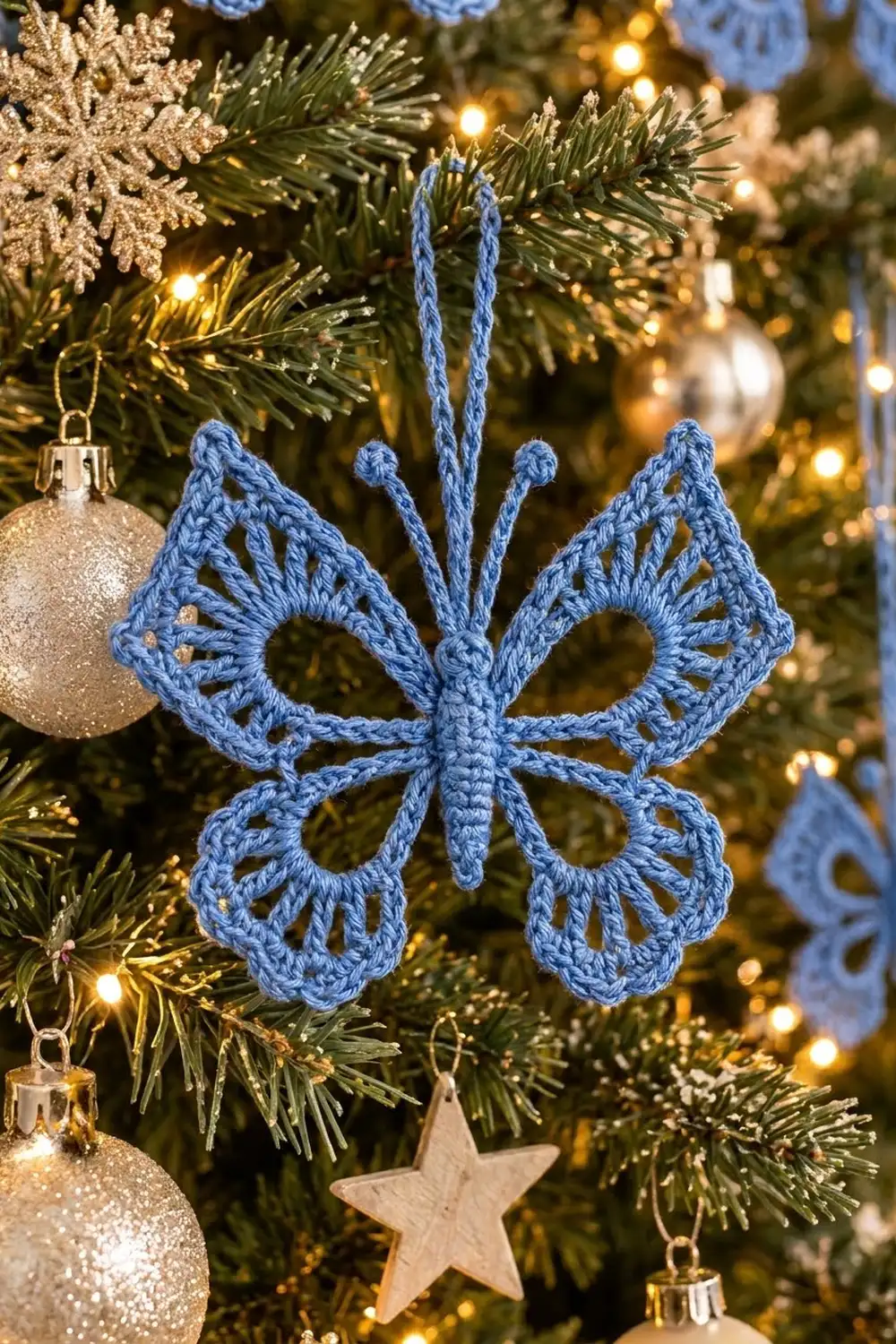
The Cornflower Lace Butterfly is a small openwork butterfly in one shade of cornflower blue cotton thread. Each wing has an oval “eye” ringed with dense single crochet. Treble crochet spokes fan out from it, and a firm frame closes the wing. The upper wings come to crisp points with a corded crab-stitch edge. The lower wings are rounder and end in six soft scallops.
A padded, ridged body sits in the center, with two chain antennae tipped in tiny bobbles. A thread loop on top turns it into a tree ornament, but it also works as an appliqué or gift topper.
The pattern uses US crochet terms. The finished butterfly measures 5 in (12.7 cm) across the upper wings and 3.75 in (9.5 cm) tall. With antennae it stands 4.75 in (12.1 cm) tall.
You make five pieces: two upper wings, two lower wings, and one body with antennae. Each wing takes four short rounds, with the edging as the last round. Then you sew the wings to the body, block, and add the hanging loop.
Finished Size and Construction
- Finished size: 5 in (12.7 cm) wide x 3.75 in (9.5 cm) tall; 4.75 in (12.1 cm) tall with antennae
- Skill level: Intermediate
- Terminology: US crochet terms
- Yarn weight: Size 3 crochet thread (Lace, weight 0)
- Hook: 2.25 mm (US B-1)
- Number of pieces: 5 (2 upper wings, 2 lower wings, 1 body with antennae)
- Layout: upper wings beside the thorax, lower wings beside the abdomen
- Upper wing size: 2.25 in (5.7 cm) wide x 2 in (5.1 cm) tall
- Lower wing size: 1.75 in (4.4 cm) x 1.75 in (4.4 cm)
- Body size: 2 in (5.1 cm) long x 0.5 in (1.3 cm) wide
- Size before border: upper wing 2 in (5.1 cm) x 1.75 in (4.4 cm); lower wing 1.5 in (3.8 cm) x 1.5 in (3.8 cm)
- Border depth: 0.125 in (0.3 cm) on upper wings; 0.25 in (0.6 cm) on lower wings
Materials
Use a smooth mercerized cotton thread. It shows the spokes clearly and holds a point after starching. Fuzzy threads blur the lace.
- Cornflower blue, size 3 crochet thread: 12 g / 50 m (about 55 yd) per butterfly
This covers all five pieces, the hanging loop, and sewing tails. Quantities include a margin of about 50 percent over the roughly 8 g / 35 m one butterfly uses. For six ornaments, plan on 72 g / 300 m.
Tools:
- 2.25 mm (US B-1) crochet hook
- Fine tapestry needle
- Small scissors
- Locking stitch markers
- A pinch of fiberfill or thread scraps
- Spray starch or fabric stiffener
- Blocking mat and rustproof pins
Abbreviations (US Terms)
- ch – chain
- sl st – slip stitch
- sc – single crochet
- dc – double crochet
- tr – treble crochet
- sc2tog – single crochet 2 together
- BLO – back loop only
- rev sc – reverse single crochet (crab stitch)
- sp(s) – space(s)
- MR – magic ring
- st(s) – stitch(es)
Special stitches
- Reverse single crochet (rev sc): Working from left to right (right-handed), insert the hook into the next stitch to the right, yarn over, pull up a loop, yarn over, and pull through both loops.
- 4-dc bobble: [Yarn over, insert hook in st, pull up a loop, yarn over, pull through 2 loops] 4 times in the same st. Yarn over and pull through all 5 loops.
Gauge and Checkpoints
Gauge: 10 sc and 11 rows = 1 in (2.5 cm) with size 3 thread and a 2.25 mm hook.
Make one upper wing first and measure it. Thread is very sensitive to tension, and a test wing takes about 15 minutes.
Upper wing checkpoints:
- After Rnd 1: the ring lies flat and measures about 1 in (2.5 cm) across.
- After Rnd 2: the fan reaches about 1.5 in (3.8 cm) across.
- After Rnd 3: 2 in (5.1 cm) x 1.75 in (4.4 cm).
- After Rnd 4: 2.25 in (5.7 cm) x 2 in (5.1 cm).
Lower wing checkpoints: 1.5 in (3.8 cm) square after Rnd 3; 1.75 in (4.4 cm) square after Rnd 4.
Body checkpoint: 2 in (5.1 cm) long after Rnd 22.
Too big? Go down to a 2.0 mm hook. Too small? Go up to a 2.5 mm hook. If the Rnd 1 ring ruffles, pack the sc more firmly onto the loop.

Upper Wings (Make 2)
Rnd 1 (eye): Ch 18, sl st in first ch to form a loop. Ch 1, work 32 sc into the loop, covering the chain completely. Join with sl st to first sc. (32 sc)
Mark the 1st and 16th sc. These 16 sc form the outer half of the eye. The other 16 sc face the body.
Rnd 2 (spokes): Ch 5 (counts as tr + ch 1, in the same sc as the join). [Tr in next sc, ch 1] 14 times, tr in next sc. Ch 10, skip the remaining 16 sc, and sl st in 4th ch of beginning ch-5. (16 tr, 15 ch-1 sps, 1 ch-10 loop)
The ch-10 loop bridges the inner half of the eye and becomes the straight body-side frame.
Rnd 3 (frame and points): Ch 1, (sc, ch 2, sc) in same st for corner A. [Sc in next ch-1 sp, sc in next tr] 7 times, sc in next ch-1 sp. (Sc, ch 2, sc) in 9th tr for corner B, the outer tip. [Sc in next ch-1 sp, sc in next tr] 6 times, sc in next ch-1 sp. (Sc, ch 2, sc) in 16th tr for corner C. Work 12 sc in ch-10 loop. Join to first sc. (46 sc, 3 ch-2 corner sps)
Stitches per side, including the corner sc at each end:
- Side A–B: 1 + 15 + 1 = 17 sc
- Side B–C: 1 + 13 + 1 = 15 sc
- Side C–A (body side): 1 + 12 + 1 = 14 sc
- Total: 17 + 15 + 14 = 46 sc
Rnd 4: border round, see Border below. Fasten off, leaving a 10 in (25.4 cm) tail.
Lower Wings (Make 2)
Rnd 1 (eye): Ch 14, sl st in first ch to form a loop. Ch 1, work 26 sc into the loop. Join. (26 sc)
Mark the 1st and 13th sc for the outer half.
Rnd 2 (spokes): Ch 5 (counts as tr + ch 1). [Tr in next sc, ch 1] 11 times, tr in next sc. Ch 8, skip the remaining 13 sc, sl st in 4th ch of beginning ch-5. (13 tr, 12 ch-1 sps, 1 ch-8 loop)
Rnd 3 (frame): Ch 1, sc in same st. [2 sc in next ch-1 sp, sc in next tr] 12 times, for 1 + (12 x 3) = 37 sc across the fan. Work 10 sc in ch-8 loop. Join. (47 sc: 37 fan + 10 body side)
Two sc per space let the curved fan lie flat, so the wing stays round.
Rnd 4: scallop border, see Border below. Fasten off, leaving a 10 in (25.4 cm) tail.
Body with Antennae (Make 1)
Work in a continuous spiral from the head down, marking the first st of each round.
- Rnd 1: 6 sc in MR. (6 sc)
- Rnd 2: 2 sc in each st around. (12 sc)
- Rnd 3: Sc in each st around. (12 sc)
- Rnd 4 (neck): [Sc in next st, sc2tog] 4 times. (8 sc)
- Rnd 5 (thorax): [Sc in next st, 2 sc in next st] 4 times. (12 sc)
- Rnds 6–7: Sc in each st around. (12 sc)
- Rnds 8–20 (abdomen): Sc in BLO of each st around. (12 sc) The unused front loops form the horizontal ridges.
- Stuff lightly so the body stays slightly flat.
- Rnd 21: [Sc in next st, sc2tog] 4 times. (8 sc)
- Rnd 22: Sc2tog 4 times. (4 sc)
Fasten off, weave the tail through the last 4 sts, and pull closed.
Antennae (make 2): Join thread with a sl st in Rnd 2, just off center at the top of the head. Ch 14. Work a 4-dc bobble in 4th ch from hook. Sl st in each of the remaining 10 ch, sl st into the head, and fasten off. Repeat 2 sts away so the antennae form a narrow V. Each is about 1 in (2.5 cm) long.
Make All Pieces
All pieces are cornflower blue:
- 2 upper wings (46 sc frame, 52-st border)
- 2 lower wings (47 sc frame, 59-st border)
- 1 body with 2 antennae
Layout (front view):
           [antennae]
[Upper wing L] [head   ] [Upper wing R]
[Upper wing L] [thorax ] [Upper wing R]
[Lower wing L] [abdomen] [Lower wing R]
               [tip    ]
Place each upper wing with side C–A against the thorax and corner B pointing up and out. Place each lower wing with its 10-sc side against the abdomen, scallops facing down and out. Flip the second wing of each pair over so the sides mirror.
Joining
Method: whipstitch with the wing tails, through both loops of the wing edge and one strand of the body.
Stitch-to-stitch logic:
- Upper wing: its 14 body-side sts sew along body Rnds 5–11, 2 wing sts per round: 7 x 2 = 14.
- Lower wing: its 10 body-side sc sew along body Rnds 12–16, 2 wing sts per round: 5 x 2 = 10.
Where corner C of an upper wing meets the first scallop of the lower wing, take 2 small tacking stitches so the wings stay together when hung.
Tension: pull each stitch just snug. Too tight puckers the wing edge; too loose lets the wings droop.
Size checkpoint: the joined butterfly measures 5 in (12.7 cm) across the upper wing tips and 3.75 in (9.5 cm) from the top of the upper wings to the bottom scallops.
Hanging loop: join thread at the top of the head between the antennae. Ch 36, sl st in the same spot, and fasten off. The loop stands about 1.75 in (4.4 cm) tall.
Border
Border gauge: rev sc into sc adds about 0.125 in (0.3 cm) all around. The dc scallops add about 0.25 in (0.6 cm) to the fan edge.
Upper wing, Rnd 4 (crab-stitch edge): Ch 1. Working left to right, rev sc in each sc around and 2 rev sc in each ch-2 corner sp. Join.
- Side A–B: 17 rev sc
- Side B–C: 15 rev sc
- Side C–A: 14 rev sc
- Corner sps: 3 x 2 = 6 rev sc
- Total: 46 + 6 = 52 rev sc
Why the math works: this is a trim round: 46 sts worked one per existing sc, plus 6 extra sts in the corner spaces. The extra stitches give the twisted cord room to turn, so corners A, B, and C stay sharp. One rev sc per sc keeps the straight sides from rippling.
Lower wing, Rnd 4 (scallops): Ch 1, sc in first sc. [Skip 2 sc, 7 dc in next sc, skip 2 sc, sc in next sc] 6 times, ending in the 37th sc. Sc in each of the 10 body-side sc. Join.
- Fan edge: 6 scallops (42 dc) + 7 anchoring sc
- Body side: 10 sc
- Total: 42 dc + 17 sc = 59 sts
Why the math works: each scallop repeat uses 6 sts. Six repeats plus the first sc use 6 x 6 + 1 = 37 sts, exactly the Rnd 3 fan count. Each scallop begins and ends on an anchoring sc, so the edge is symmetrical.
Final Blocking
- Weave in all ends except the hanging loop.
- Lay the butterfly face down on the blocking mat.
- Pin corner B of each upper wing for a 5 in (12.7 cm) width, then pin corners A and C so the sides run straight.
- Pin the center of each scallop so the lower wings open into round curves.
- Ease each eye into a smooth oval with a pin.
- Spray with starch until damp, then pin the antennae into a V.
- Dry for at least 6 hours, then confirm 5 in (12.7 cm) x 3.75 in (9.5 cm).
Final Quality-Control Checklist
- Upper wings: 16 spokes, 3 sharp corners, 52 rev sc border.
- Lower wings: 13 spokes, 6 even scallops, 59-st border.
- Eye openings are smooth ovals with no gaps.
- The body shows clear ridges and is lightly padded.
- Antennae match in length and have round bobble tips.
- Wings are mirrored and joined at the same body rounds.
- Finished size is 5 in (12.7 cm) x 3.75 in (9.5 cm).
- The hanging loop is centered and secure.
Troubleshooting
Eye ring ruffles: pack exactly 32 sc (26 for lower wings) firmly onto the loop.
Spokes lean: work each tr into its own sc, not between stitches.
Rounded upper points: check for 2 rev sc in each corner space and pin right at the tips.
Uneven scallops: recount the Rnd 3 fan; it must be exactly 37.
Drooping wings: starch more heavily and add the tacking stitches between wings.
Body too round: remove some stuffing and press flat before sewing.
Care
Hand wash in cool water with mild soap, roll in a towel, and re-block with starch while damp. Store flat in a box away from heavy ornaments.
Final Notes
The measurement chain is simple. The 32-sc eye ring measures 1 in (2.5 cm), the 16 spokes reach 1.5 in (3.8 cm), the 46-sc frame gives 2 in (5.1 cm) x 1.75 in (4.4 cm), and the 52-st border finishes the upper wing at 2.25 in (5.7 cm) x 2 in (5.1 cm). The lower wing goes from 26 sc to a 37-st fan to 6 scallops and ends at 1.75 in (4.4 cm). Two upper wings plus the 0.5 in (1.3 cm) body make the 5 in (12.7 cm) wingspan.
Check your test wing at each stage, and every butterfly in your flock will match.
Happy crocheting!