

This hanging kitchen organizer looks like a small ladder. Two lacy cream strips hang side by side, and three wooden dowels pass through solid crochet sleeves on each strip. The top dowel holds the hanging cord, the middle dowel holds a paper towel roll, and the bottom dowel holds a folded dish towel.
Each strip has a filet-style center with two columns of square windows, framed by solid double crochet edges. Shell scallops run down both long sides and across the bottom end. The whole piece uses one cream or ecru cotton, which gives it a soft farmhouse look against a kitchen wall.
The pattern uses US crochet terms. Each finished strip measures 4.25 in wide x 23.25 in long (10.8 cm x 59.1 cm). With 20 in (50.8 cm) dowels, the finished holder is 20 in (50.8 cm) wide.
Construction is simple. You work each strip flat in rows, switching between solid rows and mesh rows, and then add a two-round scalloped border. Next you sew six small tabs across the solid bands to make the dowel sleeves. Last, you slide in the dowels and tie on the cord.
Finished Size and Construction
- Finished strip size: 4.25 in x 23.25 in (10.8 cm x 59.1 cm)
- Assembled width: 20 in (50.8 cm), set by the dowels
- Skill level: Easy to intermediate
- Terminology: US crochet terms
- Yarn weight: Worsted (CYC 4), 100% cotton
- Hook: 5 mm (H-8)
- Number of pieces: 8 crocheted pieces (2 strips and 6 dowel tabs)
- Layout: 2 strips side by side and 3 dowels across, with 1 tab per dowel on each strip
- Strip size before border: 2.75 in x 22 in (7.0 cm x 55.9 cm)
- Tab size: 3.25 in x 2.5 in (8.3 cm x 6.4 cm)
- Border depth: 0.75 in (1.9 cm) on the long sides and bottom end
Materials
Choose a smooth, firm worsted cotton. Cotton keeps its shape when a damp towel hangs from the bottom dowel, and it shows the filet windows clearly. Avoid acrylic blends, which stretch under weight over time.
- Cream / ecru cotton: 150 g, about 230 m (252 yd)
Tools:
- 5 mm (H-8) crochet hook
- Three wooden dowels, 5/8 in (1.6 cm) diameter, cut to 20 in (50.8 cm)
- Tapestry needle
- Scissors
- Locking stitch markers (at least 6)
- Tape measure
- Blocking mat and rust-proof pins
- Fine sandpaper for the dowel ends
The yarn quantity includes a margin of about 30% for the hanging cord, gauge adjustments and any ripping back.
Abbreviations (US Terms)
- ch: chain
- sl st: slip stitch
- sc: single crochet
- dc: double crochet
- sk: skip
- sp: space
- st(s): stitch(es)
- RS / WS: right side / wrong side
Special stitch (Scallop repeat): (Sc in next st, sk 1, 5 dc in next st, sk 1). Each repeat uses exactly 4 stitches of the previous round.
Turning chain: Ch 3 at the start of a row counts as the first dc throughout.
Gauge and Checkpoints
Gauge: 16 dc and 8 rows = 4 in (10.2 cm) in solid dc. That works out to 4 sts and 2 rows per inch.
Make one full strip before anything else. The strip works as your swatch, so no yarn is wasted.
- After Row 3: 2.75 in (7.0 cm) wide and 1.5 in (3.8 cm) tall.
- After Row 17: 8.5 in (21.6 cm) tall.
- After Row 44: 22 in (55.9 cm) tall and still 2.75 in (7.0 cm) wide.
- After Border Round 1: 3.25 in x 22.5 in (8.3 cm x 57.2 cm).
- After Border Round 2: 4.25 in x 23.25 in (10.8 cm x 59.1 cm).
If the strip is too big, switch to a 4.5 mm hook. If it is too small, switch to a 5.5 mm hook. Height matters most, because it sets the spacing between the sleeves. If you are off by more than 1 in (2.5 cm) after Row 17, change hooks and start again.
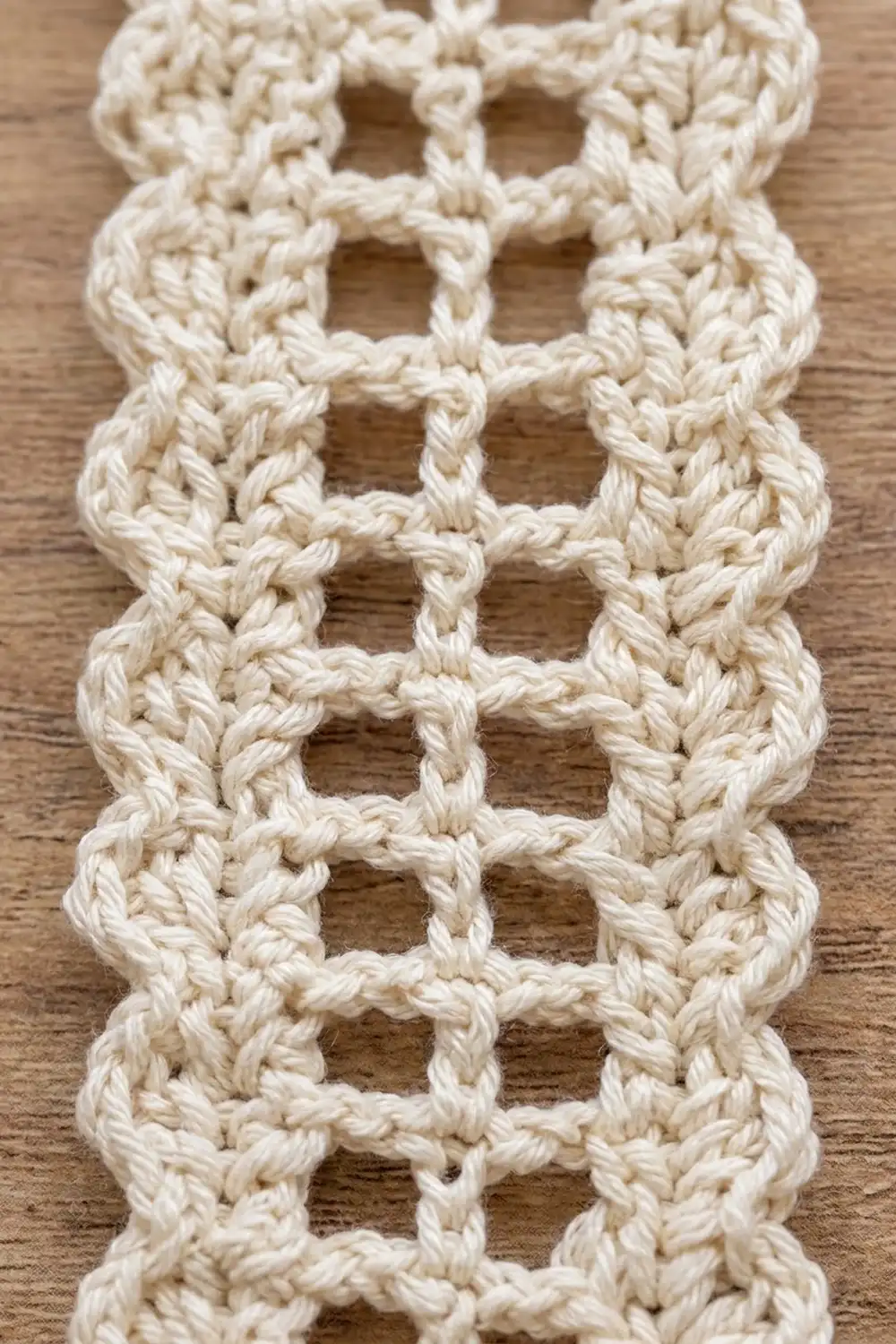
Strip (Make 2)
The strip is 11 stitches wide and uses two row types.
Solid row: Ch 3, turn. Dc in each st across. If the row below is a mesh row, work 2 dc in each ch-2 sp. (11 dc)
Mesh row: Ch 3, turn. Dc in next 2 sts, ch 2, sk 2 sts (or the ch-2 sp), dc in next st, ch 2, sk 2 sts (or the ch-2 sp), dc in last 3 sts. (8 dc + 2 ch-2 sps = 11 sts)
This gives 3 solid dc on each edge, one dc for the center bar, and two square windows.
Foundation: Ch 13.
Row 1 (solid): Dc in 4th ch from hook (the skipped 3 ch count as the first dc) and in each ch across. (11 dc)
Rows 2–3: Work 2 solid rows. (11 dc each)
Rows 1–3 form sleeve band A. Mark both ends of Row 3.
Rows 4–17: Work 14 mesh rows. (11 sts each)
This window section is 7 in (17.8 cm) tall.
Rows 18–20: Work 3 solid rows. In Row 18, work 2 dc in each ch-2 sp. (11 dc each)
Rows 18–20 form sleeve band B. Mark both ends of Rows 18 and 20.
Rows 21–30: Work 10 mesh rows. (11 sts each)
This section is 5 in (12.7 cm) tall.
Rows 31–33: Work 3 solid rows. (11 dc each)
Rows 31–33 form sleeve band C. Mark both ends of Rows 31 and 33.
Rows 34–44: Work 11 mesh rows. (11 sts each)
This section is 5.5 in (14.0 cm) tall. Do not fasten off; go straight into the border.
Row check: 3 + 14 + 3 + 10 + 3 + 11 = 44 rows. At 2 rows per inch, that is 22 in (55.9 cm).
Dowel Tab (Make 6)
Foundation: Ch 15.
Row 1: Dc in 4th ch from hook and in each ch across. (13 dc)
Rows 2–5: Ch 3, turn. Dc in each st across. (13 dc each)
Fasten off and leave a 16 in (40.6 cm) tail for sewing. Each tab is 3.25 in x 2.5 in (8.3 cm x 6.4 cm).
The tab is 13 sts wide so it covers the 11-st body plus one Border Round 1 sc on each side. The 5 rows give 2.5 in (6.4 cm) of fabric. About 1 in (2.5 cm) wraps over the front of the dowel, and 1.5 in (3.8 cm) lies over the 3-row solid band.
Make All Pieces
Every piece uses the same cream cotton.
- Strips: 2, about 50 g each including the border
- Dowel tabs: 6, about 5 g each
- Hanging cord: about 5 g
Layout (front view, top to bottom):
[cord]-------------------------------[cord]
==TAB A=========(dowel 1)=========TAB A==
| strip |                        | strip |
| mesh  |                        | mesh  |
==TAB B=========(dowel 2)=========TAB B==  paper towel roll
| mesh  |                        | mesh  |
==TAB C=========(dowel 3)=========TAB C==  dish towel
| mesh  |                        | mesh  |
\scallop/                        \scallop/
Finish the border on both strips before assembly.
Joining
The holder is assembled by sewing the tabs to the strips and then threading the dowels.
- Lay a bordered strip RS up. Place a tab RS up across sleeve band A, with its last row lined up with the top edge of the strip.
- Whipstitch the tab’s top edge to the strip’s top edge, stitch for stitch: 13 tab sts into the corner sc, 11 top sc and corner sc of Border Round 2.
- Slide a dowel under the tab and bring the tab’s foundation edge down snugly over it. Whipstitch across Row 3: tab sts 2–12 go into the 11 dc, and tab sts 1 and 13 go into the Round 1 sc at each end of Row 3.
- Take out the dowel. Sew tab B the same way, with its top edge along Row 18 and its bottom edge along Row 20. Sew tab C with its top edge along Row 31 and its bottom edge along Row 33.
- Repeat on the second strip.
Keep the whipstitch firm but not tight. The tab should hug the dowel without puckering the strip. Leave the tab’s side edges open so the dowel passes straight through.
Thread each dowel through the matching tabs on both strips. Place each tab’s outer edge 0.75 in (1.9 cm) in from the dowel end.
Size checkpoint: 20 in − 2 x (0.75 in + 3.25 in) = 12 in (30.5 cm) between the inner tab edges. A standard 11 in (27.9 cm) paper towel roll fits with room to spin.
Hanging cord: With yarn held double, chain a cord 24 in (61.0 cm) long. Tie each end around the top dowel just outside the tabs.
Border
Border gauge matches the body: 4 sc per inch along every edge. Each dc row end on a long side is 0.5 in (1.3 cm) tall, so 2 sc per row end keeps the edge flat.
Each strip gets its own border. One long side starts with 1 strip x 44 rows x 2 sc = 88 sts.
Round 1 (RS, conversion round): Ch 1, turn so the RS faces you. Across the last row: sc in first 3 dc, 2 sc in ch-2 sp, 2 sc in center dc, 2 sc in ch-2 sp, sc in last 3 dc. (11 sts worked 1 per existing st + 1 extra = 12 sc)
Ch 1 for the corner (not counted). Work 2 sc in each row end along the long side. (88 sc) Ch 1. Sc in each free loop of the foundation ch. (11 sc) Ch 1. Work 2 sc in each row end down the second long side. (88 sc) Ch 1 and sl st to the first sc.
Round 1 total: 12 + 88 + 11 + 88 = 199 sc, plus 4 corner ch-1 sps. Each side count runs from corner to corner and does not include the ch-1 sps.
Round 2: Ch 1.
- Bottom end: work the Scallop repeat 3 times. (12 sts used, 3 scallops)
- Corner: sc in ch-1 sp.
- Long side: work the Scallop repeat 22 times. (88 sts used, 22 scallops)
- Corner: sc in ch-1 sp.
- Top end: sc in each sc across. (11 sc)
- Corner: sc in ch-1 sp.
- Long side: work the Scallop repeat 22 times. (88 sts used, 22 scallops)
- Corner: sc in ch-1 sp. Sl st to the first sc. Fasten off and weave in the ends.
Round 2 total: 47 scallops x 6 sts (1 sc + 5 dc) = 282, plus 11 top sc and 4 corner sc = 297 sts.
Why the math works: each repeat uses exactly 4 sts. The long sides have 88 sts, and 88 ÷ 4 = 22, with no stitches left over. The bottom started at 11 sts, which is not a multiple of 4, so Round 1 added 1 stitch to make 12, and 12 ÷ 4 = 3. The top stays plain because tab A covers it.
Round 1 adds 0.25 in (0.6 cm) per edge and the scallops add 0.5 in (1.3 cm), for 0.75 in (1.9 cm) per long side. Width: 2.75 + 0.75 + 0.75 = 4.25 in (10.8 cm). Length: 22 in + 0.5 in at the top + 0.75 in at the bottom = 23.25 in (59.1 cm).
Final Blocking
- Take out the dowels.
- Soak the strips in cool water for 10 minutes.
- Roll them in a towel to press out the water. Do not wring.
- Pin each strip to 4.25 in x 23.25 in (10.8 cm x 59.1 cm).
- Pin each scallop into a neat rounded shape.
- Put a pin through each window to square the mesh.
- Let the strips dry completely, then put the dowels back in.
Final Quality-Control Checklist
- Both strips measure 4.25 in x 23.25 in (10.8 cm x 59.1 cm).
- Each strip has 44 rows, including three 3-row solid bands.
- Every mesh row has 2 square windows and one center dc bar.
- Each long side has 22 scallops, and the bottom has 3.
- All six tabs sit at matching heights, and the dowels slide freely.
- The strips hang level and parallel.
- All ends are woven in securely.
Troubleshooting
Windows look tall and narrow: your dc is loose. Use a smaller hook or snug each loop down before you yarn over.
Long edge ruffles: you have more than 88 sc on that side. Recount and rework.
Long edge pulls in: you have fewer than 88 sc. Recount and rework.
Scallops don’t end at the corner: a side count is off. 88 sts always gives 22 even repeats.
Strips hang crooked: one tab is lower than its partner. Re-sew it so both strips’ tabs cover the same rows.
Dowel is too tight: stretch the tab over the dowel while it is damp.
Care
Remove the dowels, hand wash the strips in cool water with mild soap, and dry them flat.
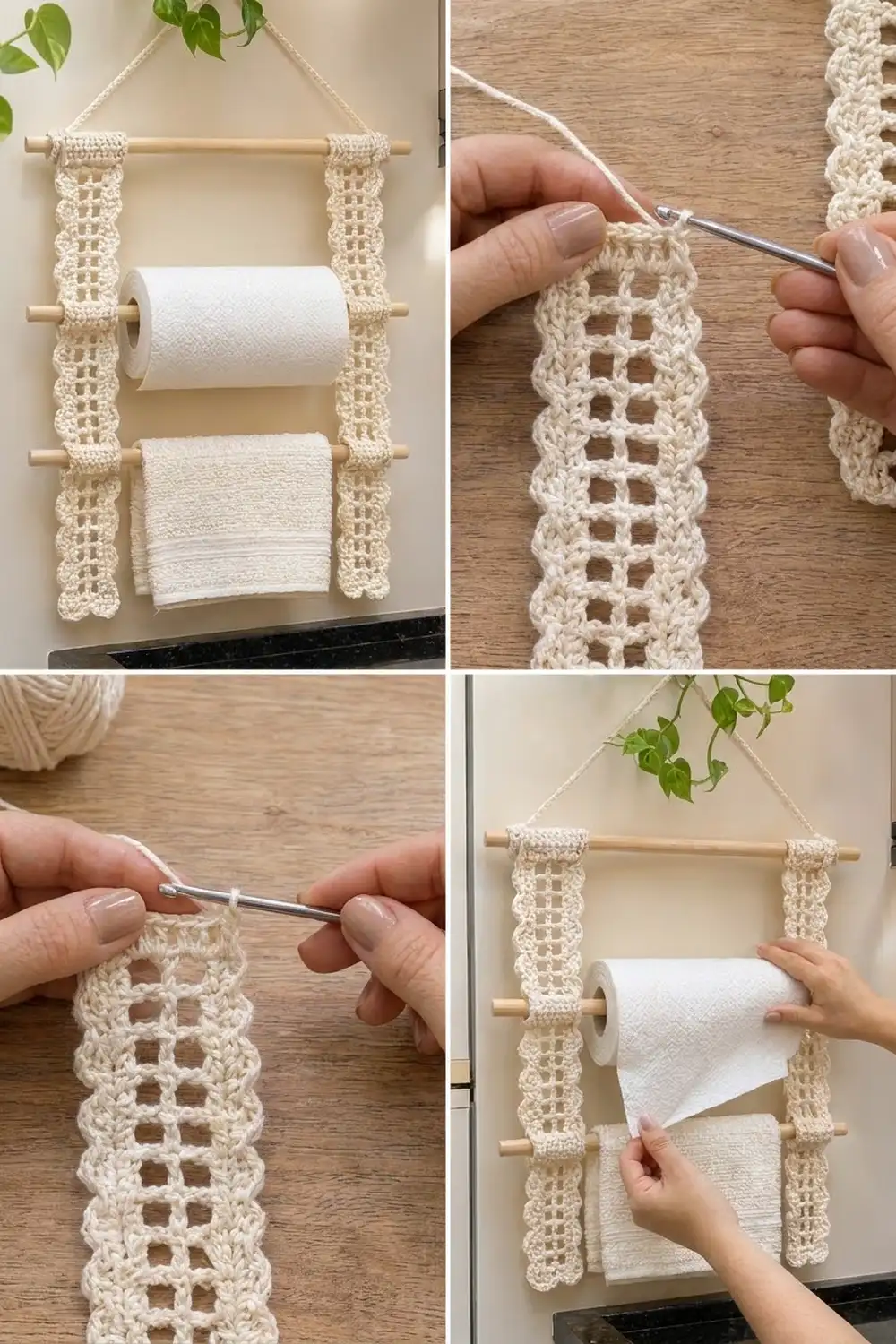
Final Notes
The measurement chain is short. A gauge of 4 sts and 2 rows per inch gives a 2.75 in x 22 in (7.0 cm x 55.9 cm) strip body. At 2 sc per row end, each long side has 88 sts, which makes 22 scallops. The border brings each strip to 4.25 in x 23.25 in (10.8 cm x 59.1 cm). Six 3.25 in (8.3 cm) tabs on 20 in (50.8 cm) dowels leave 12 in (30.5 cm) for the paper towel roll.
If the strip measures right at each checkpoint, the rest of the holder will fit. Happy crocheting!