

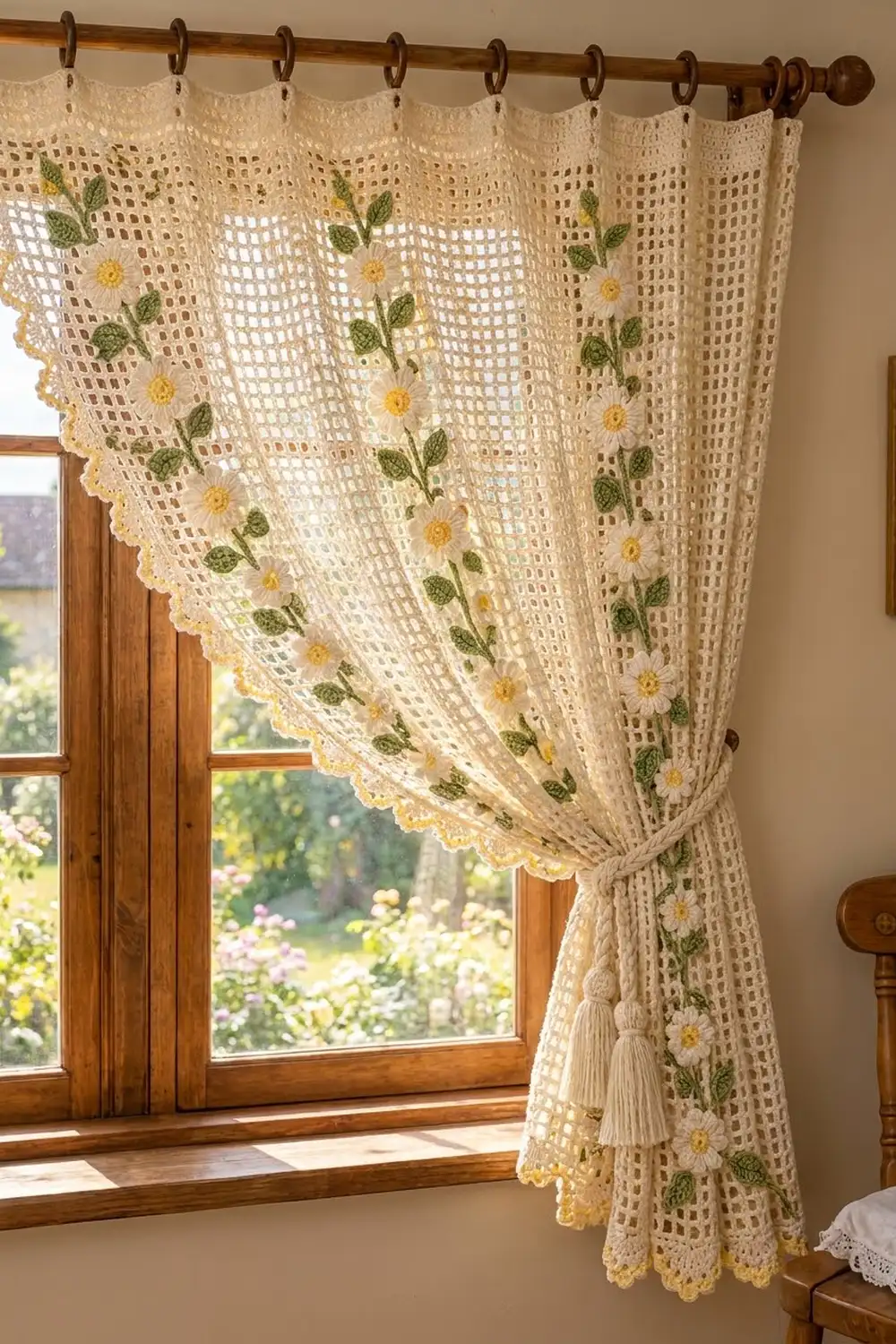
This curtain is a light, airy filet mesh panel with trailing daisy vines. The cream mesh lets sunlight through. Three green vines with white-and-yellow daisies climb from the hem to the rod. A soft scalloped border trimmed in buttercup yellow finishes the long sides and the bottom edge.
The palette has four colors: cream for the mesh and border, white for the petals, yellow for the daisy centers and the edging, and sage green for the stems and leaves. The look is cottage-garden and vintage, but the construction is simple.
The pattern uses US crochet terms. The finished curtain measures 38.5 in (97.8 cm) wide by 58 in (147.3 cm) long, including the border.
You make the panel as one piece of filet mesh worked in rows. Then you add a border, crochet 18 daisies, 36 leaves and 3 stems, and sew them on. An optional braided tieback completes the set.
Finished Size and Construction
- Finished size: 38.5 in × 58 in (97.8 cm × 147.3 cm)
- Skill level: Intermediate
- Terminology: US
- Yarn weight: Sport weight (#2) cotton
- Hook: 3.5 mm (E-4)
- Number of pieces: 1 mesh panel plus sewn-on appliqués
- Layout: Single vertical panel with three vines spaced 12 in (30.5 cm) apart
- Panel size before border: 36 in × 56.5 in (91.4 cm × 143.5 cm), which is 72 meshes × 113 rows
- Border depth: 1.25 in (3.2 cm) on the sides and bottom; 0.25 in (0.6 cm) on the top
Materials
Choose a smooth mercerized or combed cotton. It gives crisp mesh, holds its shape when hanging, and stands up to sunlight and washing. Avoid fuzzy or very stretchy blends, because they will make the open grid sag.
- Cream (A): 420 g / about 1,180 m (mesh, border, tieback)
- White (B): 40 g / about 112 m (petals)
- Yellow (C): 50 g / about 140 m (daisy centers, edging)
- Sage green (D): 40 g / about 112 m (stems, leaves)
The quantities assume about 140 m per 50 g and include a margin of roughly 10–15%.
Tools: 3.5 mm (E-4) hook, tapestry needle, stitch markers, rustproof pins, a blocking surface at least 40 in × 60 in (101.6 cm × 152.4 cm), tape measure, spray bottle, and 9 curtain ring clips.
Abbreviations (US Terms)
- ch – chain
- sl st – slip stitch
- sc – single crochet
- hdc – half double crochet
- dc – double crochet
- sk – skip
- sp – space
- st(s) – stitch(es)
- RS – right side
Mesh: dc, ch 2. Each mesh is one open square, 3 sts wide (1 dc + 2 ch).
Shell: sk 1 st, 5 dc in next st, sk 1 st, sc in next st. Each shell uses 4 sts.
Gauge and Checkpoints
Gauge: 8 meshes and 8 rows = 4 in (10.2 cm) square. One mesh is 0.5 in (1.3 cm) each way.
Test swatch first: Ch 29. Work Rows 1–8 of the panel, which gives 8 meshes. Wet the swatch, pin it, and let it dry before you measure.
- If the swatch is larger than 4 in (10.2 cm), go down a hook size.
- If it is smaller, go up a hook size.
- If the width is right but the rows are too tall, pull up shorter loops on your dc.
Checkpoints:
– After Row 1: width 36 in (91.4 cm)
– After Row 8: height 4 in (10.2 cm)
– After Row 40: height 20 in (50.8 cm)
– After Row 113: height 56.5 in (143.5 cm)
– After the border: 38.5 in × 58 in (97.8 cm × 147.3 cm)
Measure flat without stretching. The width should stay at 36 in (91.4 cm) in every row.
Panel
Use Color A.
Foundation: Ch 221.
Row 1 (RS): Dc in 8th ch from hook. Ch 2, sk 2 ch, dc in next ch; rep from * across. (72 meshes: 73 dc posts + 144 ch = 217 sts)*
Row 2: Ch 5 (counts as dc + ch 2), turn. Sk first ch-2 sp, dc in next dc. Ch 2, dc in next dc; rep from * across, working the last dc in the 3rd ch of the turning ch. (72 meshes; 217 sts)*
Rows 3–113: Rep Row 2. (217 sts in every row)
Fasten off.
Count check: For 72 meshes you need 73 posts (72 + 1) and 144 chains (72 × 2), which makes 217 sts. The foundation is 3 × 72 + 5 = 221 ch.
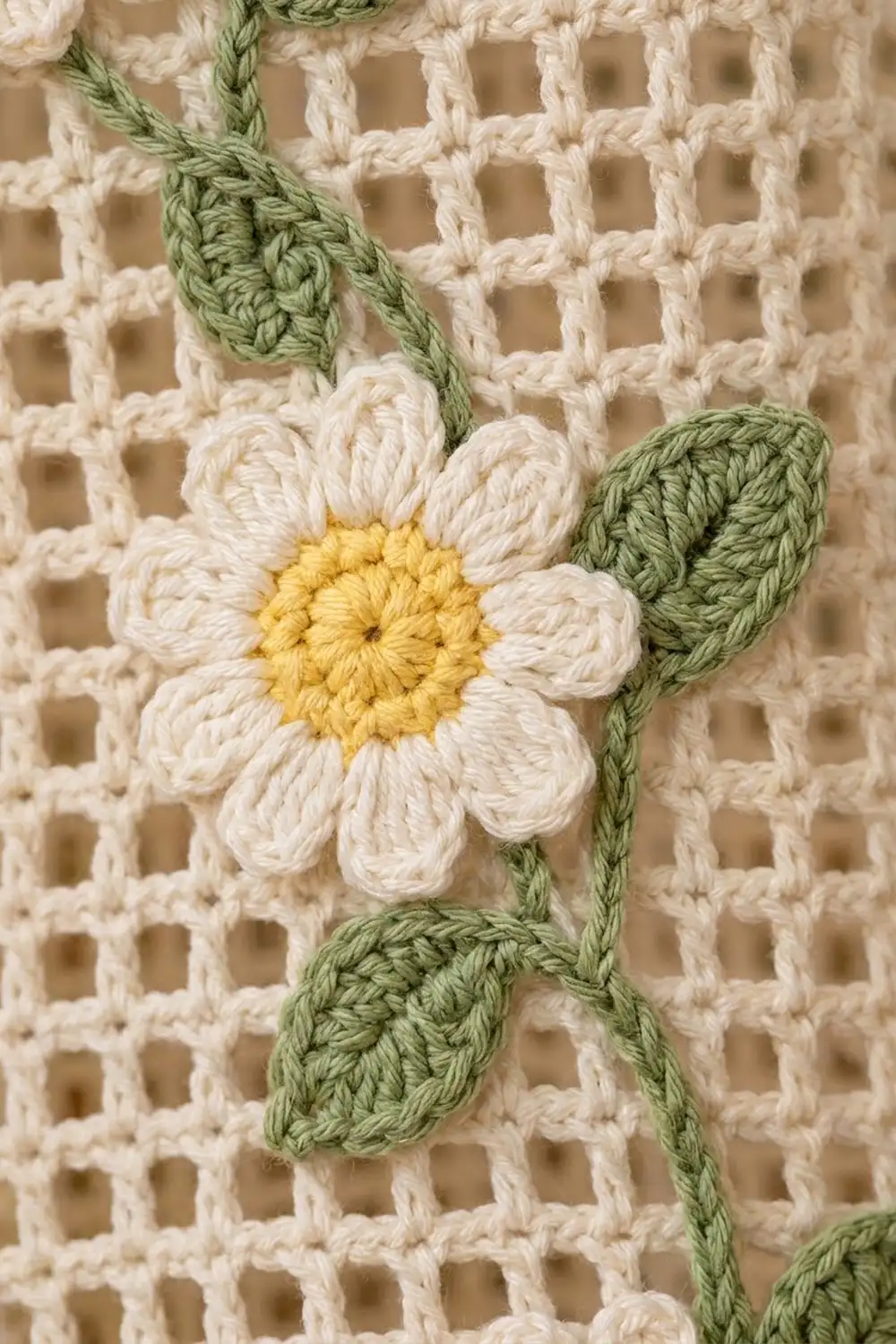
Daisies (make 18)
Round 1: With C, make a magic ring. Ch 1, work 10 sc in the ring, then sl st to the first sc. (10 sc)
Round 2: Ch 1, work 2 sc in each sc around, then sl st to the first sc. (20 sc) Fasten off.
Round 3: Join B with a sl st in any sc. Ch 6. Working back along the chain: sc in 2nd ch from hook, hdc in next ch, dc in next 2 ch, hdc in last ch. Sk next sc, sl st in next sc. Rep from * 9 more times. The last sl st lands in the joining sc. (10 petals)* Fasten off and leave a 12 in (30.5 cm) tail.
Each daisy measures about 3 in (7.6 cm) across. The tight sc center sits slightly domed.
Leaves (make 36)
With D, ch 8.
Along the first side of the chain: sc in 2nd ch from hook, hdc in next ch, dc in next 2 ch, hdc in next ch, sc in next ch, then 3 sc in the last ch for the tip.
Along the other side of the foundation chain: sc in next ch, hdc in next ch, dc in next 2 ch, hdc in next ch, sc in next ch. Sl st in the first ch. (15 sts)
Fasten off and leave a 10 in (25.4 cm) tail. Each leaf is about 1.5 in (3.8 cm) long, pointed at the tip and wide in the middle.
Stems (make 3)
With D, chain until the chain measures 56 in (142.2 cm) when relaxed. Sl st in the back bump of the 2nd ch from the hook and in each back bump to the end. Fasten off.
The extra length lets the stem curve gently over a 50 in (127 cm) run.
Appliqué Placement
Sewing on the appliqués is easiest after the border, with the panel lying flat. Number the dc posts 1–73 across the panel.
- Vine lines: Mark posts 13, 37 and 61. The outer vines sit 6 in (15.2 cm) in from the mesh edges and 12 in (30.5 cm) from the center vine.
- Stems: Pin each stem from Row 4 to Row 104, which is 2 in (5.1 cm) to 52 in (132.1 cm) above the bottom of the mesh. Let it swing about one mesh to the left and right of its marked line.
- Daisies (6 per vine): Center them on Rows 8, 26, 44, 62, 80 and 98. These rows are 4, 13, 22, 31, 40 and 49 in (10.2, 33.0, 55.9, 78.7, 101.6 and 124.5 cm) up. Alternate each daisy slightly left and right, following the curves, and lay it over the stem.
- Leaves (12 per vine): Sew one pair on Rows 17, 35, 53, 71 and 89, halfway between the daisies, and a final pair at the stem tip on Row 104. Angle each leaf upward.
Whipstitch the stems through the mesh bars with D. Tack each daisy around its center with C and at every petal tip with B. Sew the leaves around their edges with D. Keep the stitches loose enough that the mesh does not pucker.
Optional Tieback
With A, make three sl st cords 26 in (66.0 cm) long, the same way as the stems. Braid them together and knot each end. Wrap A 30 times around a 4 in (10.2 cm) card to make a tassel, then tie and trim it. Make 2 tassels and sew one to each end of the braid.
Border
Border gauge: 3 sc per row-end matches the mesh width of 6 sc per 1 in (2.5 cm), so the edges stay flat.
Round 1 (A): With RS facing, join A in the last dc of Row 113.
- Top corner: Ch 1, work 3 sc in the same dc.
- Top: Work 1 sc in each of the next 71 dc and 2 sc in each of the 72 ch-2 sps. (215 sc)
- Next corner: 3 sc in the last dc.
- Side: Work 3 sc around each of the 113 row-ends. (339 sc)
- Bottom corner: 3 sc in the base of the corner post.
- Bottom: Work 1 sc in each of the 71 base chs under the posts and 2 sc in each of the 72 ch-2 sps. (215 sc)
- Corner: 3 sc in the base of the last corner post.
- Second side: 339 sc, as before.
Sl st to the first sc. Each corner group has a center sc. Counting from one corner center sc to the next, inclusive, the top and bottom have 217 sts each and the sides have 341 sts each. (1,120 sc total) Fasten off.
Round 2 (A, sides and bottom only): With RS facing, join A with a sl st in the center sc of a top corner, then ch 1 and sc in the same st.
- Work 85 shells down the side. The last sc lands in the bottom corner center sc.
- Work 54 shells across the bottom.
- Work 85 shells up the second side, ending in the top corner center sc.
(224 shells: 1,120 dc + 225 sc) Fasten off. The top keeps only the plain sc band.
Round 3 (C): Join C with a sl st in the first sc. Sc in next 2 dc, 3 sc in next dc, sc in next 2 dc, sl st in next sc; rep from * across all 224 shells. (7 sc per shell: 595 sc per side and 378 sc along the bottom)* Fasten off.
Why the math works: Each shell uses 4 sts plus a shared anchor sc, so every edge needs a multiple of 4, plus 1. The bottom has 217 = 4 × 54 + 1, and each side has 341 = 4 × 85 + 1. Because the shells start and end on the corner center sts, both corners turn cleanly.
Final Blocking
- Weave in all ends along the mesh bars.
- Soak the curtain in cool water for 15 minutes, then press out the water. Do not wring it.
- Roll it in towels to remove more moisture.
- Lay it flat and pin the mesh to 36 in × 56.5 in (91.4 cm × 143.5 cm), squaring the corners.
- Pin the outer edge to 38.5 in × 58 in (97.8 cm × 147.3 cm), with a pin at each scallop tip.
- Shape the petals and leaves with your fingers.
- Let it dry completely before you unpin it.
- Clip 9 ring clips evenly along the top, about 4.5 in (11.4 cm) apart.
Final Quality-Control Checklist
- Every row has 72 meshes.
- The mesh measures 36 in × 56.5 in (91.4 cm × 143.5 cm).
- Border Round 1 has 215 sc on the top and bottom and 339 sc on each side, plus the corner groups.
- There are 85 shells on each side and 54 shells along the bottom.
- The finished size is 38.5 in × 58 in (97.8 cm × 147.3 cm).
- You have 18 daisies with 10 petals each, and 36 leaves.
- The vines are on posts 13, 37 and 61.
- There is no puckering behind the appliqués.
Troubleshooting
- Mesh is slanting: Work the last dc of each row into the 3rd ch of the turning ch, not the ch-2 space.
- Panel is narrowing: Count the posts. You may have skipped the last dc.
- Side border is ruffling: Your row-end sc are too loose. Go down a hook size for Round 1.
- Shells don’t end on a corner: Recount Round 1. You need 341 sts per side and 217 along the bottom, counting both corner center sts.
- Petals are cupping: Make sure you skip exactly one sc between petals, then steam the daisy flat.
- Curtain sags after hanging: Block it again, and add more clips to support the top edge.
Care
Hand wash in cool water with mild soap, press the water out, and dry flat with the curtain pinned to size. Steam lightly to refresh it between washes.
Final Notes
The measurement chain works like this. Each mesh is 0.5 in (1.3 cm). 72 meshes by 113 rows gives a 36 in × 56.5 in (91.4 cm × 143.5 cm) panel. The 1.25 in (3.2 cm) border on the sides and bottom and the 0.25 in (0.6 cm) top band bring it to 38.5 in × 58 in (97.8 cm × 147.3 cm). If your gauge swatch is right, every later count will fall into place.
Happy crocheting!