

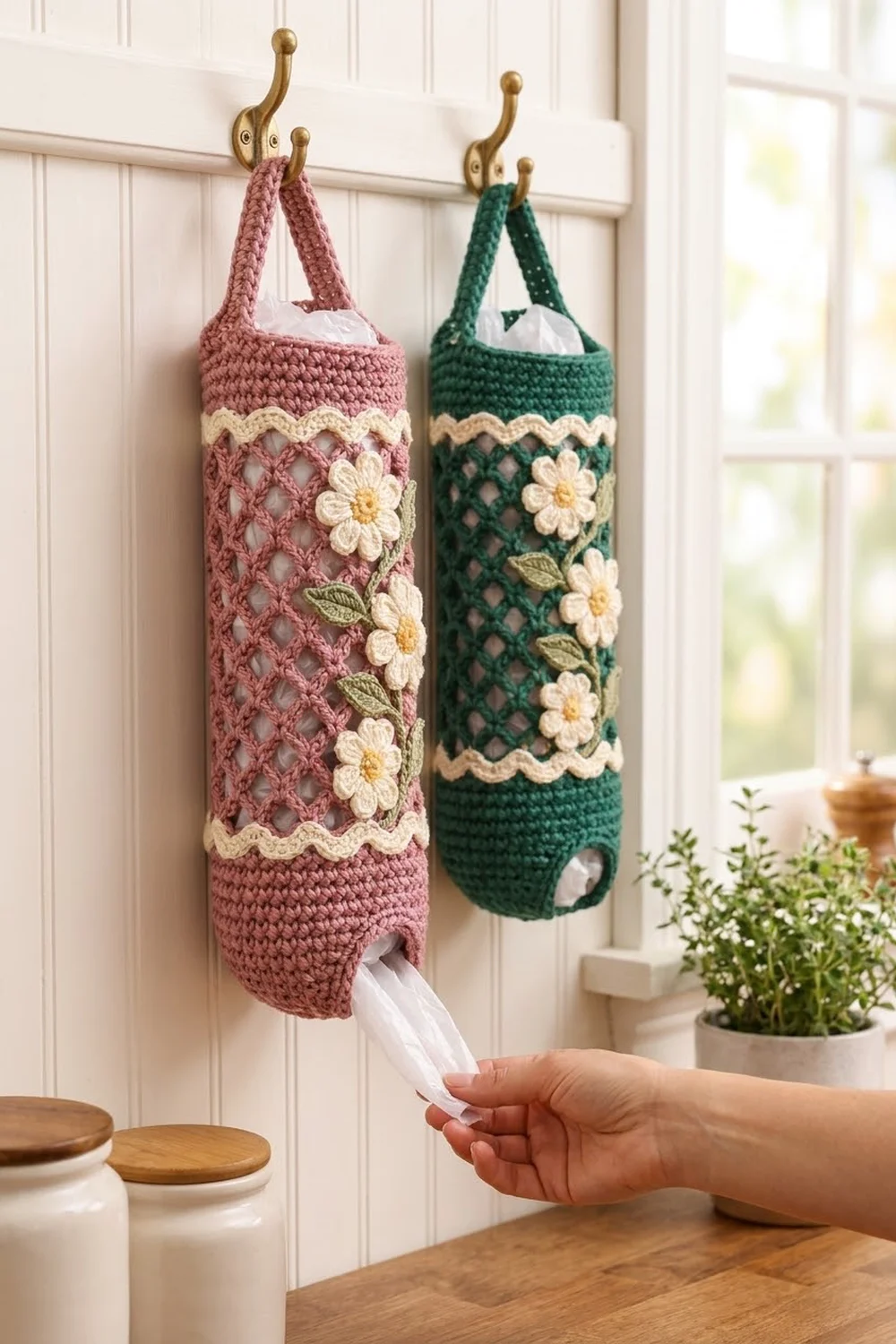
This hanging bag holder is a soft, cottage-style answer to the kitchen drawer full of loose grocery bags. Stuff bags in through the open top and pull them out one at a time through the arched opening at the bottom.
The body is dusty rose, with a solid band at the top, a solid band at the bottom and an open diamond trellis in between. Two wavy cream trims frame the trellis. Three cream daisies with mustard-yellow centers climb a sage-green vine on the front, and a narrow strap at the top lets you hang it from a hook. The same pattern looks just as good in deep forest green with the same accent colors.
The pattern uses US crochet terms. The finished holder measures about 4.8 in (12.2 cm) wide laid flat and 14.75 in (37.5 cm) tall. With the hanging strap it’s about 18 in (45.7 cm) tall.
Construction is simple. You crochet an oval base, then work the body upward in joined rounds, leaving a gap for the bag opening. Then you make the strap, two trim rings, three flowers, a vine and four leaves, and sew them all on.
Finished Size and Construction
- Finished size: 4.8 in (12.2 cm) wide flat x 14.75 in (37.5 cm) tall; about 18 in (45.7 cm) with strap
- Circumference: 9.6 in (24.4 cm), 36 sts
- Skill level: Easy-intermediate
- Terminology: US
- Yarn weight: Worsted (#4)
- Hook: 5.0 mm (H-8)
- Number of pieces: 1 holder, made from 12 components (body, strap, 2 trims, 3 daisies, 1 vine, 4 leaves)
- Layout: Single vertical tube with an oval base
- Body size before rim: 4.8 in (12.2 cm) wide flat x 14.5 in (36.8 cm) tall
- Rim depth: about 0.25 in (0.6 cm). Trim depth: about 0.75 in (1.9 cm)
Materials
Use a smooth worsted cotton or cotton blend. Cotton holds its shape, makes the trellis look crisp and survives the wash. Acrylic is fine too, but the diamonds will be a little softer.
- Color A, dusty rose (body, strap): 75 g / 150 m
- Color B, cream (trims, petals): 15 g / 30 m
- Color C, mustard yellow (flower centers): 5 g / 10 m
- Color D, sage green (vine, leaves): 10 g / 20 m
For the green version, swap Color A for deep forest green and keep the accent colors the same.
Tools:
- 5.0 mm (H-8) crochet hook
- Tapestry needle
- Stitch marker
- Scissors
- Pins
- Measuring tape
- Spray bottle and a rolled hand towel
These quantities include a margin of about 15 percent for a gauge test and weaving in ends.
Abbreviations (US Terms)
- ch – chain
- sl st – slip stitch
- sc – single crochet
- hdc – half double crochet
- dc – double crochet
- BLO – back loop only
- st(s) – stitch(es)
- rnd(s) – round(s)
- rev sc – reverse single crochet (crab stitch)
Special stitch – rev sc: Work from left to right (right to left if you’re left-handed). Insert the hook into the next st to the right, yarn over and pull up a loop, then yarn over and pull through both loops. This makes a firm, corded edge.
Gauge and Checkpoints
Gauge: 15 sc and 17 rnds = 4 in (10.2 cm) in sc worked in the round.
Trellis gauge: 4 mesh rnds = 2 in (5.1 cm) tall.
Test before you commit. Work the base and the lower band (Rnds 1–14) and measure. This part works as your gauge swatch.
Checkpoints:
- After Rnd 3, the base oval measures about 4 in x 1.5 in (10.2 x 3.8 cm).
- After Rnd 14, the lower band is 2.6 in (6.6 cm) tall and the tube lies 4.8 in (12.2 cm) wide flat.
- After Rnd 34, the trellis section is 10 in (25.4 cm) tall.
- After Rnd 42, the body is 14.5 in (36.8 cm) tall, measured from the base fold.
If your work is too big, switch to a 4.5 mm (G-7) hook. If it’s too small, switch to a 5.5 mm (I-9) hook. Keep the stitch counts the same. Every component is sized to fit 36 stitches around.

Body
Base
With Color A, ch 12.
Rnd 1: Sc in 2nd ch from hook, sc in next 9 ch, 3 sc in last ch. Working along the other side of the chain, sc in next 9 ch, then 2 sc in the last ch (the same ch as the first sc). Join with sl st to first sc. (24 sts)
Rnd 2: Ch 1, 2 sc in first st, sc in next 9, 2 sc in each of next 3, sc in next 9, 2 sc in each of last 2. Join. (30 sts)
Rnd 3: Ch 1, 2 sc in first st, sc in next st, sc in next 9, (2 sc in next, sc in next) 3 times, sc in next 9, (2 sc in next, sc in next) 2 times. Join. (36 sts)
That’s 6 increases: 1 + 3 + 2. The base should lie flat as an oval.
Lower Band and Bag Opening
Rnd 4: Ch 1, sc in BLO of each st around. Join. (36 sts)
The unworked front loops make a crisp fold where the base meets the wall. Place a marker in the first st.
Row 5: Ch 1, turn, sc in next 26 sts and leave the last 10 sts unworked. (26 sts)
Rows 6–9: Ch 1, turn, sc in each st across. (26 sts)
The 10 skipped sts form the bottom of the bag opening. The opening is 2.7 in (6.9 cm) wide and 1.2 in (3.0 cm) tall.
Rnd 10: Ch 1, turn, sc in next 26 sts, ch 10, then join with sl st to the first sc. (26 sc + 10 ch = 36 sts)
Rnd 11: Ch 1, sc in each sc and in each ch. Join. (36 sts)
Rnds 12–14: Ch 1, sc in each st around. Join. (36 sts)
Checkpoint: the 11 wall rounds (Rnds 4–14) measure 2.6 in (6.6 cm).
Diamond Trellis
Rnd 15 (setup): Ch 1, sc in first st, ch 5, skip next 3 sts. Sc in next st, ch 5, skip next 3 sts; repeat from * 7 more times. Join with sl st to first sc. (9 sc, 9 ch-5 loops)*
The math: 9 repeats x 4 sts = 36 sts, so the anchors fall evenly around.
Rnd 16: Sl st in next 3 ch to reach the center of the first loop. Ch 1, sc in same loop, ch 5. Sc in next loop, ch 5; repeat from * 7 more times. Join to first sc. (9 ch-5 loops)*
Each round anchors in the middle of the loops below it. That offset is what makes the diamonds.
Rnds 17–34: Repeat Rnd 16. (9 ch-5 loops each round)
That’s 20 trellis rounds (Rnds 15–34), for a total of 10 in (25.4 cm).
Upper Band
Rnd 35 (conversion round): Sl st in next 2 ch, ch 1, then work 4 sc in each ch-5 loop around. Join. (0 sts worked 1-per-stitch + 36 extra: 9 loops x 4 sc = 36 sts)
Rnds 36–42: Ch 1, sc in each st around. Join. (36 sts)
The upper band (Rnds 35–42) is 8 rounds, or 1.9 in (4.8 cm). Don’t fasten off. The rim is finished in the Border section.
Hanging Strap
With Color A, ch 39.
Row 1: Sc in 2nd ch from hook and in each ch across. (38 sts)
Rows 2–3: Ch 1, turn, sc in each st across. (38 sts)
Fasten off and leave a 12 in (30.5 cm) tail. The strap measures about 10 in x 0.7 in (25.4 x 1.8 cm).
Daisies (Make 3)
Rnd 1: With Color C, make a magic ring. Ch 1, work 10 sc in the ring, pull it closed and join. Fasten off. (10 sts)
Rnd 2: Join Color B in any sc. (Hdc, 3 dc, hdc) in next st, sl st in next st; repeat from * 4 more times. (5 petals, 30 sts)*
Fasten off and leave a 10 in (25.4 cm) tail. Each daisy is about 1.75 in (4.4 cm) across.
Vine and Leaves
Vine: With Color D, ch 26. Sl st in 2nd ch from hook and in each ch across. (25 sl sts) Don’t turn. Ch 12, then work 2 sc in 2nd ch from hook and in each ch back toward the stem. (22 sc) The extra stitches twist this end into a curling tendril. Fasten off and leave a long tail.
Leaves (make 4): With Color D, ch 7. Sc in 2nd ch from hook, hdc in next, dc in next 2, hdc in next, then (sc, ch 2, sc) in last ch for the pointed tip. Working along the other side of the chain: hdc in next, dc in next 2, hdc in next, sc in last. Sl st to first sc. (12 sts + ch-2 tip)
Each leaf is about 1.5 in (3.8 cm) long.
Border: Top Rim, Opening Edge and Wavy Trims
Border gauge: The edging and the trims use the body’s sc gauge: 15 sts = 4 in (10.2 cm).
Top rim (Rnd 43): Continuing with Color A from Rnd 42, ch 1, rev sc in each st around. Join and fasten off. (36 sts)
Bag opening edge: Join Color A at a bottom corner of the opening and sc around it:
- 10 sc into the free loops of the 10 skipped Rnd 4 sts
- 5 sc up the row ends of Rows 5–9
- 10 sc into the underside of the Rnd 10 chain
- 5 sc down the other row-end edge
Join. (30 sts) Fasten off.
Wavy trims (make 2): With Color B, ch 36. Without twisting the chain, join it into a ring with sl st.
Rnd 1: Ch 1, sc in each ch. Join. (36 sts)
Rnd 2: Ch 1. Sc in next st, hdc in next st, dc in next 2 sts, hdc in next st, sc in next st; repeat from * 5 more times. Join and fasten off. (6 waves, 36 sts)*
Rnd 3: Join Color B in the free loops of the foundation chain. Ch 1. Dc in next st, hdc in next st, sc in next 2 sts, hdc in next st, dc in next st; repeat from * 5 more times. Join. (6 waves, 36 sts)* Fasten off.
On Rnd 3 the tall stitches sit opposite the short stitches of Rnd 2, which gives the rickrack shape.
Why the math works: The body, the rim and both trims all have 36 sts at the same gauge. That makes each trim exactly 9.6 in (24.4 cm) around, the same as the body, so it slides on without stretching or rippling. The opening edge uses 1 sc per skipped stitch, chain or row end, so it lies flat.
Assembly
- Slide one trim over the body so it covers the line between Rnds 14 and 15. Slide the other so it covers the line between Rnds 34 and 35. Sew down both wavy edges of each trim with Color B.
- Flatten the tube with the opening centered at the front. Sew each strap end inside the top band at a side fold, overlapping Rnds 38–42 by 1 in (2.5 cm).
- Pin the vine diagonally across the front trellis with the tendril at the bottom. Add 4 leaves along the vine, then pin the 3 daisies on top.
- Sew each piece to the trellis bars, catching only the front of the bars. Weave in all ends.
Final Blocking
- Mist the whole holder lightly with water.
- Stuff it with a rolled towel so the tube is round.
- Pat the diamonds even and smooth the trims level.
- Open each daisy petal and point each leaf tip.
- Shape the bag opening into a smooth arch with your fingers.
- Let it dry completely, then remove the towel.
Final Quality-Control Checklist
- The base is a flat oval with a crisp fold.
- The body is 4.8 in (12.2 cm) wide flat and 14.75 in (37.5 cm) tall.
- Every trellis round has 9 even diamonds.
- Both trims sit level with no rippling.
- The strap ends are secure and the holder hangs straight.
- The daisies, vine and leaves are firmly attached.
- The opening is smooth and 2.7 in (6.9 cm) wide.
- All ends are woven in.
Troubleshooting
- Trellis spirals or leans: Slip stitch to the exact center (3rd ch) of the loop before each round.
- Diamonds look stretched: Your chains are loose. Tighten them, or work ch 4 throughout and recheck the height.
- Trims are loose: Your foundation chain is too loose. Chain it with a hook one size smaller.
- Base cups upward: Your increases are too tight. Go up half a hook size for Rnds 1–3.
- Opening is too narrow: Work Rows 5–9 over 24 sts and ch 12 in Rnd 10. The total stays 36.
- Holder sags when full: Use cotton, or add one more sc round to the upper band.
Care
Hand wash in cool water. Reshape it over a rolled towel and let it air dry. Don’t tumble dry, because heat can warp the appliqués.
Final Notes
Everything in this design follows from 36 stitches. The base grows from 24 to 30 to 36. The walls hold steady at 36. The trellis splits that into 9 loops of 4, and the upper band turns 9 loops back into 36. The rim and both trims match the same 36. If you hit 15 sc to 4 in (10.2 cm), the holder will be 4.8 in (12.2 cm) wide flat and 14.75 in (37.5 cm) tall, and every trim and appliqué will fit the first time.
Happy crocheting!