

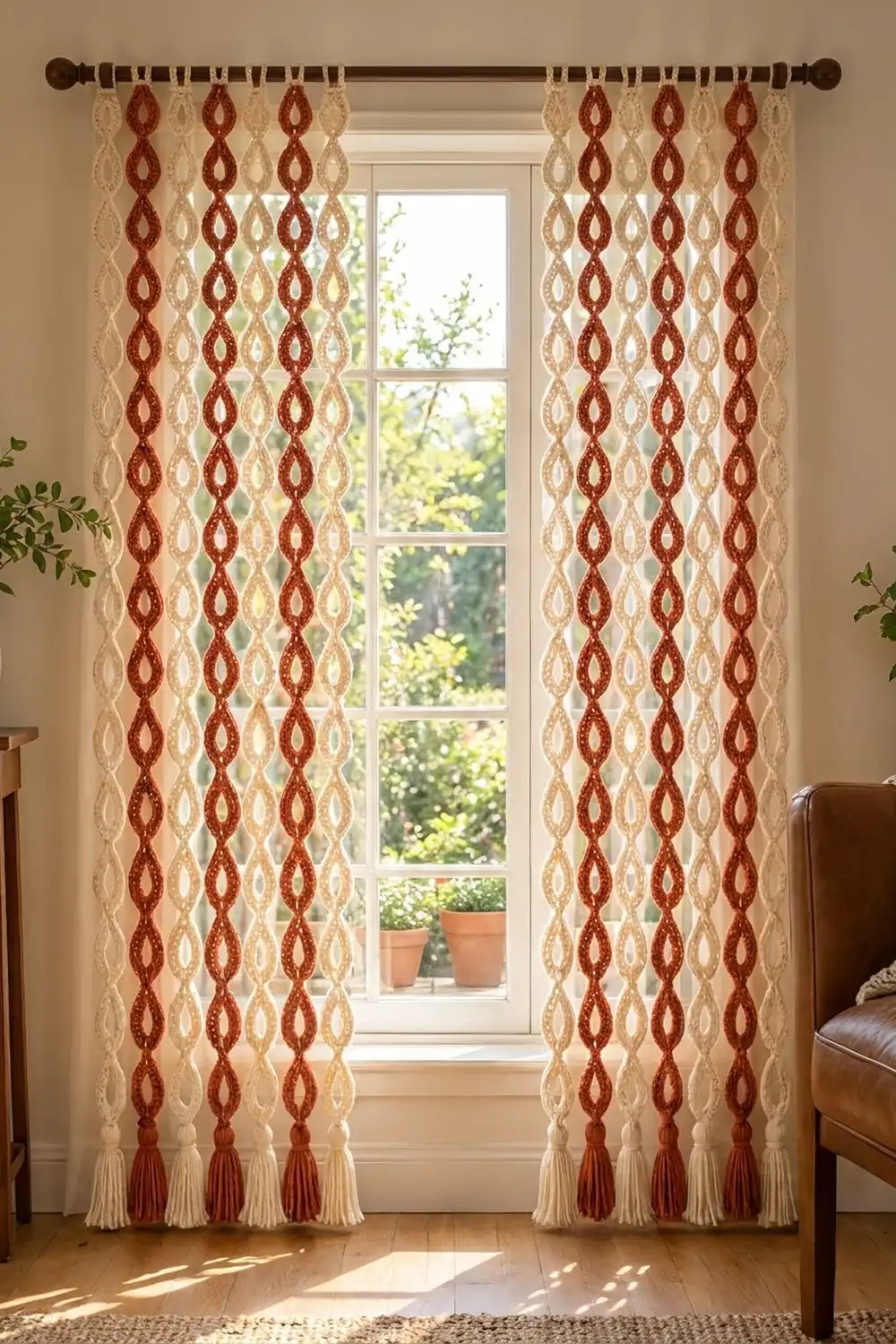
The Ember Drop Strand Curtain is a boho window panel made from vertical strands of crocheted teardrop links. Each teardrop has a pointed top, a rounded bottom, and an open center. Every strand ends in a full tassel with a round head, and all the strands hang from a solid header band with tabs for the rod.
Rust (terracotta) and cream strands alternate across the panel. In sunlight the open centers make a soft lattice that lets light through and still gives some privacy. The look is warm and earthy and works in boho, rustic, and farmhouse rooms.
This pattern uses US crochet terms. One panel measures 35 in (88.9 cm) wide and about 79.5 in (201.9 cm) from the top of the header to the tassel tips, not counting the rod tabs. For a pair like the one at the window, make two panels.
Each teardrop is worked in two rounds and linked to the motif above it as you finish it. Twelve linked motifs make one strand. Ten strands are joined in the first row of a cream header band. The rod tabs are worked straight off the header, and the tassels go on last.
Finished Size and Construction
- Finished panel size: 35 in (88.9 cm) wide x 79.5 in (201.9 cm) long, plus rod tabs
- Skill level: Intermediate
- Terminology: US crochet terms
- Yarn weight: Worsted (#4), cotton or cotton blend
- Hook: 5 mm (H-8)
- Number of pieces: 120 teardrop motifs (12 per strand x 10 strands), 1 header band with 7 tabs, 10 tassels
- Layout: 10 vertical strands side by side, alternating rust and cream
- Piece size: each motif is 3.5 in (8.9 cm) wide x 5 in (12.7 cm) tall. One motif plus its neck is 6 in (15.2 cm).
- Size before border: 35 in (88.9 cm) wide x 72 in (182.9 cm) long
- Border (header band) depth: 1.5 in (3.8 cm), plus 5 in (12.7 cm) tabs that fold into rod loops
- Tassel length: 6 in (15.2 cm)
Materials
Use a smooth worsted cotton or cotton blend with crisp stitch definition. Cotton holds the teardrop shape and doesn’t stretch much while hanging. Avoid very stretchy acrylic, because a 72 in (182.9 cm) strand will grow under its own weight.
These amounts assume yarn with about 183 m (200 yd) per 100 g:
- Rust / terracotta: 275 g, about 500 m (3 skeins of 100 g)
- Cream / ivory: 330 g, about 600 m (4 skeins of 100 g)
You need more cream because it also makes the header and tabs. Both amounts include about a 10% margin for swatching and trimming tassels. For a pair of panels, double everything.
Tools:
- 5 mm (H-8) crochet hook
- Tapestry needle and scissors
- Stitch markers
- A piece of sturdy cardboard 6 in (15.2 cm) tall, for tassels
- Measuring tape
- Rust-proof pins, a blocking surface, and a spray bottle
Abbreviations (US Terms)
- ch – chain
- sl st – slip stitch
- sc – single crochet
- hdc – half double crochet
- dc – double crochet
- st(s) – stitch(es)
- Rnd – round
- rep – repeat
Special stitch – joining sc (jsc): Insert your hook into the next foundation chain and also through the ch-6 top loop of the strand you’re attaching. Yarn over and pull up a loop, then yarn over and pull through both loops on the hook. A jsc counts as 1 sc.
Gauge and Checkpoints
Gauge: 16 sc and 16 rows = 4 in (10.2 cm) in sc worked in rows.
Make one test motif before anything else. It sets the strand width, and the header math depends on that width.
- After Rnd 1: 3 in (7.6 cm) wide x 4.5 in (11.4 cm) from point to bottom curve.
- After Rnd 2: 3.5 in (8.9 cm) wide x 5 in (12.7 cm) tall. The open center is about 1.5 in (3.8 cm) x 2.75 in (7.0 cm).
- After 4 linked motifs: 24 in (61.0 cm) from the top of the first neck to the bottom of the fourth motif.
Motif too big? Go down half a hook size. A 3.75 in (9.5 cm) motif makes the strands crowd and overlap.
Motif too small? Go up half a hook size. A 3.25 in (8.3 cm) motif leaves gaps between the strands.
Also check the header gauge on a small sc swatch. You need exactly 4 sc per inch, because each strand gets 14 header stitches.
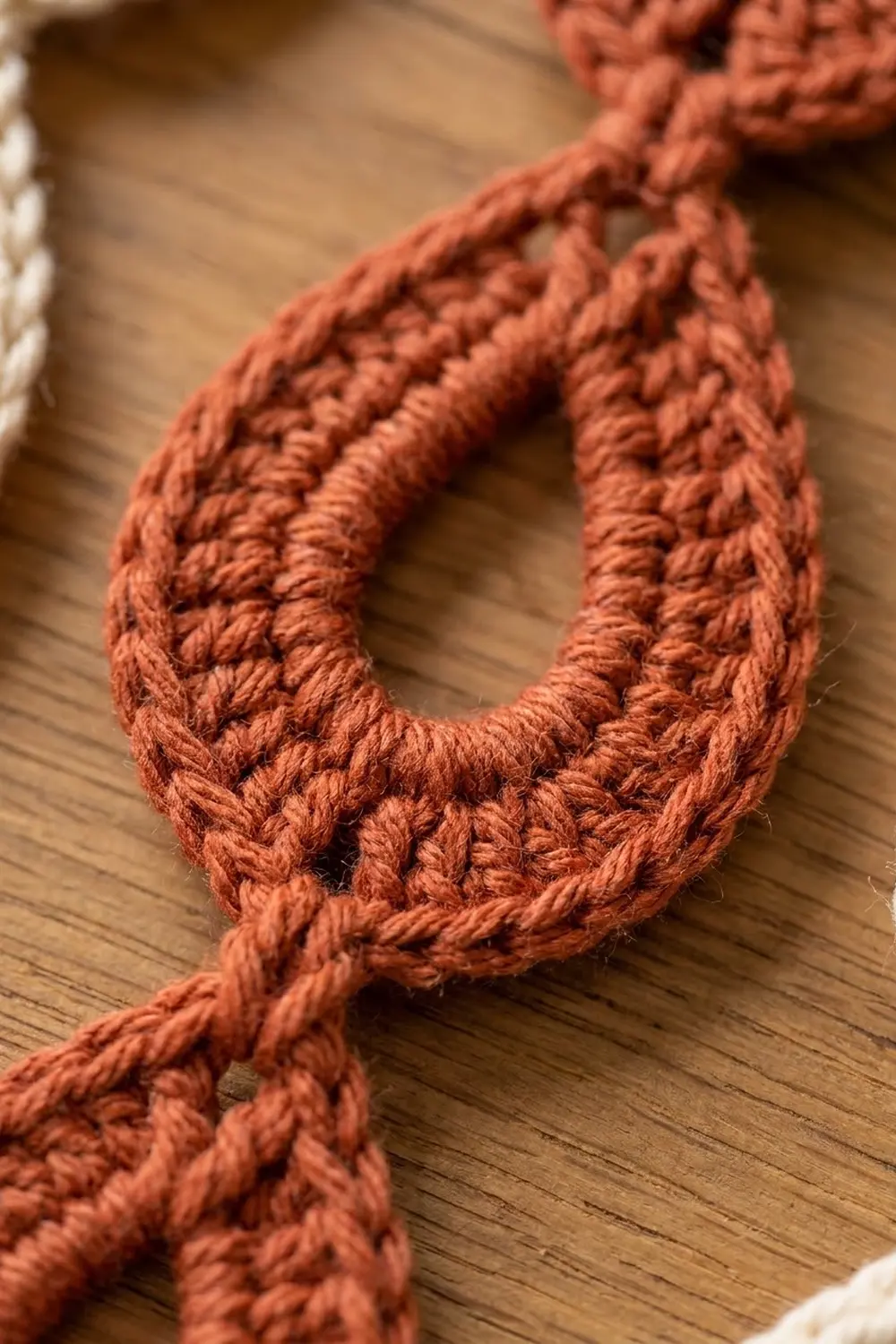
Teardrop Motif
Make each motif in its strand’s color. Rnds 1 and 2 are the same for every motif. The only difference is how you finish the point.
Foundation: Ch 24, then sl st in the first ch to form a ring without twisting it. The join is the point (top) of the teardrop.
Rnd 1 (shaping round): Ch 1, then sc in the same ch as the join. Hdc in the next 3 ch, dc in the next 4 ch, 2 dc in each of the next 8 ch, dc in the next 4 ch, hdc in the next 3 ch, and sc in the last ch. Sl st to the first sc. (32 sts: 2 sc, 6 hdc, 24 dc.)
Check: you used 1 + 3 + 4 + 8 + 4 + 3 + 1 = 24 chains and made 1 + 3 + 4 + 16 + 4 + 3 + 1 = 32 stitches. The short stitches at the top pull the ring into a point, and the paired dc at the bottom spread it into a round curve.
Rnd 2 (outline round): Ch 1. Sc in each of the first 8 sts (the first side). Work (2 sc in the next st, sc in the next st) 8 times across the 16 bottom dc. Sc in each of the last 8 sts (the second side). (40 sc: 8 + 24 + 8.)
Bottom center: The bottom curve is sts 9–32 of Rnd 2, so the center falls between sts 20 and 21. Mark st 20.
First (top) motif of a strand: Ch 6, then sl st to the first sc of Rnd 2 to make the ch-6 top loop. Fasten off and weave in the ends.
Every following motif: Ch 3. Then sl st through the marked sts 20 and 21 of the previous motif together. Ch 3, then sl st to the first sc of Rnd 2. Fasten off and weave in the ends.
The two ch-3 legs make a neck about 1 in (2.5 cm) long, linking each point to the rounded bottom above it. The motif’s 5 in (12.7 cm) plus the 1 in (2.5 cm) neck gives the 6 in (15.2 cm) repeat.
Strand: Make 1 first motif and 11 following motifs, linking each as you go, for 12 motifs per strand. The strand measures 72 in (182.9 cm).
Make All Pieces
For one panel:
- Rust: 5 strands = 60 motifs
- Cream: 5 strands = 60 motifs
- Tassels: 5 rust and 5 cream
Lay the strands out right side up, from left to right:
Header:  [=========== cream, 140 sts ===========]
Strand:   1   2   3   4   5   6   7   8   9   10
Color:    R   C   R   C   R   C   R   C   R   C
Width:   3.5 in (8.9 cm) each = 35 in (88.9 cm)
Before you start the header, finish every strand and check that each one measures 72 in (182.9 cm).
Joining
There are two kinds of joins. The necks link the motifs inside each strand, and Row 1 of the header joins all 10 strands across the panel.
Stitch-to-stitch logic: Each strand gets a 14-stitch header section: 6 sc, then 2 jsc through that strand’s ch-6 top loop, then 6 sc. The loop sits on the 2 center stitches, so each strand hangs centered under its own 3.5 in (8.9 cm) section. No stitches are added between strands.
Tension: Make the foundation chain at your normal tension or slightly looser. A tight chain makes the header narrower than the strands, and the strands will bunch. Work the jsc firmly so the loops can’t slide.
Size checkpoint: After Row 1, lay the panel flat. The header should measure 35 in (88.9 cm), and neighboring strands should just touch.
Border: Header Band and Rod Tabs
The border is the cream header band across the top. The sides and bottom are left as open strands and tassels.
Border gauge: 16 sc = 4 in (10.2 cm), or 4 sc per inch.
Starting count: 10 strands x 14 sts = 140 sts across the top edge.
Foundation: With cream, ch 141.
Row 1 (joining row): Sc in the 2nd ch from the hook and in the next 5 ch. Jsc in the next 2 ch through the top loop of strand 1, then sc in the next 6 ch. Sc in the next 6 ch, jsc in the next 2 ch through the next strand’s top loop, sc in the next 6 ch. Rep from * to * 8 more times. (140 sts: 10 sections of 14.)
Rows 2–6: Ch 1, turn, sc in each st across. (140 sts.) Don’t fasten off.
The header is now 140 ÷ 4 = 35 in (88.9 cm) wide and 1.5 in (3.8 cm) deep.
Rod tabs: You’ll make 7 tabs, each 8 sts wide, with 14 sts between tabs. Check: 7 x 8 + 6 x 14 = 56 + 84 = 140 sts.
Tab 1: Ch 1, turn, sc in the first 8 sts. Rep this row 19 more times, for 20 rows of 8 sc. Fasten off, leaving a 12 in (30.5 cm) tail.
Tabs 2–7: Skip 14 sts, join cream in the next st, and work the same as Tab 1. The tabs start on sts 1, 23, 45, 67, 89, 111, and 133, so the last tab ends on st 140.
Each tab is 2 in (5.1 cm) wide x 5 in (12.7 cm) long. Fold each tab to the back and sew its last row to header Row 2. The loop fits a rod up to about 1.25 in (3.2 cm) across.
Why the math works: Each strand is 3.5 in wide, which is exactly 14 sts at 4 sc per inch. That makes the header width 10 x 14 = 140 sts = 35 in (88.9 cm), with nothing added at the seams. The tab spacing divides the 140 sts evenly, so both end tabs sit flush with the panel edges.
Tassels
Make 10 (5 rust, 5 cream): Wrap the yarn 40 times around the 6 in (15.2 cm) cardboard. Slide a 10 in (25.4 cm) tie under the wraps at the top, then cut through the wraps along the bottom.
Head: Roll a 1 in (2.5 cm) ball of matching scrap yarn and set it in the middle of the strands. Tie the top tightly so the strands fold down over the ball. Wrap a 24 in (61.0 cm) piece of yarn 8 times around the strands about 1.25 in (3.2 cm) below the top, knot it, and bury the ends.
Attach: Use the tie ends to knot the tassel through sts 20–21 of the 12th motif on the strand of the same color. Bury the ends, then trim the tassel to 6 in (15.2 cm).
Final Blocking
- Lay the panel flat on towels.
- Mist it evenly until it’s damp but not soaked.
- Pin the header straight at 35 in (88.9 cm) x 1.5 in (3.8 cm).
- Straighten each strand directly below its section.
- Shape each motif to 3.5 in (8.9 cm) x 5 in (12.7 cm). Round the bottom, pinch the point, and open the center.
- Smooth the tassels with damp fingers.
- Let the panel dry fully, then hang it. The strands settle over 24 hours.
Final Quality-Control Checklist
- Header: 140 sts in every row, 6 rows, 35 in (88.9 cm) wide
- 7 tabs of 8 sts, with 14-st gaps and both end tabs flush with the edges
- 10 strands, alternating R, C, R, C…
- 12 motifs per strand, and each strand is 72 in (182.9 cm)
- Every motif: 32 sts in Rnd 1 and 40 sc in Rnd 2
- Every neck joined at the bottom center (sts 20–21)
- 10 tassels, each 6 in (15.2 cm), with round heads
- All ends woven in on the back
Troubleshooting
Motifs look round instead of teardrop-shaped. Only the 8 bottom chains get 2 dc each. The point should be sc and hdc. Pinch the point when you block.
The bottom edge ruffles. Go down half a hook size for Rnd 2 only.
Motifs hang tilted. The neck is off center. Undo it and re-join through sts 20 and 21 exactly.
Strands are different lengths. Count the motifs, and check that every neck uses ch-3 legs.
The header waves or pulls in. Re-count to 140 sts and loosen the foundation chain.
Tabs are too tight for the rod. Add rows. Every 4 rows adds 1 in (2.5 cm).
The panel is too long. Remove 1 motif per strand. Each motif you remove takes off 6 in (15.2 cm).
Care
Hand wash in cool water with mild soap, then press the water out in a towel. Dry flat and reshape the motifs and tassels before you hang the panel again.
Final Notes
The panel follows one measurement chain. Each motif is 3.5 in (8.9 cm) wide and 5 in (12.7 cm) tall and repeats every 6 in (15.2 cm). Twelve motifs make a 72 in (182.9 cm) strand. Each strand gets 14 header stitches, so 10 strands make 140 stitches and 35 in (88.9 cm) of width. The 1.5 in (3.8 cm) header and 6 in (15.2 cm) tassels bring the total length to 79.5 in (201.9 cm). Check your first motif and the rest of the numbers will follow.
Happy crocheting!