

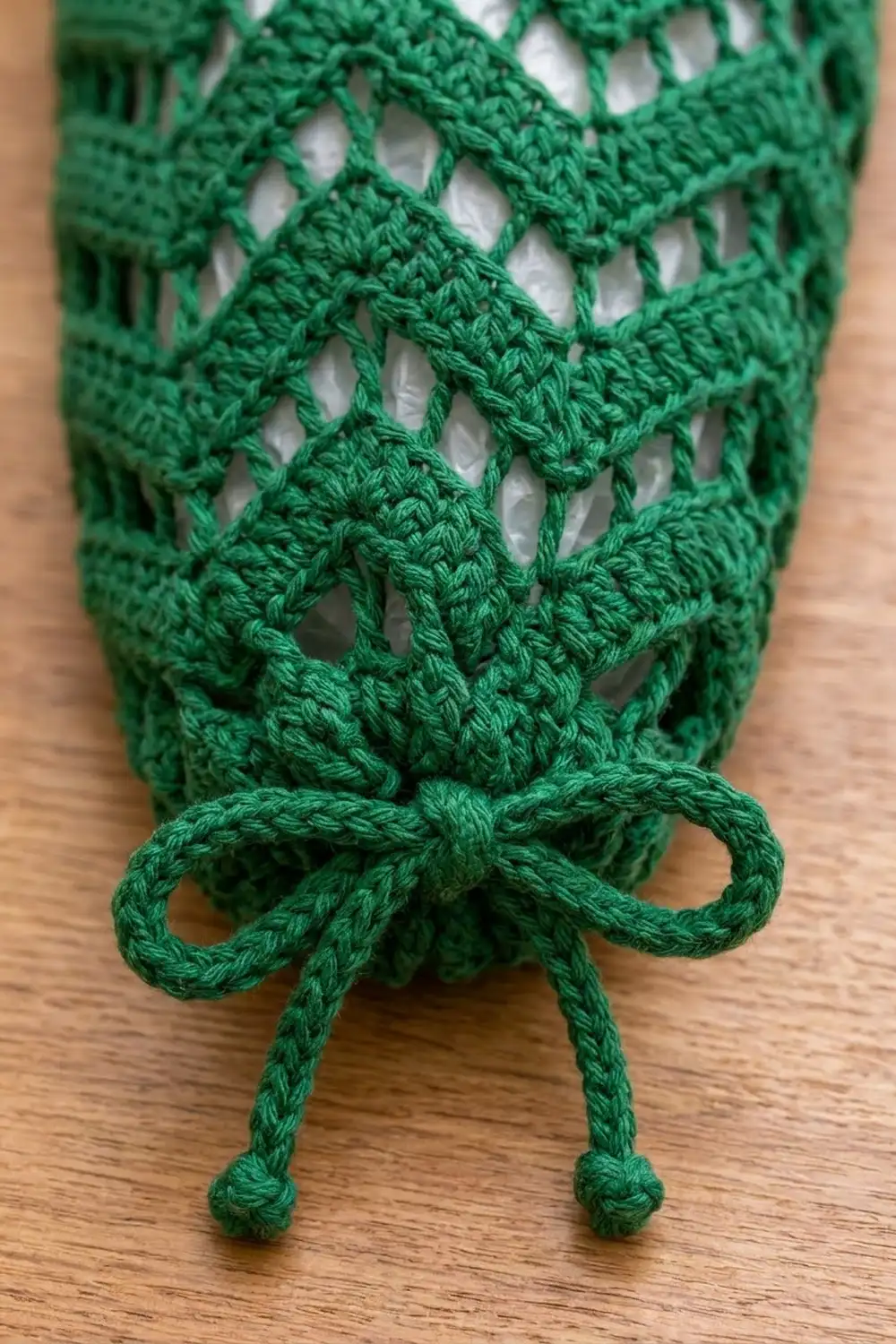
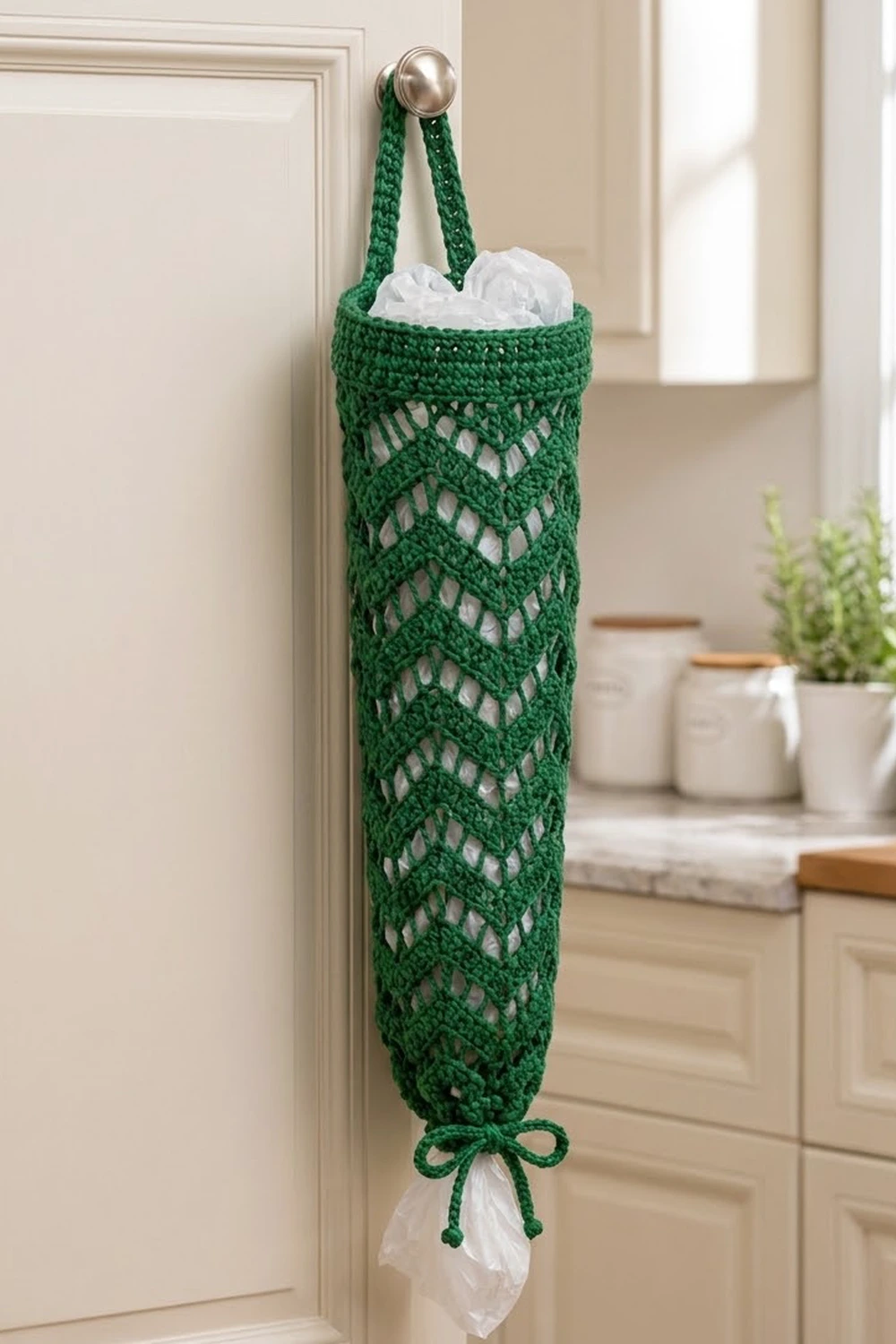
The Evergreen Chevron Bag Holder is a long, tapered tube of lacy zigzags that hangs from a cabinet knob and keeps your plastic grocery bags out of sight. You stuff bags in at the top, and you pull them out one at a time through the small gathered opening at the bottom.
The sample is worked in a deep forest green cotton. Two solid zigzag rounds alternate with one open mesh round, so the chevrons stand out clearly and you can see the bags inside. A firm single crochet rim, a narrow hanging strap, and a drawstring tied in a bow with little popcorn beads finish the piece. A natural beige version works just as well if you want a softer, farmhouse look.
This pattern uses US crochet terms. The finished holder is 20.25 in (51.4 cm) long. It measures 4 in (10.2 cm) across at the bottom before you gather it and 8 in (20.3 cm) across at the rim when laid flat. The strap adds a loop about 4 in (10.2 cm) high.
The holder is one piece, worked bottom-up in joined rounds. You start with an eyelet band, then work the chevron body and taper it in two growth stages. After that you level the zigzag top, add the rim, and work the strap straight off the rim. The drawstring cord is the only separate part.
Finished Size and Construction
- Finished size: 20.25 in (51.4 cm) long; 8 in (20.3 cm) flat width at rim
- Hanging length with strap: about 24.25 in (61.6 cm)
- Skill level: Intermediate
- Terminology: US
- Yarn weight: Worsted (#4)
- Hook: 5 mm (H-8)
- Number of pieces: 1 body (strap worked in place) plus 1 drawstring cord
- Layout: single tapered tube, 4 chevron repeats around
- Piece size before rim: 18.75 in (47.6 cm) long
- Rim (border) depth: 1.5 in (3.8 cm)
Materials
Pick a smooth worsted weight cotton or cotton blend. Cotton holds its shape when the holder is full, and it doesn’t stretch out under the weight of the bags. Avoid fuzzy yarns, because they hide the chevron lines.
- Green (main color): 150 g, about 255 m (279 yd)
- Optional beige version: the same amount, 150 g, about 255 m (279 yd)
These quantities include a margin of roughly 25 percent for the gauge swatch, the strap, the cord, and differences in tension.
Tools:
- 5 mm (H-8) crochet hook
- 4 stitch markers
- Yarn needle
- Scissors
- Measuring tape
- Rolled towel or a tall cardboard tube for blocking
Abbreviations (US Terms)
- ch – chain
- sl st – slip stitch
- sc – single crochet
- hdc – half double crochet
- dc – double crochet
- tr – treble crochet
- sk – skip
- sp – space
- st(s) – stitch(es)
- rnd – round
- beg – beginning
- rep – repeat
Special stitches
- dc3tog (double crochet 3 together): [Yarn over, insert hook in next st, pull up a loop, yarn over, pull through 2 loops] 3 times, then yarn over and pull through all 4 loops on hook. This forms each valley.
- Popcorn bead: Ch 3, work 4 dc in 3rd ch from hook. Drop the loop from your hook, insert the hook from front to back in the first dc, pick up the dropped loop, and pull it through.
Counting note: Every ch-1 sp in a mesh round counts as 1 st. In the next round, work into each ch-1 sp as if it were a stitch.
Gauge and Checkpoints
Chevron gauge: 16 sts and 7 rnds = 4 in (10.2 cm), measured flat and straight across.
Single crochet gauge: 16 sc and 16 rnds = 4 in (10.2 cm).
Instead of a flat swatch, work Rnds 1–6 and measure them. Gauge matters most for the width, since every growth stage builds on it.
- After Rnd 3: tube is 8 in (20.3 cm) around, 4 in (10.2 cm) flat, about 1 in (2.5 cm) tall.
- After Rnd 6: about 2.75 in (7.0 cm) tall.
- After Rnd 15: 6 in (15.2 cm) flat, about 8 in (20.3 cm) tall.
- After Rnd 27: 8 in (20.3 cm) flat, about 14.75 in (37.5 cm) tall.
- After Rnd 34: 8 in (20.3 cm) flat, about 18.75 in (47.6 cm) tall.
If your tube is too big, go down half a hook size. If it’s too small, go up half a size. Measure the height at the center of a peak, not at a valley.
Pattern
Bottom Eyelet Band
Ch 32 and join with a sl st to the first ch. Be careful not to twist the chain.
Rnd 1: Ch 1, sc in each ch around, join with a sl st to the first sc. (32 sts)
Rnd 2 (eyelets): Ch 4 (counts as dc + ch 1), sk next st, dc in next st, ch 1, sk next st; rep from * 15 times. Join with a sl st to the 3rd ch of beg ch-4. (16 dc + 16 ch-1 sps = 32 sts, 16 eyelets)
Rnd 3: Ch 1, sc in each dc and each ch-1 sp around, join. (32 sts)
Chevron Round Formulas
Each round has 4 repeats. In the formulas, a is the number of side sts on each slope of a repeat.
How each round begins: From Rnd 5 onward, every chevron round begins with a sl st in the next st (or ch-1 sp). That moves the round start forward by 1 st, so each valley lines up over the valley below. On the last repeat, the final dc3tog uses the last 2 sts of the round and the beg ch of the previous round.
Solid round (S): Sl st in next st, ch 3 (counts as dc), dc in next (a − 1) sts, 3 dc in next st, dc in next a sts, dc3tog; dc in next a sts, 3 dc in next st, dc in next a sts, dc3tog; rep from * 2 more times. Join to top of beg ch-3.
Growth round (G): Work the same as a Solid round, but put 5 dc in each peak st instead of 3. Each repeat grows by 2 sts.
Mesh round (M): Sl st in next st, ch 4 (counts as dc + ch 1), sk next st, [dc in next st, ch 1, sk next st] (a/2 − 1) times, (dc, ch 1, dc) in next st, [ch 1, sk next st, dc in next st] a/2 times, dc3tog; [dc in next st, ch 1, sk next st] a/2 times, (dc, ch 1, dc) in next st, [ch 1, sk next st, dc in next st] a/2 times, dc3tog; rep from * 2 more times. Join to 3rd ch of beg ch-4.
Each regular repeat uses (2a + 4) sts and makes (2a + 4) sts, so the count stays the same. A growth repeat uses (2a + 4) sts and makes (2a + 6) sts.
Section A: Narrow Body (a = 2)
Rnd 4 (S, first round): Do not sl st forward. Ch 3 (counts as dc), dc in next st, 3 dc in next st, dc in next 2 sts, dc3tog; dc in next 2 sts, 3 dc in next st, dc in next 2 sts, dc3tog; rep from * 2 more times. Join. (32 sts; 8 per repeat)
Rnd 5: S with a = 2. (32 sts)
Rnd 6: M with a = 2. (32 sts)
Rnds 7–8: S with a = 2. (32 sts)
Rnd 9: M with a = 2. (32 sts)
Rnds 10–11: S with a = 2. (32 sts)
Rnd 12: M with a = 2. (32 sts)
First Growth Stage
Rnd 13: G with a = 2. (40 sts; 10 per repeat)
Rnd 14: G with a = 3. (48 sts; 12 per repeat)
Rnd 15: M with a = 4. (48 sts)
Section B: Middle Body (a = 4)
Rnds 16–17: S with a = 4. (48 sts)
Rnd 18: M with a = 4. (48 sts)
Rnds 19–20: S with a = 4. (48 sts)
Rnd 21: M with a = 4. (48 sts)
Rnds 22–23: S with a = 4. (48 sts)
Rnd 24: M with a = 4. (48 sts)
Second Growth Stage
Rnd 25: G with a = 4. (56 sts; 14 per repeat)
Rnd 26: G with a = 5. (64 sts; 16 per repeat)
Rnd 27: M with a = 6. (64 sts)
Section C: Upper Body (a = 6)
Rnds 28–29: S with a = 6. (64 sts)
Rnd 30: M with a = 6. (64 sts)
Rnds 31–32: S with a = 6. (64 sts)
Rnd 33: M with a = 6. (64 sts)
Check: the tube should be 8 in (20.3 cm) flat.
Border: Leveling Round, Rim, and Strap
Border gauge: 16 sc = 4 in (10.2 cm), and 4 sc rnds = 1 in (2.5 cm).
Rnd 34 (conversion round): This round levels the zigzag edge. Do not sl st forward. Ch 4 (counts as tr), dc in next 2 sts, hdc in next 2 sts, sc in next 5 sts, hdc in next 2 sts, dc in next 2 sts, tr in next 2 sts; tr in next st, dc in next 2 sts, hdc in next 2 sts, sc in next 5 sts, hdc in next 2 sts, dc in next 2 sts, tr in next 2 sts; rep from * 2 more times. Join. Count: 64 sts worked 1 per existing st + 0 added = 64 sts, which is 16 per repeat. The tall sts fill the valleys, and the sc sit over the peaks.
Rnds 35–40 (rim): Ch 1, sc in each st around, join. (64 sts)
Flatten the tube so 2 repeats sit on each side. Each flat side has 32 sts on every rim round. The sides fold at the tube’s edges, so there are no corner stitches to add.
Why the math works: The tube has 64 chevron sts at 4 sts per inch, which is 16 in (40.6 cm) around. The rim has 64 sc at 4 sc per inch, which is also 16 in (40.6 cm) around. Since the two widths match, the rim won’t flare or pull in. Six rounds at 0.25 in each give 1.5 in (3.8 cm) of rim.
Strap: Flatten the holder and choose the back. Place markers in rim sts 9 and 12, counting from the round join, then place markers in sts 21 and 24. This leaves 8 sts, or 2 in (5.1 cm), between the strap ends.
- Row 1: Join yarn in st 9, ch 1, sc in sts 9–12. Turn. (4 sc)
- Rows 2–40: Ch 1, sc in each st across. Turn. (4 sc)
The strip is 1 in (2.5 cm) wide and 10 in (25.4 cm) long. Bring the end down to sts 21–24 without twisting it. Sl st through both layers across all 4 sts, then fasten off. This forms a loop about 4 in (10.2 cm) high.
Drawstring Cord
Bead 1: Work 1 popcorn bead.
Cord: Ch 100, then sl st in the back bump of the 2nd ch from the hook and each ch across. (99 sl sts) Fasten off.
Bead 2: Join yarn at the far tip of the cord and work 1 popcorn bead. Fasten off.
The cord measures about 25 in (63.5 cm). Starting at the front center, weave it over and under the 16 dc of Rnd 2 so both tails come out side by side. Pull the cord to gather the bottom to an opening about 1.5 in (3.8 cm) across, then tie a bow.
Final Blocking
- Weave in all ends along the inside, following solid rounds.
- Soak the holder in cool water for 10 minutes, then press the water out gently. Don’t wring it.
- Slide it over a rolled towel or a cardboard tube.
- Straighten each valley line so it runs straight up the tube.
- Pat the rim into a flat 8 in (20.3 cm) width and check that the length is 20.25 in (51.4 cm).
- Lay the strap flat and let everything dry completely.
- Re-tie the bow after drying.
Final Quality-Control Checklist
- Stitch counts are 32, 48, and 64 in Sections A, B, and C.
- The valleys line up in 4 straight columns.
- The mesh rounds alternate dc and ch-1 sp evenly.
- The rim lies flat at 8 in (20.3 cm).
- The strap is attached securely and isn’t twisted.
- The cord passes through all 16 eyelets, and both beads are firm.
- No ends are visible on the outside.
Troubleshooting
The valleys drift sideways. You probably skipped the sl st forward at the start of a round. Check the start of each round from Rnd 5 onward.
The stitch count is off by 2. You probably worked 3 dc in a peak on a growth round, or 5 dc on a regular round.
The rim ruffles. Your sc gauge is looser than your chevron gauge. Work the rim with a 4.5 mm hook.
The rim pulls in. Use a 5.5 mm hook for Rnds 35–40.
Bags slip out on their own. Pull the drawstring tighter and double-knot the bow.
The mesh holes are uneven. Work the ch-1 sps at the same tension as your dc.
Care
Hand wash or machine wash on a gentle cycle in cool water, then lay flat or reshape over a tube to dry. Remove the drawstring first if you wash it in a machine.
Final Notes
The measurement chain runs like this. The eyelet band is 8 in (20.3 cm) around. The tube grows to 12 in (30.5 cm) after Rnd 14 and to 16 in (40.6 cm) after Rnd 26. The rim keeps 16 in (40.6 cm) around and finishes at 20.25 in (51.4 cm) long. Check each stage against its checkpoint, and the holder will hang straight and neat from the first bag to the last.
Happy crocheting!