

The Evergreen Diamond Lace Table Runner is a lacy, festive centerpiece made from small motifs turned on point. Each motif has four soft fan shells around a tiny center ring, a light chain frame, and a scalloped edge with a three-loop cluster at every point. Joined tip to tip, the motifs leave neat diamond windows that let the tablecloth show through.
The runner is worked in a single deep teal. It looks rich against cream linen, silver ornaments, and candlelight, but it works just as well outside the holidays. The style is classic lace with a modern edge: no extra border, just a crisp zigzag outline and a tassel at each end point.
This pattern uses US crochet terms. The finished runner measures 17.1 in (43.4 cm) wide and 57 in (144.8 cm) long, not counting tassels. With a 4 in (10.2 cm) tassel at each end, the total length is 65 in (165.1 cm).
Here is how it’s made. You work 30 square motifs in the round and set them on point in a grid 3 across and 10 rows long, joining as you go at the corner tips. The motifs’ own last round forms the finished edge. Six tassels finish the short ends, three at each end.
Finished Size and Construction
- Finished size: 17.1 x 57 in (43.4 x 144.8 cm) without tassels; 65 in (165.1 cm) long with tassels
- Skill level: Intermediate
- Terminology: US crochet terms
- Yarn weight: DK (light worsted, #3) cotton
- Hook: 3.5 mm (E-4)
- Number of pieces: 30 motifs plus 6 tassels
- Layout: 3 motifs across x 10 rows, set on point
- Motif size: 4 in (10.2 cm) per side; 5.7 in (14.5 cm) from point to point
- Size before border: 17.1 x 57 in (43.4 x 144.8 cm)
- Border depth: 0 in (0 cm). Round 6 of each motif is the finished edge.
Materials
Yarn: Choose a smooth mercerized or combed DK cotton, about 110 m per 50 g. Cotton shows the fan texture clearly and holds its shape after blocking. Don’t use fuzzy or very stretchy yarn, because the open lace will lose its shape.
- Teal: 250 g (about 550 m / 600 yd)
- Motifs: about 6 g (13.2 m) each, 180 g total
- Tassels: about 7 g each, 42 g total
These quantities include a margin for gauge swatching and weaving in ends.
Tools:
– 3.5 mm (E-4) crochet hook
– Tapestry needle
– Scissors
– Stiff card 4.5 in (11.4 cm) tall, for tassels
– Rustproof pins and a blocking mat or folded towels
– Spray bottle
– Measuring tape
– Locking stitch markers
Abbreviations (US Terms)
- ch: chain
- sl st: slip stitch
- sc: single crochet
- dc: double crochet
- tr: treble crochet (yarn over twice)
- sp: space
- sk: skip
- st(s): stitch(es)
Special stitch: Corner Cluster (CC). Worked in one corner ch-5 loop: (sc, ch 3, sc, ch 5, sc, ch 3, sc). This makes the three small loops that sit at each diamond point.
Joined Corner Cluster (JCC). Worked like a CC, but the middle ch 5 becomes: ch 2, sl st into the matching ch-5 tip of the finished neighboring motif, ch 2. Its length is the same as a ch-5 tip.
Gauge and Checkpoints
Gauge: Rounds 1–3 measure 2.75 in (7.0 cm) across from fan tip to fan tip.
Make one complete motif before you start the runner, and pin it out lightly. Check it against these measurements:
- After Round 3: 2.75 in (7.0 cm) across the fans
- After Round 4: 3.25 in (8.3 cm) per side
- After Round 5: 3.6 in (9.1 cm) per side
- After Round 6: 4 in (10.2 cm) per side and 5.7 in (14.5 cm) point to point
Too big? Go down to a 3.25 mm (D-3) hook. Even 0.1 in (0.3 cm) extra per motif adds up to 1 in (2.5 cm) over 10 rows.
Too small? Go up to a 3.75 mm (F-5) hook. Check that your chains aren’t too tight, because tight chains make the frame cup.
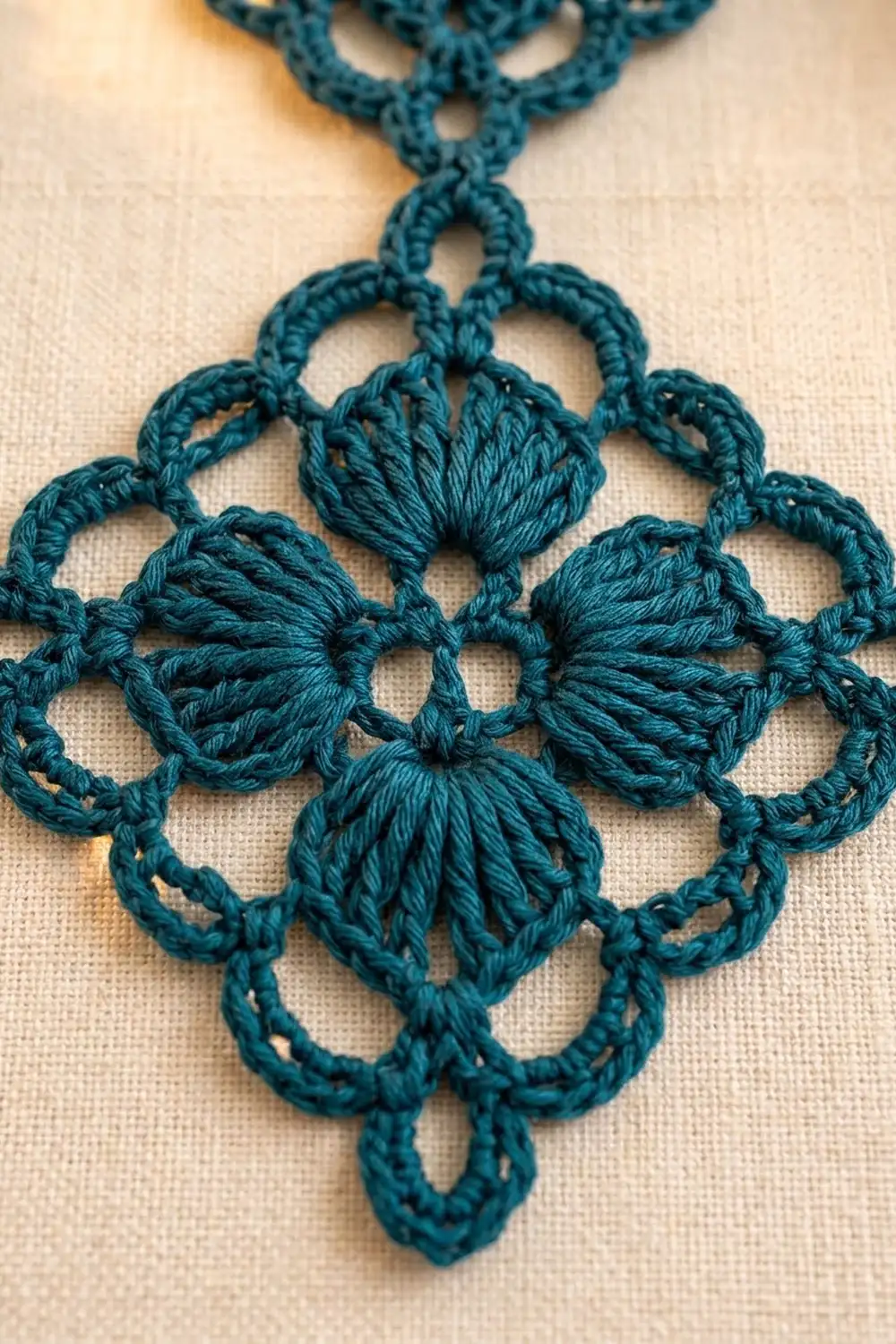
Motif (Make 30)
Each motif is a square worked in the round. You’ll set it on point later, so its four corners become the top, bottom, left, and right tips of the diamond.
Round 1: Make a magic ring. Ch 1, work 12 sc into the ring, then sl st to the first sc. Pull the ring closed, leaving a small center hole. (12 sc)
Round 2: Ch 1, sc in the first sc, ch 7, sk 2 sc. Sc in the next sc, ch 7, sk 2 sc. Repeat from * 2 more times. Sl st to the first sc. (4 sc, 4 ch-7 loops)*
Check: 4 worked sc + 8 skipped sc = 12 stitches, which matches Round 1.
Round 3 (fans): Ch 1, sc in the first sc, 9 dc in the next ch-7 loop. Sc in the next sc, 9 dc in the next ch-7 loop. Repeat from * 2 more times. Sl st to the first sc. (4 sc, 36 dc; 40 sts)*
The 9 dc packed into each loop crowd together and puff into a rounded fan. The 5th dc of each fan is its center, and that’s where the corners go.
Round 4 (frame): Sl st in each of the next 5 sts to reach the 5th dc of the first fan. Ch 1, (sc, ch 3, sc) in the same dc, ch 4, tr in the next sc (between fans), ch 4. (Sc, ch 3, sc) in the 5th dc of the next fan, ch 4, tr in the next sc, ch 4. Repeat from * 2 more times. Sl st to the first sc. (8 sc, 4 tr, 4 ch-3 corner sps, 8 ch-4 sps)*
The tr reaches up from the dip between two fans, so each side lies straight. Per side, you have ch-4, tr, ch-4 between the corners.
Round 5: Sl st into the first ch-3 corner sp. Ch 1, (sc, ch 5, sc) in the same corner sp. Ch 3, sc in the next ch-4 sp, ch 3, sc in the tr, ch 3, sc in the next ch-4 sp, ch 3, then (sc, ch 5, sc) in the next corner sp. Repeat from * 2 more times. Ch 3, sc in the next ch-4 sp, ch 3, sc in the tr, ch 3, sc in the next ch-4 sp, ch 3, sl st to the first sc. (20 sc, 4 ch-5 corner loops, 16 ch-3 sps)*
Check: 8 corner sc + 12 side sc = 20 sc. Each side has 4 ch-3 sps between its corner loops.
Round 6 (edge): Sl st into the first ch-5 corner loop. Ch 1, work a CC in the same loop. (Ch 4, sc in the next ch-3 sp) 4 times, ch 4, CC in the next corner loop. Repeat from * 2 more times. (Ch 4, sc in the next ch-3 sp) 4 times, ch 4, sl st to the first sc. Fasten off. (32 sc, 20 ch-4 arcs, 8 ch-3 picots, 4 ch-5 tips)*
Check: 4 corners x 4 sc = 16 sc, plus 4 sides x 4 sc = 16 sc, gives 32 sc. Each side has 5 ch-4 arcs, and 4 x 5 = 20.
Per-side definition: Each side runs from one ch-5 tip to the next and holds 4 sc and 5 ch-4 arcs. The corner clusters at each end belong to the corners, not the side.
Weave in the center tail on the first motif only for now. Leave the other tails until joining is done so you can adjust them if needed.
Make All Pieces
Make all 30 motifs in Teal. For the first motif, work Round 6 as written. On every later motif, swap in a JCC on Round 6 at each corner that touches a motif you’ve already finished.
Layout grid (3 across x 10 rows, every motif on point). T marks a tassel.
   T      T      T
Row 1:  A1     A2     A3
Row 2:  B1     B2     B3
Row 3:  C1     C2     C3
Row 4:  D1     D2     D3
Row 5:  E1     E2     E3
Row 6:  F1     F2     F3
Row 7:  G1     G2     G3
Row 8:  H1     H2     H3
Row 9:  I1     I2     I3
Row 10: J1     J2     J3
   T      T      T
Neighbors in a row touch at their side points. Each row touches the next at top and bottom points.
Joining
Method: Join as you go on Round 6, at the corner ch-5 tips only. The side ch-4 arcs never join, which leaves the open diamond windows between motifs.
Order:
1. A1: Work Round 6 complete.
2. A2: Use a JCC at its left point to join to A1’s right point.
3. A3: Use a JCC at its left point to join to A2’s right point.
4. B1: Use a JCC at its top point to join to A1’s bottom point.
5. B2: Use a JCC at the top point (joining A2) and at the left point (joining B1).
6. B3: Join the same way as B2, to A3 and B2.
7. Rows 3–10: Repeat the Row 2 pattern down the runner.
Stitch-to-stitch logic: Each JCC replaces one ch 5 with ch 2, sl st, ch 2. The joined tip is the same length as a free tip, so the motifs stay exactly 5.7 in (14.5 cm) apart, center to center. Every corner joins to only one neighbor, so you never stack joins in the same loop.
Tension: Keep the ch 2 on each side of the sl st loose and even. If you pull the sl st snug, it creates a hard knot and the points pucker. Before working the sl st, lay both motifs flat with their points meeting, and check that neither tip is twisted.
Size checkpoint: After Row 1, the runner should measure 17.1 in (43.4 cm) across, point to point. After Row 5, it should be 28.5 in (72.4 cm) long. Lay it flat and measure without stretching. If you’re more than 0.5 in (1.3 cm) off, check your hook and tension before continuing.
Border
Border gauge: None. This design has no added border, so border depth is 0 in (0 cm).
Why there’s no border: Round 6 already gives every motif a finished, scalloped edge. A border around the runner would fill in the zigzag and close the half-diamond notches along the long sides, which would change the look completely.
Edge counts per side of the runner:
– Long sides: Each long side has 10 exposed motif sides of 5 ch-4 arcs each on the outer half of the zigzag, and the same on the inner half. That’s 10 x 5 = 50 arcs per half, and 100 arcs per long edge in total.
– Short ends: Each short end has 3 free bottom tips (or top tips at the first end), one per motif.
Why the math works: The arcs between corners are identical on every motif, so the edge repeats evenly with no extra stitches. Joined tips are the same length as free tips, so the width stays at 3 x 5.7 in = 17.1 in (43.4 cm) and the length at 10 x 5.7 in = 57 in (144.8 cm).
Tassels (make 6):
1. Wrap the yarn 40 times around the 4.5 in (11.4 cm) card.
2. Thread a 12 in (30.5 cm) strand under the wraps at the top edge and knot it tightly. Leave the ends long for attaching the tassel.
3. Cut the wraps along the bottom edge.
4. Wrap a separate strand 6 times around the bundle, 0.75 in (1.9 cm) below the top, to make the rounded head. Tie it off and bury the ends inside the tassel.
5. Trim the bottom evenly to 4 in (10.2 cm).
Using the top ties, attach one tassel through the ch-5 tip of each of A1, A2, and A3 (top points) and J1, J2, and J3 (bottom points). Knot the ties securely and pull the ends down into the tassel.
Final Blocking
- Weave in all remaining ends along the sc stitches, not through the chains.
- Soak the runner in cool water for 10 minutes. Press out the water in a towel; don’t wring it.
- Lay the runner on the blocking surface. Measure 17.1 in (43.4 cm) across and 57 in (144.8 cm) down.
- Pin each motif tip first, starting from the center and working outward.
- Pin the middle ch-4 arc on each motif side so the sides lie straight.
- Shape each fan by hand so it sits round and plump.
- Let it dry completely, usually 24 hours. Comb the tassels straight while they’re damp.
Final Quality-Control Checklist
- Every motif measures 4 in (10.2 cm) per side and 5.7 in (14.5 cm) point to point.
- Each motif has 4 fans of 9 dc each.
- Each motif side has 5 ch-4 arcs.
- Every interior tip is joined once, with no doubled joins.
- No side arcs are accidentally joined, and all diamond windows are open.
- Width is 17.1 in (43.4 cm) and length is 57 in (144.8 cm).
- There are 3 tassels at each end, all trimmed to 4 in (10.2 cm).
- All ends are woven in securely.
Troubleshooting
The fans look flat. Your Round 2 chains may be too long or too loose. Try ch 6 instead of ch 7, but still work 9 dc into each loop.
The motif cups or curls. Your chains are too tight. Loosen them, or use a larger hook for the chains only.
The sides bow inward. You may have worked a dc instead of a tr in Round 4. Check that your tr has 2 yarn-overs.
The joined points pucker. The sl st is too tight. Rework the join with looser ch-2s.
The runner has the wrong width. Recheck the gauge against Round 3, then block to the measurements above.
The tassels are uneven. Trim them again once they’re dry. Cotton tassels relax after wetting.
Care
Hand wash in cool water with a mild detergent, then press out the water and lay flat to dry. Re-pin the tips if needed, and keep the runner away from candle flames.
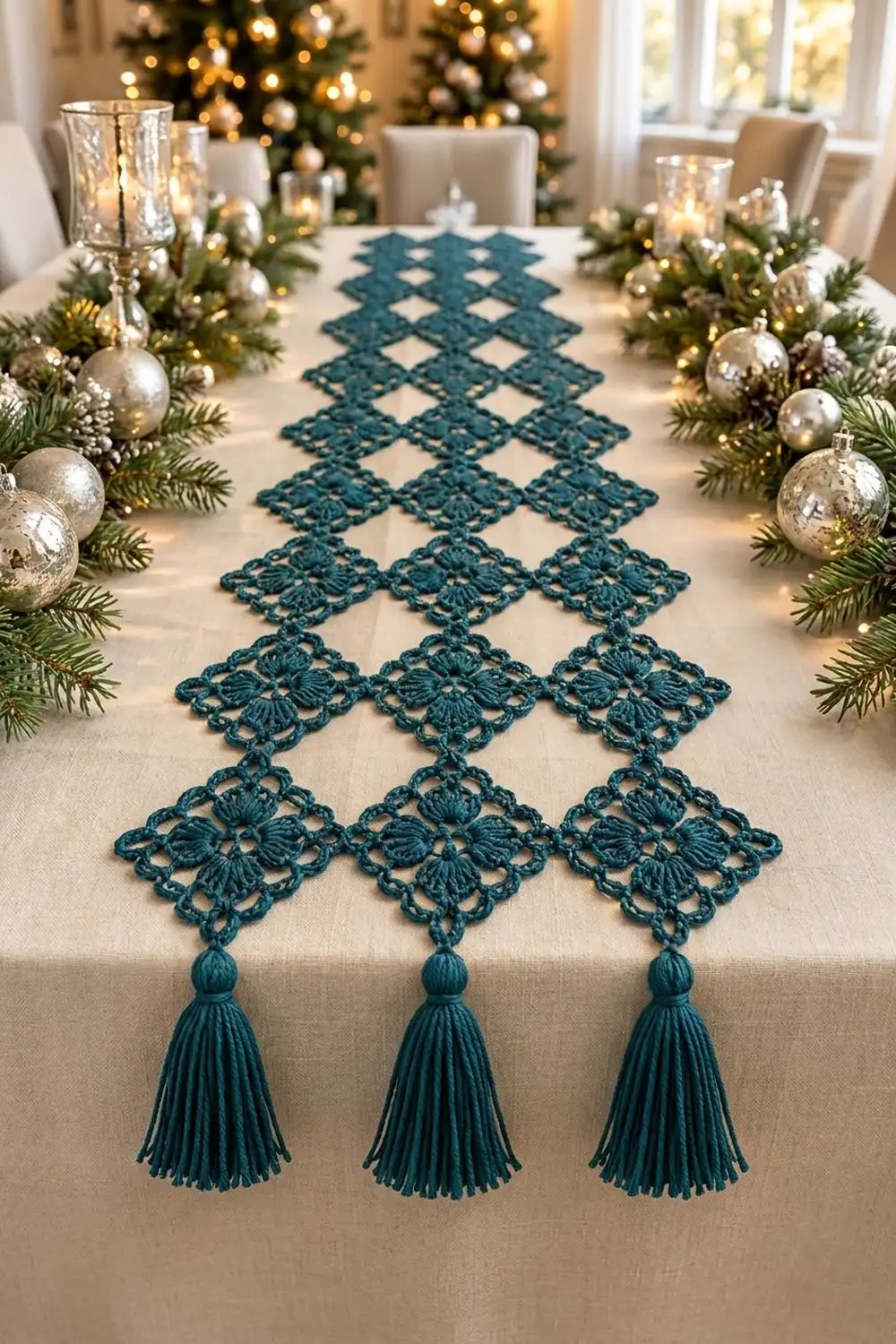
Final Notes
The measurement chain is straightforward. Rounds 1–3 measure 2.75 in (7.0 cm), and each motif finishes at 4 in (10.2 cm) per side and 5.7 in (14.5 cm) point to point. Three motifs across give 17.1 in (43.4 cm), and ten rows give 57 in (144.8 cm). With 4 in (10.2 cm) tassels at each end, the total length is 65 in (165.1 cm). If your gauge motif matches, every number after it follows.
Happy crocheting!