

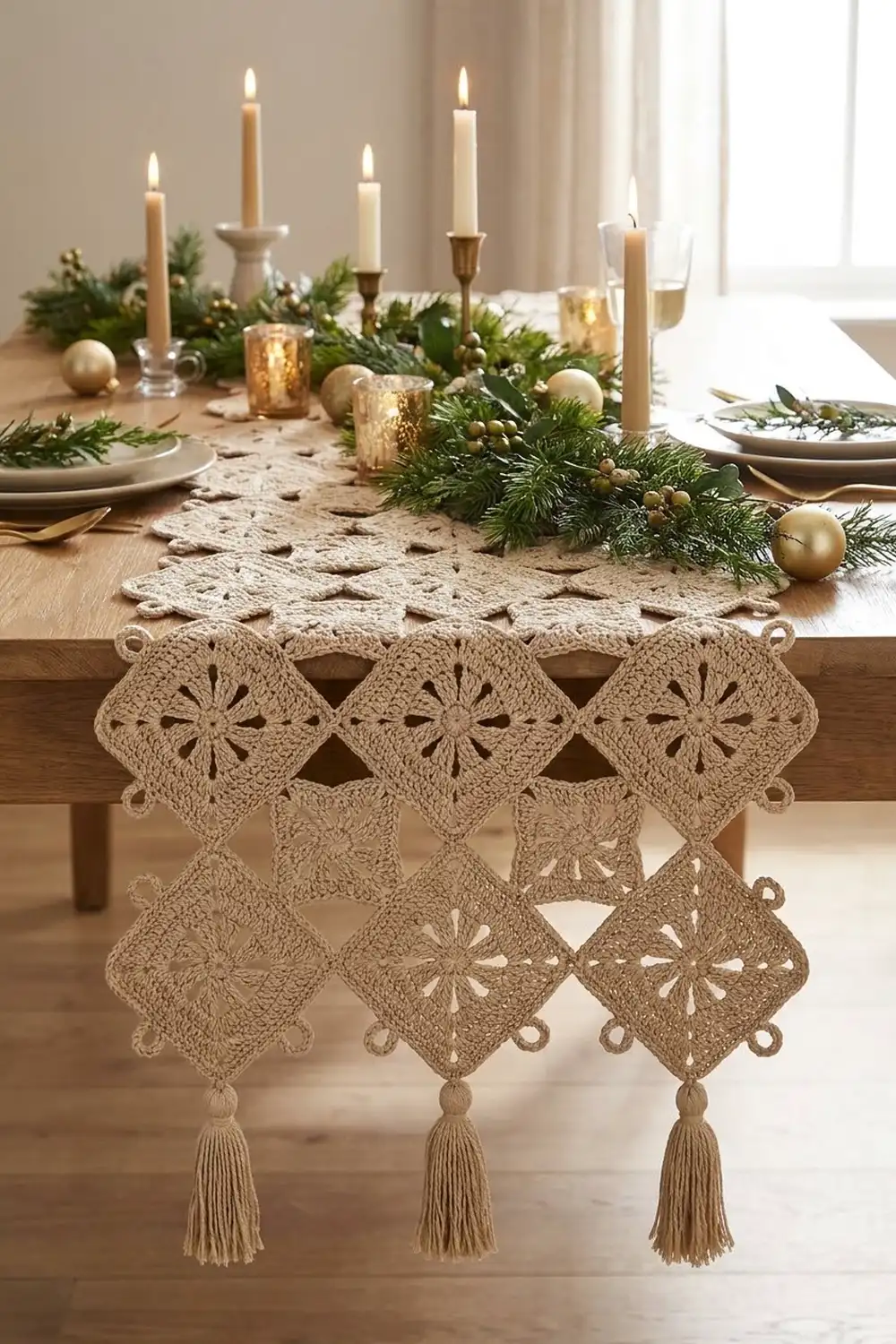
The Golden Pinwheel Table Runner is a lacy, on-point runner made from swirling square motifs joined corner to corner. Each motif has a solid eight-arm pinwheel center, a lightly squared round, and an edge of thick, rounded loops. Set out as diamonds, the motifs leave a row of open windows down the runner that let the tablecloth show through.
The sample is worked in one color, a warm sand beige cotton. A single color keeps the look calm and elegant on a holiday table and lets the swirl texture carry the design. Plump tassels hang from the outer point of each end motif.
This pattern uses US crochet terms. The finished runner measures 15 in (38.1 cm) wide by 50 in (127.0 cm) long before tassels. With tassels at both ends, it is about 59 in (149.9 cm) long.
Construction is simple. You make one motif in eight rounds, then join each new motif to its neighbors at the corner tips during its final round (join-as-you-go). No separate border is added, because the final motif round is the finished edge. Six tassels complete the runner.
Finished Size and Construction
- Finished size: 15 in (38.1 cm) x 50 in (127.0 cm); about 59 in (149.9 cm) long with tassels
- Skill level: Intermediate
- Terminology: US crochet terms
- Yarn weight: Light worsted / DK (#3) cotton
- Hook: 4.0 mm (G-6)
- Number of pieces: 30 motifs, plus 6 tassels
- Layout: 3 motifs wide x 10 motifs long, set on point
- Piece size: 5 in (12.7 cm) from tip to tip; about 3.5 in (8.9 cm) along each side
- Size before border: 15 in x 50 in (38.1 cm x 127.0 cm)
- Border depth: 0 in (0 cm), because motif Round 8 is the edge
Materials
Use a smooth combed or mercerized cotton in DK or light worsted weight. Cotton keeps the swirl ridges and round loops crisp and blocks flat. Acrylic also works, but the loops will be softer and less defined.
- Sand beige (one color): about 250 g / 550 m (601 yd), for example five 50 g / 110 m balls
- Motifs: about 15 m (16.4 yd) each, 450 m (492 yd) in total
- Tassels: about 6.7 m (7.3 yd) each, 40 m (43.7 yd) in total
These quantities include a margin of roughly 10% for swatching and weaving in ends.
Tools:
- 4.0 mm (G-6) crochet hook
- Tapestry needle
- Scissors
- Stitch markers
- Stiff card 4.5 in (11.4 cm) tall, for the tassels
- Blocking mats, rust-proof pins, and a spray bottle
- Measuring tape
Abbreviations (US Terms)
- ch – chain
- sl st – slip stitch
- sc – single crochet
- hdc – half double crochet
- dc – double crochet
- sp(s) – space(s)
- st(s) – stitch(es)
- rep – repeat
- MR – magic ring
Special stitch – Tip join: At a corner tip, work ch 1, sl st into the ch-3 tip of the neighboring finished motif, ch 1. Do this in place of the usual ch 3. It links the two tips without adding bulk.
Gauge and Checkpoints
Make one complete motif first, then block and measure it before you go on. Every runner measurement is a multiple of this one motif.
Checkpoints:
- After Round 1: about 1 in (2.5 cm) across
- After Round 3: about 2 in (5.1 cm) across
- After Round 5: about 3.5 in (8.9 cm) across, still round
- After Round 6: about 4.25 in (10.8 cm) from corner to corner
- After Round 8 (blocked): 5 in (12.7 cm) from tip to tip
Too big: Change to a 3.75 mm (F-5) hook. If each motif is 0.25 in (0.6 cm) too large, the runner ends up 2.5 in (6.4 cm) too long and 0.75 in (1.9 cm) too wide.
Too small: Change to a 4.5 mm (7) hook, and check that you are not pulling the chain loops tight.
Center cups: Your dc are too short. Pull each loop up slightly taller.
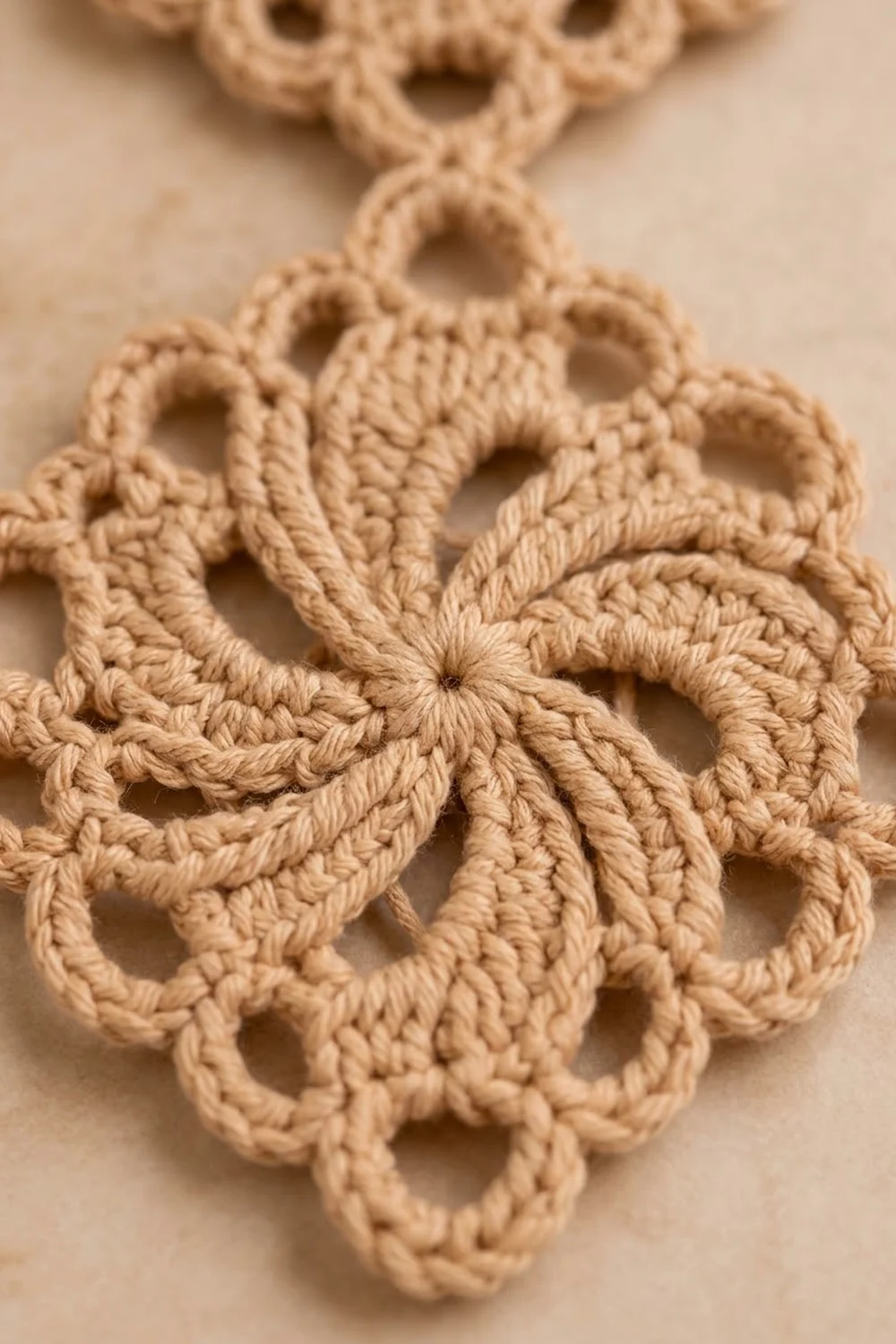
Motif (Make 30)
Every motif follows Rounds 1–7 as written. Work Round 8 plain on the first motif. On every other motif, use tip joins in Round 8 (see Joining).
Round 1: Make an MR. Ch 3 (counts as dc), work 15 dc in the ring. Pull the ring closed, then join with sl st to top of ch-3. (16 dc)
Round 2: Ch 3 (counts as dc), dc in next st, ch 2, dc in next 2 sts, ch 2; rep from * 6 more times. Join to top of ch-3. (16 dc, 8 ch-2 sps; 8 arms of 2 dc)
Round 3: Sl st in next dc. Ch 3 (counts as dc), 2 dc in next ch-2 sp, ch 2, skip next dc, dc in next dc, 2 dc in next ch-2 sp, ch 2; rep from * 6 more times. Join. (24 dc, 8 ch-2 sps; 8 arms of 3 dc)
In this round you skip the first dc of each arm and add 2 dc in the space. That moves each arm forward one step, which is what makes the pinwheel swirl.
Round 4: Sl st in next dc. Ch 3 (counts as dc), dc in next dc, 2 dc in next ch-2 sp, ch 2, skip next dc, dc in next 2 dc, 2 dc in next ch-2 sp, ch 2; rep from * 6 more times. Join. (32 dc, 8 ch-2 sps; 8 arms of 4 dc)
Round 5: Sl st in next dc. Ch 3 (counts as dc), dc in next 2 dc, 2 dc in next ch-2 sp, ch 3, skip next dc, dc in next 3 dc, 2 dc in next ch-2 sp, ch 3; rep from * 6 more times. Join. (40 dc, 8 ch-3 sps; 8 arms of 5 dc)
Round 6 (squaring round): Sl st in next 4 dc and into the next ch-3 sp. Ch 3 (counts as dc), then work (dc, ch 5, 2 dc) in the same sp to make the first corner. Hdc in next 5 dc, (hdc, ch 3, hdc) in next ch-3 sp, hdc in next 5 dc, (2 dc, ch 5, 2 dc) in next ch-3 sp; rep from * 2 more times. Hdc in next 5 dc, (hdc, ch 3, hdc) in next ch-3 sp, hdc in next 5 dc. Join to top of ch-3. (64 sts: 16 dc + 48 hdc; 4 corner ch-5 sps, 4 side ch-3 sps)
Each side has 16 sts between the corner ch-5 sps: 2 dc, 6 hdc, the side ch-3 sp, 6 hdc, and 2 dc. 4 x 16 = 64.
Round 7 (loop foundation): Sl st in next dc and into the corner ch-5 sp. Ch 1, (sc, ch 9, sc) in the same sp. Sc in next 3 sts, ch 6, skip next 3 hdc, sc in next 2 hdc, sc in side ch-3 sp, sc in next 2 hdc, ch 6, skip next 3 hdc, sc in next 3 sts, (sc, ch 9, sc) in next corner ch-5 sp; rep from * 3 more times, but leave out the final corner group on the last repeat. Join to first sc. (52 sc, 8 ch-6 loops, 4 ch-9 corner loops)
Each side has 3 + 2 + 1 + 2 + 3 = 11 sc and 2 ch-6 loops. Each corner has 2 sc and 1 ch-9 loop. (4 x 11) + (4 x 2) = 52 sc.
Round 8 (corded edge): Ch 1, sc in first sc, (6 sc, ch 3, 6 sc) in ch-9 loop, sc in next sc. Sc in next 3 sc, 7 sc in ch-6 loop, sc in next 5 sc, 7 sc in ch-6 loop, sc in next 3 sc, sc in next sc, (6 sc, ch 3, 6 sc) in next ch-9 loop, sc in next sc; rep from * 3 more times, but leave out the final corner group on the last repeat. Join to first sc. Fasten off, leaving a 6 in (15.2 cm) tail. (156 sc: 25 per side + 14 per corner; 4 ch-3 tips)
Each side has 3 + 7 + 5 + 7 + 3 = 25 sc. Each corner has 1 + 6 + 6 + 1 = 14 sc. 100 + 56 = 156. Packing the loops with sc gives the thick, rope-like round loops: two along each side and one larger loop at each corner.
Make All Pieces
Make 30 motifs in sand beige. Work Motif 1 completely, then join Motifs 2–30 in Round 8 as you go.
Layout (each number is one diamond):
Row 1:   1   2   3
Row 2:   4   5   6
Row 3:   7   8   9
Row 4:  10  11  12
Row 5:  13  14  15
Row 6:  16  17  18
Row 7:  19  20  21
Row 8:  22  23  24
Row 9:  25  26  27
Row 10: 28  29  30
Each diamond’s left and right tips meet its neighbors in the same row. Its top and bottom tips meet the motifs above and below it. Each group of four motifs frames one open diamond window.
Joining
Method: Join-as-you-go with tip joins, in Round 8 only. The motifs touch only at their ch-3 tips. Their sides never touch, and that is what leaves the windows open.
Stitch-to-stitch logic: Each tip joins to exactly one neighbor’s tip, so there are no four-way joins.
- Motif 2: Tip-join its left tip to Motif 1’s right tip.
- Motif 4: Tip-join its top tip to Motif 1’s bottom tip.
- Motif 5: Tip-join its top tip to Motif 2’s bottom tip and its left tip to Motif 4’s right tip.
- All later motifs: Join the top tip if there is a motif above, and the left tip if there is a motif to the left.
Work all joins with the right side facing up on both motifs.
Tension: Work each ch 1 at your normal tension. If the joins are too tight, the windows pinch into slits. If they are too loose, the runner sags.
Size checkpoint: After Row 3, lay the runner flat. It should measure 15 in (38.1 cm) wide and 15 in (38.1 cm) long, because 3 x 5 in = 15 in. Fix any difference now.
Border (Built-In Edge and Tassels)
Border gauge: There is no added border round. Round 8 of each outer motif is the finished edge, so the border gauge is the motif gauge: 25 sc per 3.5 in (8.9 cm) side.
Counts per side: Each long edge is a zigzag of 10 edge motifs. Each of those motifs shows 2 outer sides, so the edge is 10 x 2 x 25 = 500 sc, plus 10 free side tips. Each short end shows 3 motifs x 2 outer sides x 25 sc = 150 sc, plus 3 free end tips. No stitches are added at the seams.
Why the math works: The motifs meet tip to tip, and each one measures 5 in (12.7 cm) from tip to tip. So 3 motifs make exactly 15 in (38.1 cm) of width, and 10 make 50 in (127.0 cm) of length.
Tassels (make 6):
- Wrap yarn 25 times around the 4.5 in (11.4 cm) card.
- Slide a 12 in (30.5 cm) strand under the top loops and tie it tightly.
- Cut the bottom loops.
- Take a second 12 in (30.5 cm) strand and wrap it 6–8 times around the tassel, 0.75 in (1.9 cm) below the top, to form the head. Tie it, then bury the ends inside the tassel.
- Trim the tassel to 4 in (10.2 cm).
- Tie one tassel through the bottom tip of each of Motifs 28–30 and through the top tip of each of Motifs 1–3. Each tassel should hang about 0.5 in (1.3 cm) below its tip. Weave in the ends.
Final Blocking
- Weave in all ends along the sc rounds.
- Soak the runner in cool water for 10 minutes. Press the water out in a towel; do not wring.
- Lay the runner right side up on blocking mats.
- Pin one long edge to 50 in (127.0 cm), placing a pin at each free side tip.
- Pin the opposite side tips so the runner is 15 in (38.1 cm) wide.
- Pin the corner loops and side loops into round shapes.
- Check that each motif is 5 in (12.7 cm) from tip to tip and that the windows are even.
- Let it dry completely, then comb and trim the tassels.
Final Quality-Control Checklist
- 30 motifs, with every swirl turning the same direction
- 156 sc in Round 8 of every motif, with 25 sc per side
- Every joint is a single tip join, with no missed tips
- 15 in x 50 in (38.1 cm x 127.0 cm), within 0.5 in (1.3 cm)
- 6 even tassels, each 4 in (10.2 cm) long
- No ends showing on the right side
Troubleshooting
- Swirl looks straight: You did not skip the first dc of each arm. Rework that round.
- Motif ruffles: Recount the sc in the loops: 7 per side loop, 12 per corner loop.
- Motif cups: Use a larger hook for Rounds 1–5.
- Corners look rounded: Check that each Round 6 corner is (2 dc, ch 5, 2 dc).
- Runner skews: A tip may be joined to the wrong neighbor. Compare your work against the layout grid.
- Tassels look thin: Wrap the card 30 times instead of 25.
Care
Hand wash in cool water with a mild soap, then lay flat to dry, reshaping the loops as it dries. To freshen the runner, press it with a warm iron through a cloth.
Final Notes
The whole runner rests on one chain of measurements. The motif should be 3.5 in (8.9 cm) across after Round 5, 4.25 in (10.8 cm) from corner to corner after Round 6, and 5 in (12.7 cm) from tip to tip after Round 8. Three motifs then make 15 in (38.1 cm) of width and ten make 50 in (127.0 cm) of length. The tassels bring the total length to about 59 in (149.9 cm). Get the first motif right and every motif after it will fall into place.
Happy crocheting!