

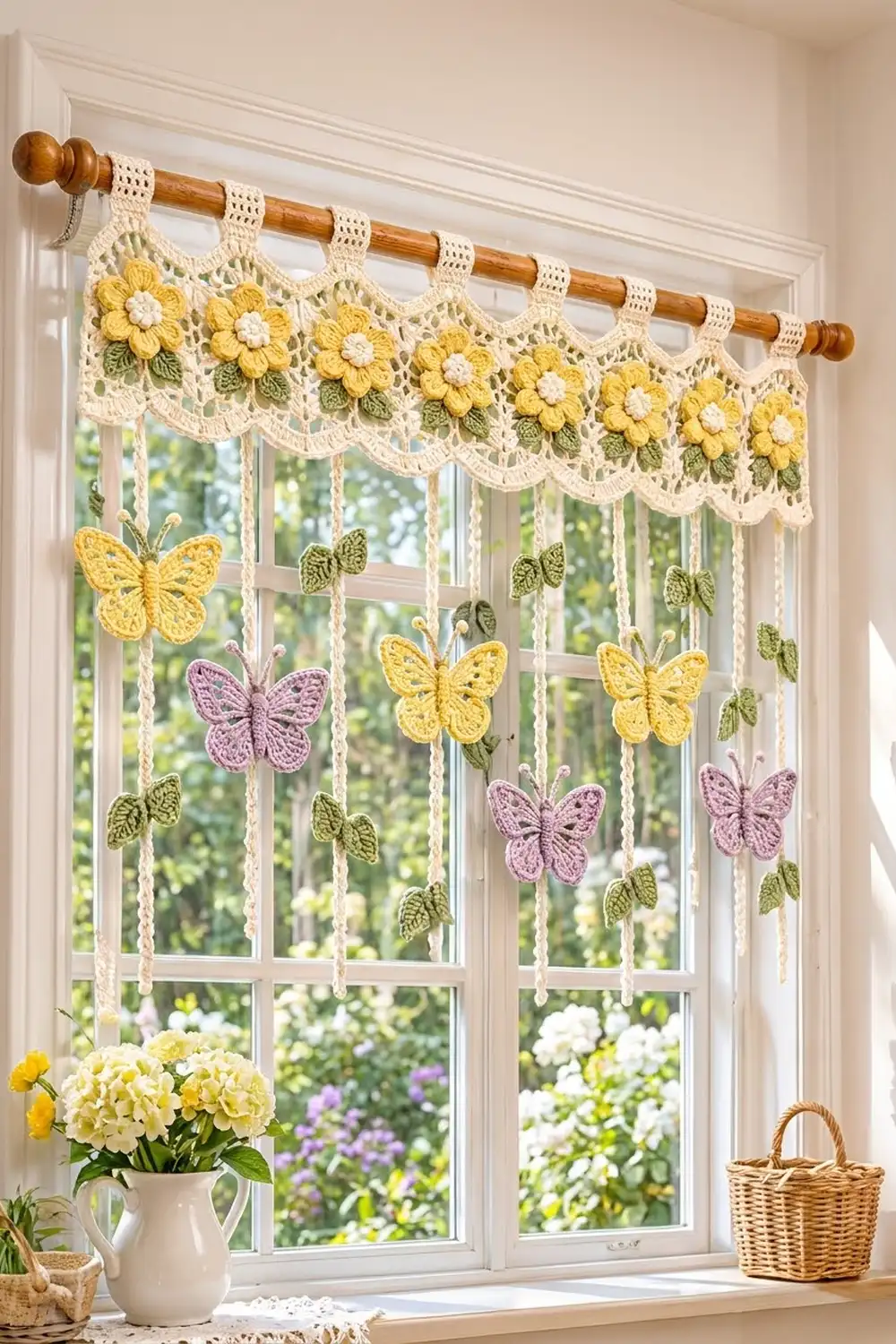
This cheerful valance brings a spring garden to your window. A strip of cream openwork lace squares, each topped with a puffy yellow flower and two sage leaves, hangs from simple mesh tabs. Below it, eight textured cords sway with yellow and lilac butterflies and little leaf pairs.
The colors are soft and fresh: cream, butter yellow, lilac, and sage green. The style is cottage-garden: airy enough to let sunshine through, with plenty of 3D detail.
The pattern uses US crochet terms. The finished header measures 35.5 in (90.2 cm) wide and 6.75 in (17.1 cm) deep at the deepest scallop. Tab loops add 2 in (5.1 cm) above, and cords hang 20–24 in (50.8–61.0 cm) below, for a total drop of about 33 in (83.8 cm).
You crochet seven lace squares, join them in a row, and add a border with a scalloped lower edge. Tabs grow out of the top border. Flowers, leaves, butterflies, and cords are made separately and sewn on.
Finished Size and Construction
- Finished header size: 35.5 in (90.2 cm) wide x 6.75 in (17.1 cm) deep
- Total drop: about 33 in (83.8 cm) including tabs and longest cords
- Skill level: Intermediate
- Terminology: US
- Yarn weight: DK (#3) cotton
- Hook: 4.0 mm (G-6)
- Number of pieces: 7 squares, 7 flowers, 7 flower centers, 14 large leaves, 32 small leaves, 8 butterflies, 8 cords
- Layout: 7 squares in 1 row
- Square size: 5 in (12.7 cm)
- Joined strip before border: 35 in (88.9 cm) x 5 in (12.7 cm)
- Border depth: 0.25 in (0.6 cm) on top and sides; along the bottom, 0.75 in (1.9 cm) at seams and 1.5 in (3.8 cm) at scallop centers
Materials
Choose a smooth cotton DK, about 120 m (131 yd) per 50 g. Cotton keeps the petals crisp and won’t sag in a window.
- Cream: 150 g, 360 m (394 yd) for squares, border, tabs, cords, and antennae
- Butter yellow: 50 g, 120 m (131 yd) for flowers and 5 butterflies
- Lilac: 25 g, 60 m (66 yd) for 3 butterflies
- Sage green: 40 g, 96 m (105 yd) for all leaves
These amounts include about 20% extra for swatching and sewing tails.
Tools: 4.0 mm (G-6) hook, tapestry needle, stitch markers, scissors, measuring tape, rustproof pins, blocking mat, spray bottle.
Abbreviations (US Terms)
- ch: chain
- sl st: slip stitch
- sc: single crochet
- hdc: half double crochet
- dc: double crochet
- tr: treble crochet
- sk: skip
- sp: space
- st(s): stitch(es)
- sc2tog: single crochet 2 together
Picot: ch 3, sl st in 3rd ch from hook.
Slip-stitch cord: Ch the stated number, then sl st in the back bump of the 2nd ch from hook and each ch across. This makes a firm, braided-looking cord that doesn’t curl.
Gauge and Checkpoints
Gauge: One square through Round 5 = 4.75 in (12.1 cm). After Round 6 it measures 5 in (12.7 cm), with 27 sc per side. Cord gauge: 9 ch = 2 in (5.1 cm).
Make and block one complete square first. Checkpoints:
- After Round 1: 1.25 in (3.2 cm) across
- After Round 3: 2.75 in (7.0 cm) across
- After Round 5: 4.75 in (12.1 cm) across
- After Round 6: 5 in (12.7 cm) across
If your square is too big, use a hook 0.5 mm smaller. If it’s too small, use a hook 0.5 mm larger. Just 0.25 in (0.6 cm) extra per square adds 1.75 in (4.4 cm) across the valance.
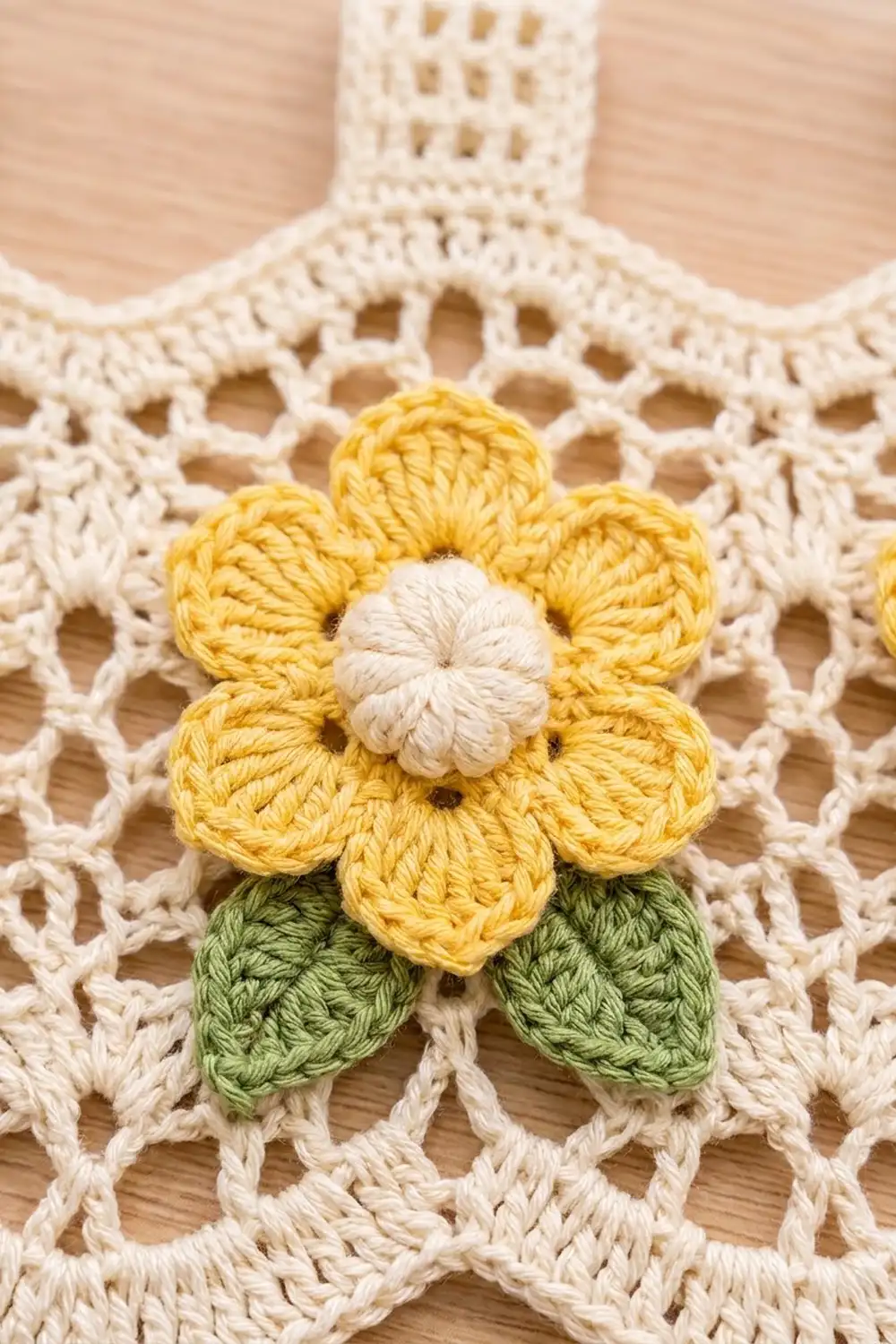
Lace Square (make 7, cream)
Round 1: Magic ring. Ch 3 (counts as dc), 2 dc in ring, ch 3, [3 dc in ring, ch 3] 3 times. Sl st to top of beginning ch-3. (12 dc, 4 corner ch-3 sps)
Round 2: Sl st in next 2 dc and into corner sp. Ch 3, (2 dc, ch 3, 3 dc) in same sp, ch 2, (3 dc, ch 3, 3 dc) in next corner sp, ch 2; repeat from * 2 more times. Sl st to top of ch-3. (24 dc: 6 per side, 1 ch-2 sp per side)
Round 3: Sl st to corner sp. Ch 3, (2 dc, ch 3, 3 dc) in same sp, ch 2, 3 dc in next ch-2 sp, ch 2, (3 dc, ch 3, 3 dc) in next corner sp; repeat around, ending with ch 2, 3 dc in last ch-2 sp, ch 2, sl st to top of ch-3. (36 dc: 9 per side, 2 ch-2 sps per side)
Round 4: Work as Round 3, with ch 2, 3 dc in every ch-2 sp along each side. (48 dc: 12 per side, 3 ch-2 sps per side)
Round 5: Repeat Round 4. (60 dc: 15 per side, 4 ch-2 sps per side)
The ch-2 gaps stack up round after round to form the open lace lines across each square.
Round 6 (conversion round): Sl st to corner sp. Ch 1, 3 sc in corner sp, then along the side work sc in each dc and 2 sc in each ch-2 sp; repeat around. Sl st to first sc. Fasten off.
Count: 60 sc (1 per existing dc) + 32 sc (2 in each of 16 ch-2 sps) + 12 sc (3 in each of 4 corners) = 104 sc. Each side has 23 sc between corner groups. Counting each corner’s middle sc as the corner stitch, each side has 27 sts including both corner sts (4 x 27 − 4 shared corners = 104).
Flower (make 7)
Round 1 (yellow): Magic ring, ch 1, 12 sc in ring. Sl st to first sc. (12 sc)
Round 2: Sl st in next sc, 5 dc in next sc; repeat 5 more times. Sl st to first sl st. Fasten off. (6 petals; 30 dc + 6 sl sts)
The flower measures 2.25 in (5.7 cm) across, and the 5-dc fans cup slightly for a 3D look.
Puff center (cream): Magic ring, 6 sc. Round 2: 2 sc in each st (12 sc). Round 3: sc2tog 6 times (6 sc). Stuff with the yarn tails and close. This makes a 0.75 in (1.9 cm) ball. Sew it to the middle of the flower.
Leaves (green)
Large leaf (make 14): Ch 7. Sc in 2nd ch from hook, hdc in next, dc in next 3, (dc, ch 2, dc) in last ch. Working along the opposite side of the foundation chain: dc in next 3, hdc in next, sc in next. Sl st to first sc. Fasten off. (12 sts + ch-2 tip) Size: 1.5 in (3.8 cm) long.
Small leaf (make 32): Ch 5. Sc in 2nd ch from hook, hdc in next, dc in next, (dc, ch 2, dc) in last ch. Working along the opposite side: dc in next, hdc in next, sc in next. Sl st to first sc. Fasten off. (8 sts + ch-2 tip) Size: 1 in (2.5 cm) long.
Butterfly (make 5 yellow, 3 lilac)
Round 1: Magic ring. Upper wing: ch 4, 3 tr in ring, ch 3, 3 tr in ring, ch 4, sl st in ring. Lower wing: ch 3, 2 dc in ring, ch 2, 2 dc in ring, ch 3, sl st in ring. Work a second lower wing, then a second upper wing. Pull the ring tight. (4 wings) The gap in the middle of each wing creates the lacy opening.
Round 2 (outline): Around each upper wing: 3 sc in ch-4 sp, sc in each of 3 tr, 4 sc in ch-3 sp, sc in each of 3 tr, 3 sc in ch-4 sp, sl st in the sl st at the ring (16 sc). Around each lower wing: 2 sc in ch-3 sp, sc in each of 2 dc, 3 sc in ch-2 sp, sc in each of 2 dc, 2 sc in ch-3 sp, sl st (11 sc). Fasten off, leaving a 24 in (61.0 cm) tail. (54 sc total)
Body: Wrap the tail vertically around the center 8 times, then secure it on the back.
Antennae: Thread a 3 in (7.6 cm) cream strand under the top of the body. Knot each end and trim to 0.75 in (1.9 cm) per side.
Finished butterfly: 2.75 in (7.0 cm) wide x 2.25 in (5.7 cm) tall.
Cords (make 8, cream)
- Long cords (make 4): Ch 108, work slip-stitch cord. (107 sl sts; 24 in / 61.0 cm)
- Short cords (make 4): Ch 90, work slip-stitch cord. (89 sl sts; 20 in / 50.8 cm)
Leave a 6 in (15.2 cm) tail at the top of each cord for sewing.
Make All Pieces
- Cream: 7 lace squares, 7 puff centers, 8 cords
- Yellow: 7 flowers, 5 butterflies
- Lilac: 3 butterflies
- Green: 14 large leaves, 32 small leaves
Layout grid (front view):
[Sq1][Sq2][Sq3][Sq4][Sq5][Sq6][Sq7]
 |    |    |    |    |    |    |    |
 L    S    L    S    L    S    L    S
 Y    Li   Y    Y    Li   Y    Li   Y
The first letter row shows cord length: long (L) or short (S). The second shows butterfly color: yellow (Y) or lilac (Li).
Joining
Block all squares to 5 in (12.7 cm) first.
Hold two squares wrong sides together and join cream at the corner sts. Sl st through both back loops of each matched pair of sts along one side, corner to corner: 27 sl sts. Fasten off. Add the remaining squares the same way (6 seams).
Each stitch meets exactly one partner, so no stitches are added or lost. Keep the sl sts as loose as your sc. If a seam puckers, join with a hook one size larger.
Size checkpoint: The strip should measure 35 in (88.9 cm) x 5 in (12.7 cm). Each long edge has 7 x 27 = 189 sts, and each short edge has 27 sts.
Border
Border gauge: 27 sc = 5 in (12.7 cm), the same as the squares. Each sc round adds 0.25 in (0.6 cm).
Round 1 (cream): Join at any outer corner st. Ch 1, sc in each st around, working 3 sc in each of the 4 outer corner sts. At the seams, work each square’s corner st as a normal stitch. Sl st to first sc. Fasten off.
- Top: 191 sts including both corner centers (189 + 2)
- Bottom: 191 sts including both corner centers
- Each short side: 29 sts including both corner centers (27 + 2)
- Total: 2 x 191 + 2 x 29 − 4 shared corners = 436 sc
Row 2 (wave, bottom edge only): With RS facing, join at the bottom-right corner center and sc in it. Over each square’s 27 sts: sc in next 2, hdc in next 3, dc in next 4, tr in next 9, dc in next 4, hdc in next 3, sc in next 2. Repeat for all 7 squares, then sc in the last corner center. (1 + 7 x 27 + 1 = 191 sts) Turn.
The 9 tr at each square’s center hang lower than the sc at the seams, which makes one soft scallop per square.
Row 3 (picot edge): Ch 1, sc in first 3 sts, picot, sc in next 3 sts, picot; repeat until 2 sts remain, then sc in last 2. Fasten off. (191 sc + 63 picots)
Why the math works: 191 = 1 + (7 x 27) + 1, so every square gets the same 27-stitch wave and every seam lands on a short sc point. Since 189 / 3 = 63, the picots are evenly spaced.
Tabs (make 7, on the top edge of Round 1): With the top edge facing, skip the corner center sc and the next 9 sts. Join cream in the next st.
- Row 1: Ch 4 (counts as dc + ch 1), sk 1, dc in next, [ch 1, sk 1, dc in next] 3 times, turn. (5 dc and 4 ch-1 sps over 9 sts)
- Rows 2–8: Ch 4, dc in next dc, [ch 1, dc in next dc] 3 times, working the last dc in the 3rd ch of the turning ch. Turn.
Fasten off with a 12 in (30.5 cm) tail. Skip 18 sts and work the next tab. The tabs sit over sts 11–19, 38–46, and so on up to 173–181. That centers each tab on its square and leaves 10 sts at each end.
Each tab is 1.7 in (4.3 cm) wide and 4 in (10.2 cm) long. Fold it to the back and sew Row 8 to the back of Row 1 to form a 2 in (5.1 cm) loop.
Final Blocking
- Pin the header to 35.5 in (90.2 cm) x 6.75 in (17.1 cm), pinning each scallop center down.
- Mist until damp and let it dry completely.
- Pin the butterflies to 2.75 in (7.0 cm) wide with the wing gaps open, and pin the leaves to points. Mist and let dry.
- Hang the cords with a small weight for an hour to straighten them.
- Assemble:
- Sew a pair of large leaves in a V under each flower, then sew each flower to the center of its square.
- Sew each cord top to the back of Row 3, at the outer corners and under each seam.
- Sew a butterfly to each cord, alternating between 8 in (20.3 cm) and 12 in (30.5 cm) below the header.
- Sew a pair of small leaves to each cord at 4 in (10.2 cm) and again at 16 in (40.6 cm) below the header.
Final Quality-Control Checklist
- 7 squares, each 5 in (12.7 cm) with 27 sts per side
- Joined strip is 35 in (88.9 cm)
- Border Round 1 has 436 sc
- Wave row has 191 sts and 7 even scallops
- 63 evenly spaced picots
- 7 centered tabs
- 8 cords, alternating long and short
- 5 yellow and 3 lilac butterflies with secure antennae
- All tails woven in
Troubleshooting
- Squares cup: Chain the ch-2 gaps more loosely or go up a hook size.
- Squares ruffle: Recount to make sure each side of each corner has 3 dc.
- Strip is wider than 35 in (88.9 cm): Re-block each square to 5 in (12.7 cm), or remake any square that’s too big.
- Scallops are flat: Check for 9 tr per square and pin the scallop centers lower.
- Cords twist: Work only into the back bumps, then let them hang to block.
- Butterfly wings flop: Pull the ring tighter and wrap the body more firmly.
Care
Hand wash in cold water with mild soap, roll in a towel, and dry flat, re-pinning the scallops. Keep the valance out of harsh afternoon sun to slow fading.
Final Notes
Here’s how the measurements build: 27 sts per side make a 5 in (12.7 cm) square. Seven squares make a 35 in (88.9 cm) strip with 189 sts per long edge. Border Round 1 brings each long edge to 191 sts and the header to 35.5 in (90.2 cm). The 27-stitch wave gives one scallop per square, and the cords hang from the corners and seams.
Happy crocheting!