

These lace curtain panels turn a window into a soft, glowing backdrop. Columns of ivory arches frame rows of gold stars. Light passes through the open lace, and the stars stay bold and solid.
The palette has two colors: warm ivory cotton for the lace and a gold metallic-blend yarn for the stars. The style is classic and a little vintage, like heirloom filet lace with a festive touch. The panels suit the holidays, but ivory and gold also work all year.
This pattern uses US crochet terms. Each finished panel measures 30 in (76.2 cm) wide by 79 in (200.7 cm) long. The hanging loops add about 2 in (5.1 cm) above the top edge.
Each panel has 44 square lace blocks, each 7 in (17.8 cm), set 4 across and 11 down. You crochet a gold star for every block and sew it to the center. The blocks are joined with a flat slip-stitch seam. A three-round border and a row of hanging loops finish each panel. The instructions make a pair: 88 blocks and 88 stars.
Finished Size and Construction
- Finished panel size: 30 in x 79 in (76.2 cm x 200.7 cm), plus loops of about 2 in (5.1 cm)
- Skill level: Intermediate
- Terminology: US crochet terms
- Yarn weight: DK / light (#3)
- Hook: 3.5 mm (E-4)
- Number of pieces: 44 blocks + 44 stars per panel; 88 + 88 for the pair
- Layout: 4 blocks wide x 11 blocks tall per panel
- Block size: 7 in (17.8 cm) square
- Size before border: 28 in x 77 in (71.1 cm x 195.6 cm)
- Border depth: 1 in (2.5 cm) on each side
Materials
Use a smooth mercerized cotton or cotton blend for the lace. It shows stitch detail clearly, holds its shape on a rod, and blocks well. For the stars, choose a soft DK gold yarn with a light metallic strand. Avoid stiff tinsel yarns.
- Ivory (Color A): 1,000 g, about 2,300 m (2,515 yd) of DK cotton
- Gold (Color B): 300 g, about 720 m (787 yd) of DK metallic-blend yarn
These amounts are for the pair of panels. They include a margin of about 10% for gauge differences and the test block.
Tools:
- 3.5 mm (E-4) crochet hook
- 4.0 mm (G-6) hook (optional, for joining)
- Tapestry needle
- Locking stitch markers
- Rust-proof pins and blocking mats
- Measuring tape
- Scissors
Abbreviations (US Terms)
- ch – chain
- sl st – slip stitch
- sc – single crochet
- hdc – half double crochet
- dc – double crochet
- tr – treble crochet
- dtr – double treble crochet
- sk – skip
- sp – space
- st(s) – stitch(es)
- RS – right side
Flat slip-stitch join: Lay two blocks side by side with the right sides up. Insert the hook through the back loop of a stitch on the first block, then through the back loop of the matching stitch on the second block. Yarn over and pull through all loops on the hook. Repeat for each pair of stitches along the edge.
Gauge and Checkpoints
The block is your gauge swatch. Make one full block and one star, block them lightly, and measure them before you continue.
- After Round 2: circle is 2.25 in (5.7 cm) across
- After Round 4: circle is 4 in (10.2 cm) across
- After Round 5: circle is 5 in (12.7 cm) across
- After Round 6: square is 5.75 in (14.6 cm) across
- After Round 8: square is 7 in (17.8 cm), with 31 sc per side
- Star: 3.5 in (8.9 cm) from point to point
If the block is larger than 7 in (17.8 cm), go down one hook size. If it is smaller, go up one. An error of 0.25 in (0.6 cm) per block adds up to 1 in (2.5 cm) across the width and 2.75 in (7.0 cm) down the length.
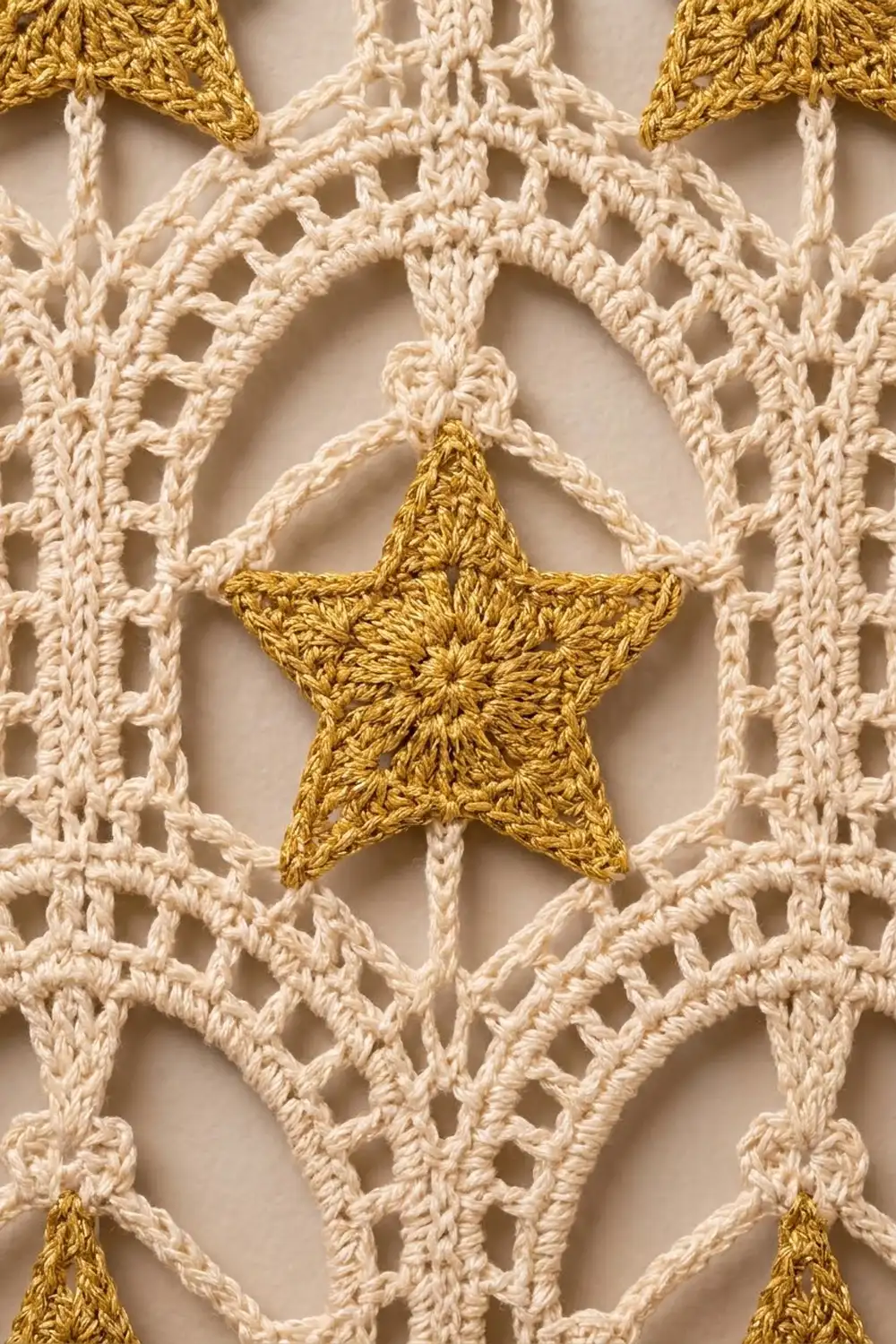
Lace Block (Make 88 in Color A)
Work in joined rounds with the RS facing. Do not turn.
Round 1: With A, ch 6 and sl st to the first ch to form a ring. Ch 3 (counts as dc), work 15 dc into the ring, then sl st to the top of the ch-3. (16 dc)
Round 2: Ch 3 (counts as dc), dc in the same st, then work 2 dc in each st around. Sl st to the top of the ch-3. (32 dc)
Round 3: Ch 1, sc in the first st, ch 4, sk 1, sc in the next st. Repeat from * around, then ch 4, sk 1, and sl st to the first sc. (16 sc, 16 ch-4 loops)
Round 4: Sl st into the first ch-4 loop, ch 1, and sc in the same loop. Ch 5, sc in the next loop. Repeat around, then ch 5 and sl st to the first sc. (16 ch-5 loops)
Round 5: Sl st into the first ch-5 loop. Ch 3 (counts as dc) and work 4 dc in the same loop, then 5 dc in each remaining loop. Sl st to the top of the ch-3. (80 dc)
This solid ring forms the arch line. The open loops of Rounds 3–4 form the lighter arch inside it.
Round 6 (squaring round): This round divides the 80 sts into 4 sides of 20. Ch 4 (counts as tr), then work (tr, ch 3, 2 tr) in the same st for the first corner. Then:
Tr in the next 2 sts, dc in the next 3, hdc in the next 3, sc in the next 3, hdc in the next 3, dc in the next 3, tr in the next 2, (2 tr, ch 3, 2 tr) in the next st. Repeat from * twice more. Work the last side without the final corner, then sl st to the top of the ch-4.
Each side uses 20 sts: 1 corner st plus 19 side sts. Count: 76 sts worked 1 per existing st (19 per side) + 16 corner tr (4 per corner). (92 sts: 23 per side between the ch-3 corner spaces, plus 4 corner spaces)
Round 7 (mesh round): Sl st into the next st and into the corner ch-3 sp. Ch 3 (counts as dc), then work (dc, ch 3, 2 dc) in the same sp. Dc in the next st, (ch 1, sk 1, dc in the next st) 11 times, (2 dc, ch 3, 2 dc) in the next corner sp. Repeat around, skipping the last corner, and sl st to the top of the ch-3.
Each side has 2 corner dc, 12 dc, 11 ch-1 spaces, and 2 more corner dc. (27 sts per side between corner spaces, counting the ch-1s; 108 sts total, plus 4 corner spaces)
Round 8 (edge round): Ch 1. Sc in each dc and each ch-1 sp, and work 3 sc in each corner ch-3 sp. Sl st to the first sc. Mark the center sc of each 3-sc corner as the corner st.
Count: 108 sts worked 1 per existing st and sp + 12 corner sc. (120 sc; 31 sts per side, counting both corner sts)
Fasten off, leaving a 6 in (15.2 cm) tail, and weave it in.
Gold Star (Make 88 in Color B)
Round 1: With B, make a magic ring. Ch 3 (counts as dc) and work 9 dc into the ring. Pull the ring closed and sl st to the top of the ch-3. (10 dc)
Round 2: Ch 3 (counts as dc), dc in the same st, then work 2 dc in each st around. Sl st to the top of the ch-3. (20 dc)
Round 3 (points): Ch 7. Working back along the chain: sc in the 2nd ch from the hook, hdc in the next ch, dc in the next ch, tr in the next ch, and dtr in each of the next 2 ch. Sk the next 3 sts of Round 2 and sl st in the next st. Repeat from * 4 more times. (5 points, 6 sts each)
Round 4 (outline): Sl st up to the first point. Sc in each of the 6 free chain loops up one side of the point, work (sc, ch 2, sc) in the tip, sc in each of the 6 sts down the other side, then sk the sl st. Repeat for each point and sl st to the first sc.
Count: 14 sc and 1 ch-2 tip per point. (70 sc, 5 ch-2 tips)
Fasten off, leaving a 12 in (30.5 cm) tail for sewing.
Attach the star: Center the star over Rounds 1–2 of a block with one point facing the top of the block. With the gold tail, whipstitch the outline round to the dc of Rounds 2–4 so the points lie flat. The ivory ring of Round 5 should show clearly around the star.
Make All Pieces
For one panel, make 44 ivory blocks and 44 gold stars, and sew a star onto each block. For the pair, make 88 of each. One panel uses about 500 g of ivory and 150 g of gold.
Layout for each panel is 4 columns by 11 rows, with every star point facing up:
Row  1:  [S] [S] [S] [S]   <- top (loops go here)
Row  2:  [S] [S] [S] [S]
Row  3:  [S] [S] [S] [S]
 ...      (repeat)
Row 11:  [S] [S] [S] [S]   <- bottom edge
Joining
Use the flat slip-stitch join with A.
- Make the columns. Join 11 blocks end to end to make a vertical strip. Match the stitches one for one, 31 to 31, starting and ending in the corner sts. Make 4 strips per panel.
- Join the strips. Lay two strips side by side and join them along the long edge. Each long edge has 11 x 31 = 341 sts, so you match 341 to 341. At every block intersection, join the two corner sts together. Continue until all 4 strips are joined.
The join goes into back loops that are already part of each block’s 31 sts, so it adds no stitches to the edge.
Tension: Keep the slip stitches as loose as the lace. If the seams pucker, use the 4.0 mm (G-6) hook for the joining only.
Checkpoint: The joined panel should measure 28 in x 77 in (71.1 cm x 195.6 cm). The seams form the straight lines between the columns of arches.
Border
Border gauge: 31 sc per 7 in (17.8 cm), the same as Round 8 of the blocks. The three border rounds measure 1 in (2.5 cm) deep.
Starting counts:
- Short edges: 4 blocks x 31 sts = 124 sts
- Long edges: 11 blocks x 31 sts = 341 sts
These counts already include the two corner sts of every block. At each seam, work one sc into each block’s corner st.
Round 1: With the RS facing, join A in the top-right corner st. Ch 1, then sc in each st around, with 3 sc in each of the 4 outer corner sts. Sl st to the first sc.
Count: 926 sts worked 1 per existing st (2 x 124 + 2 x 341, minus the 4 shared corners) + 8 extra corner sc. (934 sts: 126 per short side and 343 per long side, counting the corner centers)
Round 2: Ch 3 (counts as dc). Dc in each st around, with 3 dc in each corner center st. Sl st to the top of the ch-3. (942 sts: 128 per short side, 345 per long side)
Round 3: Ch 1. Sc in each st around, with 3 sc in each corner center st. Sl st to the first sc. (950 sts: 130 per short side, 347 per long side)
Why the math works: Each corner adds 2 sts per round, so each side grows by exactly 2 sts per round and the corners stay square. The sc and dc match the block gauge, so the border lies flat without ruffling.
Hanging loops (top edge only): Join A in the top-right corner st. Ch 1 and sc in each of the 130 sts across. Make a loop after the sc in st 5 and after every 11th sc from there (sts 5, 16, 27, 38, 49, 60, 71, 82, 93, 104, 115, and 126). For each loop, ch 20 and sl st in the top of that same sc. Fasten off. (130 sc, 12 ch-20 loops)
Loop reinforcement: Join A at the base of each loop and work 28 sc over the ch-20. Sl st at the base and fasten off. With 4 sts free at each end, the loops are evenly spaced about 2.5 in (6.4 cm) apart.
Final Blocking
- Weave in all ends securely along the seams.
- Soak each panel in cool water for 15 minutes. Press out the water in a towel without wringing.
- Lay the panel flat on mats with the RS up. Work in sections if needed.
- Pin the outer edges to 30 in x 79 in (76.2 cm x 200.7 cm), keeping the seams straight.
- Pin each Round 5 ring into a smooth circle and open up the mesh of Round 7.
- Smooth each star point flat with your fingers.
- Let the panel dry completely before hanging it.
Final Quality-Control Checklist
- Every block measures 7 in (17.8 cm) with 31 sts per side
- Every star points up and is sewn on securely
- Each column has 11 blocks and each row has 4
- Seams lie flat and the corners line up
- The border has 130 sts on each short side and 347 on each long side
- 12 evenly spaced loops run across the top
- Each panel measures 30 in x 79 in (76.2 cm x 200.7 cm)
- The two panels match in length to within 0.5 in (1.3 cm)
Troubleshooting
- Block cups or ruffles: Recount Round 5 (80 dc). Ruffling usually means extra dc. Cupping usually means the chains in Round 4 are too tight.
- Corners look rounded: In Round 6, check that the tr sit at the corners and the sc sit at the middle of each side.
- Star curls: The outline round is too tight. Rework it more loosely, or pin the star flat to dry.
- Seams pucker: Rejoin with a larger hook.
- Panel grows after hanging: Cotton lace can stretch. Block it again, then let it hang for a day before adjusting the rod height.
Care
Hand wash in cool water with mild soap and dry flat. Don’t use a dryer, because heat can damage the metallic yarn and stretch the lace.

Final Notes
Here is the measurement chain: 31 sts per block side makes a 7 in (17.8 cm) block. A grid of 4 x 11 blocks measures 28 in x 77 in (71.1 cm x 195.6 cm). The 1 in (2.5 cm) border brings each panel to 30 in x 79 in (76.2 cm x 200.7 cm), with 130 sts across the top for the 12 loops. Check your first block and keep your counts exact, and the finished panels will hang straight and match each other.
Happy crocheting!