

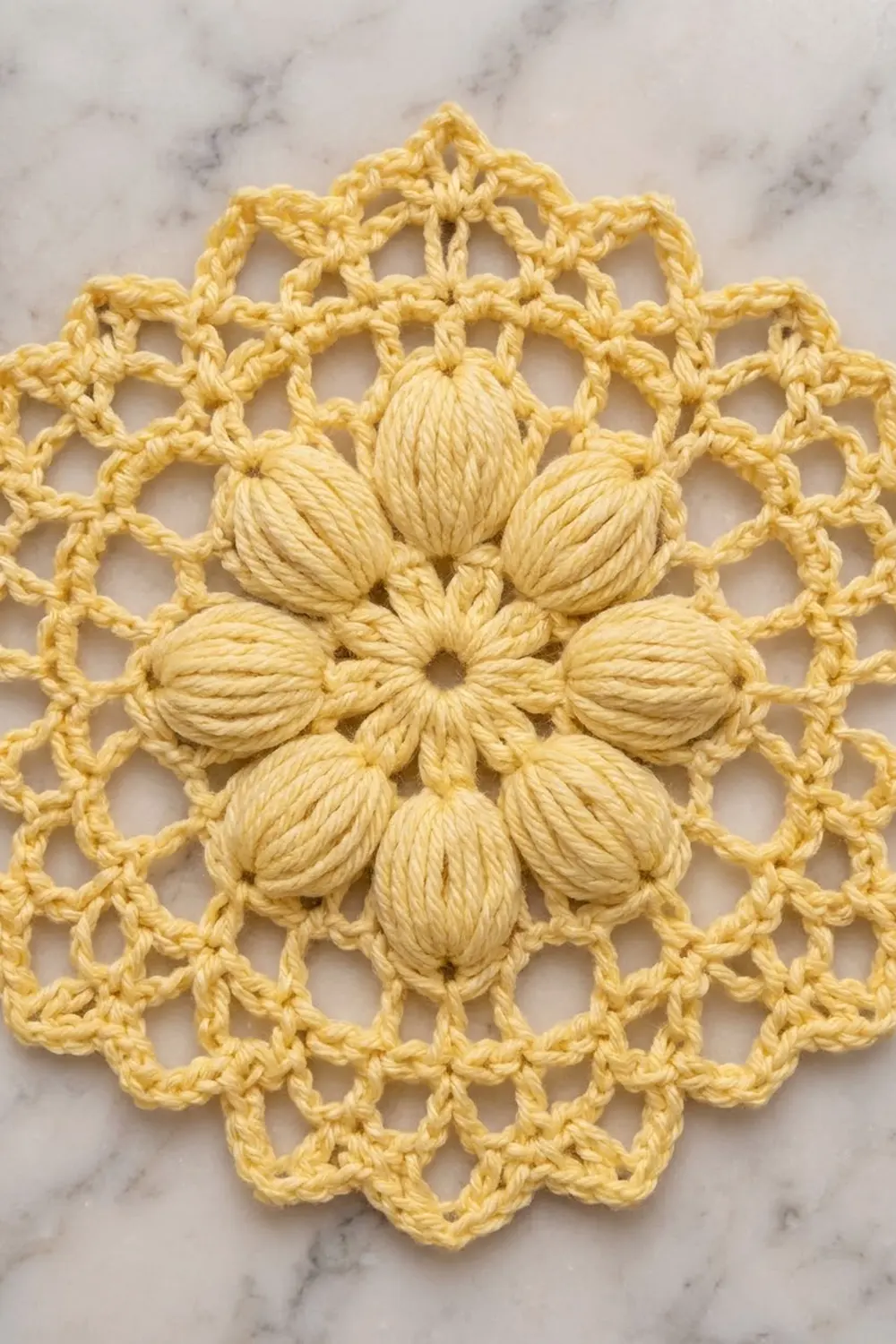
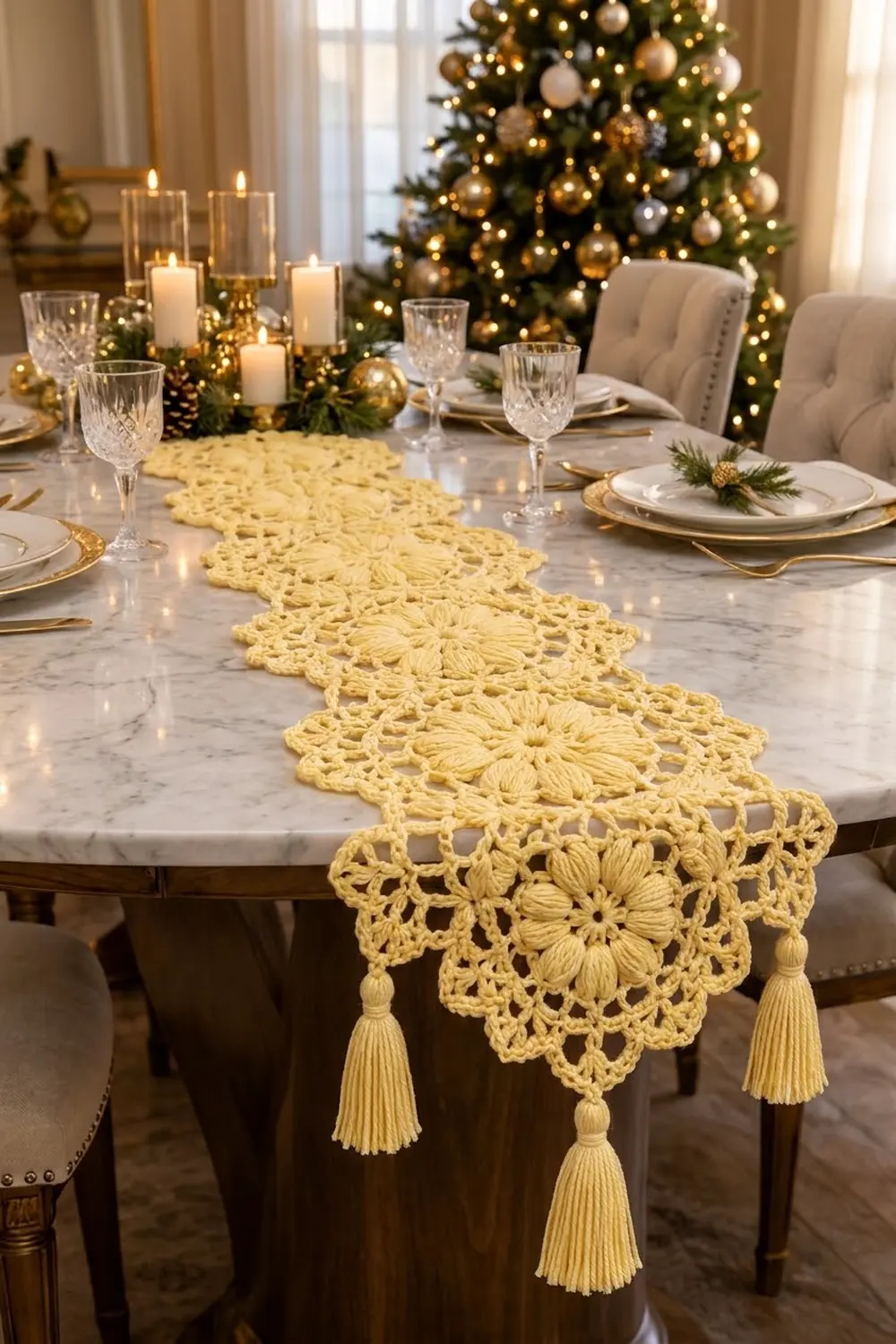
The Golden Bloom Table Runner is one long strip of lacy round motifs. Each motif has a raised flower of eight puff petals in the center. Open chain-loop rounds circle every flower, which keeps the runner light and airy on the table. Three soft tassels hang from each pointed end.
The whole runner uses one color, a soft butter yellow that looks almost gold by candlelight. It suits a holiday table, but it works just as well in spring and summer. The style is a classic vintage doily, laid out in a straight line.
This pattern uses US crochet terms. With the border, the runner measures 9 in (22.9 cm) wide and 73 in (185.4 cm) long, not counting the tassels.
You will make 9 identical round motifs. Motif 1 is made on its own. Motifs 2–9 each join to the motif before them in their last round (join-as-you-go). One picot border round then goes around the whole strip, and six tassels finish the ends.
Finished Size and Construction
- Finished size: 9 in x 73 in (22.9 cm x 185.4 cm), tassels not included
- Skill level: Intermediate
- Terminology: US crochet terms
- Yarn weight: Worsted (#4), cotton or a cotton blend
- Hook: 5.0 mm (H-8)
- Number of pieces: 9 round motifs, joined into one piece
- Layout: 1 motif wide x 9 motifs long
- Motif size: 8 in (20.3 cm) across, blocked
- Size before border: 8 in x 72 in (20.3 cm x 182.9 cm)
- Border depth: 0.5 in (1.3 cm) on each edge
- Tassels: 6 in total, each 4 in (10.2 cm) long, 3 at each end
Materials
Choose a smooth worsted cotton. Cotton holds the shape of the puff petals, keeps the chain loops crisp, and blocks flat. Acrylic also works, but the lace will be softer and may curl.
- Butter Yellow: about 300 g / 510 m (558 yd), for example 6 balls of 50 g / 85 m (93 yd) each
Here is roughly where that yarn goes: 162 g for the 9 motifs (18 g each), 30 g for the border, and 27 g for the 6 tassels. The total includes an extra 80 g or so to cover gauge differences.
Tools:
- 5.0 mm (H-8) crochet hook
- Tapestry needle
- Scissors
- Stitch markers (at least 2)
- Stiff card 4.5 in (11.4 cm) tall, for the tassels
- Blocking mats, rust-proof pins, and a spray bottle
- Tape measure
Abbreviations (US Terms)
- ch – chain
- sl st – slip stitch
- sc – single crochet
- dc – double crochet
- sk – skip
- sp – space
- st(s) – stitch(es)
- RS – right side
Puff stitch (puff): (Yarn over, insert hook in the st, yarn over and pull up a loop 0.75 in / 1.9 cm tall) 4 times, for 9 loops on the hook. Yarn over and pull through all 9 loops, then ch 1 tightly to close. The closing ch 1 is the top of the puff. It does not count as a separate stitch.
Picot: Ch 3, sl st in 3rd ch from hook.
Gauge and Checkpoints
Make one complete motif first. It is your gauge swatch, and it also becomes Motif 1 of the runner.
Motif gauge: One motif = 8 in (20.3 cm) across after blocking.
Lay the motif flat and measure its diameter at each of these points:
- After Round 1: 1.75 in (4.4 cm)
- After Round 2: 3.5 in (8.9 cm)
- After Round 3: 4 in (10.2 cm)
- After Round 4: 5.5 in (14.0 cm)
- After Round 5: 6.75 in (17.1 cm)
- After Round 6, blocked: 8 in (20.3 cm)
If your motif is too big: switch to a 4.5 mm (US 7) hook, and keep the puff loops at 0.75 in (1.9 cm).
If your motif is too small: switch to a 5.5 mm (I-9) hook. Tight chains are the usual cause of a small, cupped motif.
Being off by 0.25 in (0.6 cm) per motif adds up to 2.25 in (5.7 cm) over 9 motifs, so fix it now.
Motif Pattern
Keep the RS facing you the whole time. Do not turn your work.
Round 1 (center ring)
Ch 4, sl st to first ch to form a ring.
Ch 3 (counts as dc), 15 dc in ring. Sl st to top of beginning ch-3. (16 dc)
Round 2 (puff flower)
Ch 2 (does not count as a st), puff in same st as join, ch 3, sk next dc, puff in next dc, ch 3, sk next dc; repeat from * to * 6 more times. Sl st to top of first puff. (8 puffs, 8 ch-3 sps)
These 8 puffs are the flower petals. Push each one gently toward the RS so it stands up.
Round 3 (solid ring, conversion round)
Ch 1, sc in top of puff, 3 sc in next ch-3 sp; repeat from * to * 7 more times. Sl st to first sc.
Count: 8 sc (1 in each puff) + 24 sc (3 in each ch-3 sp) = 32 sc.
This round forms the firm ring of single crochet around the flower.
Round 4 (first mesh)
Ch 1, sc in same st, ch 5, sk next sc, sc in next sc, ch 5, sk next sc; repeat from * to * 14 more times. Sl st to first sc. (16 sc, 16 ch-5 loops)
Round 5 (second mesh)
Sl st in each of first 3 ch of next loop. Ch 1, sc in same loop, ch 6, sc in next ch-5 loop, ch 6; repeat from * to * 14 more times. Sl st to first sc. (16 sc, 16 ch-6 loops)
Round 6 (outer mesh, Motif 1 only)
Sl st in each of first 3 ch of next loop. Ch 1, sc in same loop, ch 7, sc in next ch-6 loop, ch 7; repeat from * to * 14 more times. Sl st to first sc. (16 sc, 16 ch-7 loops)
Fasten off and weave in the ends.
How the loops are numbered: The first sc of Round 6 is sc 1, and the ch-7 loop right after it is loop 1. Keep counting the same way around the motif: sc 2, loop 2, and so on up to loop 16. Loops 1 and 2 sit on either side of sc 2. Loops 9 and 10 sit on either side of sc 10, directly across the motif. Put a marker in loop 1 and another in loop 9.
Make All Pieces
Work all 9 motifs in Butter Yellow.
- Motif 1: Rounds 1–6 as written, with no joins
- Motifs 2–9: Rounds 1–5 as written, then Round 6 with joins (see Joining)
Layout grid (one row, left to right):
ROW 1: YELLOW YELLOW YELLOW YELLOW YELLOW YELLOW YELLOW YELLOW YELLOW
Motif 1 is the left end of the runner, and Motif 9 is the right end.
Joining
Method: Join-as-you-go in Round 6. Each new motif joins to the previous one at 2 loops.
Stitch-to-stitch logic: Both motifs lie RS up, so their edges run in opposite directions where they meet. Loop 1 of the new motif joins loop 10 of the previous motif. Loop 2 of the new motif joins loop 9.
Round 6 with joins (Motifs 2–9):
Sl st in each of first 3 ch of next loop. Ch 1, sc in same loop (this is sc 1).
- Joined loop 1: Ch 3, sl st in center (4th) ch of loop 10 on previous motif, ch 3.
- Sc in next ch-6 loop (sc 2).
- Joined loop 2: Ch 3, sl st in center ch of loop 9 on previous motif, ch 3.
- Sc in next ch-6 loop, ch 7; repeat from * to * 13 more times. Sl st to first sc.
Count: 16 sc, 14 ch-7 loops + 2 joined loops = 16 loops. A joined loop is ch 3 + sl st + ch 3, so it is the same length as a ch-7 loop and the motif stays round.
Tension: Make each join sl st snug, but not tight. If the motifs pucker at a join, the ch 3 before it was too tight.
Once the strip is joined, loops 3–8 of every motif run along the top edge, and loops 11–16 run along the bottom edge.
Size checkpoint: The motif centers should be 8 in (20.3 cm) apart. Three joined motifs measure 24 in (61.0 cm). All 9 measure 72 in x 8 in (182.9 cm x 20.3 cm) when lightly flattened.
Free loops before the border: The strip has 9 motifs x 16 loops = 144 loops. The 8 joins use 8 x 4 = 32 of them, which leaves 112 free loops:
- Top edge: 9 motifs x 6 loops (loops 3–8) = 54 loops
- Bottom edge: 9 motifs x 6 loops (loops 11–16) = 54 loops
- Left end (Motif 1): loops 1 and 2 = 2 loops
- Right end (Motif 9): loops 9 and 10 = 2 loops
54 + 54 + 2 + 2 = 112 ✔
Border
Border gauge: Each free ch-7 loop gets 8 sc and 1 picot. Each valley between two motifs gets one bridge: ch 3, sc in the sl st where the joined loops meet, ch 3.
With RS facing, join the yarn with a sl st in loop 3 of Motif 1.
- Top edge: In each of loops 3–8 of the motif, work (4 sc, picot, 4 sc). At the valley, ch 3, sc in joining sl st, ch 3. Repeat from * to * across Motifs 1–8. On Motif 9, work loops 3–8 only.
- Right end: Work (4 sc, picot, 4 sc) in each of loops 9 and 10 of Motif 9.
- Bottom edge: In each of loops 11–16 of the motif, work (4 sc, picot, 4 sc). At the valley, ch 3, sc in joining sl st, ch 3. Repeat from * to * across Motifs 9 to 2. On Motif 1, work loops 11–16 only.
- Left end: Work (4 sc, picot, 4 sc) in each of loops 1 and 2 of Motif 1. Sl st to first sc. Fasten off.
Counts per side:
- Top edge: 54 loops x 8 sc = 432 sc, + 8 bridge sc = 440 sc, 54 picots
- Bottom edge: 440 sc, 54 picots
- Each end: 2 loops x 8 sc = 16 sc, 2 picots
- Total: 440 + 440 + 16 + 16 = 912 sc, 112 picots
Why the math works: A ch-7 loop holds 8 sc without ruffling or pulling. The picot lands at the outer tip of each loop, so it follows the scallop the motif already has. The bridges fill the narrow valleys between motifs and keep the long edges straight. The border adds 0.5 in (1.3 cm) on every side, so the runner grows from 8 in x 72 in to 9 in x 73 in (22.9 cm x 185.4 cm).
Tassels
Make 6. Wrap the yarn 30 times around the 4.5 in (11.4 cm) card. Slide a 12 in (30.5 cm) tie strand under the wraps at the top and knot it firmly. Cut through the wraps at the bottom. Wrap another strand tightly 6 times around the bundle, 0.75 in (1.9 cm) below the top, and knot it. Trim the ends evenly to 4 in (10.2 cm).
Motif 1: Tie the center tassel to sc 2 and the side tassels to the picots on loops 4 and 15.
Motif 9: Tie the center tassel to sc 10 and the side tassels to the picots on loops 7 and 12.
Tie each tassel so its top hangs 1 in (2.5 cm) below the edge. Weave the tie ends into the tassel head.
Final Blocking
- Weave in any remaining ends.
- Lay the runner RS up on blocking mats covering at least 10 in x 76 in (25.4 cm x 193.0 cm).
- Spray the runner until it is damp all the way through. Keep the tassels dry.
- Pin the center of each motif in a straight line, with centers 8 in (20.3 cm) apart.
- Pin out every picot so the runner is 9 in (22.9 cm) wide all along its length.
- Lift each puff petal with your fingertips so it stands up.
- Let the runner dry fully, about 24 hours. Unpin it, then comb and trim the tassels.
Final Quality-Control Checklist
- Every motif has 8 puffs, 32 sc in Round 3, and 16 loops in each of Rounds 4–6.
- Each motif measures 8 in (20.3 cm) across.
- There are 8 joins, and each one uses 2 loops on each motif.
- Loops 3–8 are on the top edge and loops 11–16 are on the bottom edge.
- Each long edge has 440 sc and 54 picots. Each end has 16 sc and 2 picots.
- The runner measures 9 in x 73 in (22.9 cm x 185.4 cm).
- There are 3 tassels at each end, all 4 in (10.2 cm) long.
Troubleshooting
The puffs look flat. Pull each loop up to a full 0.75 in (1.9 cm), and close the puff with a firm ch 1.
The motif cups like a bowl. The chains are too tight. Go up a hook size for Rounds 4–6.
The motif ruffles. The chains are too loose. Go down a hook size for Rounds 4–6.
The runner zigzags. At least one join went into the wrong loops. Each new motif’s loops 1 and 2 must join loops 10 and 9 of the previous motif.
The edges dip between motifs. A bridge is missing, or its chains are too tight. Rework that spot with ch 3 on each side of the bridge sc.
The tassels hang unevenly. Re-tie them so each top sits 1 in (2.5 cm) below the edge, then trim them all to the same length.
Care
Hand wash in cool water with mild soap. Roll it in a towel to press out the water, then dry it flat, pinned to shape. Do not tumble dry, because heat can shrink cotton and tangle the tassels.
Final Notes
Here is the measurement chain from start to finish. Round 3 measures 4 in (10.2 cm) across, and one blocked motif measures 8 in (20.3 cm). Nine joined motifs make a strip of 8 in x 72 in (20.3 cm x 182.9 cm). The picot border adds 0.5 in (1.3 cm) all around, for a finished runner of 9 in x 73 in (22.9 cm x 185.4 cm), with 4 in (10.2 cm) tassels at each end.
Measure your first motif carefully, and the rest of the runner will follow. Once it is blocked and laid down the table, the puff flowers and soft gold color carry the whole look.
Happy crocheting!