

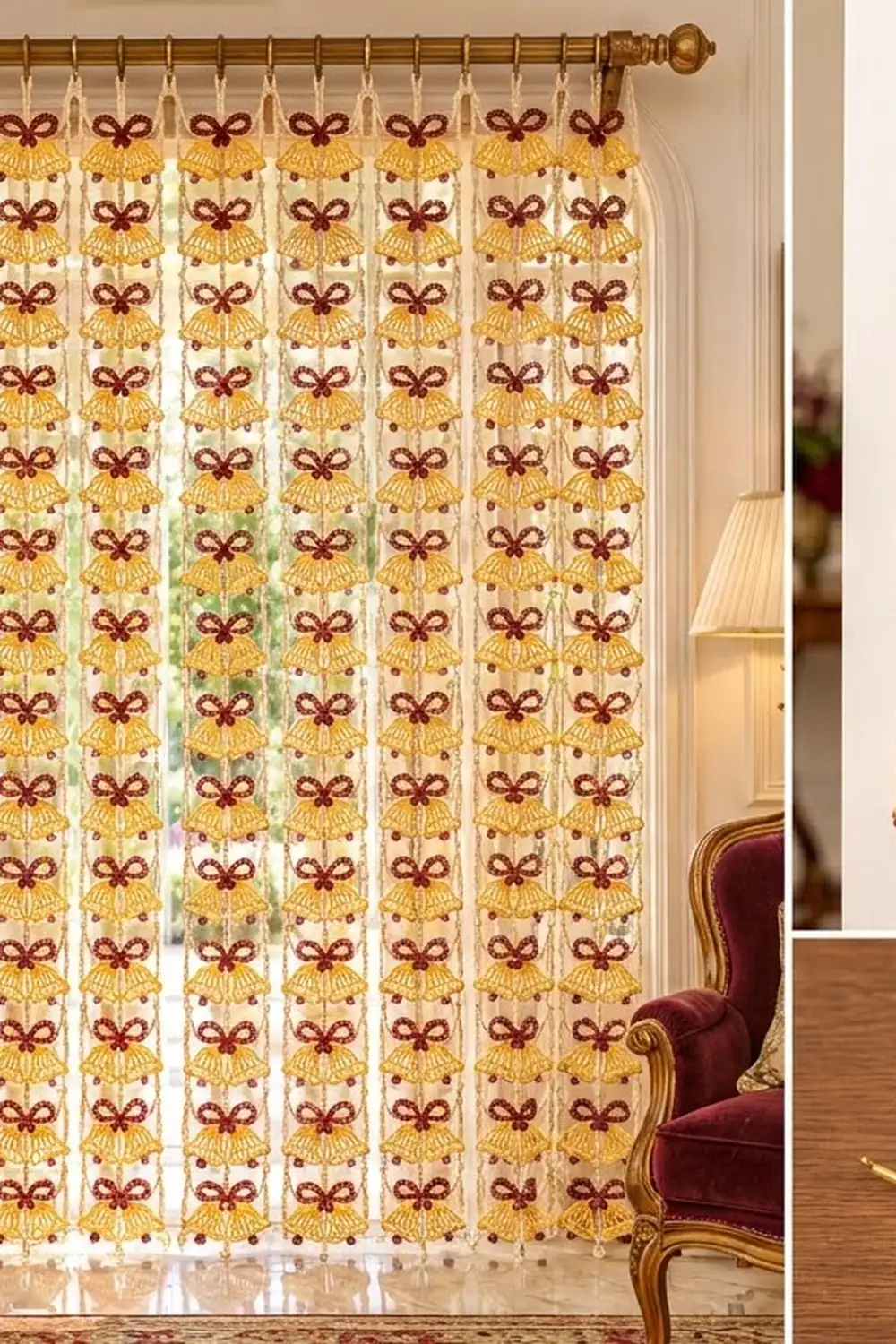
This curtain hangs pairs of golden bells down a cream chain cord. Every pair has a deep burgundy bow, three burgundy berries, burgundy scalloped rims, and a small burgundy clapper under each bell. Cream side rails swing out to each bell’s rim and back in to the next bow, which turns each strand into a light lattice that lets daylight through.
The palette is warm yellow, wine burgundy, and soft cream. The look is classic Christmas with a vintage touch. It suits a doorway, a window, or a room divider, and because the strands are separate it moves gently when people walk past.
All terms are US. The finished curtain measures 84 in (213.4 cm) wide and 81 in (205.7 cm) long including the hanging loops. It is made from 12 separate strands, each 7 in (17.8 cm) wide.
Construction is modular. First you crochet the bells, bows, clappers, and berries as small flat pieces. Next you make a cream spine cord for each strand and sew 20 bell motifs onto it. Finally you work cream rails down both sides of each strand, anchoring them to the bows and bell rims.
Finished Size and Construction
- Finished size: 84 in (213.4 cm) wide x 81 in (205.7 cm) long
- Skill level: Intermediate
- Terminology: US crochet terms
- Yarn weight: Super fine (#1), fingering-weight mercerized cotton
- Hook: 2.25 mm (B-1)
- Number of pieces: 12 strands; each strand has 1 spine, 20 bows, 40 bells, 40 clappers, and 60 berries
- Layout: 12 strands side by side, 20 motifs per strand
- Piece size: one bell is 3.25 in (8.3 cm) wide x 2 in (5.1 cm) tall; one motif repeat is 6.5 in (16.5 cm) wide x 4 in (10.2 cm) tall
- Strand size before border: 6.5 in (16.5 cm) x 81 in (205.7 cm)
- Border depth: 0.25 in (0.6 cm) per side, giving a 7 in (17.8 cm) strand
Materials
Choose a smooth mercerized cotton with about 170 m per 50 g. Cotton keeps the bells crisp and won’t stretch much when hung. Avoid fuzzy or acrylic yarns, because the openwork bells will blur and the long strands will grow over time.
- Yellow (bells): 700 g / 2,380 m
- Burgundy (rims, bows, clappers, berries): 550 g / 1,870 m
- Cream (spines and rails): 500 g / 1,700 m
Tools:
- 2.25 mm (B-1) hook
- Tapestry needle
- Locking stitch markers (at least 20)
- Rust-proof pins and a large blocking surface
- Spray starch (optional)
- Curtain rod, 84 in (213.4 cm) or longer
These quantities already include about a 10% margin for swatching, tails, and sewing.
Abbreviations (US Terms)
- ch: chain
- sl st: slip stitch
- sc: single crochet
- hdc: half double crochet
- dc: double crochet
- tr: treble crochet
- sp: space
- st(s): stitch(es)
- beg: beginning
- RS / WS: right side / wrong side
Special stitch, 4-dc cluster: [Yo, insert hook in ring, yo and pull up a loop, yo and draw through 2 loops] 4 times, then yo and draw through all 5 loops on hook.
Gauge and Checkpoints
Gauge: 16 sc = 2 in (5.1 cm). For the cords, 20 ch = 2 in (5.1 cm), measured relaxed.
Before you commit to the full curtain, make one bell. Measure it flat without stretching, and check it at each stage:
- After Row 3: 1.5 in (3.8 cm) tall
- After Row 4: 2.375 in (6.0 cm) wide
- After Row 6: 3.125 in (7.9 cm) wide and 1.75 in (4.4 cm) tall
- After Row 7: 3.25 in (8.3 cm) wide and 2 in (5.1 cm) tall
If your bell is too big, go down 0.25 mm in hook size. If it’s too small, go up 0.25 mm. Keep the stitch counts exactly as written and change only the hook. You’ll make this bell 480 times, so even a 0.25 in (0.6 cm) error per bell changes how the curtain hangs.
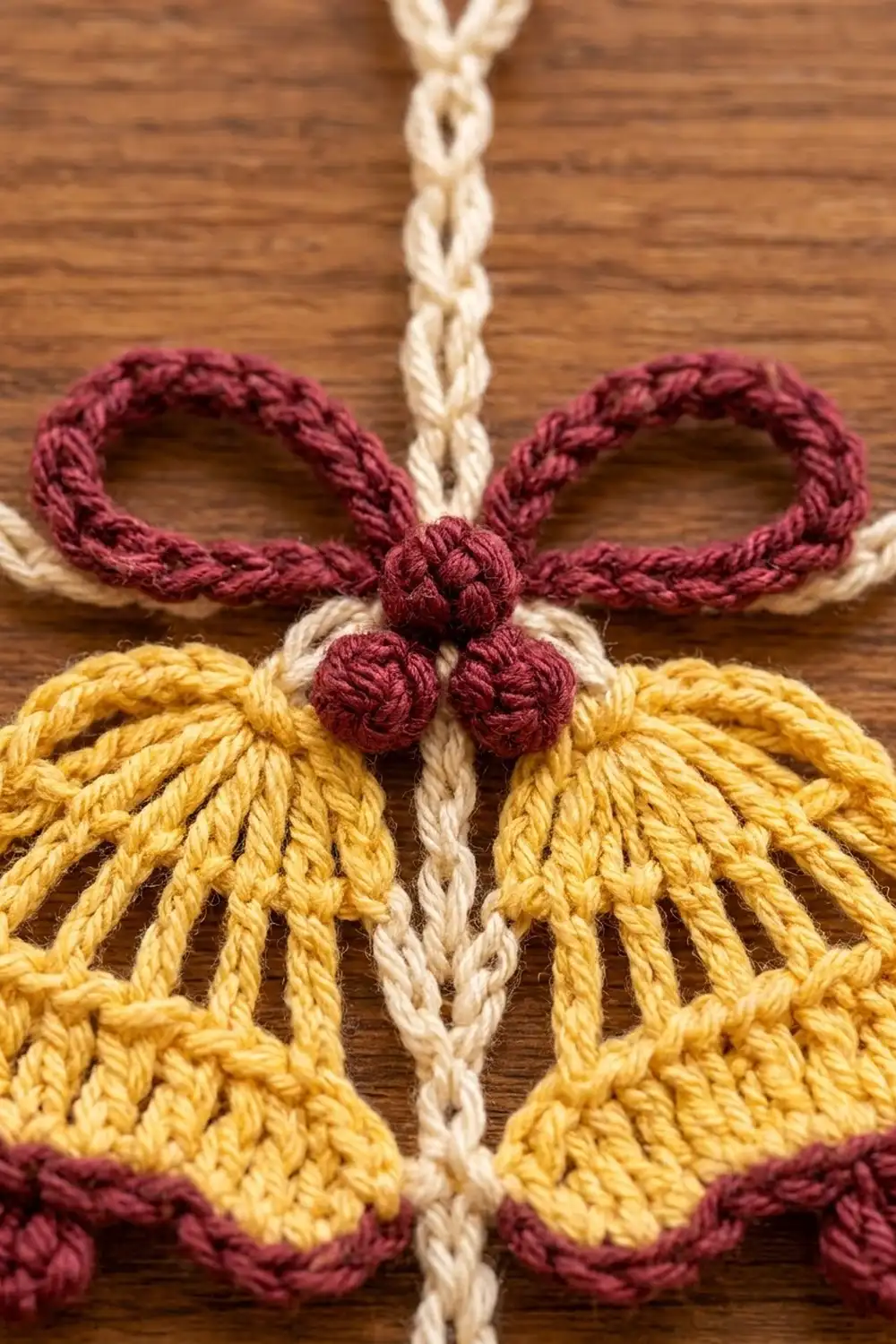
Bell (make 40 per strand)
Use yellow.
Row 1 (RS): Make a magic ring, ch 3 (counts as dc), 6 dc in ring. Pull the ring closed. Turn. (7 dc)
Row 2 (WS): Ch 4 (counts as dc + ch 1), [dc in next dc, ch 1] 5 times, dc in top of beg ch-3. Turn. (7 dc, 6 ch-1 sps)
Row 3 (RS): Ch 6 (counts as tr + ch 2), [tr in next dc, ch 2] 5 times, tr in 3rd ch of beg ch-4. Turn. (7 tr, 6 ch-2 sps)
These long tr spokes make the open windows in the bell’s crown.
Row 4 (WS, conversion row): Ch 1, sc in first tr, [2 sc in next ch-2 sp, sc in next tr] 6 times; the last sc goes in the 4th ch of beg ch-6. Turn. (7 sc on the tr + 12 sc in the spaces = 19 sc)
Row 5 (RS): Ch 2 (does not count), hdc in each sc across. Turn. (19 hdc)
Row 6 (WS, growth row): Ch 1, sc in first hdc, [sc in next 2 hdc, 2 sc in next hdc] 6 times. Fasten off. (25 sc)
This row makes the flared rim.
Row 7 (RS, rim): Join burgundy with a sl st in the first sc. Ch 1, sc in same st, [skip next sc, 3 hdc in next sc, skip next sc, sc in next sc] 6 times. Fasten off, leaving a 6 in (15.2 cm) tail. (7 sc + 18 hdc = 25 sts, 6 scallops)
Check: 1 + (6 x 4) = 25 sts worked, so the last sc lands in the last st.
Clapper and Berry (make 40 clappers and 60 berries per strand)
Use burgundy. Clappers and berries are made the same way.
Make a magic ring, ch 2, work a 4-dc cluster in the ring, then ch 1 to lock it. Pull the ring tight and fasten off, leaving a 6 in (15.2 cm) tail. Each ball measures about 0.4 in (1.0 cm).
Bow (make 20 per strand)
Use burgundy.
Row 1: Ch 51, sc in 2nd ch from hook and in each ch across. Fasten off, leaving a 12 in (30.5 cm) tail. (50 sc; strip is 6.25 in / 15.9 cm long)
Shaping: Lay the strip flat. Fold both ends to the center so they overlap by 0.25 in (0.6 cm), forming 2 equal loops. Wrap the tail tightly around the center 5 times and secure it on the back. The finished bow measures 3 in (7.6 cm) wide x 1.25 in (3.2 cm) tall.
Spine (make 1 per strand)
Use cream.
Row 1: Ch 801, sc in back bump of 2nd ch from hook and in each ch across. (800 sc; 80 in / 203.2 cm)
Hanging loop: Don’t fasten off. Ch 12, sl st in last sc made. Work 16 sc into the ch-12 loop, then sl st in the first sc. Fasten off. This end is the top. The loop adds 1 in (2.5 cm), so the spine is 81 in (205.7 cm) long in total.
Starting at the top, place a marker after every 40 sts. This divides the spine into 20 segments of 4 in (10.2 cm) each.
Make All Pieces
Per strand: 40 bells, 40 clappers, 20 bows, 60 berries, 1 spine.
Full curtain (12 strands):
- Yellow: 480 bells
- Burgundy: 240 bows, 480 clappers, 720 berries (the 480 bell rims are worked as part of the bells)
- Cream: 12 spines
Layout (S = strand, M = one bell motif; rows are motifs 1 to 20 from the top):
      S1 S2 S3 S4 S5 S6 S7 S8 S9 S10 S11 S12
M1    M  M  M  M  M  M  M  M  M  M   M   M
M2    M  M  M  M  M  M  M  M  M  M   M   M
...   (repeat rows M3 to M19)
M20   M  M  M  M  M  M  M  M  M  M   M   M
Each strand hangs by its own loop. The strands are not joined to each other.
Joining
Work one segment at a time. Lay the spine flat with the RS of every piece facing up, and number the sts in each segment 1 to 40, starting from the top.
- Bow: Center the wrapped knot over sts 5 to 7. Whipstitch the knot to the spine through the back loops so the spine stays straight.
- Berries: Sew 3 berries in a tight cluster over the knot: one on each side of the spine and one just below.
- Bells: Place one bell on each side of the spine. Its crown (Row 1) touches the spine at sts 10 to 14, and its rim flares outward. Tilt each bell slightly so the inner corners of the 2 rims meet at st 30. Sew the inner edge of Rows 1 to 3 to the spine, attaching each bell row edge to 1 or 2 spine sts.
- Clappers: Sew one clapper under the center scallop of each rim so it dangles about 0.4 in (1.0 cm) below.
- Gap: Leave sts 31 to 40 empty. This makes a small gap before the next bow.
Weave in the tails of each piece as you sew it on. This keeps the back neat and saves a long finishing session later.
Tension: Sew firmly but keep the spine flat. If the spine ripples, your stitches are too tight. If a bell flops away from the spine, add one more tack.
Checkpoint: A sewn strand measures 6.5 in (16.5 cm) wide at the rims and 81 in (205.7 cm) long. Each motif repeat measures 4 in (10.2 cm).
Border (Side Rails)
Border gauge: 20 ch = 2 in (5.1 cm), relaxed.
Each strand gets 2 rails, one on each side. A rail is a cream chain held in place with sl st anchors and then doubled with a return pass of sl sts.
Row 1 (one side):
- Join cream with a sl st at the base of the hanging loop.
- Ch 20, then sl st in the outer tip of the segment 1 bow loop.
- Ch 30, sl st in the outer rim tip of the bell on this side. Ch 26, sl st in the outer tip of the next segment’s bow loop. Repeat from * to * 18 more times. You’re now at the segment 20 bow.
- Ch 30, sl st in the outer rim tip of the segment 20 bell.
- Ch 36, sl st in the bottom sc of the spine.
Chain count for one side (anchor sl sts are not counted):
- 20 segments x 56 ch (30 + 26) = 1,120 ch
- In the last segment, the 26-ch return is replaced by 36 ch: +10 ch
- Top arm: +20 ch
- Total: 1,150 ch
Row 2: Working back up the rail, sl st in the back bump of each ch, skipping the anchor sl sts. Fasten off at the top. (1,150 sl sts)
Repeat Rows 1 and 2 on the other side.
Why the math works: Each 4 in (10.2 cm) segment gets 5.6 in (14.2 cm) of rail because the rail doesn’t run straight down. It runs about 3 in (7.6 cm) diagonally from the bow tip out to the rim tip, then about 2.4 in (6.1 cm) back in to the next bow. The 30 ch and 26 ch match those distances and leave just enough ease for a soft curve.
The 20-ch top arm forms a small upward arc beside the hanging loop. The 36-ch tail covers about 3.4 in (8.6 cm), the distance from the last rim tip to the bottom of the spine.
Each rail adds 0.25 in (0.6 cm) outside the rim tips, so the strand is 6.5 + 0.25 + 0.25 = 7 in (17.8 cm) wide. Twelve strands x 7 in = 84 in (213.4 cm).
Final Blocking
- Soak each finished strand in cool water for 10 minutes, then roll it in a towel to press out the water. Don’t wring it.
- Lay the strand flat on a blocking surface with the spine straight.
- Pin the spine at every segment marker, 4 in (10.2 cm) apart.
- Pin each bell’s rim tip 3.25 in (8.3 cm) out from the spine and open up the scallops.
- Shape the bow loops into rounded ovals.
- Ease the rails into even curves without stretching them.
- For crisper bells, mist with starch. Let the strand dry completely.
- Remove the markers and hang the strand on the rod.
Final Quality-Control Checklist
- Every bell has 25 rim sts and 6 even scallops.
- Every bell measures 3.25 in (8.3 cm) x 2 in (5.1 cm).
- Every bow measures 3 in (7.6 cm) wide.
- Every bow has 3 berries and every bell has 1 clapper.
- Each spine is 81 in (205.7 cm) long, with 20 motifs spaced 4 in (10.2 cm) apart.
- Each rail has 1,150 ch and lies flat without pulling.
- Every strand is 7 in (17.8 cm) wide.
- All ends are woven in securely.
Troubleshooting
- Bell curls: Row 6 is too tight. Go up 0.25 mm in hook size for Rows 6 and 7 only.
- Rim ruffles: The scallops are too full. Work each scallop as (sc, hdc, sc) instead of 3 hdc.
- Crown windows close up: The tr are too short. Pull up each loop to full height.
- Spine stretches when hung: Work the sc firmly, then re-block with starch.
- Rail puckers the bells: The chains are too tight. Rework that segment with a looser chain, keeping the same count.
- Bows look uneven: Measure the 0.25 in (0.6 cm) overlap before wrapping the center.
- Strand twists: Sew every bell on with the RS facing the same way, then block flat.
Care
Hand wash in cool water with mild soap, then dry flat, pinned to shape. Store the strands rolled around a tube so the rails don’t tangle.
Final Notes
Every measurement builds on the one before it. A 3.25 in (8.3 cm) bell pairs into a 6.5 in (16.5 cm) motif. Twenty motifs at 4 in (10.2 cm) make an 80 in (203.2 cm) spine, and the 1 in (2.5 cm) loop brings it to 81 in (205.7 cm). The rails widen each strand to 7 in (17.8 cm), and 12 strands make the 84 in (213.4 cm) curtain. If your first bell measures correctly, the rest of the measurements will follow.
Happy crocheting!