

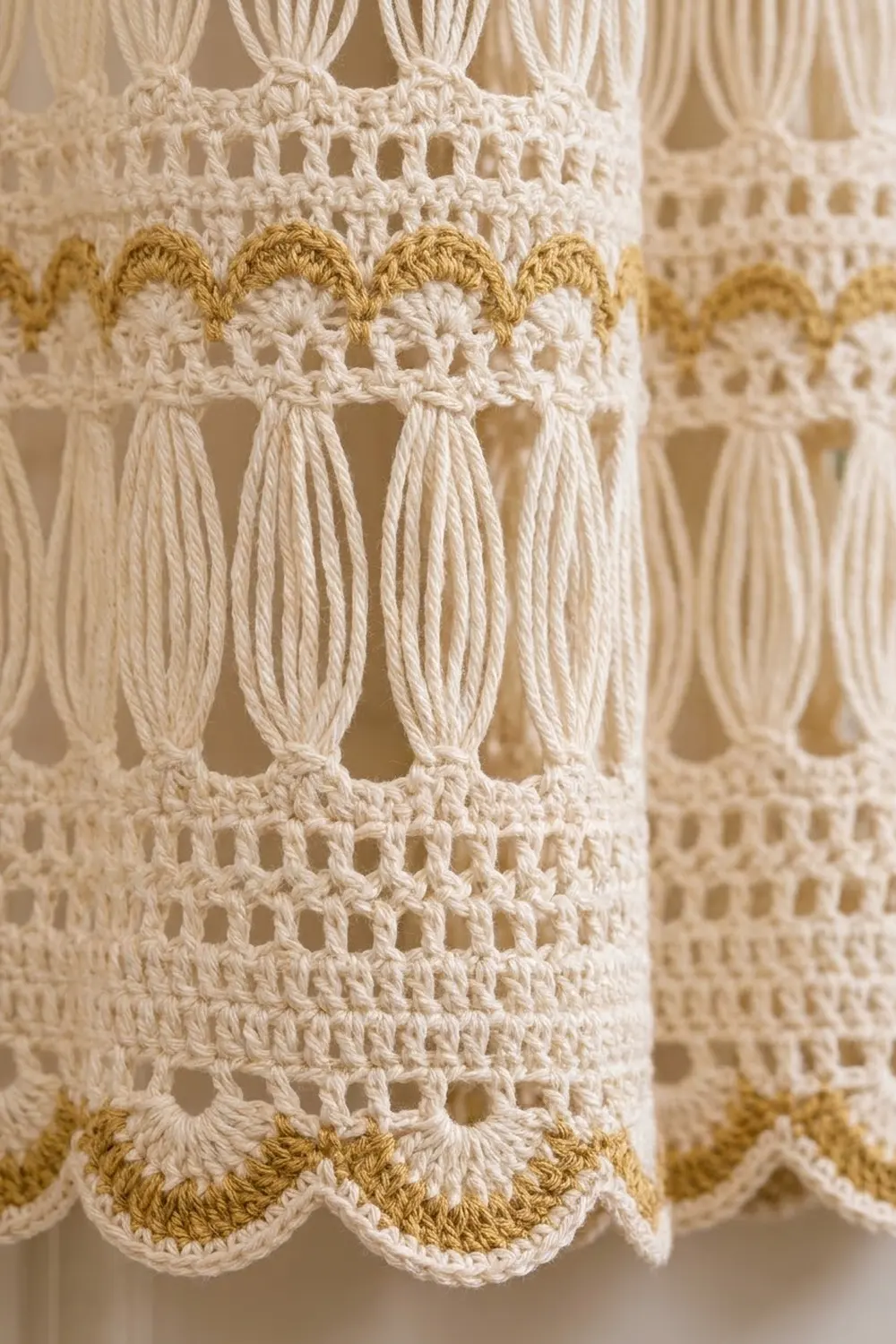
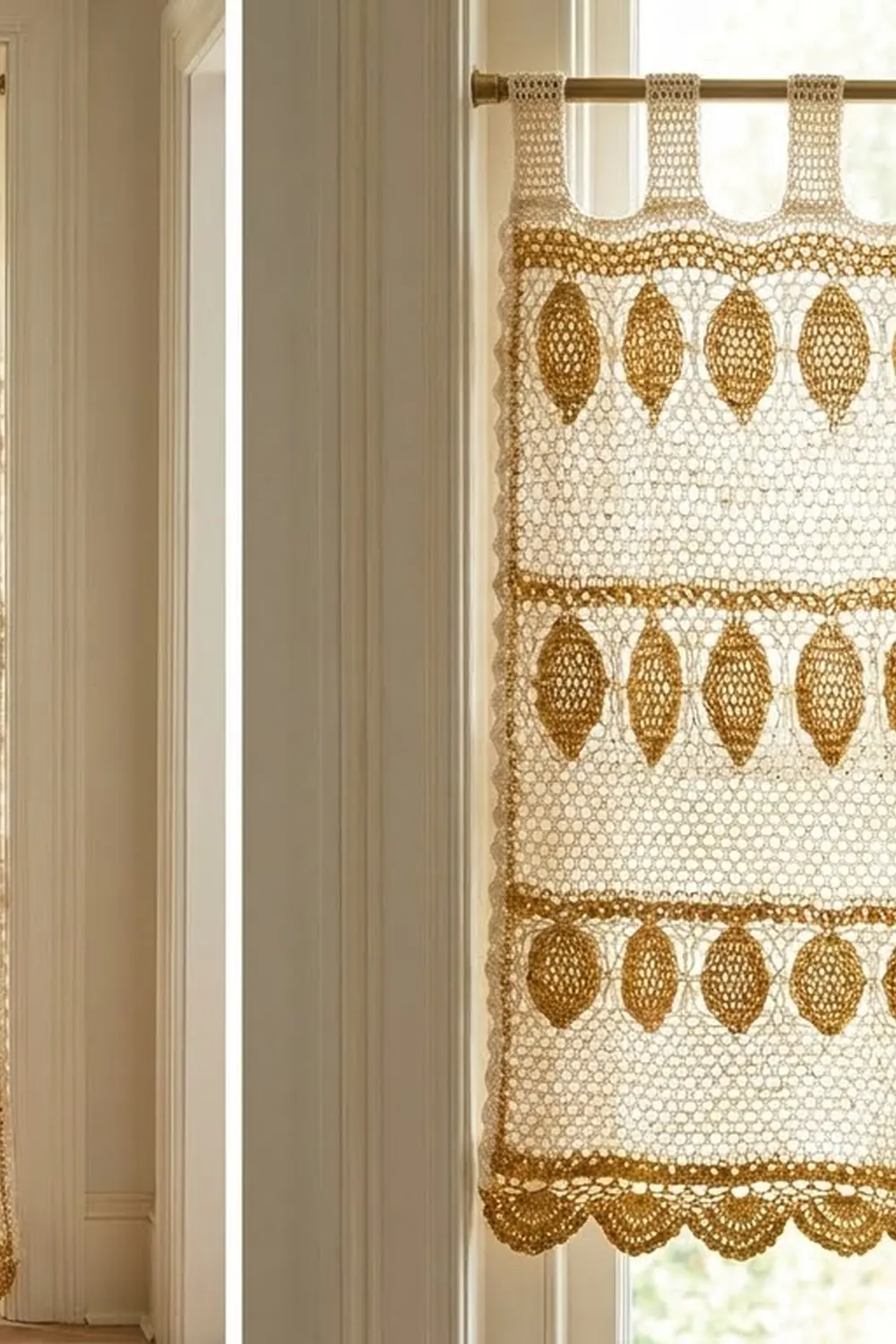
These curtains are built from horizontal bands that repeat all the way down the panel. Long cream loops gather into tall lantern shapes. Between the lantern bands sit an open mesh row, solid single crochet rows, and a row of gold scallops. The result is airy, textured, and lets the light through.
The palette is a warm cream main color with a soft antique gold accent. The gold shows up only as one row of small fans in each band and in the scalloped bottom edge, so it reads like a thin gilded trim. The style suits a traditional or cottage room, especially next to brass hardware.
The pattern uses US crochet terms. Each finished panel measures 41.75 in (106.0 cm) wide and 82 in (208.3 cm) long, not counting the tabs. With the tab loops it hangs about 85 in (215.9 cm) from the top of the rod.
You work each panel flat, from the bottom up, in sixteen identical 5 in (12.7 cm) bands. A narrow mesh row finishes the top. Eight tabs are worked straight off that top row, folded to the back, and sewn down. A three-row edging then goes down one side, across the bottom (where it becomes a gold scallop trim), and up the other side.
Finished Size and Construction
- Finished panel size: 41.75 in x 82 in (106.0 cm x 208.3 cm), plus 3 in (7.6 cm) tab loops
- Skill level: Intermediate
- Terminology: US
- Yarn weight: Worsted (4), cotton
- Hook: 5.5 mm (US I-9)
- Number of pieces: 2 panels (a pair), each worked in one piece with 8 tabs
- Layout: One panel on each side of the window, hung on one rod
- Piece size before border: 40.25 in x 80.75 in (102.2 cm x 205.1 cm)
- Border depth: 0.75 in (1.9 cm) on the sides, 1.25 in (3.2 cm) along the bottom
Materials
Use a smooth, mercerized or combed worsted-weight cotton, about 190 m (208 yd) per 100 g. Cotton hangs straight and keeps the lantern loops crisp. Avoid acrylic, which tends to make the loops limp, and pure linen, which is heavy for a panel this long.
Yarn for the pair:
- Color A, cream: 3,200 g, about 6,080 m (6,649 yd); 1,600 g (3,040 m) per panel
- Color B, antique gold: 400 g, about 760 m (831 yd); 200 g (380 m) per panel
These quantities include a margin of roughly 10 percent for swatching and dye-lot safety. Buy each color from one dye lot.
Tools:
- 5.5 mm (US I-9) crochet hook
- Loop strip: a flat strip of stiff card or plastic, 2.5 in (6.4 cm) wide and at least 12 in (30.5 cm) long
- Locking stitch markers
- Tapestry needle
- Tape measure
- Blocking pins and a large clean surface or a sheet on the floor
Abbreviations (US Terms)
- ch – chain
- sl st – slip stitch
- sc – single crochet
- dc – double crochet
- sk – skip
- st(s) – stitch(es)
- sp – space
- RS / WS – right side / wrong side
- rep – repeat
Special stitches:
- Lantern loop group (LG): Insert hook in the indicated st, yo, pull up a loop, stretch it up and slip it over the loop strip. Rep 4 more times in the same st, for 5 loops from one st.
- Gather group (GG): Insert hook through 5 loops together and lift them off the strip, yo, pull through, then work 5 sc into the center of the 5-loop bundle.
Stitch counting: In mesh rows, every dc and every ch-1 sp counts as 1 st.
Gauge and Checkpoints
Gauge: 16 sc and 16 sc rows = 4 in (10.2 cm). One full band (8 rows plus the lantern loops) = 5 in (12.7 cm) tall.
Test one piece first. Ch 22. Work Row 1 below (21 sts), then one band of Rows 2 to 10, with 4 groups instead of 32. Your swatch should measure 5.25 in (13.3 cm) wide and 5.25 in (13.3 cm) tall.
Checkpoints for the panel:
- After Row 1: 40.25 in (102.2 cm) wide
- One lantern band (Rows 7 and 8): 2.75 in (7.0 cm) tall
- After band 1: 5.25 in (13.3 cm) from the bottom edge
- After band 4: 20.25 in (51.4 cm)
- After band 8: 40.25 in (102.2 cm)
- After band 16: 80.25 in (203.8 cm)
- After the top mesh row: 80.75 in (205.1 cm)
Measure lying flat, never hanging. A long cotton panel stretches under its own weight.
If your piece is too big: go down a hook size, or pull the lantern loops snug against the strip. If it’s too small: go up a hook size. If only the height is off, check the lantern bands first. They make up more than half of each band, so a narrower or wider strip changes the length quickly.
Panel Pattern
The repeat is 5 sts plus 1 edge st. Rows 2 to 10 form one band.
Foundation
With A, ch 162.
Row 1 (RS): Sc in 2nd ch from hook and in each ch across. Turn. (161 sts)
Band (rep 16 times)
Row 2 (WS, mesh): Ch 4 (counts as dc + ch 1), sk next st, dc in next st, ch 1, sk next st, dc in next st across. Turn. (81 dc + 80 ch-1 sps = 161 sts)
Row 3 (RS): Ch 1, sc in each dc and each ch-1 sp across, ending with sc in 3rd ch of turning ch. Do not turn. Place the cream loop on a marker. (161 sts)
Row 4 (RS, gold scallops): With RS still facing, join B with sl st in the first st of Row 3 (the right edge, where Row 3 began). Ch 1. Work sc in st, sk 1 st, 5 dc in next st, sk 1 st, sc in next st 32 times; the first sc goes in the same st as the join. Sc in last st. Fasten off B. (32 repeats x 7 sts + 1 edge sc = 225 sts)
The 5-dc fan sits on the center (3rd) st of every 5-st group. Because Row 4 travels in the same direction as Row 3, it ends right next to the waiting cream loop.
Row 5 (WS, conversion row): Pick up the cream loop, ch 1, turn. Sc in the edge sc, then sc in next sc, sc in 2nd dc, sc in 3rd dc, sc in 4th dc, sc in next sc 32 times. Turn. (1 + 32 x 5 = 161 sts. You work into 161 of the 225 sts and skip the 1st and 5th dc of each fan, 64 sts in all, so the scallops stand out as little fans.)
Row 6 (RS): Ch 1, sc in each st across. Do not turn. (161 sts)
Row 7 (RS, lantern loops): Your hook sits at the left edge with RS facing. Hold the loop strip behind the top of the work. Stretch the loop on your hook and slip it over the strip (edge loop). Working left to right: sk 2 sts, LG in next st, sk 2 sts 32 times. Slide loops along the strip as it fills. (1 edge loop + 32 groups x 5 loops = 161 loops)
Each LG sits on the same center st as a gold fan below, so lanterns and scallops line up.
Row 8 (RS, gather): Working right to left: GG over the first 5 loops, adding ch 1 after pulling through for the first group only (this ch does not count). Rep GG across all 32 groups, then sc through the single edge loop. Do not turn. (32 x 5 + 1 = 161 sts)
All 5 loops come up from one st and are gathered together at the top. That pinches each group at both ends into a tall, rounded lantern.
Row 9 (WS): Ch 1, turn, sc in each st across. Turn. (161 sts)
Row 10 (RS): Ch 1, sc in each st across. Turn. (161 sts)
That completes one band. Rep Rows 2 to 10 fifteen more times, for 16 bands in all. The last band ends with Row 10, RS.
Top Mesh
Row 11 (WS): Rep Row 2. Fasten off. (161 sts)
The panel now measures 40.25 in x 80.75 in (102.2 cm x 205.1 cm).
Tabs (make 8 per panel)
With RS facing, count sts of Row 11 from the right edge. Tabs sit on sts 1–7, 23–29, 45–51, 67–73, 89–95, 111–117, 133–139, and 155–161. That gives 8 tabs of 7 sts, 1.75 in (4.4 cm) wide, with 7 gaps of 15 sts, 3.75 in (9.5 cm) wide. Check: 8 x 7 + 7 x 15 = 161.
Tab Row 1 (RS): Join A in first st of the tab, ch 1, sc in same st and next 6 sts. Turn. (7 sts)
Tab Row 2: Ch 4 (counts as dc + ch 1), sk 1, dc in next, (ch 1, sk 1, dc in next) twice. Turn. (4 dc + 3 ch-1 sps = 7 sts)
Tab Rows 3–16: Alternate sc rows (as Tab Row 1, worked into the existing sts without joining) and mesh rows (as Tab Row 2), ending with Row 16 (mesh). Fasten off with a 12 in (30.5 cm) tail. (7 sts; tab measures 6 in, 15.2 cm)
Make All Pieces
Make 2 identical panels. Each uses 1,600 g of A and 200 g of B, with 16 gold scallop rows plus the gold bottom trim.
[ Panel 1 ]   [ window ]   [ Panel 2 ]
  8 tabs                     8 tabs
The panels are identical, so either one can hang on the left.
Joining
The two panels hang separately and are not joined to each other. The only joining is closing the tabs.
Method: Fold each tab to the WS. Using the tail, whipstitch the 7 sts of Tab Row 16 to the 7 sts at the base of the same tab on the WS (the back of Row 10, just below Row 11). Work stitch to stitch, 1 whipstitch per st, so the tab stays straight and doesn’t twist.
Tension: Pull each whipstitch just snug. Tight stitches pucker the top band, and loose ones let the tab sag.
Size checkpoint: Each tab loop stands 3 in (7.6 cm) above the top edge and fits a rod up to 1.5 in (3.8 cm) across.
Border
Border gauge: 4 sc per 1 in (2.5 cm) along the side edges. That’s 20 sc per band: 2 for the mesh row, 1 per sc row (Rows 3, 5, 6, 9, 10), 2 for the scallop row, and 11 for the lantern band. Along each side above Row 1 you have 16 x 20 + 2 (Row 11) = 322 sc.
Border Row 1 (A): With RS facing, join A at the top left corner. Work 322 sc evenly down the left side, 3 sc in the corner st of Row 1, 1 sc in each of the next 159 foundation ch, 3 sc in the last corner st, then 322 sc up the right side. Turn. (322 + 3 + 159 + 3 + 322 = 809 sts)
Border Row 2 (A): Ch 1, sc in each st, with 3 sc in each center corner sc. Fasten off. (323 + 3 + 161 + 3 + 323 = 813 sts)
Each side now has 324 sts, counting the first sc of its corner group. This row adds 4 sts in total: 2 at each corner.
Border Row 3 (B, bottom only): With RS facing, join B in the left center corner sc. Ch 1, sc in same st, then sk 1, 5 dc in next, sk 1, sc in next 41 times, ending in the right center corner sc. Fasten off. (41 x 6 + 1 = 247 sts)
This works because the bottom of Row 2, from corner center to corner center, is 1 + 1 + 161 + 1 + 1 = 165 sts. 165 = 41 x 4 + 1, so the scallops fit exactly. Each scallop is 1 in (2.5 cm) wide.
Border Row 4 (A): With RS facing, join A at the top left corner. Work 324 sc down the side (1 per st of Row 2), 3 sc in the gold corner sc, 1 sc in each of the next 245 sts across the scallops, 3 sc in the other gold corner sc, then 324 sc up the right side. Fasten off. (324 + 3 + 245 + 3 + 324 = 899 sts)
The side edge is 3 sc rows, 0.75 in (1.9 cm). The bottom is 2 sc rows, the gold fans, and a cream outline, 1.25 in (3.2 cm). Final size: 40.25 + 1.5 = 41.75 in (106.0 cm) wide and 80.75 + 1.25 = 82 in (208.3 cm) long.
Final Blocking
- Weave in all ends along the side borders, where they are hidden.
- Soak the panel in cool water with a little gentle wash for 15 minutes.
- Press out the water gently. Don’t wring. Roll the panel in towels to remove more water.
- Lay it flat on a sheet. Pin it to 41.75 in x 82 in (106.0 cm x 208.3 cm).
- Pin each bottom scallop into a round fan, and coax each lantern into an even oval with your fingers.
- Let it dry completely flat. Block both panels to the same measurements.
Final Quality-Control Checklist
- Every band row has 161 sts. Row 4 has 225 sts.
- Every gold fan sits directly under a lantern.
- There are 32 lanterns across each band, all a similar height.
- There are 16 bands and 8 tabs, evenly spaced.
- The tabs are sewn straight and all loops are 3 in (7.6 cm) tall.
- The border sides are straight, with 41 bottom scallops.
- Both panels match within 0.5 in (1.3 cm).
Troubleshooting
- Lanterns uneven: Pull up every loop to the full width of the strip before moving on.
- Panel narrowing: Check that the mesh row has 161 sts. Missing the last turning ch is the usual cause.
- Fans and lanterns misaligned: Recount Row 4, which should end with 1 edge sc at the left.
- Side border ruffles: Spread the 20 sc per band more evenly, or check your hook size.
- Tabs twisted: Unpick and resew them stitch to stitch.
Care
Hand wash, or machine wash cold on a gentle cycle in a mesh bag, then dry flat. Don’t hang the panels wet, or they will stretch.
Final Notes
The measurement chain is simple. A 16 sc gauge gives 161 sts = 40.25 in (102.2 cm). Each 5 in (12.7 cm) band repeats sixteen times, and Row 1 plus the top mesh bring the length to 80.75 in (205.1 cm). The border adds 0.75 in (1.9 cm) per side and 1.25 in (3.2 cm) at the bottom, for a finished panel of 41.75 in x 82 in (106.0 cm x 208.3 cm), hanging on 3 in (7.6 cm) tabs.
Happy crocheting!