

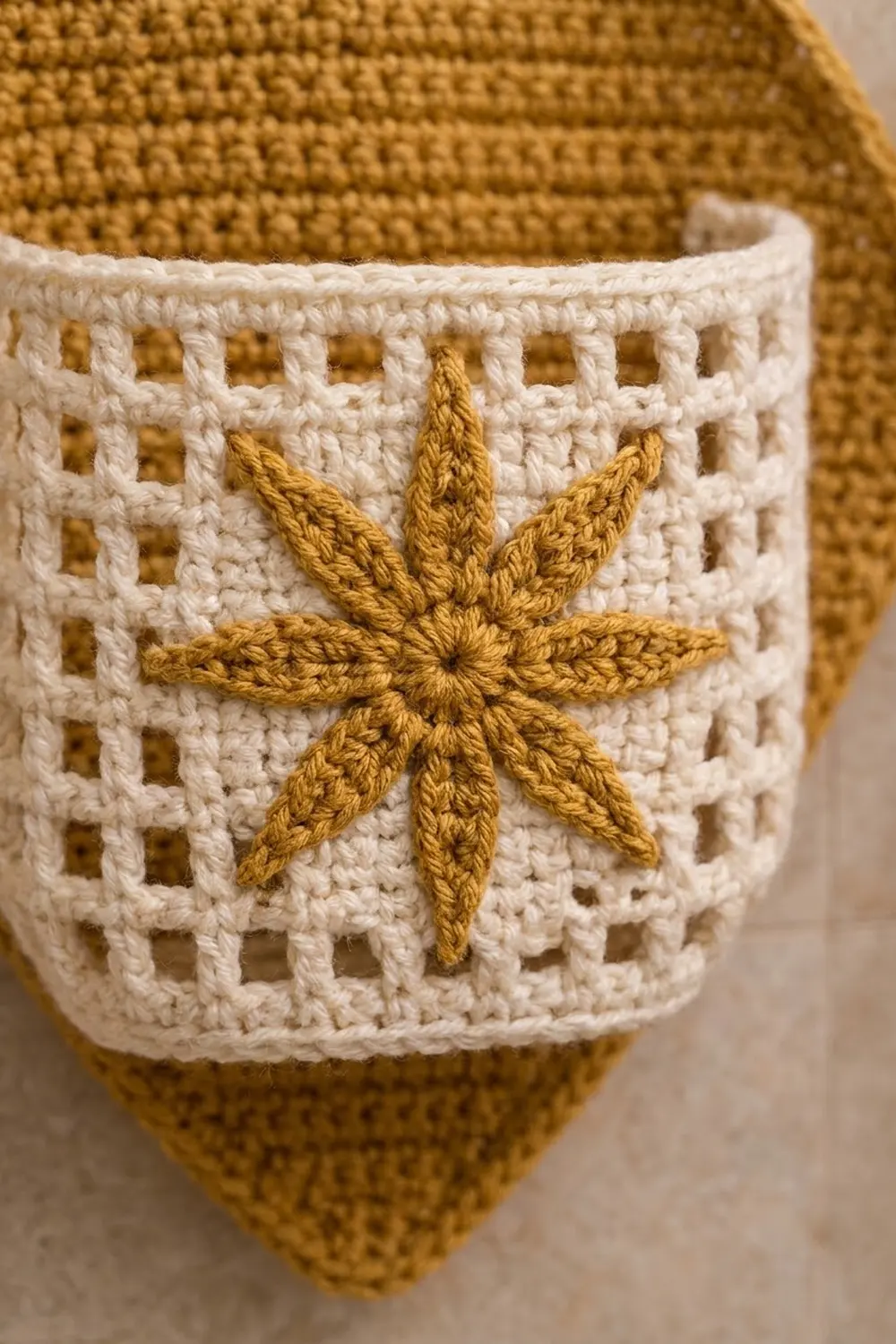
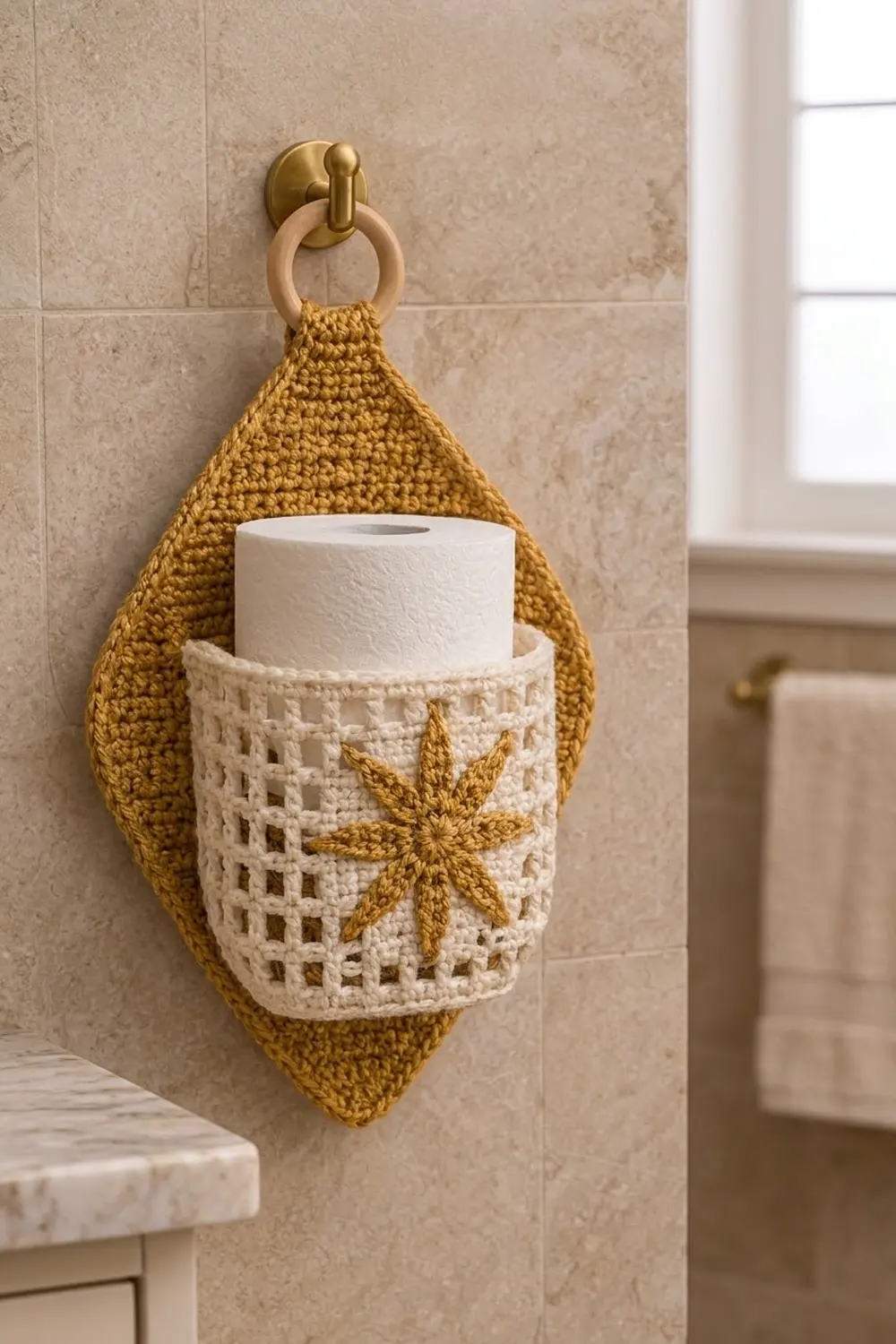
This hanging holder pairs a mustard-gold diamond backing with a cream filet mesh pocket and a gold eight-petal star. It holds one standard toilet roll and hangs from a wooden ring. It adds a cozy touch to a holiday or neutral bathroom.
The backing is dense gold single crochet that lies flat against the wall. The pocket is open cream mesh with a solid center block, and the star appliqué sits on that block.
This pattern uses US crochet terms. The bordered backing panel measures 10 3/4 in (27.3 cm) wide by 14 1/4 in (36.2 cm) tall, not counting the hanging loop. From the bottom point to the top of the ring, the holder is about 16 1/2 in (41.9 cm).
You crochet the backing bottom-up in rows, shaping a diamond that ends in a narrow strap. The pocket is worked flat in filet and the star in the round. Then you sew everything together, add a border, and fold the strap over the ring.
Finished Size and Construction
- Finished size: panel 10 3/4 in x 14 1/4 in (27.3 cm x 36.2 cm); about 16 1/2 in (41.9 cm) tall including ring
- Skill level: Easy-Intermediate
- Terminology: US
- Yarn weight: worsted (#4)
- Hook: 4.5 mm (US 7)
- Number of pieces: 3 crocheted parts (backing, pocket, star) plus 1 wooden ring
- Layout: pocket centered on the lower half of the backing; star centered on the pocket
- Piece sizes: edged pocket 8 1/4 in x 4 7/8 in (21.0 cm x 12.4 cm); star 3 1/2 in (8.9 cm) across
- Size before border: panel 10 1/4 in x 13 3/4 in (26.0 cm x 34.9 cm)
- Border depth: 1/4 in (0.6 cm)
Materials
Use worsted cotton or a cotton blend. It holds its shape under a roll’s weight and handles bathroom humidity.
- Gold (mustard): 50 g, about 90 m (98 yd), for backing, border, and star
- Cream: 25 g, about 45 m (49 yd), for pocket and seams
Both quantities include a safety margin of roughly 30%.
Tools: 4.5 mm (US 7) hook; wooden ring, 2 in (5.1 cm) outer diameter; tapestry needle; 6–8 locking stitch markers; scissors; tape measure; rustproof pins and a blocking mat.
Abbreviations (US Terms)
- ch – chain
- sl st – slip stitch
- sc – single crochet
- hdc – half double crochet
- dc – double crochet
- sc2tog – (insert hook in next st, pull up a loop) twice, yarn over, draw through all 3 loops
- st(s) – stitch(es); sp – space; RS – right side
Special stitches (filet):
– Mesh square: ch 1, skip 1 st, dc in next st.
– Block: dc in each of the next 2 sts (or in the ch-1 sp and the next dc).
– Squares share their dividing dc, so a row is 1 + (2 x squares) sts.
Gauge and Checkpoints
- Single crochet: 16 sts x 18 rows = 4 in (10.2 cm)
- Double crochet: 16 sts x 8 rows = 4 in (10.2 cm), so each mesh square is 1/2 in (1.3 cm) square
Make the pocket first. It doubles as your dc gauge test and should measure 7 3/4 in (19.7 cm) wide.
Checkpoints:
– Backing after Row 20: 10 1/4 in (26.0 cm) wide, about 4 1/2 in (11.4 cm) tall
– Backing after Row 26: about 5 3/4 in (14.6 cm) tall
– Backing after Row 62: about 13 3/4 in (34.9 cm) tall
– Pocket after Row 8: 7 3/4 in (19.7 cm) wide, 4 in (10.2 cm) tall
– Star: about 3 1/2 in (8.9 cm) tip to tip
Too big? Use a hook one size smaller. Too small? Go one size larger. Pocket gauge matters most, because the roll must fit.
Backing Panel (Gold)
Work in rows from the bottom point up. The ch 1 at the start of each row does not count as a stitch.
Row 1 (RS): Ch 2, 3 sc in 2nd ch from hook, turn. (3 sts)
Row 2: Ch 1, 2 sc in first st, sc in next st, 2 sc in last st, turn. (5 sts)
Rows 3–20: Ch 1, 2 sc in first st, sc in each st to last st, 2 sc in last st, turn. Each row is 2 sts wider, so Row n has 2n + 1 sts: Row 3 has 7, Row 14 has 29, Row 20 has 41.
Rows 21–26: Ch 1, sc in each st across, turn. (41 sts)
Row 27: Ch 1, sc2tog, sc in each st to last 2 sts, sc2tog, turn. (39 sts)
Row 28: Ch 1, sc in each st across, turn. (39 sts)
Rows 29–62: Repeat Rows 27–28 another 17 times. Row 29 has 37 sts, Row 35 has 31, and Rows 61–62 have 5. Decreasing every other row makes the upper half taller than the lower half.
Strap, Rows 63–76: Ch 1, sc in each st across, turn. (5 sts, 14 rows)
The strap is 1 1/4 in (3.2 cm) wide and about 3 in (7.6 cm) long. Fasten off, leaving an 18 in (45.7 cm) tail.
Placement markers: On Row 14 (29 sts), mark the 6th st from each edge. The 2 marked sts plus the 17 between them form a 19-st, 4 3/4 in (12.1 cm) pocket window.
Pocket (Cream)
Worked flat in filet. A ch 3 turning chain counts as 1 dc.
Foundation: Ch 33.
Row 1 (solid): Dc in 4th ch from hook and in each ch across, turn. (31 sts = 15 blocks)
Row 2 (mesh): Ch 4 (counts as dc + ch 1), skip next st, dc in next st, *ch 1, skip next st, dc in next st; repeat from * across, working the last dc in the top of the turning ch, turn. (15 squares: 16 dc + 15 ch-1 sps = 31 sts)
Rows 3–7 (center block): Ch 4, skip next st, dc in next dc, [ch 1, skip next st, dc in next dc] 4 times (5 squares), dc in each of next 10 sts (5 blocks), [ch 1, skip next st, dc in next dc] 5 times (5 squares), turn. (31 sts)
The result is a solid square 5 squares wide by 5 rows tall, 2 1/2 in (6.4 cm).
Row 8 (mesh): Work as for Row 2. Over the block, ch 1 and skip a dc. (15 squares, 31 sts)
Rows 9–10 (top band): Ch 1, sc in each dc and ch-1 sp across, turn. (31 sc) Do not fasten off.
Edging, Round 1: With the RS facing, work across the top: 3 sc in first st, sc in next 29 sts, 3 sc in last st (35). Down the side: 2 sc per dc row-end and 1 sc per sc row-end (18). Across the foundation’s free loops: 3 sc in first ch, sc in next 29 ch, 3 sc in last ch (35). Up the other side (18). Sl st to the first sc. (35 + 18 + 35 + 18 = 106 sts)
Fasten off, leaving a 12 in (30.5 cm) tail.
Star Appliqué (Gold)
Worked in the round. Do not turn.
Round 1: Magic ring, 8 sc in the ring. Leave a small center hole when you pull it closed. Sl st to the first sc. (8 sts)
Round 2: Ch 1, 2 sc in each st around, sl st to the first sc. (16 sts, about 1 in / 2.5 cm across)
Round 3 (petals): Ch 7; working back along the chain, sl st in 2nd ch from hook, sc in next ch, hdc in next ch, dc in next ch, hdc in next ch, sc in last ch (6 sts); sl st in the base st, sl st in each of the next 2 sts. Repeat from * to * 7 more times, so the last sl st lands in the first st. (8 petals, 2 Round 2 sts per petal)
Each petal is short at both ends and tallest in the middle. This gives a pointed leaf about 1 1/4 in (3.2 cm) long. Fasten off, leaving a 12 in (30.5 cm) tail.
Make All Pieces
- Gold: 1 backing panel, 1 star
- Cream: 1 pocket
Layout (front view, top to bottom):
   [ wooden ring ]
   [ strap, folded to back ]
   [ gold backing, upper half ]
   [ cream pocket + gold star ]
   [ gold backing, bottom point ]
Joining
Star to pocket: Center the star on the solid block. Using the gold tail, whipstitch the edge of Round 2 to the block, then tack each petal tip down with 2 small stitches.
Pocket to backing (cream yarn, top edge left open):
- Side seams: Each pocket side has 20 sts: the bottom corner center, 18 side sc, and the top corner center. Sew them 1:1 to 20 panel rows (Rows 14–33), going straight up from each marker.
- Bottom seam: Between corner centers, the pocket has 31 sts. Between the markers, the panel has 17. Starting from each corner, sew 2 pocket sts into each of the next 7 panel sts. Then sew the center 3 sts 1:1. That uses 14 + 3 + 14 = 31 pocket sts over 7 + 3 + 7 = 17 panel sts.
Gathering 8 1/4 in (21.0 cm) of pocket into a 4 3/4 in (12.1 cm) window rounds the bottom corners and curves the front so it holds a 4 in (10.2 cm) roll. The sides ease in slightly over the 4 1/2 in (11.4 cm) of rows.
Tension: Make the seams snug but not tight, so they lie flat.
Size checkpoint: The panel should still be 10 1/4 in (26.0 cm) wide. A roll should stick up about 1 1/2 in (3.8 cm) above the pocket.
Border (Gold)
Border gauge: 16 sc = 4 in (10.2 cm), the same as the panel. Sc rows are nearly square, so 1 sc per row-end lies flat on steep edges. The shallower lower edges need extra sts.
Round 1: With the RS facing, join at the bottom point.
– Bottom point: 3 sc in the free loop of the foundation ch (3)
– Lower right edge, Rows 1–20: 1 sc per row-end, 2 sc in Rows 3, 6, 9, 12, 15, 18 (26)
– Right side, Rows 21–26 (6)
– Upper right edge, Rows 27–62 (36)
– Right side of strap, Rows 63–76 (14)
– Strap top: 3 sc in first st, sc in next 3, 3 sc in last st (9)
– Left side of strap (14), upper left (36), left side (6), lower left with mirrored extras (26)
Sl st to the first sc. (176 sts)
Why the math works: Each lower edge rises 4 1/2 in (11.4 cm) over 4 3/4 in (12.1 cm), a slant of about 6 1/2 in (16.5 cm). At 4 sts per inch, that needs 26 sts: 20 row-ends plus 6 extras. Each upper edge rises 8 in (20.3 cm) over 4 1/2 in (11.4 cm), a slant of about 9 1/4 in (23.5 cm), which 36 row-ends cover. Total: 3 + 26 + 6 + 36 + 14 + 9 + 14 + 36 + 6 + 26 = 176.
Round 2: Sl st loosely in each st around. (176) Fasten off.
The border adds 1/4 in (0.6 cm) per side, so the panel is now 10 3/4 in x 14 1/4 in (27.3 cm x 36.2 cm).
Hanging loop: Pass the strap through the ring from front to back. Fold it down against the back of Rows 60–62 and whipstitch it in place. With its border, the strap is 1 3/4 in (4.4 cm) wide and sits snugly in the ring.
Final Blocking
- Weave in all ends.
- Mist the piece until it is damp.
- Pin the backing to 10 3/4 in x 14 1/4 in (27.3 cm x 36.2 cm) with sharp points and straight sides.
- Push a rolled towel about 4 in (10.2 cm) across into the pocket so the curve sets.
- Smooth the star petals flat.
- Let it dry completely before unpinning.
Final Quality-Control Checklist
- Panel is 10 3/4 in (27.3 cm) wide and symmetrical
- Border has 176 sts with no ripples
- Pocket has 15 squares per row and a centered block
- Star has 8 even petals, all tacked down
- Side seams are vertical and the bottom gathers match
- Ring hangs straight and a roll stays put
Troubleshooting
- Diamond leans: An increase or decrease is missing. Recount the rows.
- Lower border ruffles: You have too many extras. Keep it to 26 per lower edge.
- Upper border pulls in: Use a larger hook for Round 1.
- Mesh squares look rectangular: Pull up taller dc loops.
- Roll is loose: Move each side seam 1 st inward.
- Roll will not fit: The pocket is under gauge. Remake it with a larger hook.
Care
Hand wash in cool water, roll in a towel to remove water, and dry flat with a rolled towel in the pocket.
Final Notes
Everything follows from gauge. At 16 sts = 4 in (10.2 cm), the 41-st panel is 10 1/4 in (26.0 cm) wide, and the 31-st pocket is 7 3/4 in (19.7 cm), or 8 1/4 in (21.0 cm) once edged. The pocket is gathered into a 4 3/4 in (12.1 cm) window to hold a 4 in (10.2 cm) roll. The 176-st border then brings the panel to 10 3/4 in x 14 1/4 in (27.3 cm x 36.2 cm).
Happy crocheting!