

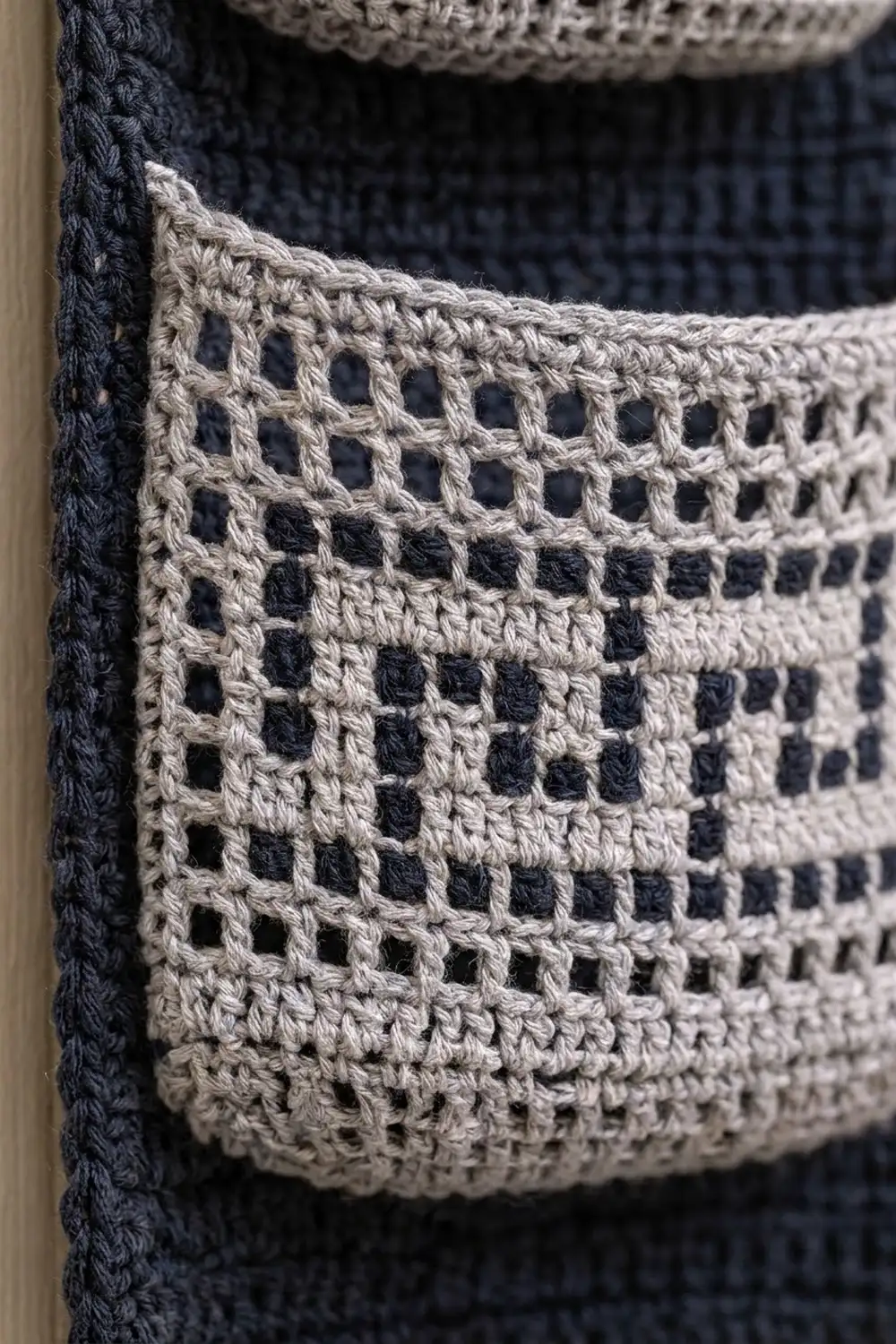
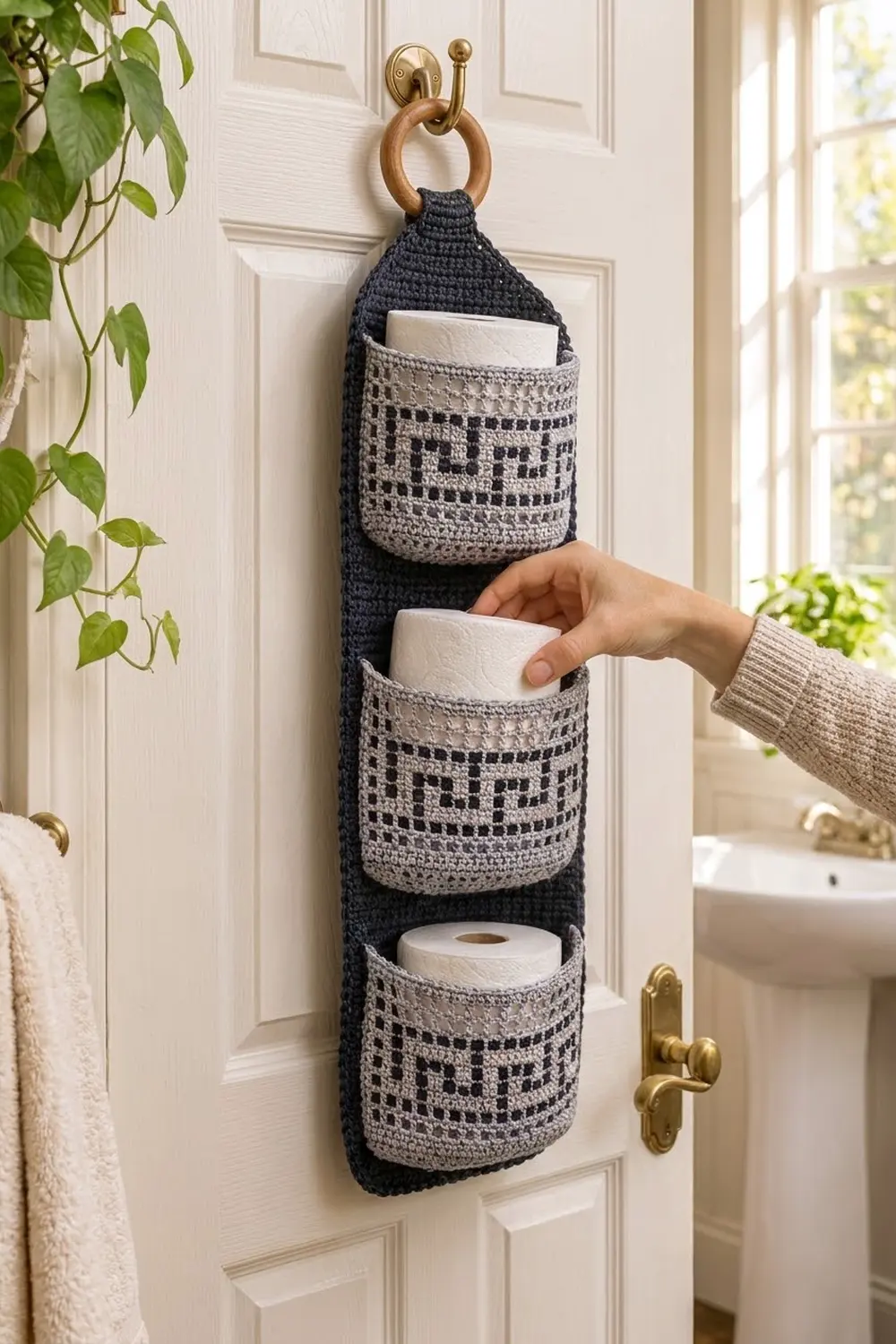
This hanging toilet paper holder pairs a deep navy backing panel with three light gray pockets. Each pocket carries a band of navy Greek key between open filet mesh rounds. A natural wooden ring at the top lets it hang from a door hook or an over-door hanger.
The look is classic and tidy: a dark background, a soft gray filet texture, and one bold geometric motif repeated around each cup. It suits a white or cream bathroom and gives spare rolls a neat, slightly Mediterranean home.
All instructions use US crochet terms. Laid flat, the finished holder measures about 6.5 in (16.5 cm) wide and 27.2 in (69.1 cm) long. With the tab folded over the ring, it hangs about 25.5 in (64.8 cm) long, not counting the ring.
Construction is simple. You work one navy panel in single crochet rows, shaping short sloped shoulders and a narrow tab at the top. Then you make three round gray cups from the base up, with the key band worked in tapestry double crochet. One border round finishes the panel. Then you sew on the cups and wrap the tab around the ring.
Finished Size and Construction
- Finished size: 6.5 in (16.5 cm) wide x 27.2 in (69.1 cm) long when flat; about 25.5 in (64.8 cm) hanging
- Skill level: Intermediate (tapestry color changes, filet mesh, seaming)
- Terminology: US
- Yarn weight: Worsted (#4) cotton or cotton blend
- Hook: 4.5 mm (US 7)
- Number of pieces: 4 crocheted pieces (1 backing panel, 3 pockets) plus 1 wooden ring
- Layout: 1 column, 3 pockets stacked vertically
- Panel size before border: 6 in (15.2 cm) x 26.7 in (67.8 cm)
- Pocket size: base 4.75 in (12.1 cm) across; wall 4.2 in (10.7 cm) tall; circumference 15 in (38.1 cm)
- Border depth: 1 round of sc, about 0.25 in (0.6 cm)
Materials
Choose a smooth, firm cotton. It holds the cup shape, shows the key clearly, and handles a damp bathroom well. Avoid fuzzy or very stretchy yarn, because full rolls will pull the pockets out of shape.
- Navy (Color A): 150 g, about 255 m. Used for the panel, border, and key motif.
- Light gray (Color B): 150 g, about 255 m. Used for the pockets.
These amounts assume a cotton of about 85 m per 50 g. They include a margin of roughly 20 percent for your gauge test and the carried strands.
Tools:
- 4.5 mm (US 7) crochet hook
- 1 wooden ring, 2.75 in (7.0 cm) outer diameter
- Tapestry needle
- 6 or more locking stitch markers
- Scissors and measuring tape
- 1 standard toilet roll for blocking
- Spray bottle and pins
Abbreviations (US Terms)
- ch: chain
- sl st: slip stitch
- sc: single crochet
- dc: double crochet
- sc2tog: single crochet 2 together
- BLO: back loop only
- sp: space
- st(s): stitch(es)
- RS / WS: right side / wrong side
- A / B: navy / gray
Filet block: Every block is 2 sts wide. An open mesh is (dc, ch 1), where the ch 1 skips 1 st. A filled block is 2 dc.
Tapestry color change: Work the last dc of the old color until 2 loops remain. Yarn over with the new color and pull through. Carry the unused color along the top of the previous round and crochet over it so it stays hidden inside the stitches.
Gauge and Checkpoints
- Single crochet (panel): 16 sts and 18 rows = 4 in (10.2 cm)
- Double crochet (pocket wall): 16 sts and 8 rounds = 4 in (10.2 cm)
- Filet block: 0.5 in (1.3 cm) wide and tall
Make one pocket first. It is the quickest test of both your sc and dc gauge, and the base shows right away whether a roll will fit.
Checkpoints:
- Pocket base after Rnd 10: 4.75 in (12.1 cm) across.
- Pocket after Rnd 20: wall 4.2 in (10.7 cm) tall, and a roll slides in with gentle ease.
- Panel after Row 18: 6 in (15.2 cm) wide and 4 in (10.2 cm) tall.
- Panel after Row 99: 22 in (55.9 cm) tall.
If your pieces come out too big, go down 0.5 mm. If they come out too small, go up 0.5 mm. If the width is right but the length is off, keep your hook and change only the gap rows in the layout, so the pockets stay evenly spaced.
Part 1: Backing Panel
Use A. Work the panel flat, from the bottom edge up.
Foundation: Ch 25.
Row 1 (RS): Sc in 2nd ch from hook and in each ch across, turn. (24 sc)
Rows 2–99: Ch 1 (does not count as a st), sc in each st across, turn. (24 sc each row)
Checkpoint: the panel now measures 6 in (15.2 cm) x 22 in (55.9 cm).
Shoulder Shaping
Row 100: Ch 1, sc2tog, sc in each st to last 2 sts, sc2tog, turn. (22 sts)
Rows 101–106: Repeat Row 100. Totals: Row 101: 20 sts; Row 102: 18 sts; Row 103: 16 sts; Row 104: 14 sts; Row 105: 12 sts; Row 106: 10 sts.
These 7 rows, about 1.6 in (4.1 cm), form the short sloping shoulders.
Hanging Tab
Rows 107–120: Ch 1, sc in each st across, turn. (10 sc each row)
The tab is 14 rows, about 3.1 in (7.9 cm). Don’t fasten off, because you will use this yarn for the border.
Panel total before border: 120 rows, 26.7 in (67.8 cm).
Part 2: Pocket (Make 3)
Each pocket is a round cup. It starts with a flat sc base and a turning ridge. Next come walls of filet mesh with a tapestry Greek key band, and a sc rim finishes it. Work in joined rounds without turning, so the RS always faces you.
Base
Use B.
Rnd 1: Magic ring, ch 1, 6 sc in ring, sl st to first sc. (6 sc)
Rnd 2: Ch 1, 2 sc in each st, join. (12 sc)
Rnd 3: Ch 1, sc in next st, 2 sc in next st 6 times, join. (18 sc)
Rnd 4: Ch 1, sc in next 2 sts, 2 sc in next st 6 times, join. (24 sc)
Rnds 5–10: Work as for Rnd 4, adding 1 more plain sc before each of the 6 increases every round. Totals: Rnd 5: 30 sc; Rnd 6: 36 sc; Rnd 7: 42 sc; Rnd 8: 48 sc; Rnd 9: 54 sc; Rnd 10: 60 sc.
Checkpoint: the base lies flat and measures 4.75 in (12.1 cm) across.
Walls
Rnd 11 (turning ridge): Ch 1, sc in BLO of each st, join. (60 sc)
This round creates the crisp edge between the base and the wall.
Rnd 12 (mesh): Ch 4 (counts as dc + ch 1), skip next st, dc in next st, ch 1, skip next st around, sl st to 3rd ch of beginning ch-4. (30 dc + 30 ch-1 sps = 60 sts; 30 meshes)
Rnds 13–17 (Greek key band): Every block in these rounds is filled. The ch 3 at the start counts as the first dc of block 1. Work 2 dc per block: one in the next dc and one in the next ch-1 sp or st. Work the 6-block sequence below 4 times, then 6 blocks of B for the back section. Sl st to top of ch-3. (60 dc each round)
Join A at the start of Rnd 13 and carry both colors through Rnd 17.
| Round | Blocks 1–6 (work 4 times) | Blocks 25–30 |
|---|---|---|
| Rnd 13 | A, A, A, A, B, A | 6 B |
| Rnd 14 | B, B, B, A, B, A | 6 B |
| Rnd 15 | B, A, B, A, B, A | 6 B |
| Rnd 16 | B, A, B, B, B, A | 6 B |
| Rnd 17 | B, A, A, A, A, A | 6 B |
The navy blocks form an interlocking running key. Rnd 13 is the bottom line, Rnd 17 is the top line, and columns 2, 4, and 6 form the hooks. At the end of Rnd 17, fasten off A.
Rnd 18 (mesh): With B, work as for Rnd 12, placing each dc in the first dc of a block. (30 meshes; 60 sts)
Rnd 19 (rim conversion): Ch 1, sc in each dc and in each ch-1 sp, join. (30 sc in dc + 30 sc in ch-1 sps = 60 sc)
Rnd 20: Ch 1, sc in each st, join. Fasten off, leaving a 30 in (76.2 cm) tail for sewing. (60 sc)
Checkpoint: the wall is 4.2 in (10.7 cm) tall. The back section is blocks 25–30: 12 sts, 3 in (7.6 cm) wide. Mark its first and last st on Rnd 11 and on Rnd 20.
Make All Pieces
- Navy (A): 1 backing panel (Rows 1–120)
- Light gray (B) with navy key: 3 pockets
Panel layout, counted in panel rows from the bottom:
Rows 107–120   tab (folds over ring)
Rows 100–106   shoulders
Rows  88– 99   top space (12 rows)
Rows  69– 87   POCKET 3   (19 rows)
Rows  56– 68   gap        (13 rows)
Rows  37– 55   POCKET 2   (19 rows)
Rows  24– 36   gap        (13 rows)
Rows   5– 23   POCKET 1   (19 rows)
Rows   1–  4   bottom margin
Check: 4 + 19 + 13 + 19 + 13 + 19 + 12 = 99 rows.
Center each pocket’s back section over panel sts 7–18 (12 sts). That leaves 6 sts free on each side.
Joining
Work the border (next section) first, then sew on the pockets. Lay the panel RS up and mark the bottom row of each pocket position: Rows 5, 37, and 69.
Base seam: Hold the pocket upright with its back section against the panel. With the B tail, whipstitch the 12 back-section sts of Rnd 11 one-to-one to panel sts 7–18 of the marked row. (12 sts to 12 sts)
Side seams: Sew straight up from each end of the base seam. Join the first marked column of the back section to panel st 7, and the last marked column to panel st 18. The wall is 10 rounds tall and has to cover 19 panel rows:
- Rnd 11 (sc): 1 row
- Rnd 12 (dc): 3 rows
- Rnds 13–17 (dc): 2 rows each = 10 rows
- Rnd 18 (dc): 3 rows
- Rnds 19–20 (sc): 1 row each = 2 rows
Total: 1 + 3 + 10 + 3 + 2 = 19 rows.
Keep your tension snug but not tight. The stitches should sit flush against the panel without puckering it. Leave the top rim free. The back section between the side seams lies flat behind the roll.
Size checkpoint: each pocket top sits 4.2 in (10.7 cm) above its base row. You should see 2.9 in (7.4 cm) of panel between pockets.
Border
The border uses the same gauge as the panel: 16 sc = 4 in (10.2 cm). Single crochet rows are shorter than the sts are wide (18 rows vs. 16 sts per 4 in). So along the long sides, work 8 sc for every 9 row ends to keep the edges flat.
Rnd 1: Continuing with A from Row 120, ch 1 and turn so the RS faces you.
- Top of tab (10 sts): 3 sc in first st, sc in next 8 sts, 3 sc in last st. (14 sc)
- Tab side (14 row ends): Sc in each row end, skipping the 7th and the 14th. (12 sc)
- Shoulder (7 row ends): 1 sc in each row end. (7 sc)
- Long side (99 row ends): Sc in next 8 row ends, skip 1 11 times. (88 sc)
- Bottom (24 foundation sts): 3 sc in first st, sc in next 22 sts, 3 sc in last st. (28 sc)
- Second long side, shoulder, and tab side: Work them the same as the first side: 88 sc, 7 sc, 12 sc.
Join with sl st to first sc. Fasten off.
Round total: 14 + 12 + 7 + 88 + 28 + 88 + 7 + 12 = 256 sc.
Why the math works: Splitting 99 rows into 11 groups of 9 gives 11 x 8 = 88 sc. That matches the 16:18 ratio exactly, so the sides neither ruffle nor pull in. Each corner is worked into an existing corner st, so the bottom is 24 sts + 4 extra = 28, and the tab top is 10 sts + 4 extra = 14. No corner is counted twice. The shoulder edge runs on a diagonal, which is longer than straight row ends, so it takes 1 sc per row.
Finished panel: 6.5 in (16.5 cm) x 27.2 in (69.1 cm).
Ring: Slide the ring onto the tab and fold the top 7 rows to the WS. Whipstitch the 10 sts of Row 120 and their border sc to the back of Row 107. The ring should sit snugly in the fold.
Final Blocking
- Mist the whole holder until it is damp, not soaked.
- Lay it flat, RS up, and pat the panel to 6.5 in (16.5 cm) x 27.2 in (69.1 cm).
- Pin the long edges straight and keep the border flat.
- Slide a toilet roll into each pocket and smooth the key band so the blocks look square.
- Shape each rim into a smooth curve with your fingers.
- Let it dry completely, at least 12 hours, before hanging.
Final Quality-Control Checklist
- Panel is 6.5 in (16.5 cm) wide along its full length
- Border has 256 sc and lies flat
- All three pocket bases sit level across panel sts 7–18
- Key motif is centered on each pocket front
- No navy strands show through the gray mesh rounds
- Each side seam covers exactly 19 rows
- Tab is folded and sewn securely around the ring
- All yarn ends are woven in
Troubleshooting
- Base curls up like a bowl: Your sc is tight. Go up 0.5 mm for Rnds 1–10.
- Base ruffles: Your sc is loose. Go down 0.5 mm, and check that you increase only 6 times per round.
- Key looks slanted: Joined rounds shift slightly at the join. The join sits at the edge of the back section, so the shift hides in the side seam.
- Carried yarn shows: Lay the carried strand along the top of the previous round and crochet over it every time.
- Long sides wave: You worked too many sc. Keep to 8 sc per 9 rows.
- Roll is too tight: Add one more base round (66 sts) and work the walls with 33 blocks. Make the back section 9 blocks and sew it across panel sts 4–21.
Care
Hand wash in cool water and lay flat to dry, reshaping each pocket around a roll. Avoid the dryer, which can shrink the cotton and distort the key.
Final Notes
Every measurement in this pattern builds on the one before it, and each is easy to check. A 60-st base gives a 4.75 in (12.1 cm) cup with a 15 in (38.1 cm) wall. Seven dc rounds and three sc rounds make a 4.2 in (10.7 cm) wall that spans 19 panel rows. The three pockets, margins, and gaps fill 99 rows, or 22 in (55.9 cm). The shoulders and tab bring the panel to 26.7 in (67.8 cm), and the 256-st border finishes it at 6.5 in (16.5 cm) x 27.2 in (69.1 cm). Check each measurement as you go, and the holder will hang straight and hold rolls neatly.
Happy crocheting!