

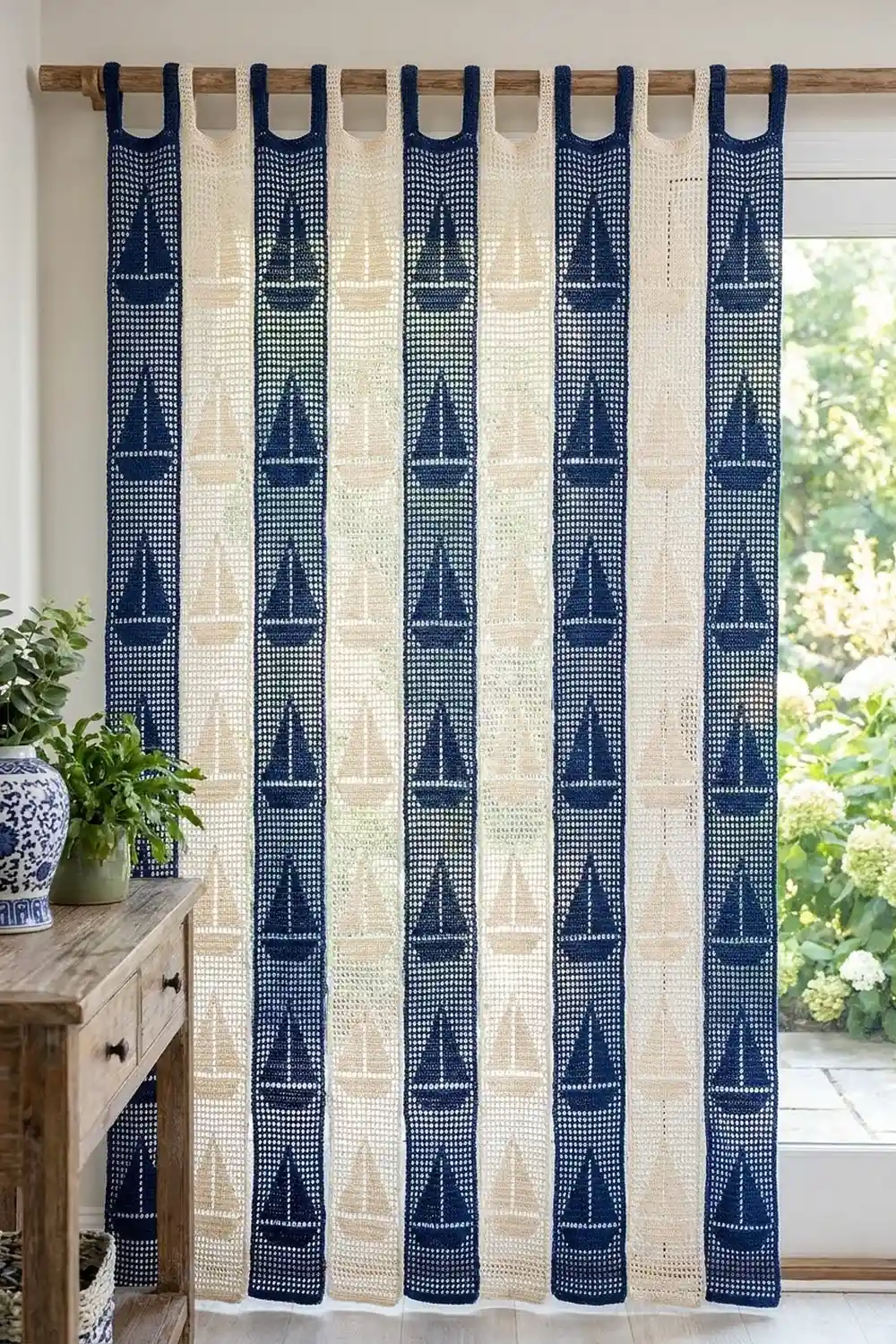
This breezy door curtain is made of seven long filet crochet strips, each carrying a column of small sailboats. The strips alternate deep navy and cream and hang from a curtain rod by two loops each. Because the strips are not joined, you can walk through the curtain easily and push it aside like a beaded door curtain.
Every strip is worked in a single color. The boats are made of solid filet blocks set into open mesh, so they show up as clean silhouettes, especially with daylight behind them. The look is coastal, light and graphic. It suits a patio door, a pantry opening or a wide window.
The pattern uses US crochet terms. Each finished strip measures 5 in (12.7 cm) wide by 75.5 in (191.8 cm) long, plus hanging loops about 1.5 in (3.8 cm) tall.
Construction is simple. You work each strip flat in rows of ch-1 filet mesh from the bottom up, add a round of single crochet edging, and then add two covered chain loops at the top corners. Make seven strips and slide them onto your rod.
Finished Size and Construction
- Strip size (finished): 5 in x 75.5 in (12.7 cm x 191.8 cm), plus loops of 1.5 in (3.8 cm)
- Skill level: Easy / Advanced Beginner
- Terminology: US crochet terms
- Yarn weight: Medium (#4) worsted cotton
- Hook: US 7 (4.5 mm)
- Number of pieces: 7 separate strips (4 navy, 3 cream)
- Layout: 7 strips side by side on a rod, not joined
- Mesh size: 9 squares wide x 150 rows tall
- Size before border: 4.5 in x 75 in (11.4 cm x 190.5 cm)
- Border depth: 0.25 in (0.6 cm) on every side, from 1 round of sc
- Curtain width: 35 in (88.9 cm) with strips touching, or about 38 in (96.5 cm) with 0.5 in (1.3 cm) gaps
Materials
Yarn: Choose a smooth, mercerized or combed worsted-weight cotton. Cotton holds the filet squares crisp, does not stretch much when it hangs, and washes well. Avoid fuzzy or very stretchy acrylics, which blur the boat shapes and can grow in length.
- Navy: 360 g / 560 m (4 strips at 90 g / 140 m each)
- Cream: 270 g / 420 m (3 strips at 90 g / 140 m each)
Each strip uses about 77 g / 119 m. The quantities above include a margin of roughly 15% for your gauge swatch, tension differences and the loops.
Tools:
– US 7 (4.5 mm) crochet hook
– Tapestry needle
– Locking stitch markers
– Measuring tape
– Rust-proof pins and a long blocking surface (foam mats or a carpeted floor covered with a towel)
– A curtain rod up to 1 in (2.5 cm) in diameter
Abbreviations (US Terms)
- ch – chain
- sc – single crochet
- dc – double crochet
- sl st – slip stitch
- sk – skip
- sp – space
- st(s) – stitch(es)
- RS / WS – right side / wrong side
Special stitches (filet squares):
– Open square (O): ch 1, sk next st (a ch-1 sp or the middle dc of a block), dc in next dc.
– Block (B): dc in next st (a ch-1 sp or the middle dc of a block), dc in next dc.
– Row start: ch 4 (counts as dc + ch-1 sp), turn, dc in next dc. This makes square 1 as an open square. In this design square 1 is always open.
– Row end: the last dc of every row goes into the 3rd ch of the turning ch-4. This closes square 9, which is also always open.
Every row has 19 sts: 10 dc plus 9 ch-1 sps. Each block swaps one ch-1 sp for one dc, so the total stays at 19.
Gauge and Checkpoints
Gauge: 1 filet square = 0.5 in (1.3 cm) wide x 0.5 in (1.3 cm) tall. That works out to 9 squares = 4.5 in (11.4 cm) and 12 rows = 6 in (15.2 cm).
Do not make a separate swatch. Instead, start your first strip and work Rows 1–12, which is the first open band plus the first boat. Then lay it flat and measure.
Checkpoints:
– After Row 12: 4.5 in (11.4 cm) wide x 6 in (15.2 cm) tall
– After Row 72 (6 boats): 36 in (91.4 cm) tall
– After Row 150: 75 in (190.5 cm) tall
– After the border: 5 in x 75.5 in (12.7 cm x 191.8 cm)
If your strip is too big: go down to a 4 mm (US G-6) hook, and keep your ch-1 spaces snug.
If your strip is too small: go up to a 5 mm (US H-8) hook. Height matters more than width here. If your rows are short, pull up the first loop of each dc a little taller.
Over 150 rows, a height difference of just 0.05 in (0.1 cm) per row adds up to 7.5 in (19.1 cm). That is why checking at Row 12 matters.
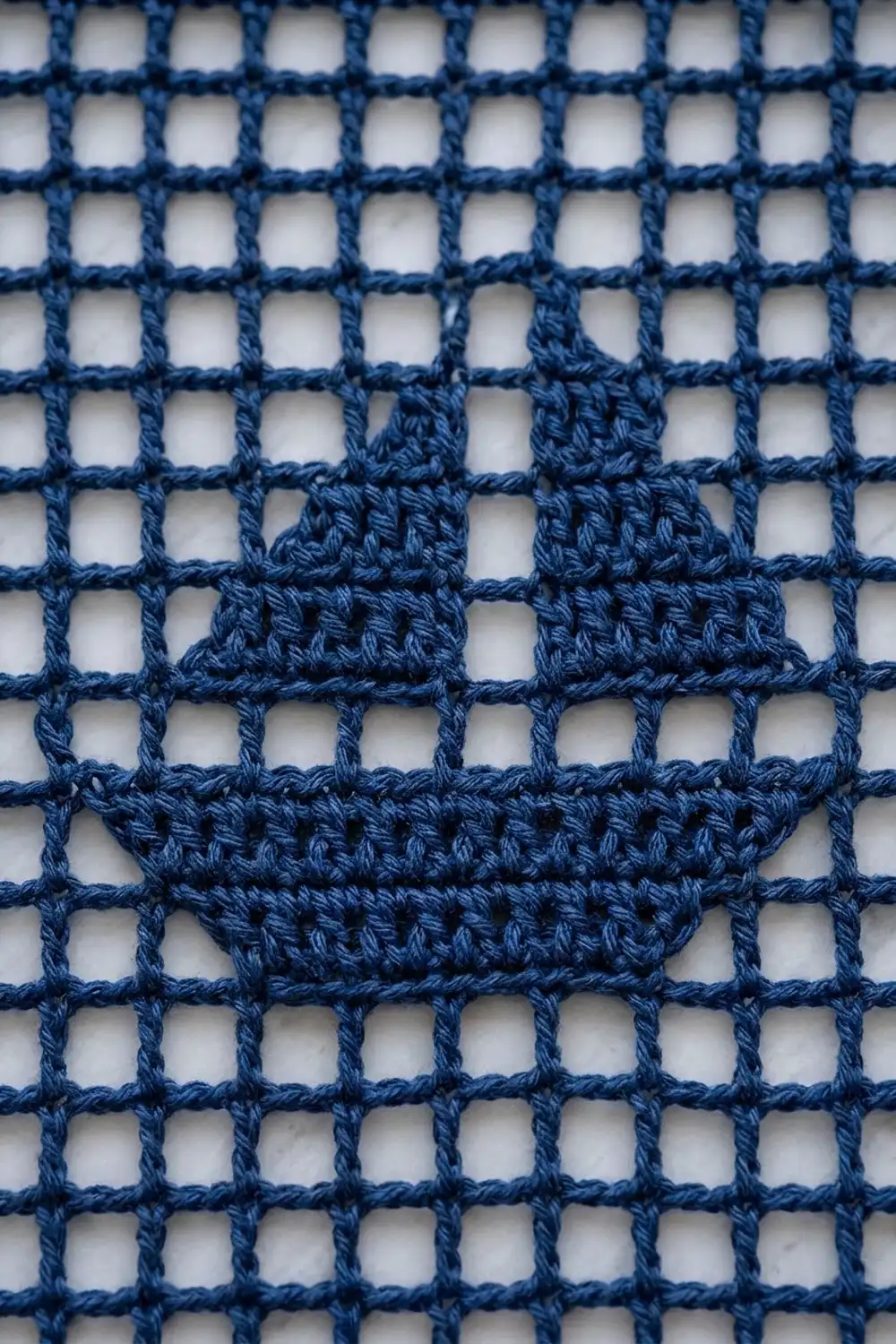
Strip Pattern (Make 7)
Squares are numbered 1 to 9 in the order you work them on RS (odd-numbered) rows. On WS (even-numbered) rows, you work from square 9 back to square 1. The row instructions below are already written in working order, so just follow them as written.
Foundation
Ch 21.
Row 1 (RS): Dc in the 5th ch from hook. The skipped chs count as dc + ch-1 sp and make the first open square. [Ch 1, sk next ch, dc in next ch] 8 times. (9 open squares: 10 dc, 9 ch-1 sps, 19 sts)
Rows 2–6: Row start, then O 8 times, with the last dc in the 3rd ch of the turning ch. (9 open squares, 19 sts per row)
Boat Motif
Row 7 (RS) – hull bottom: Row start, O 1, B 5, O 2. (Squares 1–2 open, 3–7 blocks, 8–9 open: 15 dc, 4 ch-1 sps, 19 sts)
Row 8 (WS) – hull top: Row start, B 7, O 1. (Squares 9 and 1 open, 7 blocks between them: 17 dc, 2 ch-1 sps, 19 sts)
The hull now steps outward by one square on each side, which makes it wider at the top.
Row 9 (RS) – sail base: Row start, O 1, B 2, O 1, B 3, O 1. (Blocks in squares 3–4 and 6–8, with square 5 open as the mast gap: 15 dc, 4 ch-1 sps, 19 sts)
When you work a block over an open square, put the first dc into the ch-1 sp. When you work an open square over a block, ch 1 and skip the middle dc.
Row 10 (WS): Row start, O 1, B 2, O 1, B 1, O 3. (Working order: squares 9–8 open, 7–6 blocks, 5 open, 4 block, 3–1 open: 13 dc, 6 ch-1 sps, 19 sts)
Row 11 (RS): Row start, O 4, B 2, O 2. (Blocks in squares 6–7: 12 dc, 7 ch-1 sps, 19 sts)
Row 12 (WS) – mainsail tip: Row start, O 1, B 1, O 5. (Working order: squares 9–7 open, 6 block, 5–1 open: 11 dc, 8 ch-1 sps, 19 sts)
The jib is 2 squares then 1 square, so it is 2 rows tall. The mainsail is 3, 2, 2, then 1 squares, so it is 4 rows tall. Together they give the boat its two-sail outline with an open mast line between them.
Checkpoint: 4.5 in x 6 in (11.4 cm x 15.2 cm).
Repeating the Boats
Rows 13–144: [Work 6 rows as Row 2 (open mesh), then work 6 rows as Rows 7–12] 11 times. (12 boats in total. The repeat is 12 rows, an even number, so the boat rows always fall on the same RS/WS rows and every boat faces the same way.)
Boat number k sits on Rows (12k – 5) through 12k. For example, boat 6 sits on Rows 67–72.
Rows 145–150: Work 6 rows as Row 2. (This open band at the top matches the one at the bottom.)
Do not fasten off. Checkpoint: 4.5 in x 75 in (11.4 cm x 190.5 cm), 150 rows, 19 sts per row.
Make All Pieces
- Navy: 4 strips
- Cream: 3 strips
- Total: 7 identical strips, each with 12 boats
Layout, left to right:
| N | C | N | C | N | C | N |
N = navy, C = cream. Navy strips sit at both outer edges.
Joining and Hanging
The strips are not joined. Each one hangs on its own from two loops, so the curtain parts easily when you walk through it.
Spacing: Seven strips at 5 in (12.7 cm) each come to 35 in (88.9 cm) if they touch. If you leave 0.5 in (1.3 cm) between strips (6 gaps), the curtain covers about 38 in (96.5 cm). Measure your door opening before you make all seven. You can add or remove strips in pairs to keep navy at both edges.
Tension advice: Make both loops on a strip with the same number of stitches so the strip hangs level. A loop that is even one stitch tighter will tilt the strip.
Size checkpoint: When hung, every strip should end at the same height, within 0.5 in (1.3 cm). If one is longer, re-block it before you change any stitches.
Border
Border gauge: about 4 sc per inch (2.5 cm) on every side. That matches the mesh: 2 sc per 0.5 in (1.3 cm) square on all edges.
Round 1: Continue with the loop on your hook from Row 150, with RS facing.
- Top edge: ch 1, 3 sc in the first dc (corner). Then sc in each ch-1 sp and each dc across to the last st, and 3 sc in the last st (corner).
- Long side: 2 sc in the side of each row, so 150 rows x 2 = 300 sc.
- Bottom edge: 3 sc in the corner st. Then sc in each foundation ch-1 sp and the base of each dc across, and 3 sc in the last corner st.
- Second long side: 300 sc.
- Join with a sl st to the first sc.
Count:
– Top: 19 sts worked 1 per existing st + 4 extra corner sc = 23 sc, including both corner groups
– Bottom: 19 + 4 = 23 sc
– Each long side: 300 sc between the corner groups
– Round total: (19 + 19 + 300 + 300) worked once into the edge + 8 extra corner sc = 646 sc
Why the math works: The top edge has 19 sc across 4.5 in (11.4 cm), which is about 4.2 sc per inch. Each side has 300 sc across 75 in (190.5 cm), which is exactly 4 sc per inch. Those rates are close enough that the edging lies flat without ruffling or cupping. The 3-sc corners make square turns. The border adds 0.25 in (0.6 cm) on every side, giving 5 in x 75.5 in (12.7 cm x 191.8 cm).
Fasten off and weave in the end.
Hanging Loops (make 2 per strip)
With RS facing, number the 23 top-edge sc from right to left. The loops go on sc 2 and sc 22, which are the center sc of each top corner group.
- Join the yarn with a sl st in sc 2.
- Ch 14 and sl st in the same sc to form a loop.
- Work 22 sc into the loop, covering the chain completely.
- Sl st into the same base sc and fasten off.
- Repeat on sc 22.
Each covered loop stands about 1.5 in (3.8 cm) tall and fits a rod up to 1 in (2.5 cm) thick. The total hanging length is 77 in (195.6 cm).
Final Blocking
- Soak the strip in cool water with a little wool wash or mild soap for 15 minutes.
- Press the water out gently. Roll the strip in a towel, and do not wring it.
- Lay it on your blocking surface with RS up.
- Pin the four corners to 5 in x 75.5 in (12.7 cm x 191.8 cm).
- Pin along both long edges every 6 in (15.2 cm), keeping the width at 5 in (12.7 cm) the whole way down.
- Nudge the mesh into true squares, and check that the open mast gap on each boat is clearly visible.
- Lay the loops flat and pin them upright.
- Let the strip dry completely, usually 24 hours.
- Block all seven strips to the same pin positions so they match.
Final Quality-Control Checklist
- Every strip has 150 rows and 19 sts per row.
- Each strip has 12 boats that all face the same way.
- Squares 1 and 9 are open on every row.
- The border round totals 646 sc, with 23 sc across the top and bottom and 300 sc on each long side.
- Loops sit on sc 2 and sc 22, and each one has 22 sc.
- Blocked size is 5 in x 75.5 in (12.7 cm x 191.8 cm).
- All ends are woven in securely, especially at the loops.
- You have 4 navy and 3 cream strips, arranged N-C-N-C-N-C-N.
Troubleshooting
The strip is getting wider or narrower. Count your dc. Every row needs 10 dc plus 9 ch-1 sps. Check that the last dc goes into the turning chain.
A boat is facing the wrong way. A row was probably skipped or doubled, which flips the RS/WS order. Check that boat k ends on Row 12k.
The blocks look smaller than the open squares. Your dc in the ch-1 sp may be too tight. Work it loosely, the same as your other dc.
The border ruffles along the sides. Your rows may be shorter than 0.5 in (1.3 cm). Work 3 sc in every other row-end pair instead of 4 per two rows, or block the strip firmly.
The strip sags longer when hung. Re-block it and let it dry flat. Next time, use a firmer cotton or a smaller hook.
One strip hangs tilted. The two loops are uneven. Redo the shorter one with exactly 22 sc.
Care
Hand wash or machine wash on a gentle cycle in cool water, inside a laundry bag. Reshape the strips and dry them flat to keep their length even.
Final Notes
The measurement chain is simple. One square is 0.5 in (1.3 cm), 9 squares make a 4.5 in (11.4 cm) width, and 150 rows make a 75 in (190.5 cm) length. The sc border adds 0.25 in (0.6 cm) on every side, giving a 5 in x 75.5 in (12.7 cm x 191.8 cm) strip. Two 1.5 in (3.8 cm) loops bring the hanging length to 77 in (195.6 cm). Seven strips cover 35 in (88.9 cm) to 38 in (96.5 cm) of doorway.
If you check your first strip at Row 12 and keep your counts honest, all seven strips will hang evenly in the breeze.
Happy crocheting!