

The Ivory Bloom Coverlet is a bed-sized lace throw made entirely from five-petal flower motifs in one soft cream shade. Each flower has an open wheel center with ten spokes, a solid sc ring, and five rounded, ribbed petals outlined in single crochet.
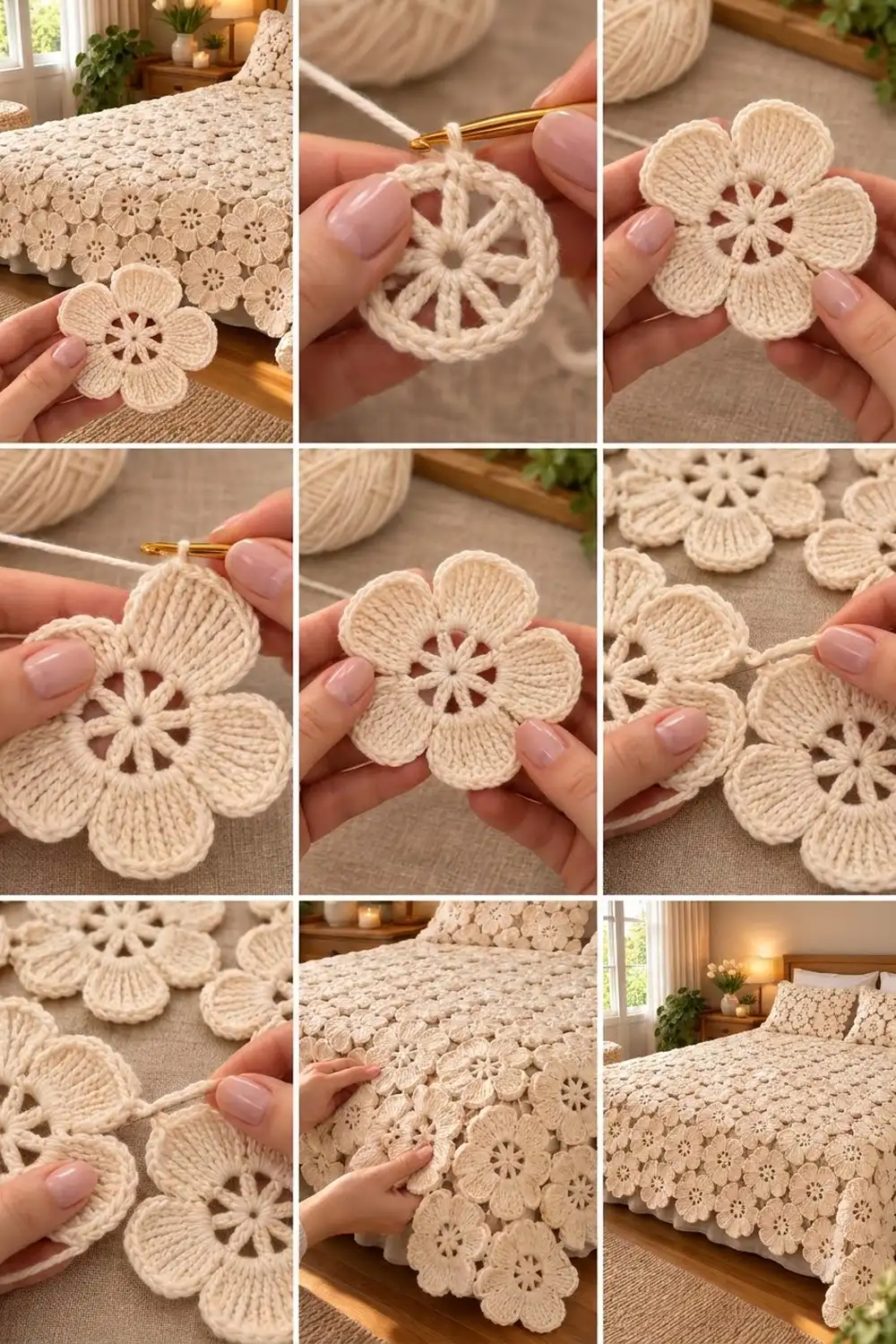
You join the flowers as you go at their petal tips, in staggered rows. The finished piece reads as a field of separate blossoms with small open gaps between them. The look is calm, textured, and cottage-style. It suits a white or natural bedroom and layers well over a plain blanket.
This pattern uses US crochet terms. With the optional edge round, the finished coverlet measures about 71.75 in x 86 in (182.2 cm x 218.4 cm). That fits a twin bed with a generous drop, or works as a topper on a larger bed.
Construction is simple: crochet one motif in four rounds, then join each new motif to its neighbors during Round 4. You can add a two-round chain-bridge edge at the end to steady the scalloped outline.
Finished Size and Construction
- Finished size: 71.75 in x 86 in (182.2 cm x 218.4 cm)
- Skill level: Intermediate (join-as-you-go)
- Terminology: US crochet terms
- Yarn weight: Worsted (#4), cotton or cotton blend
- Hook: 5 mm (H-8)
- Number of pieces: 276 flower motifs
- Layout: 19 staggered rows, alternating 15 and 14 motifs
- Piece size: 4.75 in (12.1 cm) across the two side petal tips; 4.5 in (11.4 cm) from the top tip to the lower petal line
- Size before border: 71.25 in x 85.5 in (181.0 cm x 217.2 cm)
- Border depth: about 0.25 in (0.6 cm) beyond the outer petal tips
Materials
Choose a smooth worsted cotton or cotton blend with about 180 m per 100 g (197 yd per 100 g). Cotton shows the ribbed petal texture clearly and keeps the flowers flat. Avoid fuzzy or highly textured yarn, because it hides the spokes.
- Cream / ivory: 2,650 g, about 4,770 m (5,217 yd), roughly 27 skeins of 100 g
Each motif uses about 8.5 g (15 m). The border uses about 50 g (90 m). The total above includes a margin of about 10% for gauge swatches, tails, and dye-lot safety. Buy all the yarn from one dye lot.
Tools
- 5 mm (H-8) crochet hook
- Tapestry needle
- Scissors
- Stitch markers
- Tape measure
- Blocking mats, rustproof pins, and a spray bottle
Abbreviations (US Terms)
- ch – chain
- sl st – slip stitch
- sc – single crochet
- dc – double crochet
- tr – treble crochet
- sp(s) – space(s)
- st(s) – stitch(es)
- rnd – round
- RS – right side
- T – top petal
- UL / UR – upper-left / upper-right petal
- LL / LR – lower-left / lower-right petal
Special stitch – Joining tip (JT): In place of the ch 2 at a petal tip, work ch 1, sl st into the ch-2 tip of the neighboring motif, ch 1.
Double joining tip (DJT): Ch 1, sl st into the first neighbor’s tip, ch 1, sl st into the second neighbor’s tip, ch 1.
Gauge and Checkpoints
Make one complete motif before you start the coverlet. Gauge matters more than usual here, because 276 small errors add up quickly.
- After Rnd 1: the wheel measures 1.5 in (3.8 cm) across.
- After Rnd 2: the sc ring measures 2.25 in (5.7 cm) across.
- After Rnd 3: center to petal tip measures 2.25 in (5.7 cm).
- After Rnd 4: center to petal tip measures 2.5 in (6.4 cm). The width across the UL and UR tips is 4.75 in (12.1 cm). The height from the T tip to the LL/LR line is 4.5 in (11.4 cm).
If your motif is too big, change to a 4.5 mm hook. If it is too small, change to a 5.5 mm hook. Measure the motif lightly blocked and lying flat, without stretching it.
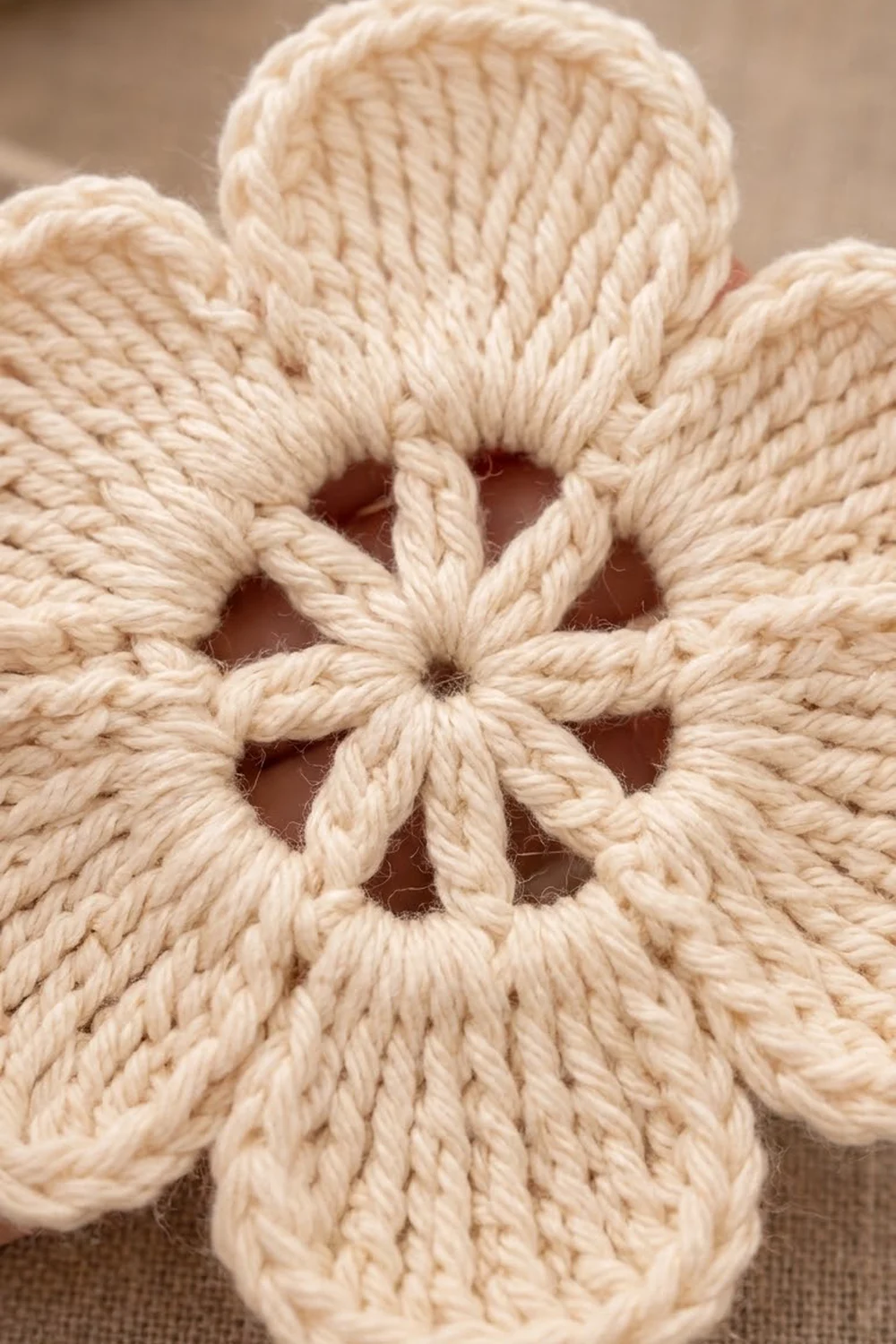
Flower Motif
Make 276. Work in the round with the RS facing and do not turn.
Rnd 1 (spokes): Make a magic ring. Ch 6 (counts as tr + ch 2), then [tr in ring, ch 2] 9 times. Pull the ring closed and sl st to the 4th ch of the beginning ch-6. (10 tr, 10 ch-2 sps)
The tr posts become the ten spokes, and the ch-2 sps become the open windows of the wheel.
Rnd 2 (sc ring): Ch 1, sc in same st as join, 3 sc in next ch-2 sp, sc in next tr, 3 sc in next ch-2 sp; repeat from * 8 more times. Sl st to first sc. (40 sc)*
This is a conversion round: 10 sc worked 1-per-tr + 30 sc worked into the 10 spaces = 40 sc.
Rnd 3 (petals): Ch 1. Start the first repeat in the same st as the join: sc in next st, dc in next st, 2 tr in each of next 4 sts, dc in next st, sc in next st; repeat from * 4 more times. Sl st to first sc. (5 petals of 12 sts each = 60 sts)*
Each petal uses 8 stitches of Rnd 2 (5 x 8 = 40). Per petal: 1 sc + 1 dc + 8 tr + 1 dc + 1 sc = 12 sts. The tall tr posts give the petals their vertical ribbed look. The sc at each end makes the deep notch between petals.
Rnd 4 (petal outline): Ch 1 (does not count). Start the first repeat in the same sc as the join: sl st in next sc, sc in next dc, sc in next tr, 2 sc in next tr, sc in next tr, 2 sc in next tr, ch 2 (petal tip), 2 sc in next tr, sc in next tr, 2 sc in next tr, sc in next tr, sc in next dc, sl st in next sc; repeat from * 4 more times. Join with a sl st to the first sl st. Fasten off and weave in the ends. (80 sts + 5 ch-2 tips)*
Per petal: 1 sl st + 1 sc + 6 sc + ch-2 tip + 6 sc + 1 sc + 1 sl st = 16 sts plus one ch-2 tip. Five petals give 80 sts. The 8 tr take 12 sc (8 worked 1-per-st + 4 increases), which rounds the petal.
Make All Pieces
All 276 motifs are cream.
- Odd rows (1, 3, 5 … 19): 10 rows x 15 motifs = 150 motifs
- Even rows (2, 4, 6 … 18): 9 rows x 14 motifs = 126 motifs
- Total: 150 + 126 = 276 motifs
Lay each motif with one petal (T) pointing toward the top edge. Even rows sit half a motif to the right, so each even-row flower nests between two flowers above it.
Row 1:   O O O O O O O O O O O O O O O   (15)
Row 2:    O O O O O O O O O O O O O O    (14)
Row 3:   O O O O O O O O O O O O O O O   (15)
Row 4:    O O O O O O O O O O O O O O    (14)
 ...      continue alternating ...
Row 19:  O O O O O O O O O O O O O O O   (15)
The first motif is a complete flower with no joins. Every later motif is joined during its own Rnd 4.
Joining
Use join-as-you-go at the petal tips only. Work Rnd 4 as written, and swap the ch 2 for a JT or DJT wherever a neighbor is already in place. The sc counts never change; only the tip chain changes.
Row 1: Motif 1 has no joins. For motifs 2–15, join the UL tip to the UR tip of the previous motif (JT).
Even rows: Motif k joins its T tip to the LR tip of motif k and the LL tip of motif k+1 in the row above (DJT). From motif 2 onward, also join the UL tip to the UR tip of the previous motif (JT).
Odd rows 3–19:
– Motif 1: join the T tip to the LL of motif 1 above (JT).
– Motifs 2–14: join the T tip to the LR of motif k–1 and the LL of motif k above (DJT).
– Motif 15: join the T tip to the LR of motif 14 above (JT).
– Motifs 2–15: join the UL tip to the UR of the previous motif (JT).
Each join is one sl st into a ch-2 tip, never into a petal stitch, so the motifs stay flat. Keep the ch 1 on each side of a join at the same height as your sc. A tight sl st will cup the petal.
Size checkpoint: After Rows 1 and 2, the strip should measure 71.25 in (181.0 cm) wide and about 9 in (22.9 cm) deep. Each motif adds 4.75 in (12.1 cm) of width (15 x 4.75 = 71.25 in). Each row adds 4.5 in (11.4 cm) of length (19 x 4.5 = 85.5 in).
Border (Optional Edge Round)
The coverlet shown leaves the petals free. For a steadier edge, add this two-round chain bridge. It anchors only at outer petal tips and joins, so the scallops stay visible above it.
Border gauge: ch 9 measures about 3 in (7.6 cm). Use ch 9 to span two tips of one motif and ch 5 for the short gap between bottom motifs. Use ch 7 to go from an odd-row lower tip to the even-row upper side tip below it, and ch 15 to cross a side notch.
Anchors: An anchor is an sc worked into an exposed ch-2 tip, or around both ch-1s of a top-edge join. The corners are:
– Top-left: Row 1 motif 1 UL
– Top-right: Row 1 motif 15 UR
– Bottom-right: Row 19 motif 15 LR
– Bottom-left: Row 19 motif 1 LL
Rnd 1 (bridges): Join the yarn at the top-left corner tip. Work an sc in each anchor in order around the coverlet, with the chains below between anchors. Sl st to the first sc.
- Top (30 loops): UL, T, join, T, join … T, UR. That is 2 loops per motif x 15 motifs = 30 loops, all ch 9. 29 inner anchors.
- Right side (28 loops): On each odd row, ch 9 from UR to LR (10 loops). Ch 7 from that LR to the UR of the even-row motif below (9 loops). Ch 15 from that even UR to the UR of the next odd row (9 loops). 27 inner anchors.
- Bottom (29 loops): Ch 9 from each motif’s LR to its LL (15 loops) and ch 5 from that LL to the next motif’s LR (14 loops). 28 inner anchors.
- Left side (28 loops): Mirror of the right side: 10 x ch 9, 9 x ch 7, 9 x ch 15. 27 inner anchors.
Count: 115 anchors (27 + 28 + 29 + 27 inner, plus 4 corners) and 1,051 chains (270 + 288 + 205 + 288). (1,166 sts)
Rnd 2 (sc edge): Ch 1. Work 1 sc in each anchor sc, 1 sc for each chain (worked into the loop), and 3 sc in each corner anchor. Sl st to the first sc and fasten off.
Rnd 2 is a conversion round: 1,166 sts worked 1-per-stitch + 8 extra corner sts = 1,174 sc.
- Top: 270 + 29 = 299 sc
- Right: 288 + 27 = 315 sc
- Bottom: 205 + 28 = 233 sc
- Left: 288 + 27 = 315 sc
- Corners: 4 x 3 = 12 sc
- Total: 299 + 315 + 233 + 315 + 12 = 1,174 sc
Why the math works: Every loop holds as many sc as it has chains, so Rnd 2 adds no ruffle. Each chain length matches the straight distance between its two tips (two tips of one motif are about 3 in apart). That keeps the edge flat and adds only about 0.25 in (0.6 cm) per side. The coverlet grows from 71.25 in x 85.5 in to 71.75 in x 86 in (182.2 cm x 218.4 cm).
Final Blocking
- Weave in all remaining tails along the backs of the sc rounds.
- Lay the coverlet flat on mats, or on a clean carpet covered with a sheet.
- Mist it evenly until damp, not soaked.
- Pin the four corners first, to 71.75 in x 86 in (182.2 cm x 218.4 cm).
- Pin along each edge every 6–8 in (15.2–20.3 cm), keeping the rows straight.
- Pat each petal flat with your palm and open the center wheels with a fingertip.
- Let it dry completely before unpinning, usually about 24 hours.
Final Quality-Control Checklist
- Every motif has 10 spokes, a 40-sc ring, and 5 petals.
- All petals point the same way, with T toward the top edge.
- Rows alternate 15 and 14 motifs, 19 rows in total.
- No tip is left unjoined where a neighbor touches it.
- Width is 71.25 in (181.0 cm) before the border.
- Border Rnd 2 totals 1,174 sc.
- All ends are woven in and trimmed.
Troubleshooting
Center wheel ruffles: Your tr are too tall. Tighten the ch-2 sps or go down a hook size.
Petals cup or curl: Rnd 4 is too tight. Loosen your sc, and check that each petal has exactly 4 increases.
Gaps look too large: The ch-1s around your joins are loose. Keep them snug and level with the sc.
Coverlet leans: A T tip is joined to the wrong neighbor. Compare it with the joining list and redo that tip.
Border waves: There are too many sc in the loops. Work exactly one sc per chain.
Border pulls in: Your chains are tight. Go up a hook size for Rnd 1 only.
Care
Hand wash, or machine wash cool on a gentle cycle in a laundry bag. Dry flat and reshape the petals while damp.
Final Notes
The measurement chain is simple. A 1.5 in (3.8 cm) wheel grows to a 2.25 in (5.7 cm) ring, then to a 4.75 in (12.1 cm) flower. Fifteen flowers make 71.25 in (181.0 cm) of width, and 19 rows at 4.5 in (11.4 cm) make 85.5 in (217.2 cm) of length. The optional border brings the coverlet to 71.75 in x 86 in (182.2 cm x 218.4 cm). Check your first motif and your first two rows, and the rest will follow.
Happy crocheting!