
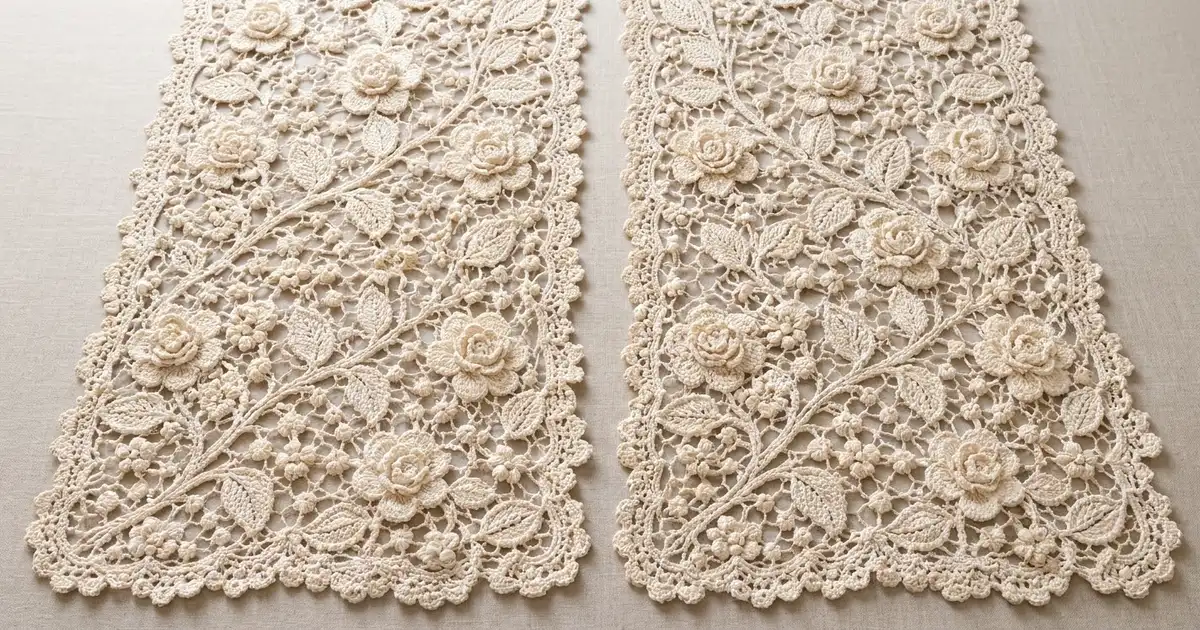
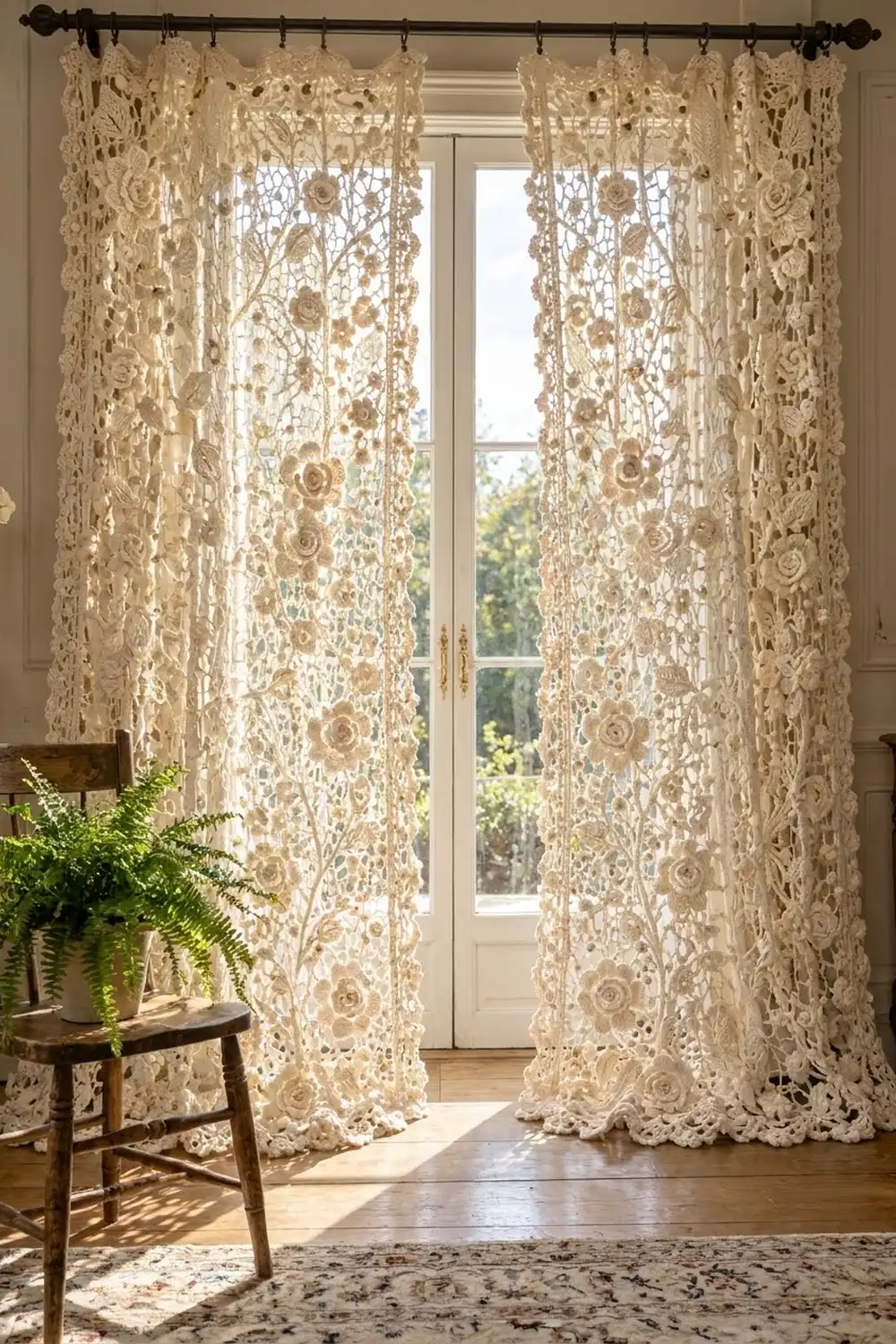
These curtains are made from soft ivory lace with raised roses, ridged leaves and small bobble flowers spread across an open mesh. When they hang in a sunny window, the light comes through the mesh and the roses stand out in relief, much like heirloom Irish crochet.
The pattern makes a pair of curtain panels in one color, a warm ivory cotton. The style is romantic and vintage, but each block is worked in simple, countable rounds. All instructions use US crochet terms.
Each finished panel measures 43 × 91 in (109.2 × 231.1 cm) after blocking. Hang each panel with clip rings.
Here is how the panels are built. You make 8 in (20.3 cm) square rose blocks, starting each one with a three-tier rose at the center and squaring it off with mesh. Then you sew four leaves and a coiled bud onto each block, join 55 blocks per panel, and finish with a scalloped border.
Finished Size and Construction
- Finished size (each panel): 43 × 91 in (109.2 × 231.1 cm)
- Skill level: Experienced
- Terminology: US
- Yarn weight: DK (#3 light), mercerized cotton
- Hook: 3.25 mm (US D-3)
- Number of pieces: 2 panels, each with 55 rose blocks (110 blocks total)
- Layout: 5 blocks wide × 11 blocks long per panel
- Block size: 8 × 8 in (20.3 × 20.3 cm), 38 sts per side
- Size before border: 40 × 88 in (101.6 × 223.5 cm)
- Border depth: 1.5 in (3.8 cm) on every side
Materials
Yarn: Use a smooth, tightly plied mercerized cotton in DK weight, about 110 m per 50 g. Mercerized cotton gives you crisp petals, a clear stitch definition and a soft sheen. Buy all your yarn from a single dye lot.
- Ivory: 2,700 g (about 5,940 m / 6,496 yd)
The quantity includes a margin of about 10% for gauge swatches, sewing tails and small differences in tension.
Tools:
– 3.25 mm (US D-3) crochet hook
– 3.5 mm (US E-4) hook, for joining
– Tapestry needle
– Rust-proof pins and blocking mats
– Spray bottle
– Stitch markers
– Tape measure
– Curtain clip rings, about 10 per panel
Abbreviations (US Terms)
- ch – chain
- sl st – slip stitch
- sc – single crochet
- hdc – half double crochet
- dc – double crochet
- st(s) – stitch(es)
- sp – space
- BLO – back loop only
- RS / WS – right side / wrong side
Special stitches
- Bobble: [Yo, insert hook in the indicated st, yo and pull up a loop, yo and draw through 2 loops] 5 times, then yo and draw through all 6 loops on the hook.
- Bobble flower (bf): Ch 3, then work a bobble in the 3rd ch from the hook.
- bf-loop: Ch 2, bf, ch 2. Once the bobble pops forward, this loop is the same length as a ch-5 loop.
Gauge and Checkpoints
Gauge: 19 sc and 21 rows = 4 in (10.2 cm) with a 3.25 mm hook.
Make one complete block before you start production, including the blocking step. The block is your real gauge test.
Checkpoints for each block:
– After Rnd 3: 2.25 in (5.7 cm) across
– After Rnd 7: 4 in (10.2 cm) across the outer petals
– After Rnd 9: 4.75 in (12.1 cm) across
– After Rnd 13: 7.75 in (19.7 cm) square before blocking, 8 in (20.3 cm) after blocking
If your block is too big, go down to a 3.0 mm hook. If it’s too small, go up to a 3.5 mm hook. A difference of 0.5 in (1.3 cm) per block adds up to 5.5 in (14.0 cm) over the length of a panel, so fix the gauge first.
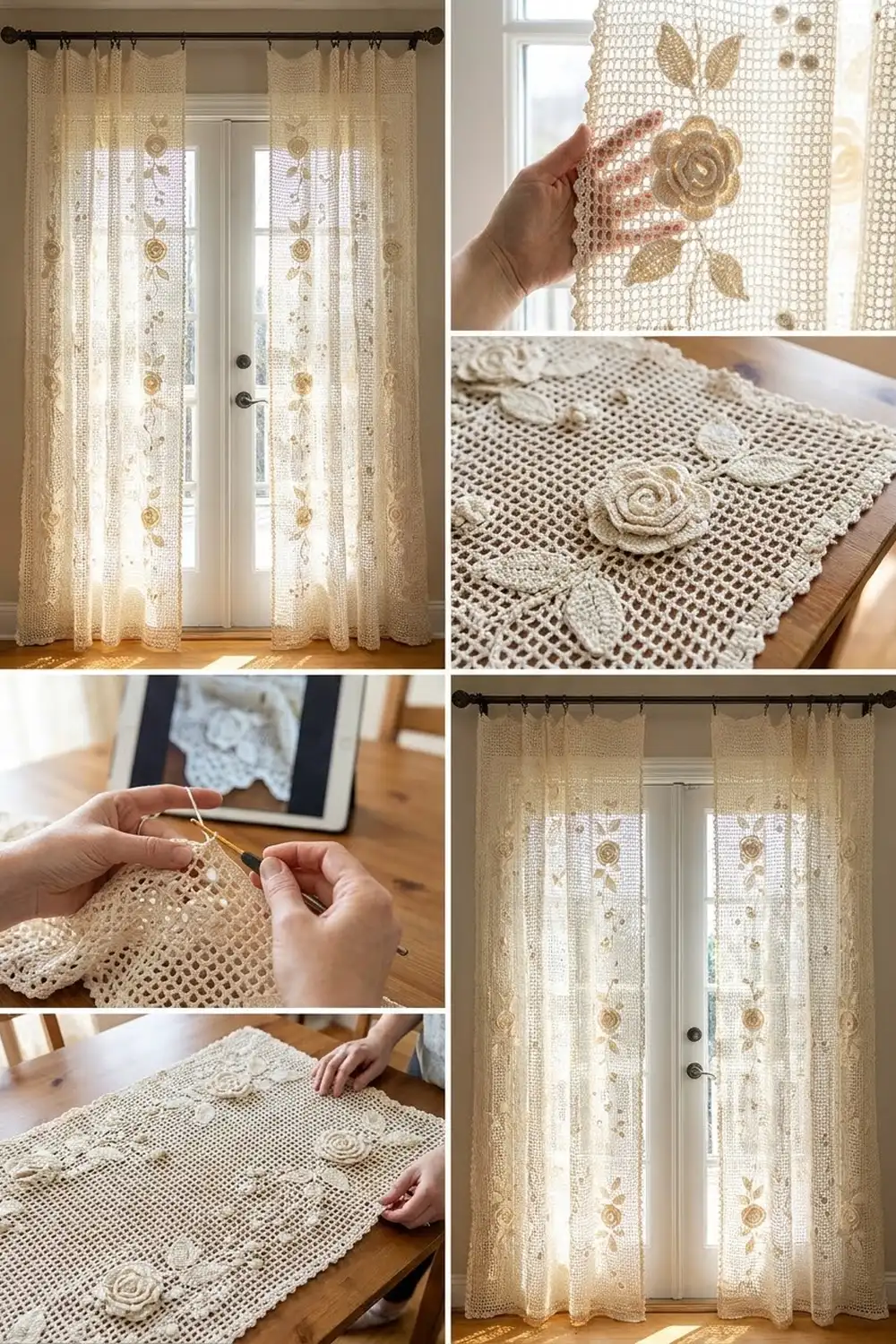
Rose Block (make 110)
Rnd 1: Ch 8 and sl st to the first ch to form a ring. Ch 1, work 16 sc in the ring, sl st to the first sc. (16 sc)
Rnd 2: Ch 1, sc in the first st, ch 3, skip 1. Sc in the next st, ch 3, skip 1. Repeat from * 6 more times. Sl st to the first sc. (8 sc, 8 ch-3 sps)
Rnd 3 (inner petals): Work (sc, hdc, 3 dc, hdc, sc) in each ch-3 sp. Sl st to the first sc. (8 petals, 56 sts)
Rnd 4: Working behind the petals, ch 1. Sc around the post of the next Rnd 2 sc from the back, ch 5. Repeat from * 7 more times. Sl st to the first sc. (8 ch-5 loops)
Rnd 5 (middle petals): Work (sc, hdc, 5 dc, hdc, sc) in each ch-5 loop. Sl st to the first sc. (8 petals, 72 sts)
Rnd 6: Working behind the petals, sc around the post of the next Rnd 4 sc, ch 7. Repeat from * 7 more times. Sl st to the first sc. (8 ch-7 loops)
Rnd 7 (outer petals): Work (sc, hdc, 7 dc, hdc, sc) in each ch-7 loop. Sl st to the first sc. (8 petals, 88 sts)
Each tier of petals is two dc wider than the tier before it and sits behind it, which gives the rose its cupped, layered look.
Rnd 8: Working behind the petals, sc around the post of the next Rnd 6 sc, ch 9. Repeat from * 7 more times. Sl st to the first sc. (8 ch-9 loops)
Rnd 9 (conversion round): Work 12 sc in each ch-9 loop. Sl st to the first sc. (8 loops × 12 sc = 96 sc)
Rnd 10 (squaring round): Ch 1, sc in the same st as the join, ch 5, skip 3. [Sc in the next st, ch 5, skip 3] 4 times. Sc in the next st, ch 9, skip 3. [Sc in the next st, ch 5, skip 3] 5 times, sc in the next st, ch 9, skip 3. Repeat from * 2 more times. Sl st to the first sc.
(24 sc. 24 loops: 20 ch-5 and 4 corner ch-9. Each repeat uses 4 sts, and 24 × 4 = 96.)
Rnd 11: Sl st in the next 3 ch. Ch 1, sc in the same loop. [Ch 5, sc in the next ch-5 loop] 4 times, ch 5, then work (sc, ch 7, sc) in the corner ch-9 loop. Ch 5, sc in the next ch-5 loop, [ch 5, sc in the next ch-5 loop] 4 times, ch 5, (sc, ch 7, sc) in the corner loop. Repeat from * 2 more times. Ch 5 and sl st to the first sc.
(28 sc. 6 ch-5 loops per side, 24 in total, plus 4 corner ch-7 loops.)
Rnd 12 (bobble round): Sl st in the next 3 ch. Ch 1, sc in the same loop.
[Ch 5, sc in the next ch-5 loop, bf-loop, sc in the next ch-5 loop] 2 times. Ch 5, (sc, ch 7, sc) in the corner ch-7 loop. Ch 5, sc in the next ch-5 loop, bf-loop, sc in the next ch-5 loop.
Repeat from * 3 more times. On the last repeat, leave out the final sc and sl st to the first sc instead.
(32 sc. 7 loops per side, in the order ch-5, bf, ch-5, bf, ch-5, bf, ch-5 between the corners. That makes 28 side loops, with 12 bobble flowers, plus 4 corner ch-7 loops.)
Rnd 13 (edge round): Ch 1. Work 4 sc in each side loop. In each bf-loop, put 2 sc on each side of the bobble so it stays on top. Work 9 sc in each corner ch-7 loop. Sl st to the first sc. Fasten off.
(28 loops × 4 = 112 sc, plus 4 corners × 9 = 36 sc, for 148 sc in total.)
Stitches per side: The 5th sc of each corner group is the corner st. Each side has 1 corner st + 4 sc + 28 sc + 4 sc + 1 corner st = 38 sts, including both corner sts. As a check, 4 × 38 − 4 shared corners = 148.
Leaves (make 440, 4 per block)
Rnd 1: Ch 12. Sc in the 2nd ch from the hook, hdc in the next ch, dc in the next 6 ch, hdc in the next ch, sc in the next ch, and 3 sc in the last ch. Working along the other side of the chain, sc in the next ch, hdc in the next ch, dc in the next 6 ch, hdc in the next ch, sc in the next ch. (23 sts)
Rnd 2 (vein ridge): Don’t join. Ch 1 and work in BLO for this whole round: sc in the next 11 sts, 3 sc in the center tip st, sc in the next 11 sts. (25 sts)
Stem: Ch 7. Sl st in the 2nd ch from the hook and in the next 5 ch. Fasten off and leave a 10 in (25.4 cm) tail.
Working in BLO leaves a raised ridge of front loops, which gives the leaf its vein. Each leaf is about 2.75 in (7.0 cm) long without the stem.
Coiled Bud (make 110, 1 per block)
Ch 12. Work 2 sc in the 2nd ch from the hook and in each ch across. (22 sc) The strip will twist into a spiral. Roll it up tightly and sew it into the Rnd 1 ring at the center of the rose.
Assembling Each Block
- Pin 4 leaves on the RS. Point each tip toward a corner and tuck each base under the outer petals.
- Sew each leaf down along its center vein, working over Rnds 9–11. Leave the edges free so the leaf stands up slightly.
- Lay each stem along the mesh in a curve and tack it down so it looks like a short vine.
- Weave in all the ends on the WS.
Make All Pieces
For 2 panels in ivory, make:
– 110 rose blocks (55 per panel)
– 440 leaves
– 110 coiled buds
Layout per panel (R = rose block, 5 across × 11 down):
R R R R R
R R R R R
R R R R R
R R R R R
R R R R R
R R R R R
R R R R R
R R R R R
R R R R R
R R R R R
R R R R R
Turn the blocks so the bobble flowers fall in the same position on every block. That way the mesh reads as one continuous pattern.
Joining
Method: Flat slip-stitch seam on the WS, worked through the outer loops only.
- Hold 2 blocks with RS together and their edges lined up.
- With the 3.5 mm hook, sl st through the outer loops of each matching pair of sts. Go corner st to corner st, for 38 pairs per seam.
- Join the blocks into 11 strips of 5 blocks each. Each strip has 4 short seams.
- Join the strips along their long edges. Each long seam has 5 × 38 = 190 st pairs. At each intersection, sl st straight across the corners without adding a chain.
Tension: Keep the slip stitches as loose as the sc edge. The larger hook keeps the seams from puckering. If a seam pulls tight, take it out and redo it.
Size checkpoint: A strip of 5 blocks should measure 40 in (101.6 cm). The joined panel should measure 40 × 88 in (101.6 × 223.5 cm).
Border
Border gauge: 19 sts = 4 in (10.2 cm), the same as the edge of a block. That gives 190 sts = 40 in (101.6 cm) and 418 sts = 88 in (223.5 cm).
Starting counts:
– Short sides (top and bottom): 5 blocks × 38 = 190 sts
– Long sides: 11 blocks × 38 = 418 sts
No stitches are added at the seams. The corner sts of neighboring blocks sit side by side, and each one already counts in its own block’s 38.
Rnd 1: Join the yarn in any st. Work 1 sc in each st. In each of the 4 panel corner sts, work (sc, ch 2, sc). Sl st to the first sc.
(190 sc per short side and 418 sc per long side, for 1,216 sc in total, plus 4 corner ch-2 sps.) Each corner st counts toward both of its sides, and the two sc worked into it keep the count exact.
Rnd 2 (dc mesh): Start in the first sc of a short side with a standing dc.
[Ch 2, skip 2, dc in the next sc] 63 times. Ch 3, skip the corner sp, dc in the first sc of the long side. [Ch 2, skip 2, dc in the next sc] 139 times. Ch 3, skip the corner sp, dc in the first sc of the next side.
Repeat from * once more. On the last repeat, leave out the final dc and sl st to the first dc instead.
(63 ch-2 sps per short side and 139 per long side, for 404 ch-2 sps in total, plus 4 corner ch-3 loops.)
Rnd 3 (scallops): Sl st into the next corner ch-3 loop, then work ch 3 and 6 dc there. This counts as the first corner shell.
[Sc in the next ch-2 sp, 5 dc in the next ch-2 sp] 31 times, sc in the next ch-2 sp, then 7 dc in the corner loop. [Sc in the next ch-2 sp, 5 dc in the next ch-2 sp] 69 times, sc in the next ch-2 sp, then 7 dc in the corner loop.
Repeat from * once more. On the last repeat, leave out the final corner shell, which you already made at the start, and sl st to the top of the ch-3. Fasten off.
(Short sides: 31 shells and 32 sc. Long sides: 69 shells and 70 sc. Plus 4 corner shells.)
Why the math works:
– Each mesh repeat uses 3 sts. The first dc of a side covers 1 st, so 1 + 63 × 3 = 190 and 1 + 139 × 3 = 418.
– Both 63 and 139 are odd, so every side starts and ends with an sc. That keeps the scallops symmetrical at the corners.
– Each scallop (1 sc + 5 dc = 6 sts) covers 2 ch-2 sps, which are 6 sts of base, so the edge lies flat.
Final Blocking
- Weave in all the remaining ends.
- Soak the panel in cool water for 15 minutes. Press the water out gently and never wring it.
- Roll the panel in towels to remove the extra water.
- Lay one section of the panel on the mats and pin it to 43 in (109.2 cm) wide.
- Pin out every scallop, and open the mesh loops with your fingers.
- Shape each rose by cupping the petals upward with your fingertips.
- Let the section dry completely, then move on to the next one. The finished length is 91 in (231.1 cm).
Final Quality-Control Checklist
- Every block measures 8 in (20.3 cm) and has 38 sts per side.
- All 4 leaves on each block are sewn down along the vein and point toward the corners.
- The seams lie flat on the RS, and no rose petals are caught in the seams.
- Border Rnd 1 has 190 and 418 sts on its sides.
- All the scallops are even, and the corner shells mirror each other.
- Each panel measures 43 × 91 in (109.2 × 231.1 cm).
- The two panels match in length within 0.5 in (1.3 cm).
Troubleshooting
- Petals are flat, not cupped: Make sure you’re working the behind-rounds around the posts from the back, and keep the chain loops snug.
- Block is cupping: Your Rnd 9 sc are too tight. Go up a hook size for that round.
- Corners are rounded: Count the chains in the corner loops. Rnd 10 needs ch 9, and Rnds 11–12 need ch 7.
- Bobbles sink to the WS: Push each bobble to the RS before you work Rnd 13.
- Border ruffles: Recount Rnd 1. Any extra sts will throw off the mesh.
- Panels are different lengths: Block both panels at the same time to the same pinned measurements.
Care
Hand wash in cool water with a mild soap, then dry flat and reshape the roses while the lace is damp. Keep the curtains out of harsh direct sun for long periods so the ivory doesn’t yellow.
Final Notes
Everything in this pattern builds on one measurement chain: a gauge of 19 sc = 4 in (10.2 cm), which gives a 38-st block of 8 in (20.3 cm). Five blocks make 40 in (101.6 cm) and eleven make 88 in (223.5 cm). The 1.5 in (3.8 cm) border brings each panel to 43 × 91 in (109.2 × 231.1 cm). If you check each link in that chain as you go, the two panels will hang evenly in your window.
Happy crocheting!