

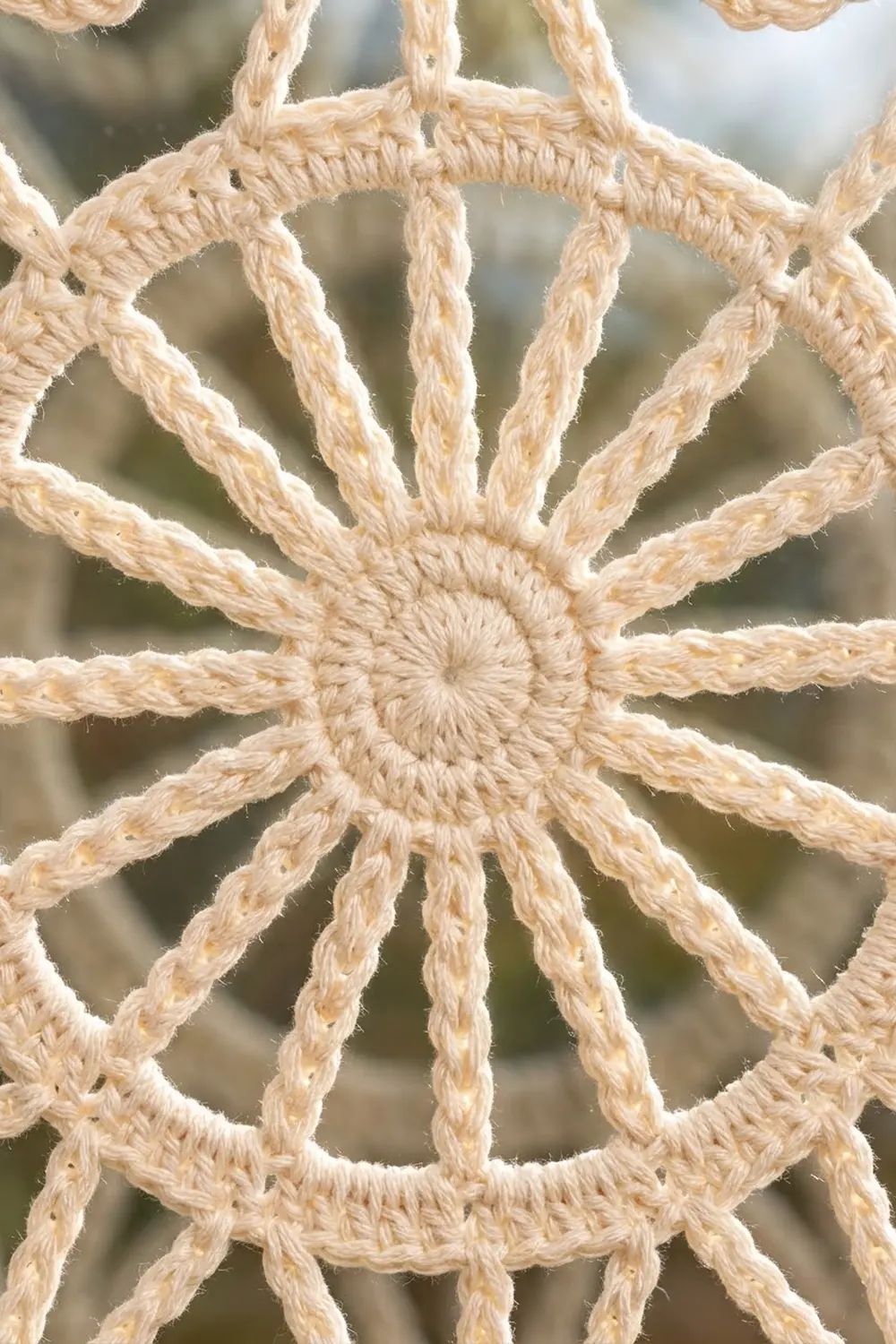
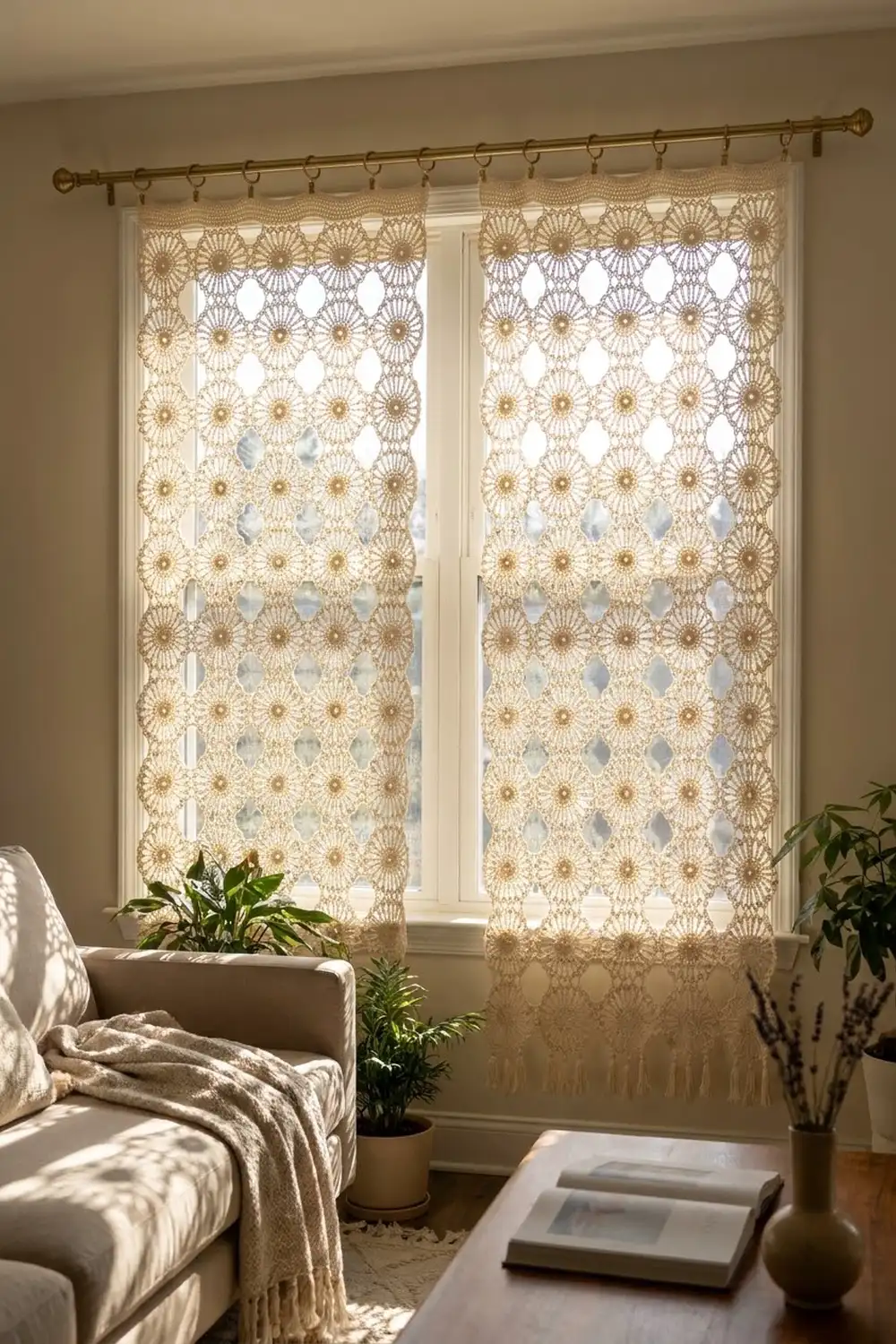
This curtain is built from one simple idea repeated many times: a small, solid sunburst center with sixteen long chain spokes, closed by a ring of short chain arcs. Joined tip to tip in a grid, the motifs turn into an airy lattice that filters light instead of blocking it.
Everything is worked in a single ivory or cream cotton. With only one color, the texture does the work. You get dense single crochet centers, doubled-chain rays, and open star-shaped windows where four motifs meet. The finished curtain is two matching panels. Each one has a narrow solid heading at the top for ring clips and a row of tassels hanging from the bottom points.
The pattern uses US crochet terms. Each panel measures 30 in (76.2 cm) wide and 72 in (182.9 cm) tall across the motif area. With the heading, it is 72.75 in (184.8 cm) tall, and the tassels bring the total to 76.75 in (194.9 cm).
Construction is simple. You crochet the motif center in rounds, add the chain-loop spokes, then work the outer arc round. From the second motif on, you join each new motif to its neighbors as you go during that last round. A three-row heading closes the top edge, and the tassels go on last.
Finished Size and Construction
- Finished size (per panel): 30 in (76.2 cm) wide x 76.75 in (194.9 cm) long, tassels included
- Skill level: Intermediate
- Terminology: US crochet terms
- Yarn weight: Worsted / medium (#4) cotton
- Hook: 5.0 mm (H-8)
- Number of pieces: 120 motifs (60 per panel), joined as you go into 2 panels
- Layout per panel: 5 motifs wide x 12 motifs tall
- Motif size: 6 in (15.2 cm) from tip to opposite tip
- Size before border: 30 in x 72 in (76.2 cm x 182.9 cm)
- Border: top heading only, 0.75 in (1.9 cm) deep; 4 in (10.2 cm) tassels along the bottom
Materials
Yarn: Choose a smooth, firmly twisted worsted cotton or cotton blend in ivory or cream. The spokes are plain chain, so a fuzzy or splitty yarn will blur the doubled-chain look. Mercerized or combed cotton keeps the rays crisp and hangs well.
- Ivory (one color only): 1,200 g / 2,160 m total, or 12 balls of 100 g / 180 m each (600 g / 1,080 m per panel)
That breaks down to about 8 g / 15 m per motif, roughly 11 g / 19 m per heading, and about 2.5 g / 4.6 m per tassel. The quantities include a margin of about 10% for swatching, tails, and small differences in tension.
Tools:
- 5.0 mm (H-8) crochet hook
- Tapestry needle
- Stitch markers (at least 4)
- Scissors
- A 4 in (10.2 cm) piece of stiff card for the tassels
- Measuring tape
- Blocking mats and rust-proof pins
- Spray bottle
- 18 curtain ring clips (9 per panel)
Abbreviations (US Terms)
- ch – chain
- sc – single crochet
- sl st – slip stitch
- st(s) – stitch(es)
- rnd – round
- MR – magic ring
- JAYG – join as you go
Special technique – tip join: Work the sc at the tip as normal. Then insert the hook from front to back under both loops of the matching tip sc on the finished neighbor motif, yarn over, and pull through both loops on the hook (one sl st). The sl st does not count toward the stitch total.
Tip numbering: The Rnd 6 tip sc are numbered 0 to 15 in working order. Tip 0 is the top, tip 4 is the right side, tip 8 is the bottom, and tip 12 is the left side.
Gauge and Checkpoints
Gauge: 16 sc and 18 rows = 4 in (10.2 cm) in sc worked in rows. 16 ch = 4 in (10.2 cm) when relaxed.
Make one complete motif before anything else, and block it. Every later measurement depends on it.
Checkpoints:
- After Rnd 4: the solid center is 2 in (5.1 cm) across.
- After Rnd 5: the spokes are 1.75 in (4.4 cm) long, and the motif is 5.5 in (14.0 cm) from tip to opposite tip.
- After Rnd 6: the motif is 6 in (15.2 cm) from tip to opposite tip after blocking.
If your motif is too big (over 6.25 in / 15.9 cm), go down to a 4.5 mm hook, or tighten your chains. Loose chains are the usual cause.
If your motif is too small (under 5.75 in / 14.6 cm), go up to a 5.5 mm hook. Don’t change the chain counts, because the spoke and arc lengths are matched to each other.
Motif Pattern
Rnd 1: Make a MR, ch 1, work 8 sc into the ring, then sl st to the first sc. Pull the ring tight. (8 sc)
Rnd 2: Ch 1, work 2 sc in each st around, then sl st to the first sc. (16 sc)
Rnd 3: Ch 1, sc in next st, 2 sc in next st; repeat from * 8 times total, then sl st to the first sc. (24 sc)
Rnd 4: Ch 1, sc in each of next 2 sts, 2 sc in next st; repeat from * 8 times total, then sl st to the first sc. (32 sc)
Check that the center lies flat and measures 2 in (5.1 cm) across.
Rnd 5 (spokes): Ch 1, sc in next st, ch 14, sc in next st; repeat from * 16 times total, then sl st to the first sc. (32 sc and 16 ch-14 loops)
Each ch-14 loop folds in half into a slim spoke made of two parallel chain strands, 7 chains long. The two sc at the base of each loop sit side by side, so the spokes start right next to each other all around the center.
Rnd 6 (outer arcs): Sl st in each of the first 6 ch of the first loop, ch 1, then sc in the next ch (the 7th ch, at the spoke tip). This is tip 0. Ch 5, sc in the 7th ch of the next loop; repeat from * 15 times, so you reach tip 15. Ch 5 and sl st to the first sc. (16 sc and 16 ch-5 arcs = 96 sts)
Per-side count: Treat each quarter between tips 0, 4, 8, and 12 as one side. A side has 5 tip sc (including both corner tips) and 4 ch-5 arcs, so 25 sts per side. Corners are shared, so the round total is 4 x 25 − 4 = 96. This matches.
Fasten off. Weave in the ends through the solid center so they disappear.
Make All Pieces
Make 1 motif completely and check it against all the checkpoints. Make the rest using the same Rnds 1–5. Work Rnd 6 with joins as described in the Joining section.
- Ivory: 120 motifs in total, 60 per panel
Layout per panel (5 columns x 12 rows; each X is one motif):
Row 1:  X X X X X   <- top (heading side)
Row 2:  X X X X X
Row 3:  X X X X X
Row 4:  X X X X X
Row 5:  X X X X X
Row 6:  X X X X X
Row 7:  X X X X X
Row 8:  X X X X X
Row 9:  X X X X X
Row 10: X X X X X
Row 11: X X X X X
Row 12: X X X X X   <- bottom (tassel side)
Joining
Method: Join as you go during Rnd 6, using the tip join. Work the motifs row by row, left to right.
- Row 1, motif 1: Work Rnd 6 with no joins.
- Row 1, motifs 2–5: At tip 12, join to tip 4 of the motif on the left.
- Rows 2–12, motif 1: At tip 0, join to tip 8 of the motif above.
- Rows 2–12, motifs 2–5: At tip 0, join to tip 8 of the motif above. At tip 12, join to tip 4 of the motif on the left.
Stitch-to-stitch logic: Each join connects exactly one tip sc to one tip sc. No chains are added and none are skipped, so every motif keeps 96 sts and 25 sts per side. The sl st joins are not counted. Each motif touches its neighbors at single points only. Where four motifs meet, the arcs frame an open, four-pointed window. That gives the lattice its diamond rhythm.
Tension advice: Keep the join sl st snug but not tight. A tight join pulls the tips into puckers. A loose one leaves a visible gap. Lay the work flat before each join, and check that the spoke you are joining points straight at its neighbor.
Size checkpoint: A finished row of 5 motifs should measure 30 in (76.2 cm) from the left tip to the right tip. Each set of 4 rows adds 24 in (61.0 cm). The full grid is 30 in x 72 in (76.2 cm x 182.9 cm). If a row is more than 0.5 in (1.3 cm) off, fix the hook size before you continue.
Border: Top Heading
Border gauge: 16 sc or 16 ch = 4 in (10.2 cm), the same as the main gauge.
The heading runs only along the top edge, across the top three tips of each Row 1 motif. The side and bottom edges stay open and lacy.
Row 1: With the right side facing, join yarn in tip 15 of motif 1. Ch 1, then work across the first motif: sc in tip 15, 4 sc in the ch-5 arc, sc in tip 0, 4 sc in the next ch-5 arc, sc in tip 1. That’s 11 sts per motif. Ch 13, then across the next motif: sc in tip 15, 4 sc in arc, sc in tip 0, 4 sc in arc, sc in tip 1. Repeat from * 3 more times, so you’ve worked across all 5 motifs. Turn.
Row 1 count: (5 motifs x 11 sts) + (4 bridges x 13 ch) = 55 + 52 = 107 sts.
Row 2: Ch 1 (doesn’t count as a st), sc in each sc and in each ch across. Turn. (107 sc)
Row 3: Ch 1, sc in each st across. (107 sc) Fasten off.
Why the math works: Tips 15 and 1 sit about 1.2 in (3.0 cm) either side of each motif’s centerline. So the span from tip 15 of motif 1 to tip 1 of motif 5 is 24 in + 2.4 in = 26.4 in (67.1 cm). At 4 sts per inch, 107 sts measure 26.75 in (67.9 cm). The small extra amount is taken up by the width of the tip sc. Four sc into each 1.25 in (3.2 cm) arc pulls it straight without gathering, and the ch-13 bridges hold the gap between motifs level. The 3 heading rows add 0.75 in (1.9 cm) above the top tips.
Ring clips: Attach 9 ring clips along Row 3 at sts 1, 14, 28, 41, 54, 67, 80, 94, and 107. That spaces them about 3.25 in (8.3 cm) apart.
Tassels: Wrap the yarn 20 times around the 4 in (10.2 cm) card. Tie the bundle at the top with a 12 in (30.5 cm) strand, wrap it 0.5 in (1.3 cm) below the top, then cut the bottom loops. Attach one tassel at tip 7 and one at tip 9 of each Row 12 motif, so 10 tassels per panel and 20 in total. Trim them to an even 4 in (10.2 cm).
Final Blocking
- Wet each panel in cool water, then press the water out gently with a towel. Don’t wring it.
- Lay the panel flat on the blocking mats, working one section at a time if your space is limited.
- Pin the outer corners so the grid is 30 in (76.2 cm) wide and 72 in (182.9 cm) tall from the top tips to the bottom tips.
- Pin every joined tip so each motif measures 6 in (15.2 cm) and the joins line up in straight rows and columns.
- Straighten each spoke with your fingers so all 16 point evenly out from the center.
- Pin the heading straight and flat, 26.75 in (67.9 cm) wide.
- Mist the tassels and comb them straight.
- Leave everything to dry completely before unpinning.
Final Quality-Control Checklist
- Every center has 32 sc and lies flat.
- Every motif has 16 spokes and 16 ch-5 arcs.
- Every motif measures 6 in (15.2 cm) from tip to tip.
- All joins are at tips 0/8 and 4/12, with no missed or doubled joins.
- Each panel is 5 x 12 motifs and 30 in x 72 in (76.2 cm x 182.9 cm).
- The heading has 107 sts in every row.
- 9 clips per panel are evenly spaced.
- 10 tassels per panel, all trimmed to 4 in (10.2 cm).
- All ends are woven into solid centers or the heading.
Troubleshooting
Center ruffles: Your sc is too loose for the increase rate. Go down half a hook size for Rnds 1–4 only.
Center cups: Your tension is too tight. Go up half a hook size for Rnds 1–4.
Spokes twist: Turning the chain while you work it twists the loop. Keep the chain flat as you make it, and untwist each loop before Rnd 6.
Arcs sag: Your chains are loose. Tighten them, or go down half a hook size for Rnd 6 only. Keep the ch 5 count so the per-side and heading counts don’t change.
Panel leans: A join is on the wrong tip. Count the tips from tip 0 and redo that join.
Heading ruffles or pulls: Check that you have exactly 4 sc per arc and 13 ch per bridge.
Care
Hand wash in cool water with mild detergent and dry flat. Re-pin the tips if needed. Rehang only once the panel is completely dry, so it doesn’t stretch.
Final Notes
The whole curtain comes down to one chain of measurements. The center is 2 in (5.1 cm), the spokes take it to 5.5 in (14.0 cm), and the arcs finish each motif at 6 in (15.2 cm). Five motifs make a 30 in (76.2 cm) width, and twelve rows make 72 in (182.9 cm). The 0.75 in (1.9 cm) heading and 4 in (10.2 cm) tassels bring each panel to 76.75 in (194.9 cm). If your first motif hits 6 in (15.2 cm), everything after it falls into place.
Happy crocheting!