
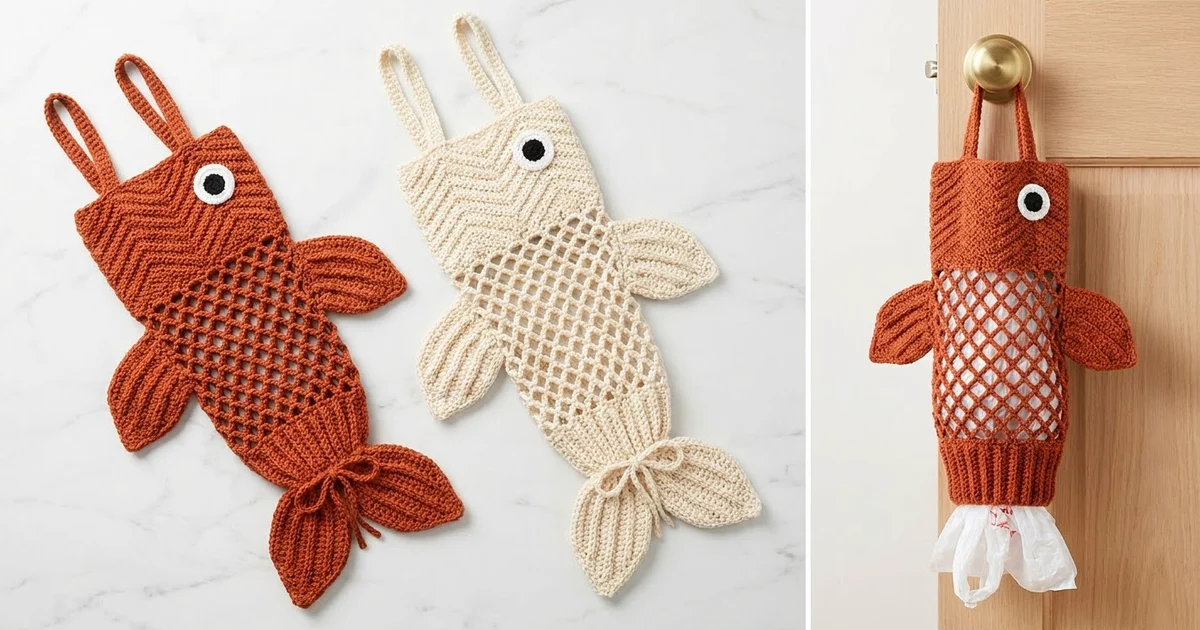
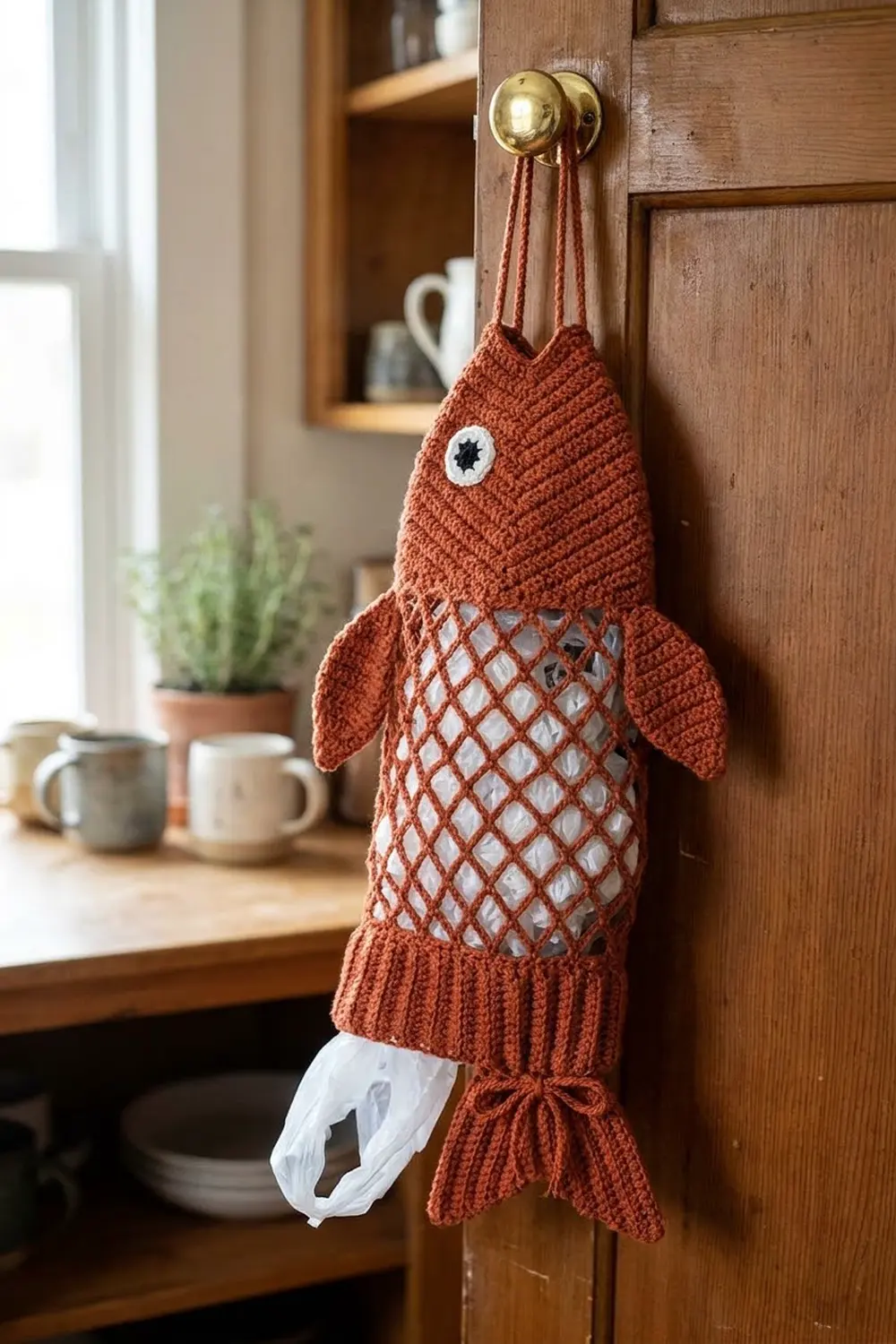
This rust-orange fish keeps your grocery bags in one place. You push bags in through the mesh body and pull them out one at a time through the ribbed cuff by the tail. The open net shows the bags inside, and the solid head, ridged fins, and forked tail make the fish easy to recognize.
The sample uses one main color, a warm rust/terracotta, plus small scraps of white and black for the eye. It also works well in cream or another solid shade. The look is simple and graphic: diamond netting, a knit-look head, and leaf-shaped fins with ridges.
The pattern uses US crochet terms. The body is about 15 in (38.1 cm) long and 8 in (20.3 cm) wide at the belly laid flat. With the tail, the fish is 19 in (48.3 cm) long.
You work the body in one piece from the bottom up: ribbed cuff, mesh, textured head, then a flat seam across the top. You make the fins, tail lobes, bow, hanging loops, and eye separately and sew them on.
Finished Size and Construction
- Finished size: 8 in (20.3 cm) wide × 19 in (48.3 cm) long without the loops; 23 in (58.4 cm) with the loops
- Skill level: Intermediate
- Terminology: US
- Yarn weight: Worsted (#4) cotton
- Hook: US H-8 (5 mm)
- Number of pieces: 8 (1 body, 2 fins, 2 tail lobes, 1 bow, 2 hanging loops), plus 1 eye
- Layout: body hangs vertically, with a fin on each side, the tail below, and the loops above
- Body size: 8 in (20.3 cm) × 15 in (38.1 cm)
- Cuff before border: 4 in (10.2 cm) wide × 2 in (5.1 cm) tall, laid flat
- Border depth: 0.5 in (1.3 cm) around the opening
Materials
Use a smooth worsted-weight cotton or cotton blend. Cotton holds the mesh open, doesn’t sag under the weight of the bags, and shows the fin ridges clearly. Avoid yarn that splits easily, because it makes the net look fuzzy.
- Rust (main color): 130 g / about 220 m
- White: 3 g / about 5 m
- Black: 1 g / about 2 m
These amounts include about 25% extra.
Tools: US H-8 (5 mm) hook, 4 stitch markers, tapestry needle, scissors, measuring tape, rust-proof pins, blocking mat.
Abbreviations (US Terms)
- ch – chain
- sl st – slip stitch
- sc – single crochet
- dc – double crochet
- tr – treble crochet
- FPdc / BPdc – front / back post double crochet
- BLO – back loop only
- st(s) – stitch(es); rnd(s) – round(s)
Special stitches
- Waistcoat stitch (ws): Insert the hook through the center of the next sc, between its two vertical legs. Yarn over and pull up a loop, then yarn over and pull through both loops. Stacked rounds of ws make V columns that look like knitting.
- ws2tog: Pull up a loop as for ws in each of the next 2 sts, then yarn over and pull through all 3 loops.
- Reverse sc (crab stitch): Work sc from left to right (right to left if you crochet left-handed) to make a corded edge.
Gauge and Checkpoints
- Dc in rounds: 16 sts × 8 rnds = 4 in (10.2 cm)
- Waistcoat stitch: 16 sts × 18 rnds = 4 in (10.2 cm)
- Sc in BLO rows: 16 sts × 18 rows = 4 in (10.2 cm)
- Mesh: each ch-7 round adds about 0.75 in (1.9 cm) of height
Use the cuff as your gauge test. It’s only 4 rounds and shows your dc gauge right away.
Checkpoints:
1. After Rnd 4: the cuff is 4 in (10.2 cm) wide flat and 2 in (5.1 cm) tall.
2. After Rnd 16: the body is 11 in (27.9 cm) tall, and the mesh is about 8 in (20.3 cm) wide flat when lightly stretched.
3. After Rnd 17: the head base is 6 in (15.2 cm) wide flat.
4. After Rnd 36: the body is 15 in (38.1 cm) tall, and the top seam is 4 in (10.2 cm) long.
If your piece is too big, go down half a hook size. If it’s too small, go up half a size. If only the mesh is off, change the loops to ch 6 or ch 8 and keep every stitch count the same.
Body
Cuff
Ch 32 and join with a sl st to the first ch, taking care not to twist the chain.
Rnd 1: Ch 2 (does not count as a st). Dc in each ch around, then join to the first dc. (32 dc)
Rnds 2–4: Ch 2. FPdc, BPdc 16 times, then join. (32 sts)
This 1×1 ribbing pulls in slightly and keeps the tube neat.
Mesh
Each mesh round ends with “ch 3, tr in first sc.” This takes the place of the last ch-7 loop and leaves your hook at the center of that loop.
Rnd 5: Ch 1, sc in the first st. Ch 7, skip 3 sts, sc in the next st 7 times. Ch 3, skip the last 3 sts, tr in the first sc. (8 sc, 8 loops)
Rnd 6: Ch 1, sc around the tr post. Ch 7, sc in the next loop 7 times. Ch 3, tr in the first sc. (8 loops)
Rnd 7 (growth): Ch 1, (sc, ch 7, sc) around the tr post. Ch 7, sc in the next loop, ch 7, (sc, ch 7, sc) in the next loop 3 times. Ch 7, sc in the next loop, ch 3, tr in the first sc. (12 sc, 12 loops)
Rnds 8–9: Ch 1, sc around the tr post. Ch 7, sc in the next loop 11 times. Ch 3, tr in the first sc. (12 loops)
Rnd 10 (growth): Ch 1, (sc, ch 7, sc) around the tr post. [Ch 7, sc in the next loop] twice, ch 7, (sc, ch 7, sc) in the next loop 3 times. [Ch 7, sc in the next loop] twice, ch 3, tr in the first sc. (16 sc, 16 loops)
Rnds 11–16: Ch 1, sc around the tr post. Ch 7, sc in the next loop 15 times. Ch 3, tr in the first sc. (16 loops)
Going from 8 to 12 to 16 loops widens the narrow tail end into the belly. The 12 mesh rounds measure about 9 in (22.9 cm) tall.
Head
Rnd 17 (conversion): Ch 1. Work 3 sc in each of the 16 loops, counting the ch-3 + tr as the last loop. Join. (16 loops × 3 sc = 48 sc)
From here, work in a continuous spiral and move your marker up each round.
Rnds 18–21: Ws in each st around. (48)
Rnd 22: Ws in next 10, ws2tog 4 times. (44)
Rnds 23–24: Ws in each st around. (44)
Rnd 25: Ws in next 9, ws2tog 4 times. (40)
Rnds 26–27: Ws in each st around. (40)
Rnd 28: Ws in next 8, ws2tog 4 times. (36)
Rnds 29–30: Ws in each st around. (36)
Rnd 31: Ws in next 7, ws2tog 4 times. (32)
Rnds 32–35: Ws in each st around. (32)
Rnd 36 (closing): Flatten the head so the decreases line up along the side folds. Ch 1, then sc through both layers across. (16 sc) Fasten off.
The head is about 4 in (10.2 cm) tall and tapers from 6 in (15.2 cm) wide to 4 in (10.2 cm) wide. The V columns give it the chevron texture.
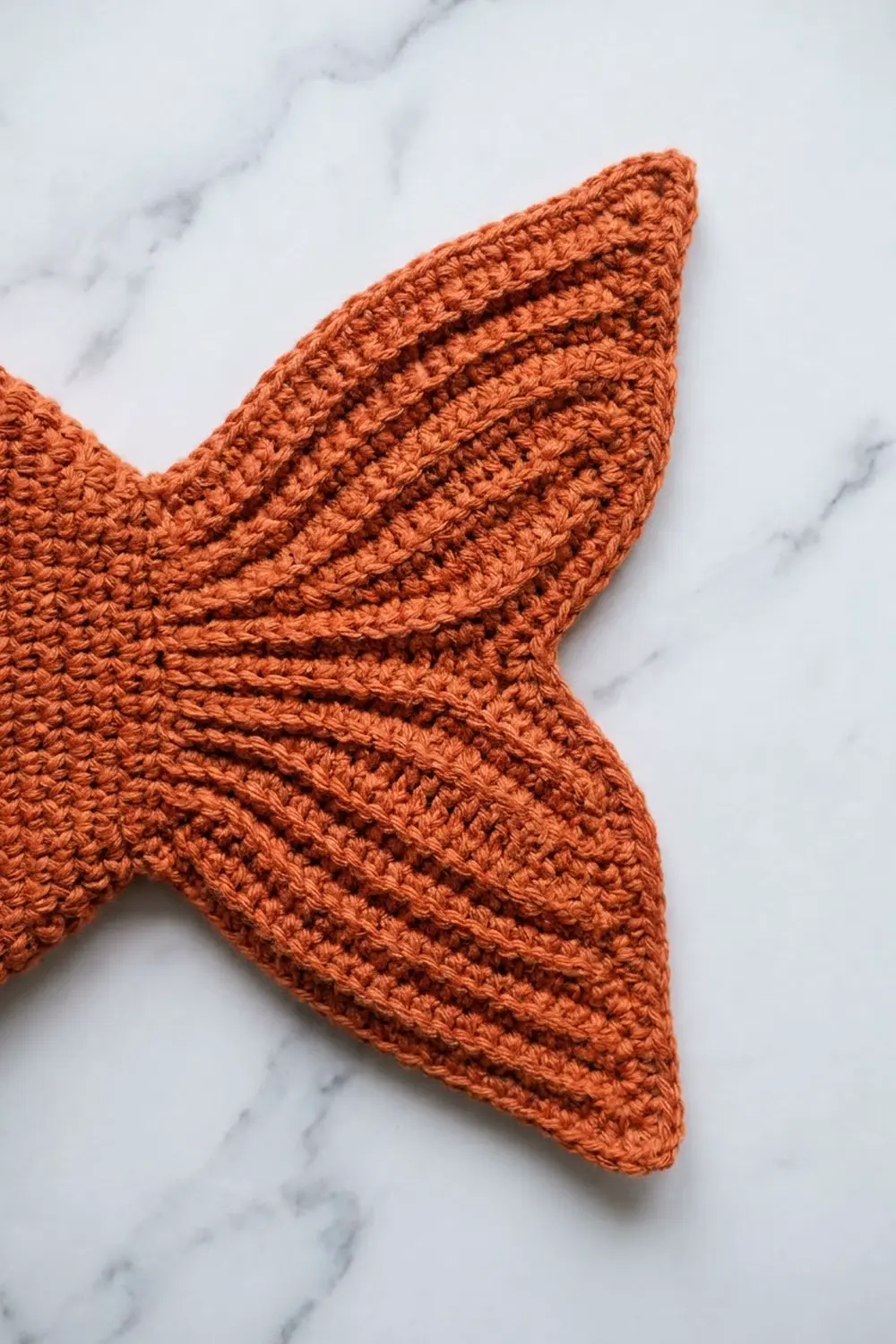
Fins (Make 2)
Ch 19.
Row 1: Sc in the 2nd ch from the hook and in the next 16 ch. Work 3 sc in the last ch. Working along the other side of the chain, sc in the next 16 ch, leaving the last ch unworked. Turn. (17 + 3 + 16 = 36 sts)
Rows 2–5: Ch 1. Sc BLO up to the center st of the 3-sc tip, work 3 sc in that center st, then sc BLO to the end, leaving the last st unworked. Turn. (Row 2: 37, Row 3: 38, Row 4: 39, Row 5: 40)
Each row adds 2 sts at the tip and skips 1 st at the end, for a net gain of 1. Fasten off, leaving a 12 in (30.5 cm) tail. Each fin is about 5 in (12.7 cm) × 2.25 in (5.7 cm).
Tail Lobes (Make 2)
Ch 17.
Row 1: Sc in the 2nd ch from the hook and in the next 14 ch. Work 3 sc in the last ch. Working along the other side of the chain, sc in the next 14 ch, leaving the last ch unworked. Turn. (15 + 3 + 14 = 32 sts)
Rows 2–6: Work as for Fin Rows 2–5. (Row 2: 33, Row 3: 34, Row 4: 35, Row 5: 36, Row 6: 37)
Fasten off, leaving a long tail. Each lobe is about 4.5 in (11.4 cm) × 2.75 in (7.0 cm).
Bow
Ch 13.
Row 1: Sc in the 2nd ch from the hook and in each ch across. Turn. (12)
Rows 2–5: Ch 1, sc BLO in each st across. Turn. (12)
Fasten off, leaving a 20 in (50.8 cm) tail. The rectangle is 3 in (7.6 cm) × 1 in (2.5 cm). Pinch it at the center and wrap the tail tightly around it 8–10 times.
Hanging Loops (Make 2)
Ch 40 and join with a sl st to the first ch.
Rnd 1: Ch 1, sc in each ch around, then join. (40)
Fasten off. Each loop is 5 in (12.7 cm) long when flattened.
Eye (Make 1)
Rnd 1: With black, work 6 sc in a magic ring. Join with white. (6)
Rnd 2: With white, work 2 sc in each st, then join. (12)
Fasten off. The eye is 1 in (2.5 cm) across. If you want an eye on the back too, make a second one.
Make All Pieces
- Rust: 1 body, 2 fins, 2 tail lobes, 1 bow, 2 hanging loops
- White + black: 1 eye
Assembly map (front view):
        [loop] [loop]
      [  head + eye  ]
[fin] [     mesh     ] [fin]
      [  cuff + bow  ]
      [lobe]  [lobe]
Joining
Whipstitch each piece in place with its matching yarn tail, sewing through both loops of the edge stitches.
- Loops: Flatten each loop. Sew its lower 1 in (2.5 cm) inside the head at the top seam, 1.5 in (3.8 cm) in from each end. Each loop rises 4 in (10.2 cm) above the head.
- Fins: Sew each fin’s narrow base to a side fold, right at Rnd 17, so the tip points down and out. Sew the base sts one-to-one into the head-base sc directly above.
- Tail lobes: Overlap the two bases by 0.5 in (1.3 cm) and sew them together in a V. Sew the joined base to the outside back of the cuff over Rnds 2–4. Leave the foundation edge free so the opening stays clear.
- Bow: Center the bow across the front of the cuff and tack it down through the wrapped center.
- Eye: Sew the eye to the front of the head, 1 in (2.5 cm) below the top seam and 1 in (2.5 cm) in from the side fold.
Sew firmly but keep the seams flat so they don’t pucker or distort the mesh. Size check: the fish measures 19 in (48.3 cm) from the top seam to the tail tips.
Border
This border firms up the opening the bags come out of. Border gauge: sc at 4 sts per in (2.5 cm), the same as the cuff’s dc gauge.
Rnd 1: Hold the body with the cuff at the top. Join rust in the free loop of any foundation ch. Sc in each ch around, then join. (32 sc: 16 per side when flattened)
Rnd 2: Ch 1, reverse sc in each st around, then join. (32: 16 per side) Fasten off.
Why the math works: The cuff started with 32 ch, and the border works exactly 1 st in each one, adding and skipping nothing. That keeps the opening at 4 in (10.2 cm) wide flat, so a hand fits in. It also won’t flare and drop bags or pull tight and trap them.
Final Blocking
- Weave in all ends through solid stitches, not through the mesh.
- Lightly mist the fins, tail, bow, and head. Keep the mesh dry.
- Pin each fin and lobe into a smooth leaf curve with the ridges straight.
- Fill the body with bags or a rolled towel so it holds an oval shape.
- Let everything dry completely, about 6–8 hours.
- Unpin, then even out the mesh loops by hand.
Final Quality-Control Checklist
- Cuff has 32 sts, is 4 in (10.2 cm) wide flat, and the opening is clear
- Mesh has 16 even loops at the widest point
- Head has 48 sts at the base, 32 at the top, and a flat seam
- Fins match and sit at the same height
- Tail lobes form a balanced V
- Loops are secure and the same length
- Total length is 19 in (48.3 cm)
Troubleshooting
- Mesh spirals: You probably missed the “ch 3, tr” finish on a round. Count your loops every round.
- Loose ribbing: Go down one hook size for the cuff only.
- Head flares out: Snug each ws loop before you yarn over.
- Fins curl: Pin them flat to block, and check that you skipped the last st on every row.
- Bags fall out: Work Border Rnd 1 with a hook half a size smaller.
Care
Hand wash in cool water and lay flat to dry, reshaping the mesh while it’s damp.
Final Notes
Here’s how the measurements build. The 32-st cuff is 4 in (10.2 cm) wide flat and 2 in (5.1 cm) tall. The mesh grows from 8 to 16 loops, reaching about 8 in (20.3 cm) wide over 9 in (22.9 cm). The head goes from 48 sts down to 32 over 4 in (10.2 cm). Together that makes a 15 in (38.1 cm) body. The tail brings the fish to 19 in (48.3 cm), and the loops bring the hanging length to 23 in (58.4 cm). Check each stage against these numbers and the fish will come out the right size.
Happy crocheting!