

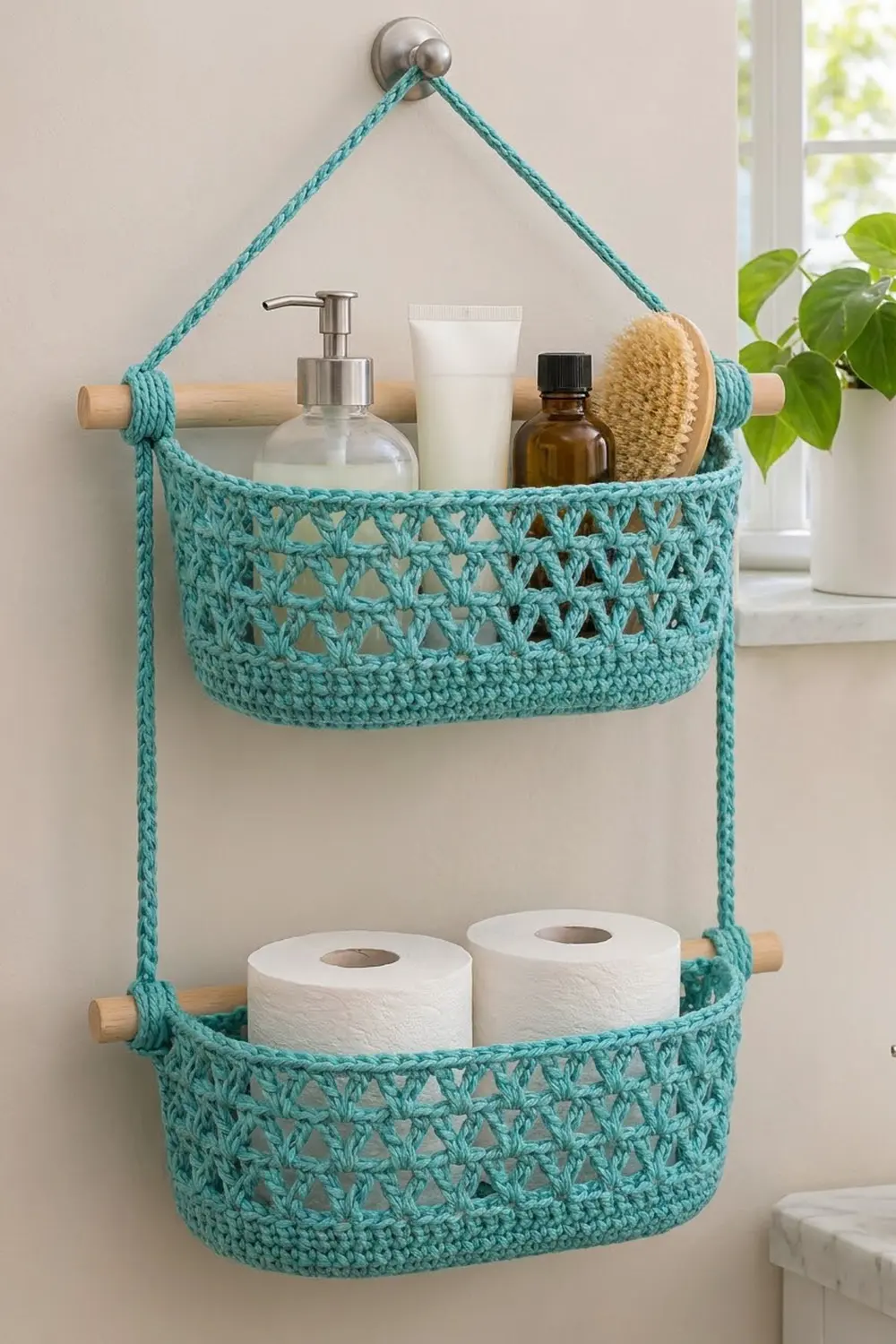
The Lagoon Lattice organizer is a two-tier wall caddy made of two oval baskets hung one above the other on wooden dowels. It is made for small bathrooms, where it holds soap pumps, brushes and spare toilet rolls without taking up counter space.
Each basket has a solid single crochet base and lower wall, an open band of offset V-stitches that forms triangular windows, and a firm rim with a rolled reverse-single-crochet edge. Everything is worked in one turquoise worsted cotton, so the texture is the main feature.
This pattern uses US crochet terms. Each basket measures 9 in long × 3.5 in deep × 4 in tall (22.9 × 8.9 × 10.2 cm). The assembled organizer is about 12 in (30.5 cm) wide at the dowels and about 23 in (58.4 cm) tall, including the hanging loop.
How it’s made: you work each basket in joined rounds, starting from a foundation chain for the oval base and then building the walls straight up with no further increases. You add two dowel loops to each rim. Then you make two slip-stitch cords and wrap them around the dowels to link the two tiers.
Finished Size and Construction
- Basket size: 9 × 3.5 in base (22.9 × 8.9 cm), 4 in (10.2 cm) tall
- Assembled size: about 12 × 23 in (30.5 × 58.4 cm)
- Skill level: Easy-Intermediate
- Terminology: US
- Yarn weight: Medium (#4) worsted cotton
- Hook: 4.0 mm (G-6)
- Number of pieces: 2 baskets and 2 cords, plus 2 wooden dowels
- Layout: 1 column × 2 tiers
- Size before border: 9 × 3.5 in base, 3.5 in (8.9 cm) tall after Rnd 18
- Border depth: 0.5 in (1.3 cm), Rnds 19–20
Materials
Yarn: Use 100% cotton or a cotton blend in worsted weight. Cotton holds its shape, copes with bathroom humidity, and keeps the mesh crisp. Avoid acrylic, which tends to sag once the basket is loaded.
- Turquoise: 120 g (about 204 m), based on 170 m per 100 g
The quantity includes a margin of about 30% for your gauge test, the cords and normal tension differences.
Tools:
– 4.0 mm (G-6) crochet hook
– 2 wooden dowels, 3/4 in (1.9 cm) diameter × 12 in (30.5 cm) long
– 4 locking stitch markers
– Tapestry needle
– Scissors and a tape measure
– Rust-proof pins and a blocking surface
– 1 wall knob or hook
Abbreviations (US Terms)
- ch – chain
- sl st – slip stitch
- sc – single crochet
- dc – double crochet
- BLO – back loop only
- sk – skip
- sp – space
- st(s) – stitch(es)
- rev sc – reverse single crochet (crab stitch): working from left to right, insert the hook into the next st to the right, yarn over, pull up a loop, yarn over, and pull through both loops.
Special stitch:
– V-st (V-stitch): (dc, ch 1, dc) in the same st or sp.
Gauge and Checkpoints
Gauge: 16 sc × 18 rounds = 4 in (10.2 cm). Mesh rounds are about 0.5 in (1.3 cm) tall each.
Make one complete basket before starting the second, and check it at each stage:
- After Rnd 4: base is about 7.25 × 1.75 in (18.4 × 4.4 cm)
- After Rnd 8: base is 9 × 3.5 in (22.9 × 8.9 cm)
- After Rnd 13: solid wall is about 1 in (2.5 cm) tall
- After Rnd 17: wall is about 3.25 in (8.3 cm) tall
- After Rnd 20: wall is 4 in (10.2 cm) tall
If your base is too big, go down to a 3.75 mm hook. If it’s too small, go up to a 4.5 mm hook. Don’t change the stitch counts, because the mesh repeat depends on a total of 92 stitches.
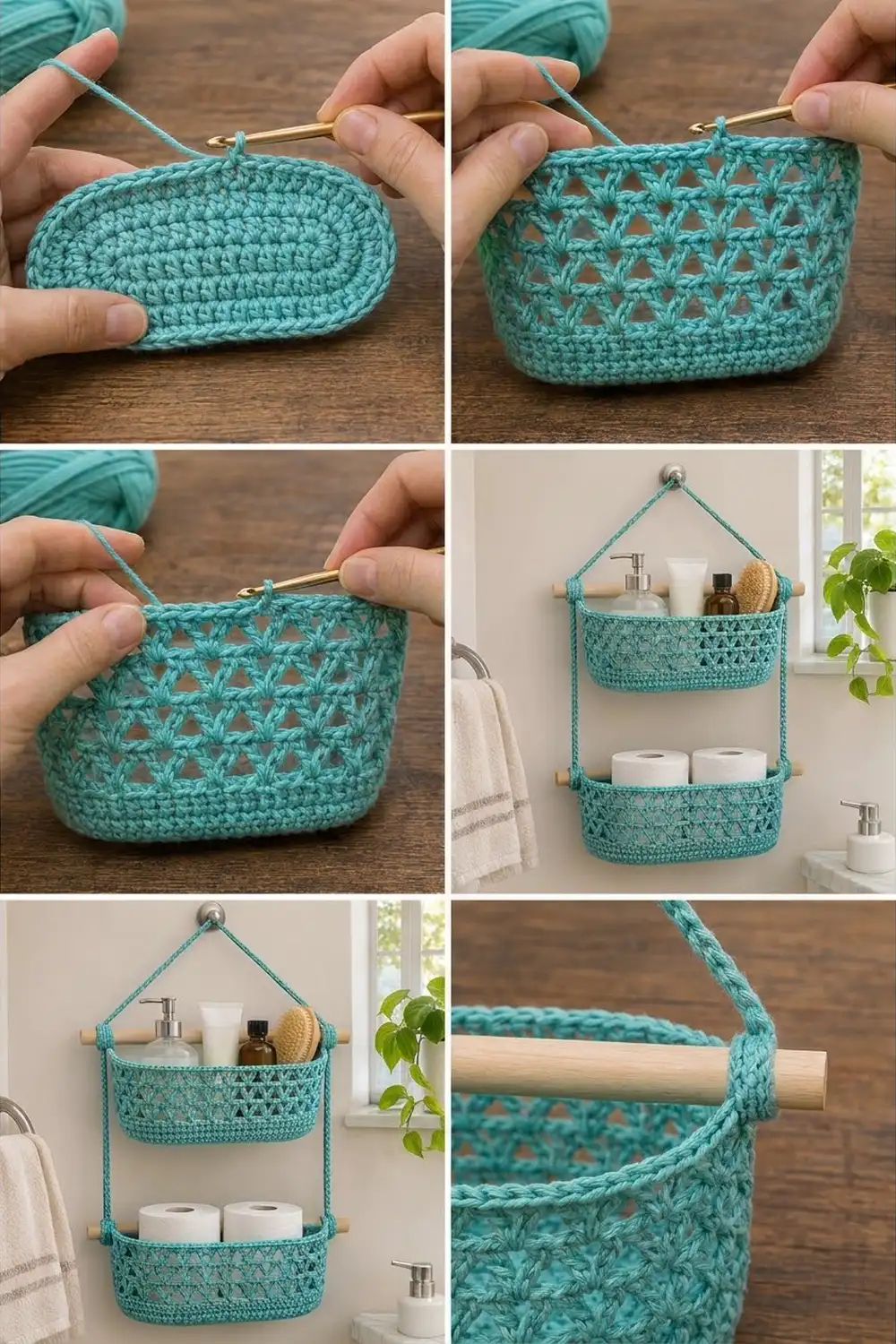
Basket (Make 2)
Join every round with a sl st to the first st. The ch 1 at the start of each sc round does not count as a stitch.
Oval Base
Ch 25.
Rnd 1: 3 sc in 2nd ch from hook (end B), sc in next 22 ch, 3 sc in last ch (end A). Rotate and work along the free loops: sc in next 22 free loops. Join. (50 sts: 3 + 22 + 3 + 22)
Each round now follows the same order: end B, side 1, end A, side 2. Only the end sections increase.
Rnd 2: Ch 1, [2 sc in each of next 3 sts, sc in next 22] twice. Join. (56 sts)
Rnd 3: Ch 1, [(sc in next st, 2 sc in next st) 3 times, sc in next 22] twice. Join. (62 sts)
Rnd 4: Ch 1, [(sc in next 2 sts, 2 sc in next st) 3 times, sc in next 22] twice. Join. (68 sts)
Rnd 5: Ch 1, [(sc in next 3 sts, 2 sc in next st) 3 times, sc in next 22] twice. Join. (74 sts)
Rnd 6: Ch 1, [(sc in next 4 sts, 2 sc in next st) 3 times, sc in next 22] twice. Join. (80 sts)
Rnd 7: Ch 1, [(sc in next 5 sts, 2 sc in next st) 3 times, sc in next 22] twice. Join. (86 sts)
Rnd 8: Ch 1, [(sc in next 6 sts, 2 sc in next st) 3 times, sc in next 22] twice. Join. (92 sts: 24 end B + 22 side 1 + 24 end A + 22 side 2)
Put a marker in the first st of each of the 4 sections. Move the markers up as you work so the end centers are easy to find later.
Solid Lower Wall
Rnd 9: Ch 1, sc in BLO of each st around. Join. (92 sts) The unused front loops make a crisp fold line where the base turns into the wall.
Rnds 10–13: Ch 1, sc in each st around. Join. (92 sts each round)
Triangle Mesh
Rnd 14: Ch 4 (counts as dc + ch 1), dc in same st as join (first V-st made), ch 1, sk next 3 sts, V-st in next st, ch 1, sk next 3 sts; repeat from * 21 more times. Join with sl st to 3rd ch of beginning ch-4. (23 V-sts and 23 spacer ch-1 sps) Each repeat uses 4 base sts: 23 × 4 = 92.
Rnd 15: Sl st in V-st center ch-1 sp, sl st in next dc, sl st in next spacer ch-1 sp. Ch 4, dc in same sp, ch 1, V-st in next spacer ch-1 sp (skipping over the V-st), ch 1; repeat from * 21 more times. Join to 3rd ch of beginning ch-4. (23 V-sts)
Rnds 16–17: Repeat Rnd 15. (23 V-sts each round)
Each V-st sits in the gap between two V-sts of the round below, so the openings form the stacked triangles that give this design its look.
Rnd 18 (conversion round): Ch 1, sc in dc, sc in V-st center sp, sc in next dc, sc in spacer sp; repeat from * around. Join. (46 sc in dc + 23 sc in V centers + 23 sc in spacers = 92 sts, +0 extra)
Make All Pieces
Baskets: Make 2, working Rnds 1–20 plus the dowel loops for each.
Cords (Make 2): Ch 153. Sl st in the back bump of 2nd ch from hook and in each ch across. (152 sl sts) Each cord should measure 38 in (96.5 cm) at 4 sl sts per 1 in (2.5 cm). If your cord is short, add chains in multiples of 4. Fasten off with a 12 in (30.5 cm) tail.
Yarn use per piece: each basket uses about 35 g and each cord about 5 g, all in Turquoise.
Layout grid (front view):
           [hanging loop]
             /        \
         cord A      cord B
  [=========== DOWEL 1 ===========]
        (   BASKET 1 - top   )
          |                |
        cord A           cord B
  [=========== DOWEL 2 ===========]
        (  BASKET 2 - bottom )
Joining
Method: Cord wraps hold the dowels, and the baskets hang from the dowel loops. Nothing is sewn between the two baskets.
- Slide one dowel through both dowel loops of Basket 1 so it sticks out about 1.5 in (3.8 cm) past each loop. Do the same with Basket 2.
- Measure 3 in (7.6 cm) down from the top of each cord. Hold both cords together, fold that 3 in down into a 1.5 in (3.8 cm) loop, and wrap it tightly with yarn over 0.5 in (1.3 cm). Sew through the wrap twice.
- Below the loop, measure 10 in (25.4 cm) of free cord, then wrap the next 7 in (17.8 cm) three times around the top dowel, just outside the dowel loop. The dowel is about 2.4 in (6.1 cm) around, so three wraps use about 7 in.
- Leave 9 in (22.9 cm) of free cord, then wrap the next 7 in (17.8 cm) three times around the lower dowel in the same position.
- The last 2 in (5.1 cm) is tail. Tuck it under the wraps and sew it to the wraps stitch by stitch: each needle pass goes through one sl st of the tail and one sl st of the wrap beside it.
Tension: Make the wraps snug enough that they don’t slide when you press on them, but not so tight that they twist the cord. Pull the sewing yarn just until the sts touch.
Size checkpoint: Hang the organizer empty. The dowels should be level and 9 in (22.9 cm) apart, and there should be about 4.25 in (10.8 cm) of clearance between the bottom of Basket 1 and Dowel 2. Adjust the wraps before you add any weight.
Border
The border is the rim band, Rnds 19–20, plus the dowel loops. It is worked at the base gauge of 4 sc per 1 in (2.5 cm).
Rnd 19: Ch 1, sc in each st around. Join. (92 sts: 24 end B, 22 side 1, 24 end A, 22 side 2)
Rnd 20: Ch 1, rev sc in each st around. Join. (92 rev sc: 24 / 22 / 24 / 22) Fasten off and weave in the ends.
Dowel loops (2 per basket): Each end section has 24 sts, split as 10 + 4 + 10. Join the yarn with a sl st in st 11 of end A, ch 10, and sl st in st 14 of the same end. Turn and work 18 sc over the ch-10 arch, then sl st in st 11. Fasten off. Repeat on end B.
The arch stands about 1 in (2.5 cm) above the rim. Its covered stitches wrap the dowel as a solid band. Because both anchors sit along the end of the rim, the loop opening lines up with the length of the basket, so the dowel passes straight through.
Why the math works: The base stops at 92 sts and the walls never increase, so the rim keeps the base’s exact outline. 92 is 23 × 4, which fits the mesh repeat with no extra stitches. The rim circumference is 92 ÷ 4 = 23 in (58.4 cm), which matches the oval base.
Final Blocking
- Wet each basket with cool water and squeeze out the excess.
- Stuff it firmly with a folded towel shaped into a 9 × 3.5 in (22.9 × 8.9 cm) oval.
- Pull each V-st open so the triangular holes are even.
- Pinch the BLO fold line from Rnd 9 to sharpen the base edge.
- Shape the dowel loops around a dowel while they’re damp.
- Let everything air-dry for 24 hours, then check that each basket is 4 in (10.2 cm) tall.
Final Quality-Control Checklist
- Every base round shows its correct count, ending at 92.
- Each mesh round has 23 V-sts, offset from the round below.
- The rim is 92 sts, with 24 / 22 / 24 / 22 per section.
- The dowel loops sit centered on each end, anchored in sts 11 and 14.
- Each cord measures 38 in (96.5 cm) before assembly.
- The dowels hang level and 9 in (22.9 cm) apart.
- All ends are woven in at least 2 in (5.1 cm).
Troubleshooting
- The base cups upward: your tension is too tight. Go up a hook size.
- The base ruffles: your tension is too loose. Go down a hook size.
- The ends of the base look pointed: stacked increases cause this. Blocking around the oval towel rounds them out.
- The mesh slants: you skipped a spacer. Recount the V-sts; each round needs 23.
- The basket sags forward when loaded: the dowel loops are too loose. Rework the arch with ch 9.
- The dowels tilt: the cord wraps differ. Re-measure the 10 in (25.4 cm) and 9 in (22.9 cm) sections.
- The cords stretch: cotton relaxes under load. Shorten the free sections by 0.5 in (1.3 cm).
Care
Hand wash in cool water, reshape, and dry flat with the baskets stuffed. Take the dowels out before washing and dry them separately.
Final Notes
Here is the measurement chain from start to finish. At a gauge of 16 sc per 4 in (10.2 cm), the ch-25 foundation gives a 92-st base that measures 9 × 3.5 in (22.9 × 8.9 cm). The 92 sts divide into 23 V-st repeats of 4 sts each. Five solid rounds, four mesh rounds and three rim rounds bring the wall to 4 in (10.2 cm). The 152-st cords measure 38 in (96.5 cm) each and hang the dowels 9 in (22.9 cm) apart, giving an organizer about 12 × 23 in (30.5 × 58.4 cm). If each checkpoint matches, the finished organizer will hang straight.
Happy crocheting!