

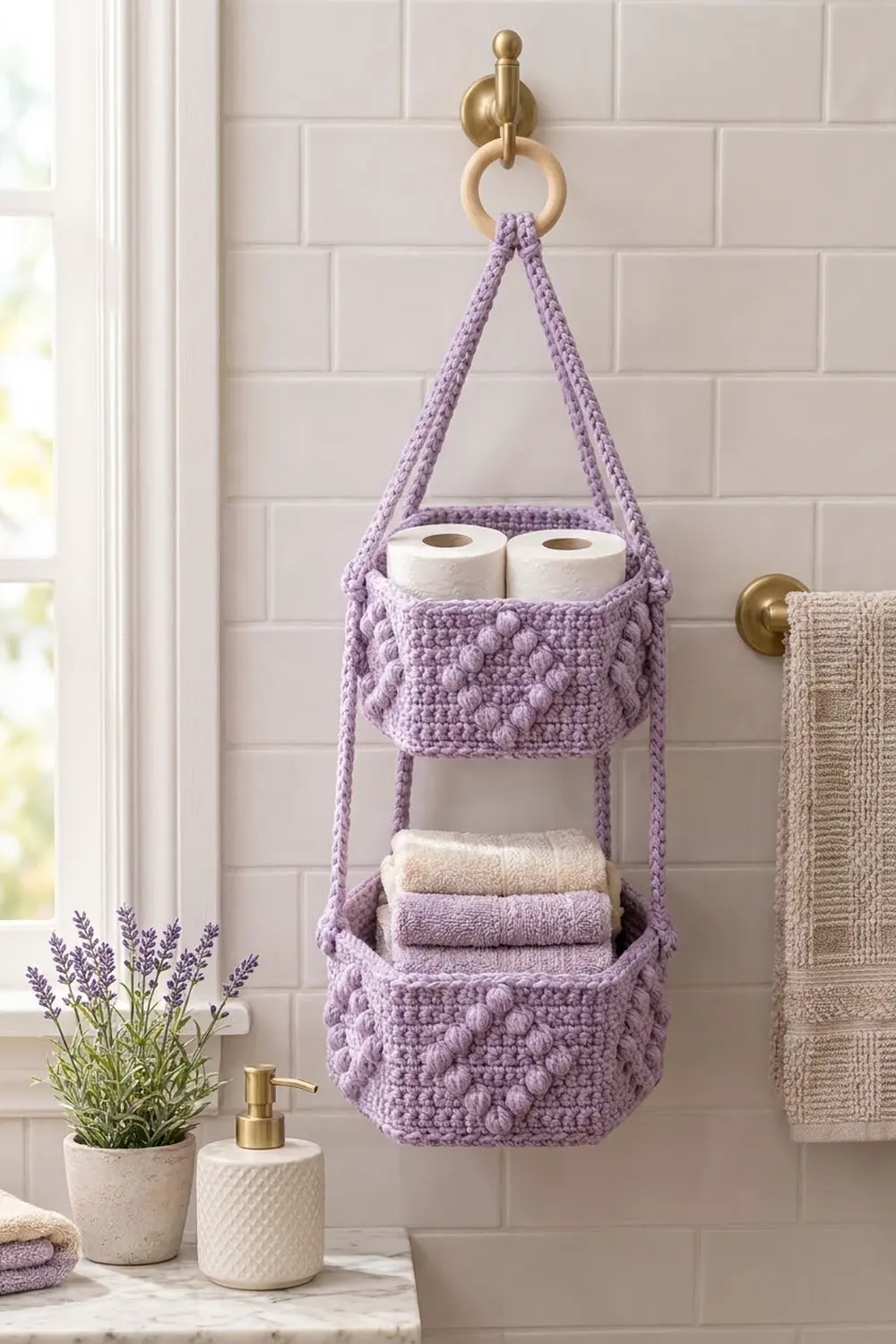
This two-tier hanging basket is made from two hexagonal baskets in soft lavender. Each of the six side panels has a raised diamond of bobbles. The set hangs from crocheted cord straps and a natural wooden ring, and it works well for spare toilet rolls, washcloths, or nursery bits.
The fabric is firm single crochet in a bulky yarn, so the walls stand up on their own. The bases are flat double crochet hexagons, and a crab-stitch rim gives the top edge a neat rolled cord.
This pattern uses US crochet terms. The small basket measures 8.0 in (20.3 cm) corner to corner and 5.1 in (13.0 cm) tall. The large basket measures 10.7 in (27.2 cm) corner to corner and 6.3 in (16.0 cm) tall. Hung, the set is about 32 in (81.3 cm) from the top of the ring to the bottom of the large basket.
Each basket starts as a flat hexagon base. A back-loop round turns up the wall. After that you work joined, turned rounds, so the bobbles you make on wrong-side rounds pop to the outside. Four cord straps link the ring and both baskets.
Finished Size and Construction
- Small basket: 8.0 in (20.3 cm) corner to corner, 6.9 in (17.5 cm) flat to flat, 5.1 in (13.0 cm) tall
- Large basket: 10.7 in (27.2 cm) corner to corner, 9.2 in (23.4 cm) flat to flat, 6.3 in (16.0 cm) tall
- Skill level: Intermediate
- Terminology: US
- Yarn weight: Bulky (#5)
- Hook: 5.5 mm (I-9)
- Number of pieces: 6 crocheted pieces (2 baskets, 2 long straps, 2 short straps) plus 1 wooden ring
- Layout: Vertical stack: ring, small basket, large basket
- Panel size: Small panel 4.0 in (10.2 cm) wide; large panel 5.3 in (13.5 cm) wide
- Size before border: Small wall 4.6 in (11.7 cm) tall; large wall 5.8 in (14.7 cm) tall
- Border depth: 0.5 in (1.3 cm), 2 rounds
Materials
Choose a smooth bulky cotton or cotton-acrylic blend. Cotton gives crisp bobbles and firm walls. Fuzzy or very stretchy yarns blur the texture and let the baskets sag.
- Lavender: 300 g, about 330 m (360 yd) in total
- Small basket: 80 g, about 90 m
- Large basket: 125 g, about 140 m
- Four straps: 20 g, about 22 m
These amounts include a margin of about 25% for swatching and differences in tension.
Tools:
- 5.5 mm (I-9) crochet hook
- 3 in (7.6 cm) wooden ring
- 12 locking stitch markers
- Tapestry needle, scissors, measuring tape
- Optional: plastic canvas cut into hexagons to stiffen the bases
Abbreviations (US Terms)
- ch: chain
- sl st: slip stitch
- sc: single crochet
- dc: double crochet
- BLO: back loop only
- sp: space
- st(s): stitch(es)
- MR: magic ring
- RS / WS: right side / wrong side
- rev sc: reverse single crochet (crab stitch), sc worked from left to right
Bobble (4-dc bobble): *Yarn over, insert the hook in the st, yarn over and pull up a loop, yarn over and draw through 2 loops. Repeat from * 3 more times in the same st (5 loops on hook). Yarn over and draw through all 5 loops. A bobble counts as 1 st. Always work bobbles on WS rounds so they pop out on the RS.
Gauge and Checkpoints
Gauge: 12 sts = 4 in (10.2 cm) in both dc and sc. In sc, 13 rounds = 4 in (10.2 cm).
Make the small basket first. It is quicker and tests your gauge on the real stitch pattern.
Checkpoints:
- Base Rnd 3: each side measures 2.7 in (6.9 cm).
- Small base Rnd 5: each side measures 4.0 in (10.2 cm), and the base is 8.0 in (20.3 cm) corner to corner.
- Large base Rnd 7: each side measures 5.3 in (13.5 cm), and the base is 10.7 in (27.2 cm) corner to corner.
- Wall: 13 wall rounds = 4.0 in (10.2 cm) tall.
If the base is too big, go down to a 5.0 mm hook. If it is too small, go up to a 6.0 mm hook. If the base ruffles, loosen your dc a little. If it cups, tighten them. If the walls feel floppy, use a hook one size smaller for the walls only.

Basket Base (Both Sizes)
Work in joined rounds with the RS facing. Do not turn.
Rnd 1: In a MR, ch 5 (counts as dc and ch 2). *Work 3 dc, ch 2; repeat from * 4 more times. Work 2 dc, then sl st in the 3rd ch of the beginning ch-5. (18 dc, 6 ch-2 sps; 3 dc per side)
Rnd 2: Sl st in the first ch-2 sp. Ch 5 (counts as dc and ch 2) and work 1 dc in the same sp. *Dc in each of the next 3 dc, then work (dc, ch 2, dc) in the next ch-2 sp; repeat from * 4 more times. Dc in each of the last 3 dc, then sl st in the 3rd ch of the beginning ch-5. (30 dc; 5 dc per side)
Rnds 3 and on: Sl st in the first ch-2 sp. Ch 5 and work 1 dc in the same sp. *Dc in each dc to the next ch-2 sp, then work (dc, ch 2, dc) in that sp; repeat from * 4 more times. Dc in each dc to the end, then sl st in the 3rd ch of the beginning ch-5. Each round adds 2 dc per side.
- Rnd 3: 42 dc (7 per side)
- Rnd 4: 54 dc (9 per side)
- Rnd 5: 66 dc (11 per side). Small basket: stop here.
- Rnd 6: 78 dc (13 per side)
- Rnd 7: 90 dc (15 per side). Large basket: stop here.
Do not fasten off.
Basket Wall
The sc you work into each ch-2 sp becomes a corner st. It forms the fold line between panels and is not counted as part of a panel. A panel is 11 sts on the small basket and 15 sts on the large basket.
Sl st in the next ch-2 sp.
W1 (RS, conversion round): Ch 1, then sc in the same ch-2 sp (corner st; place a marker). *Sc BLO in each dc to the next ch-2 sp, then sc in that sp (corner st; place a marker); repeat from * 4 more times. Sc BLO in each dc to the end, then sl st in the first sc.
- Small: 66 sts worked 1 per dc + 6 corner sts = 72 sc (12 per side: 1 corner + 11 panel)
- Large: 90 sts worked 1 per dc + 6 corner sts = 96 sc (16 per side: 1 corner + 15 panel)
From here on, start every round with ch 1 and turn. Then *sc in the corner st and work the panel; repeat from * 5 more times. Sl st in the first sc to close the round. The ch 1 never counts as a stitch. Each panel is symmetrical, so it reads the same in either direction.
Plain round: sc in each panel st.
Bobble rounds (always WS), small panel (11 sts):
- B1: sc 5, bobble, sc 5
- B2: sc 4, bobble, sc 1, bobble, sc 4
- B3: sc 3, (bobble, sc 1) twice, bobble, sc 3
- B4: repeat B2
- B5: repeat B1
Bobble rounds, large panel (15 sts):
- B1: sc 7, bobble, sc 7
- B2: sc 6, bobble, sc 1, bobble, sc 6
- B3: sc 5, (bobble, sc 1) twice, bobble, sc 5
- B4: repeat B2
- B5: repeat B1
Bobble rounds keep the full count: 72 sts on the small basket and 96 on the large. Each diamond has 9 bobbles, so each basket has 54 bobbles.
Small wall (15 rounds):
- W2 and W3: plain
- W4: B1
- W5: plain
- W6: B2
- W7: plain
- W8: B3
- W9: plain
- W10: B4
- W11: plain
- W12: B5
- W13 to W15: plain
That leaves 3 plain rounds below the diamond and 3 above it. Checkpoint: 4.6 in (11.7 cm) tall, 72 sts.
Large wall (19 rounds):
- W2 to W5: plain
- W6: B1
- W7: plain
- W8: B2
- W9: plain
- W10: B3
- W11: plain
- W12: B4
- W13: plain
- W14: B5
- W15 to W19: plain
That leaves 5 plain rounds below the diamond and 5 above it. Checkpoint: 5.8 in (14.7 cm) tall, 96 sts.
W15 and W19 are RS rounds. Leave the markers in the corner sts. You will need corners C1 and C4 when you assemble the set.
Straps
Long strap (make 2): body of 42 ch, 14 in (35.6 cm); about 16.5 in (41.9 cm) overall.
Short strap (make 2): body of 18 ch, 6 in (15.2 cm); about 8.5 in (21.6 cm) overall.
- Ch 8, then sl st in the first ch to form Loop A. Ch 1, work 14 sc into Loop A, and sl st in the first sc.
- Ch 42 for a long strap or 18 for a short strap. This is the body.
- Ch 8, then sl st in the last body ch to form Loop B. Ch 1, work 14 sc into Loop B, and sl st in the first sc.
- Work back along the body with a sl st in the back bump of each body ch (42 or 18 sl sts). Sl st in the base of Loop A. Fasten off, leaving a 12 in (30.5 cm) tail.
Each loop opens to about 1 in (2.5 cm). The row of slip stitches makes the body into a firm, braided-looking cord.
Make All Pieces
Make every piece in lavender:
- 1 small basket: base Rnds 1 to 5, walls W1 to W15, border
- 1 large basket: base Rnds 1 to 7, walls W1 to W19, border
- 2 long straps and 2 short straps
- 1 wooden ring (purchased)
Layout grid (front view):
            [ RING ]
           /        \
     Long A          Long B
        |               |
 [C1]  SMALL BASKET  [C4]
        |               |
    Short A          Short B
        |               |
 [C1]  LARGE BASKET  [C4]
C1 and C4 are opposite corners. To find C4, count 3 corner markers on from C1.
Joining
Finish the borders on both baskets before you join anything. Use the strap tails to whipstitch, going through both loops of each edge stitch. Keep the stitches snug, but not so tight that the fabric puckers.
- Ring: Wrap Loop A of each long strap around the ring. Whipstitch the loop flat against its own strap body, 1.5 in (3.8 cm) below the ring.
- Long straps to the small basket: Center Loop B on the outside of the base fold at C1 and sew all around the loop. Whipstitch the strap body up the corner fold, catching 1 stitch per wall round, and tack it at the rim. Repeat at C4. With the straps running along the full corners, the basket cannot tip.
- Short straps: Sew Loop A of each short strap over the long strap’s Loop B at C1 and C4. Sew Loop B of each short strap to the outside of the large basket’s rim at C1 and C4. Tack each strap again 1 in (2.5 cm) below the rim.
Size checkpoint: Hang the set. Both rims should sit level, and the full drop should be about 32 in (81.3 cm). If one side hangs low, move that strap’s rim tack up 1 round.
Border
Work the border on each basket after its last wall round. Border gauge matches the wall: 12 sts = 4 in (10.2 cm), and 2 rounds = 0.5 in (1.3 cm).
Border Rnd 1 (RS): Ch 1 and do not turn. Sc in each st around, then sl st in the first sc.
- Small: 72 sts worked 1 per st + 0 added = 72 sc (12 per side: 1 corner + 11 panel)
- Large: 96 sts worked 1 per st + 0 added = 96 sc (16 per side: 1 corner + 15 panel)
Border Rnd 2 (RS): Ch 1 and do not turn. Rev sc in each st around, then sl st in the first st. Fasten off.
- Small: 72 rev sc (12 per side)
- Large: 96 rev sc (16 per side)
Why the math works: The walls rise straight up, so the rim needs exactly the wall count. That is 6 × 12 = 72 sts on the small basket and 6 × 16 = 96 on the large. Each per-side count already includes its 1 corner st, so you add nothing at the corners. Extra stitches would make the rim flare, and fewer would pull it in.
Final Blocking
- Mist each basket lightly with water until it is damp.
- Stuff it firmly with a towel so the walls stand straight.
- Pinch each corner fold to sharpen it.
- Press the base flat and check that it measures 8.0 in (20.3 cm) or 10.7 in (27.2 cm) corner to corner.
- Push each bobble outward with a fingertip.
- Pin the straps out straight and shape the loops into rounds.
- Let everything dry completely. If you are using plastic canvas, cut it slightly smaller than each base and insert it now.
Final Quality-Control Checklist
- Bases have 66 dc (small) and 90 dc (large)
- Every wall round has 72 sts (small) or 96 sts (large)
- Each basket has 6 diamonds of 9 bobbles, each centered on its panel
- All bobbles pop out on the RS
- Each border has the same stitch count as its wall
- The straps in each pair are the same length
- All loops and tacks are secure
- Both rims hang level
Troubleshooting
- Bobbles show on the inside: You worked them on a RS round. Bobble rounds must be even-numbered WS rounds.
- A diamond is off-center: A corner st was skipped or doubled. Recount 1 corner st plus 11 or 15 panel sts per side.
- The seam slants: You did not turn. Turn after every round from W1 on.
- The base cups or ruffles: Adjust your dc height and re-check Rnd 3.
- The walls lean out: Your sc are too loose. Use a smaller hook or add plastic canvas.
- The rim flares: Work Border Rnd 2 with a smaller hook.
- The basket tilts: The straps are not on exactly opposite corners. Re-sew them at C1 and C4.
Care
Remove any inserts, then spot clean or hand wash in cool water. Reshape each basket over a towel and let it dry flat.
Final Notes
Every measurement builds on the gauge of 12 sts = 4 in (10.2 cm). The bases measure 8.0 in (20.3 cm) and 10.7 in (27.2 cm) corner to corner. The conversion round turns them into walls of 72 and 96 sts, which gives panels 4.0 in (10.2 cm) and 5.3 in (13.5 cm) wide. The walls rise to 4.6 in (11.7 cm) and 5.8 in (14.7 cm), and the border brings the finished heights to 5.1 in (13.0 cm) and 6.3 in (16.0 cm). Check each stage before you move on, and the set will hang straight and level.
Happy crocheting!