

This hanging holder stores five toilet rolls on any wall, hook or towel bar. Five round baskets sit in three tiers on a solid backing panel, and two straps hang the whole piece between two wooden dowels.
Each basket has a lavender base, white open filet-mesh sides and a sturdy lavender rim. The panel and straps are plain lavender single crochet, so the white grid stands out against them. The look is clean and soft, and it suits a bathroom with a spa feel.
The pattern uses US crochet terms. The finished holder is about 12 in (30.5 cm) wide at the dowels and 27 in (68.6 cm) tall. Each basket is 5.75 in (14.6 cm) across and 3.6 in (9.1 cm) tall.
You crochet each part separately: five baskets worked in joined rounds, one panel worked in rows with a two-round border, and two straps worked lengthwise. Then you sew the baskets to the panel, sew the straps along the panel sides, and slide in the dowels.
Finished Size and Construction
- Finished size: about 12 in (30.5 cm) wide × 27 in (68.6 cm) tall
- Skill level: Easy–Intermediate
- Terminology: US crochet terms
- Yarn weight: worsted (#4), cotton or cotton blend
- Hook: US H-8 (5.0 mm)
- Number of pieces: 8 crocheted pieces (5 baskets, 1 panel, 2 straps) plus 2 dowels
- Layout: 1 basket on the top tier, 2 on the middle tier, 2 on the bottom tier
- Basket size: 5.75 in (14.6 cm) across × 3.6 in (9.1 cm) tall
- Panel size before border: 9 in (22.9 cm) × 14 in (35.6 cm)
- Border depth: about 0.5 in (1.3 cm) on each side
- Panel size after border: 10 in (25.4 cm) × 15 in (38.1 cm)
- Strap size: 31 in (78.7 cm) long × 0.9 in (2.3 cm) wide
Materials
Use a smooth worsted-weight cotton. Cotton holds its shape, copes well with bathroom humidity and keeps the mesh squares crisp. Acrylic also works, but the baskets will be softer. The amounts below assume a yarn with about 190 m per 100 g.
- Lavender: 200 g (about 380 m), for the basket bases, bands and rims, the panel, the border and the straps
- White: 70 g (about 133 m), for the basket mesh walls
Both quantities include a margin of roughly 20–25% for swatching and gauge differences.
Tools:
- US H-8 (5.0 mm) crochet hook
- Tapestry needle
- 4–6 stitch markers
- Scissors
- Measuring tape
- 2 wooden dowels, each 12 in (30.5 cm) long and 0.5 in (1.3 cm) in diameter
- Rust-proof pins for blocking
- Optional: fabric stiffener for the baskets
Abbreviations (US Terms)
- ch – chain
- sl st – slip stitch
- sc – single crochet
- dc – double crochet
- st(s) – stitch(es)
- sk – skip
- sp – space
- BLO – back loop only
- MR – magic ring
- rep – repeat
- inc – 2 sc in the same stitch
Special stitch – mesh square: (dc, ch 1), skipping 1 stitch below. One mesh square covers 2 stitches of the round below and measures 0.5 in (1.3 cm) wide and 0.5 in (1.3 cm) tall at gauge.
Gauge and Checkpoints
Gauge: 16 sc × 18 rows = 4 in (10.2 cm) in sc. That is 4 sts and 4.5 rows per 1 in (2.5 cm). In mesh, 2 mesh squares = 1 in (2.5 cm) wide, and 2 dc rounds = 1 in (2.5 cm) tall.
Make one complete basket first. It works as your gauge test.
Checkpoints:
- After base Round 12: the base measures 5.5 in (14.0 cm) across and lies flat.
- After Round 19: the wall stands 3 in (7.6 cm) tall above the base edge.
- Finished basket: 5.75 in (14.6 cm) across × 3.6 in (9.1 cm) tall. A standard roll, 4.5 in (11.4 cm) across, should drop in easily.
- Panel after Row 18: 4 in (10.2 cm) tall and 9 in (22.9 cm) wide.
If your piece is too big, go down one hook size. If it is too small, go up one hook size. If the base ruffles, your tension is loose, so drop a hook size for the base only. If it cups, your tension is tight, so go up a size.
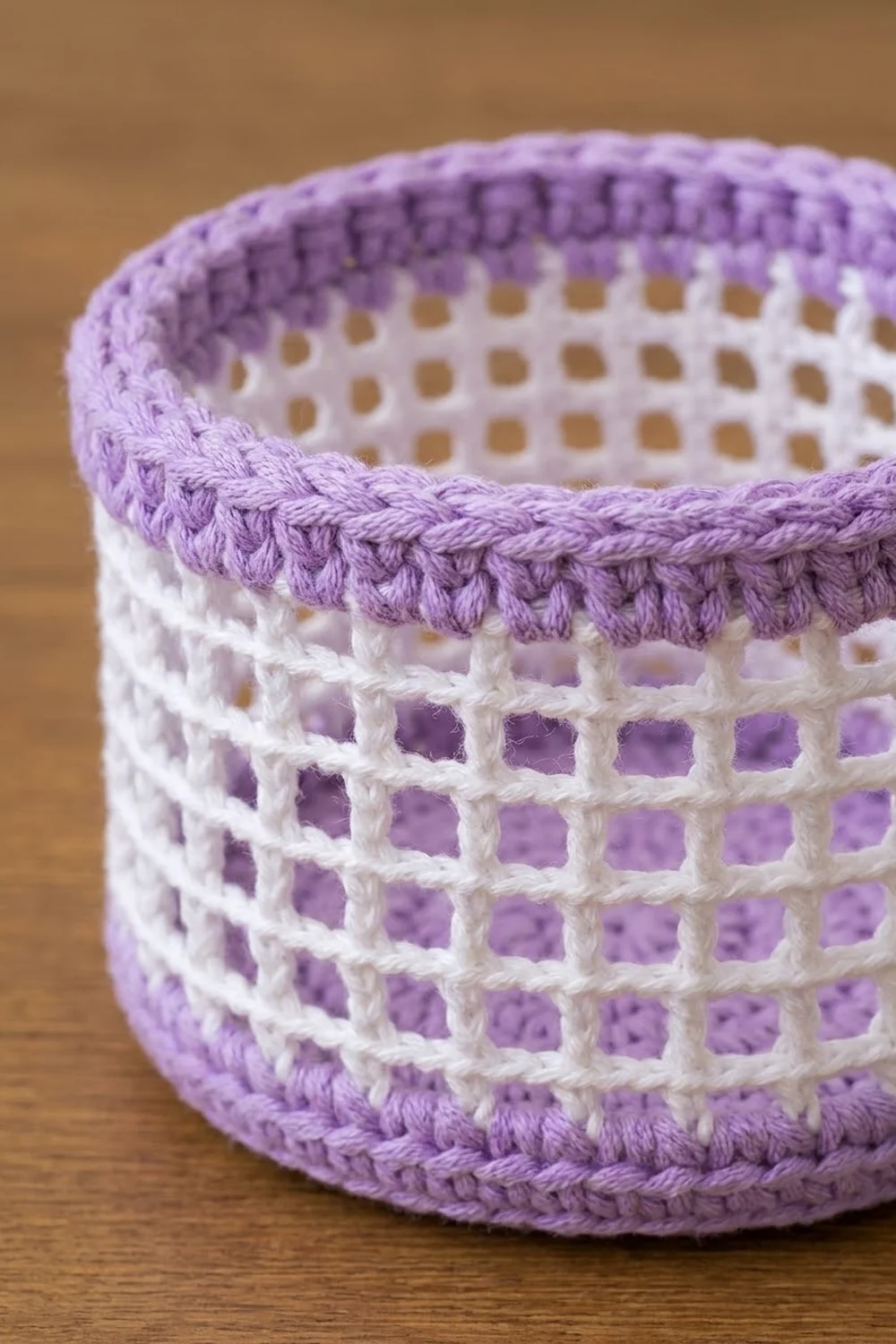
Basket (Make 5)
Join every round with a sl st to the first st. The ch 1 at the start of a sc round never counts as a stitch.
Base (lavender)
- Rnd 1: Work 6 sc in a MR. (6 sts)
- Rnd 2: Inc in each st around. (12 sts)
- Rnd 3: Sc 1, inc rep around. (18 sts)
- Rnd 4: Sc 2, inc rep around. (24 sts)
- Rnd 5: Sc 3, inc rep around. (30 sts)
- Rnd 6: Sc 4, inc rep around. (36 sts)
- Rnd 7: Sc 5, inc rep around. (42 sts)
- Rnd 8: Sc 6, inc rep around. (48 sts)
- Rnd 9: Sc 7, inc rep around. (54 sts)
- Rnd 10: Sc 8, inc rep around. (60 sts)
- Rnd 11: Sc 9, inc rep around. (66 sts)
- Rnd 12: Sc 10, inc rep around. (72 sts)
Checkpoint: the base is 5.5 in (14.0 cm) across and flat.
Bottom band (lavender)
- Rnd 13: Ch 1, sc in BLO of each st around. (72 sts) The unused front loops form a neat ridge, and the wall turns upward here.
- Rnd 14: Ch 1, sc in each st around. (72 sts)
Fasten off the lavender.
Mesh wall (white)
- Rnd 15: Join the white in any st. Ch 4 (counts as dc + ch 1), sk next st, dc in next st, ch 1, sk next st rep around. Join with sl st to the 3rd ch of the beginning ch-4. (36 dc + 36 ch-1 sps = 72 sts, which makes 36 mesh squares)
- Rnds 16–19: Ch 4 (counts as dc + ch 1), sk ch-1 sp, dc in next dc, ch 1, sk ch-1 sp rep around. Join to the 3rd ch of the ch-4. (36 dc + 36 ch-1 sps = 72 sts in each round)
That makes 5 mesh rounds, about 2.5 in (6.4 cm) tall. Each dc sits directly on top of the dc below, which keeps the grid square and vertical. Fasten off the white.
Checkpoint: the wall is 3 in (7.6 cm) tall above the base edge.
Rim (lavender)
- Rnd 20 (conversion round): Join the lavender in any dc. Ch 1, sc in the dc, sc in the ch-1 sp rep around. (36 sc in dc + 36 sc in sps = 72 sts)
- Rnds 21–22: Ch 1, sc in each st around. (72 sts)
Fasten off and weave in all ends along the solid bands, not through the mesh.
Height check: 2 band rounds (about 0.5 in) + 5 mesh rounds (2.5 in) + 3 rim rounds (about 0.6 in) = 3.6 in (9.1 cm). The circumference is 72 sts ÷ 4 = 18 in (45.7 cm), which gives a diameter of 5.75 in (14.6 cm).
Backing Panel (Make 1)
Use lavender.
- Foundation: Ch 37.
- Row 1: Sc in the 2nd ch from the hook and in each ch across. (36 sts)
- Rows 2–63: Ch 1, turn, sc in each st across. (36 sts)
Do not fasten off. Go straight on to the border.
Checkpoint: 36 sts ÷ 4 = 9 in (22.9 cm) wide, and 63 rows ÷ 4.5 = 14 in (35.6 cm) tall.
Straps (Make 2)
Use lavender. The straps are worked lengthwise.
- Foundation: Ch 125.
- Row 1: Sc in the 2nd ch from the hook and in each ch across. (124 sts)
- Rows 2–4: Ch 1, turn, sc in each st across. (124 sts)
Fasten off. Each strap is 124 ÷ 4 = 31 in (78.7 cm) long and about 0.9 in (2.3 cm) wide.
Mark these zones with stitch markers, counting stitches from one end:
- Sts 1–12: top loop, 3 in (7.6 cm)
- Sts 13–52: free diagonal, 10 in (25.4 cm)
- Sts 53–112: section sewn to the panel, 15 in (38.1 cm)
- Sts 113–124: bottom loop, 3 in (7.6 cm)
Check: 12 + 40 + 60 + 12 = 124 sts.
Make All Pieces
- Lavender + white: 5 baskets
- Lavender: 1 panel (with border) and 2 straps
Layout grid (front view):
   [=========== top dowel ===========]
         \                 /
          \   [ B1 ]      /
         |  [ B2 ][ B3 ]  |
         |  [ B4 ][ B5 ]  |
   [========= bottom dowel ==========]
B1 is centered on the top tier. B2/B3 and B4/B5 sit side by side, touching each other. Each pair spans 11.5 in (29.2 cm), so it overhangs the 10 in (25.4 cm) panel by 0.75 in (1.9 cm) on each side.
Joining
Method: whipstitch with lavender yarn and a tapestry needle, working through both loops.
Basket to panel, stitch to stitch:
- Pick a 9-st arc at the back of a basket. That is 2.25 in (5.7 cm) of its circumference.
- Mark the same 9 sts on Rnd 14 (bottom band) and on Rnd 22 (rim).
- Sew each marked st to the panel one stitch at a time. Keep the arc flat against the panel, but don’t stretch it.
Do not sew through the white mesh. It would distort the grid.
Basket placement, measured from the panel’s bottom edge to each basket’s base:
- Bottom tier (B4, B5): 0.5 in (1.3 cm)
- Middle tier (B2, B3): 5 in (12.7 cm)
- Top tier (B1): 9.5 in (24.1 cm), centered
Each tier leaves room for a 4 in (10.2 cm) tall roll to stand without touching the basket above.
Straps to panel:
- Lay strap section sts 53–112 (60 sts) along one panel side.
- Start at the top corner. Sew each strap st to one border st: 59 side sts + 1 corner center st = 60 sts.
- A strip 60 sts long matches a 15 in (38.1 cm) side at 4 sts per in, so neither piece puckers.
- Repeat for the second strap on the other side.
Loops:
- Fold sts 1–12 in half over the top dowel so st 1 lies on st 12.
- Sew across and along both edges.
- Center the top loops 7 in (17.8 cm) apart on the dowel. This gives the straps their A-shape.
- Make the bottom loops from sts 113–124 the same way around the bottom dowel. They sit 10 in (25.4 cm) apart, right below the panel corners.
Tension: pull each stitch snug, just until the seam yarn sinks into the fabric. Seams sewn too tightly will wrinkle the panel.
Size checkpoint: lay the joined piece flat. It should measure 12 in (30.5 cm) wide at the dowels and about 27 in (68.6 cm) from the top of the top loops to the bottom of the bottom loops.
Panel Border
Work the border before you sew anything to the panel. Border gauge is the same as the body: 4 sts per in (2.5 cm). Corner groups are (3 sc in one st). Counts below are given between corner center sts.
Rnd 1: Ch 1. Do not turn.
- Top edge: 3 sc in the first st, sc in each of the next 34 sts, 3 sc in the last st.
- Side: Work down the side over the row ends of Rows 62 to 2. Sc in each row end, but skip every 9th row end (6 skips), for 55 sc.
- Bottom edge: working into the foundation ch loops, 3 sc in the first loop, sc in each of the next 34 loops, 3 sc in the last loop.
- Second side: work 55 sc up the other side the same way. Join.
Total: 4 corner groups × 3 = 12, plus 34 + 34 + 55 + 55 = 190 sts. Between corner centers: top and bottom 36 each, sides 57 each. Check: 4 + 72 + 114 = 190.
Rnd 2 (conversion round): Ch 1, sc in each st around, working 3 sc in each corner center st. Join.
Total: 190 worked 1 per stitch + 8 extra = 198 sts. Between corner centers: top and bottom 38 each, sides 59 each. Check: 4 + 76 + 118 = 198.
Fasten off.
Why the math works: sc rows stack at 4.5 per in but the border stitches sit at 4 per in. Skipping every 9th row end brings the sides back to stitch gauge. The 61 row ends would only need about 54 sts at 4 sts per in, and 55 keeps the edge flat. The corner increases add the extra length the outer rounds need, so the panel neither cups nor ruffles. The finished side has 59 sts + 1 corner center = 60 sts, which matches the strap’s 60-st sewing zone exactly.
Final Blocking
- Block the pieces before you assemble them.
- Wet each piece in cool water and press out the excess in a towel.
- Pin the panel to 10 in × 15 in (25.4 cm × 38.1 cm) with straight edges.
- Pin the straps straight at 31 in (78.7 cm).
- Stand each basket over a can or jar about 5.5 in (14.0 cm) across. Line up the mesh columns vertically and pull the rim level.
- Optional: brush a light coat of fabric stiffener onto the bases and rims.
- Let everything dry completely before sewing.
Final Quality-Control Checklist
- Each basket has 72 sts in Rnds 12–14 and 20–22, and 36 mesh squares in each mesh round.
- The mesh columns are vertical and the squares are even.
- Every basket is 5.75 in (14.6 cm) across × 3.6 in (9.1 cm) tall.
- The panel border counts are 190 and 198 sts, and the panel lies flat.
- The tiers sit 0.5 in, 5 in and 9.5 in (1.3, 12.7, 24.1 cm) above the panel bottom.
- The straps are sewn 60 sts to 60 sts with no puckering.
- The dowels slide through the loops snugly and the holder hangs level.
- All ends are woven into the solid lavender areas.
Troubleshooting
- Base cups: your tension is too tight. Go up one hook size or redo the base more loosely.
- Base ruffles: you have too many sts or loose tension. Recount each round (6 more per round) and drop a hook size.
- Mesh leans or spirals: you are working into the ch-1 sp instead of the dc. Place each dc into the top of the dc below.
- Basket too tight for a roll: go up one hook size and remake it. The inside must be at least 4.75 in (12.1 cm) across.
- Border waves: you added too many side sts. Skip more row ends.
- Border pulls in: you skipped too many row ends. Skip fewer.
- Holder tilts: the top loops aren’t centered. Re-sew them 7 in (17.8 cm) apart.
- Baskets droop forward: sew a few extra stitches at the back of the rim arc.
Care
Hand wash in cool water and lay flat to dry. Reshape the baskets while damp. Remove the dowels before washing.
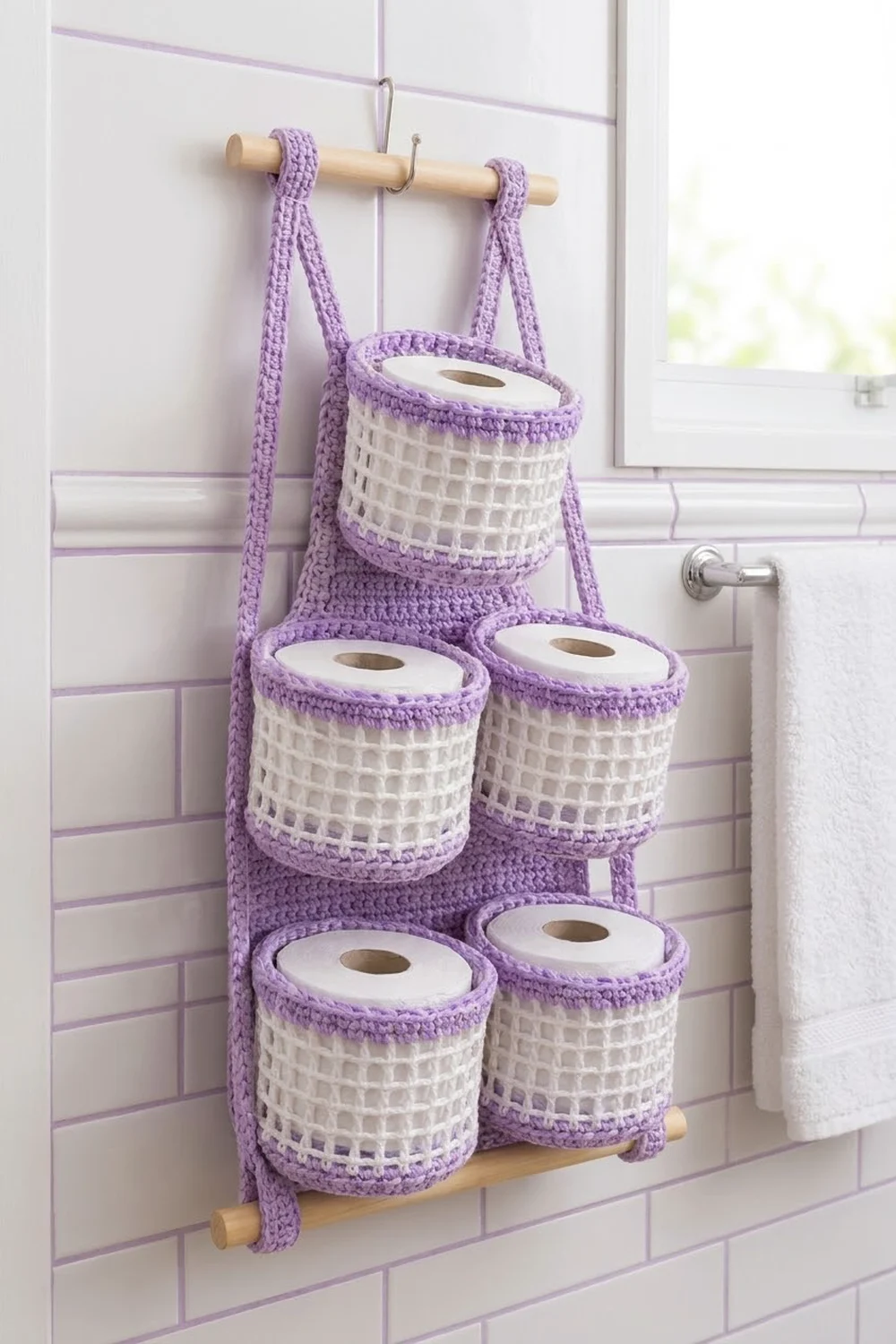
Final Notes
Everything follows from the gauge of 16 sc × 18 rows = 4 in (10.2 cm):
- The 72-st base becomes an 18 in (45.7 cm) circumference and a 5.75 in (14.6 cm) basket.
- 36 sts × 63 rows make a 9 × 14 in (22.9 × 35.6 cm) panel, and the border brings it to 10 × 15 in (25.4 × 38.1 cm).
- 60 sts along each finished side match the strap’s 60-st sewing zone.
- The 124-st straps set the hanging height at 27 in (68.6 cm).
Check each stage before moving on, and the assembly will come together cleanly.
Happy crocheting!