
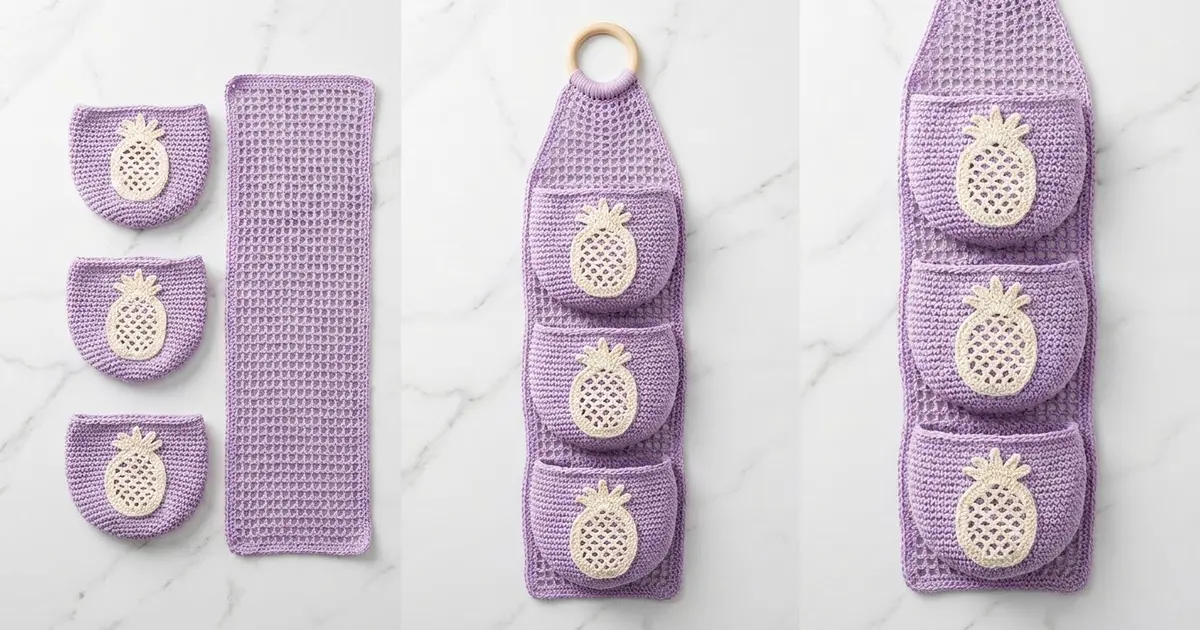
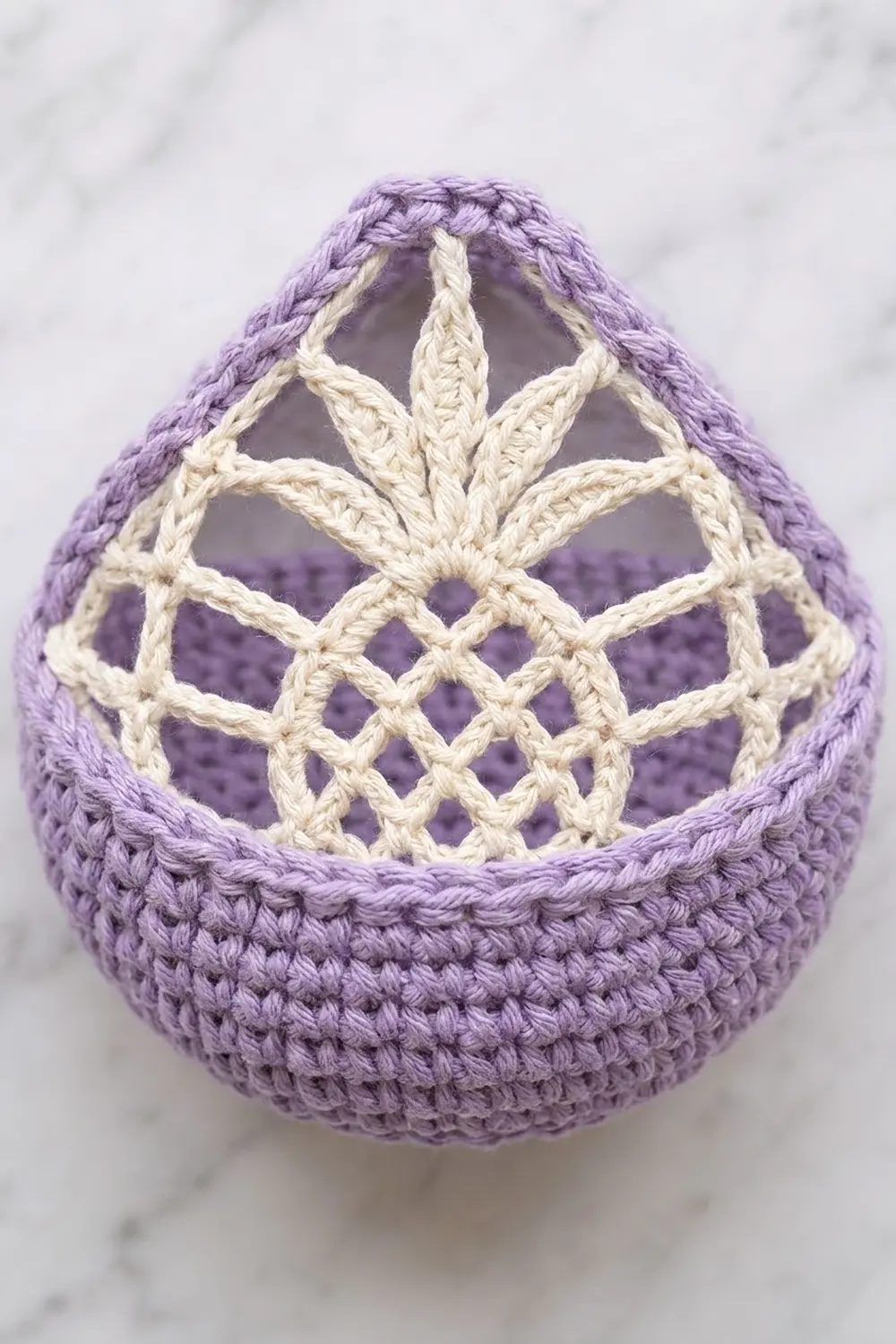
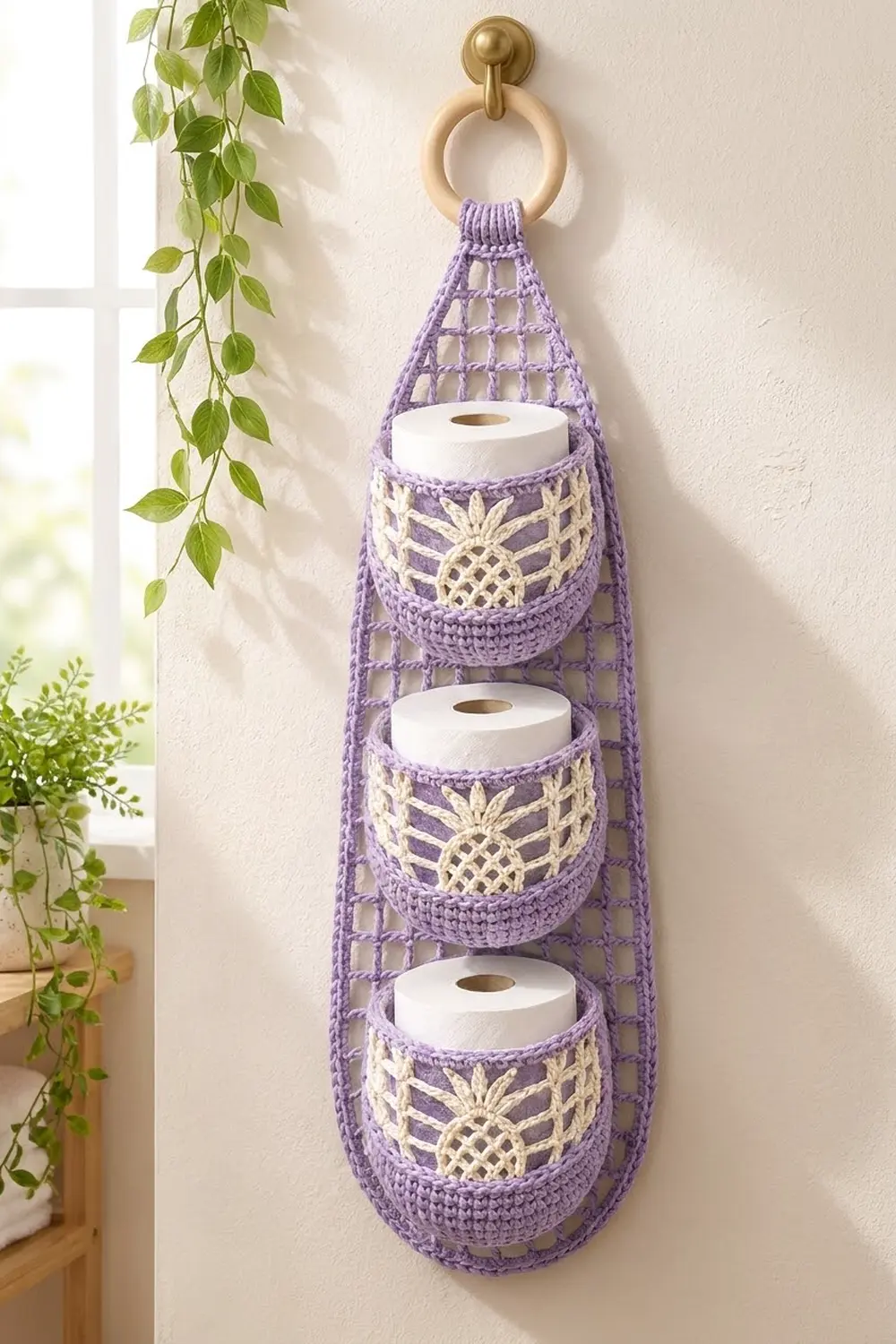
This hanging holder stores three spare toilet rolls in three round pockets. The pockets are stacked down a long lavender mesh panel that hangs from a wooden ring. Each pocket has a cream pineapple appliqué on the front, with an open lattice body and a fan of chain leaves.
The colors are soft lavender and cream, in an airy farmhouse style. The solid single crochet pockets sit against an open filet grid, so the piece looks light on the wall.
The pattern uses US crochet terms. The finished panel measures 7.7 in (19.6 cm) wide by 26.25 in (66.7 cm) long. With the strap and ring, the holder hangs about 30.5 in (77.5 cm) long. Each pocket is 5.1 in (13.0 cm) across and 4 in (10.2 cm) deep.
You crochet the mesh panel from the bottom up in rows, the pockets in continuous rounds, and the pineapples in rows. Sew the pineapples onto the pockets and the pockets onto the panel. Then add a two-round border, wrap the strap around the ring, and block.
Finished Size and Construction
- Finished size: panel 7.7 in × 26.25 in (19.6 cm × 66.7 cm); overall about 30.5 in (77.5 cm) with the ring
- Skill level: Intermediate
- Terminology: US
- Yarn weight: worsted (#4) cotton
- Hook: 4.0 mm (G-6)
- Number of pieces: 7 crocheted (1 panel, 3 pockets, 3 pineapples) + 1 wooden ring
- Layout: 3 pockets in one vertical column, centered on the panel
- Piece sizes:
- Pocket: 5.1 in (13.0 cm) across, with a 4 in (10.2 cm) wall
- Pineapple body: 2.6 in × 2.6 in (6.6 cm × 6.6 cm)
- Panel size before border: 7.2 in × 26 in (18.3 cm × 66.0 cm)
- Border depth: 0.25 in (0.6 cm)
Materials
Use a smooth, firm worsted cotton. Cotton holds the pocket shape and won’t sag under the weight of the rolls. Acrylic also works, but the pockets will be softer.
- Lavender: 400 g / 680 m (panel, pockets, border, strap)
- Cream: 50 g / 85 m (three pineapples)
- 4.0 mm (G-6) crochet hook
- 2.75 in (7.0 cm) unfinished wooden ring
- 4 stitch markers
- Tapestry needle
- Rust-proof pins and a blocking mat
- Spray bottle and measuring tape
The yarn quantities include about a 20% margin for gauge swatches and differences in tension.
Abbreviations (US Terms)
- ch: chain
- sl st: slip stitch
- sc: single crochet
- hdc: half double crochet
- dc: double crochet
- tr: treble crochet
- dtr: double treble crochet
- inc: 2 sc in the same stitch
- sc2tog: single crochet 2 together
- MR: magic ring
- ms: mesh square
- sp: space
- rev sc: reverse single crochet (crab stitch)
Special stitches
- Large ms (panel): dc, ch 2, skip 2. A row of n large ms has 3n + 1 stitches.
- Small ms (pineapple): dc, ch 1, skip 1. A row of n small ms has 2n + 1 stitches.
- End increase: after the last dc of the row, ch 2 (panel) or ch 1 (pineapple). Then work a dtr (panel) or tr (pineapple) in the same stitch as that last dc. This adds 1 ms.
- End decrease: work across until 1 ms remains, then turn and leave that ms unworked. This removes 1 ms.
- Leaf (L): ch 7, sl st in 2nd ch from hook, sc in next ch, hdc in next 2 ch, sc in next ch, sl st in last ch. (6 sts)
- Tall leaf (TL): ch 9, sl st in 2nd ch from hook, sc in next 2 ch, hdc in next 3 ch, sc in next ch, sl st in last ch. (8 sts)
All shaping happens at the end of a row. Rows change direction each time, so back-to-back shaping rows work on opposite sides and the piece stays symmetrical.
Gauge and Checkpoints
- Lavender sc: 18 sc × 20 rnds = 4 in (10.2 cm)
- Panel mesh: 5 large ms × 6 rows = 4 in (10.2 cm)
- 1 ms is 0.8 in (2.0 cm) wide.
- 1 row is 2/3 in (1.7 cm) tall.
- Pineapple mesh: 9 small ms × 9 rows = 4 in (10.2 cm)
Make one pocket first, because it works as your gauge test.
- After pocket Rnd 12, the base measures 5.1 in (13.0 cm) across.
- After pocket Rnd 32, the wall is 4 in (10.2 cm) tall.
- After panel Row 5, the panel is 7.2 in (18.3 cm) wide.
- After panel Row 27, the panel is 18 in (45.7 cm) long.
- After panel Row 39, the panel is 26 in (66.0 cm) long.
If the pocket base is more than 0.25 in (0.6 cm) too big, go down one hook size. If it’s too small, go up one size. A base that is too small won’t hold a standard 4.5 in (11.4 cm) roll.
Part 1: Mesh Panel (make 1, lavender)
Work the panel from the bottom edge up.
Row 1: Ch 20, dc in 8th ch from hook, *ch 2, skip 2 ch, dc in next ch; rep from * across, turn. (5 ms, 16 sts)
Row 2: Ch 5 (counts as dc + ch 2), dc in next dc, *ch 2, dc in next dc; rep from * across, working the last dc in the top of the turning chain. End increase, turn. (6 ms, 19 sts)
Row 3: Work as Row 2. (7 ms, 22 sts)
Row 4: Work as Row 2. (8 ms, 25 sts)
Row 5: Work as Row 2. (9 ms, 28 sts)
Checkpoint: the bottom curves evenly and the panel is 7.2 in (18.3 cm) wide.
Rows 6–27: Ch 5, dc in next dc, *ch 2, dc in next dc; rep from * across, working the last dc in the top of the turning chain, turn. (9 ms, 28 sts)
Row 28: Work in pattern with an end decrease. (8 ms, 25 sts)
Row 29: Work in pattern with an end decrease. (7 ms, 22 sts)
Rows 30–31: Work even. (7 ms, 22 sts)
Row 32: End decrease. (6 ms, 19 sts)
Row 33: End decrease. (5 ms, 16 sts)
Rows 34–35: Work even. (5 ms, 16 sts)
Row 36: End decrease. (4 ms, 13 sts)
Row 37: End decrease. (3 ms, 10 sts)
Rows 38–39: Work even. (3 ms, 10 sts)
Strap
Row 40 (conversion row): Ch 1, *sc in next dc, 2 sc in next ch-2 sp; rep from * 2 more times, sc in last dc, turn. (4 sc in dc + 6 sc in sps = 10 sc)
Row 41: Ch 1, sc2tog, sc in next 6, sc2tog, turn. (8 sc)
Row 42: Ch 1, sc2tog, sc in next 4, sc2tog, turn. (6 sc)
Rows 43–60: Ch 1, sc in each sc, turn. (6 sc)
Fasten off. The strap is 1.3 in (3.3 cm) wide and 4.2 in (10.7 cm) long.
Part 2: Pockets (make 3, lavender)
Work in continuous rounds without joining. Move a marker up at the start of each round.
Rnd 1: 6 sc in MR. (6)
Rnd 2: Inc in each st. (12)
Rnd 3: (Sc 1, inc) × 6. (18)
Rnd 4: (Sc 2, inc) × 6. (24)
Rnd 5: (Sc 3, inc) × 6. (30)
Rnd 6: (Sc 4, inc) × 6. (36)
Rnd 7: (Sc 5, inc) × 6. (42)
Rnd 8: (Sc 6, inc) × 6. (48)
Rnd 9: (Sc 7, inc) × 6. (54)
Rnd 10: (Sc 8, inc) × 6. (60)
Rnd 11: (Sc 9, inc) × 6. (66)
Rnd 12: (Sc 10, inc) × 6. (72)
Checkpoint: the base is 5.1 in (13.0 cm) across, with a circumference of 16 in (40.6 cm).
Rnds 13–32: Sc in each st. (72)
Work through both loops so the base curves gently up into the wall and the bowl stays rounded. At the end of Rnd 32, sl st in the next st.
Rnd 33 (rim): Ch 1, rev sc in each st, join with sl st. (72)
Fasten off and leave a 40 in (101.6 cm) tail. Place a marker at the end of the round to mark the center back. Stitch 36 counted from that marker is the center front.
Part 3: Pineapple Appliqués (make 3, cream)
Row 1: Ch 10, dc in 6th ch from hook, *ch 1, skip 1 ch, dc in next ch; rep from * once more, turn. (3 ms, 7 sts)
Row 2: Ch 4 (counts as dc + ch 1), dc in next dc, *ch 1, dc in next dc; rep from * across, working the last dc in the top of the turning chain. End increase, turn. (4 ms, 9 sts)
Row 3: Work as Row 2. (5 ms, 11 sts)
Row 4: Work in pattern with an end decrease. (4 ms, 9 sts)
Row 5: Work in pattern with an end decrease. (3 ms, 7 sts)
Do not fasten off.
Edging round: Ch 1, then work around the pineapple body as follows:
- Top: 2 sc in first dc, sc in next 5 sts, 2 sc in last st. (9)
- Side 1: 2 sc in each of 5 row ends, plus 1 sc in the exposed ch-1 sp at the decrease step. (11)
- Bottom: 2 sc in first foundation ch, sc in next 5 ch, 2 sc in last ch. (9)
- Side 2: work as Side 1. (11)
Join with sl st. (9 + 11 + 9 + 11 = 40 sc)
The body measures 2.6 in × 2.6 in (6.6 cm × 6.6 cm).
Crown: Number the 9 top sc from 1 to 9. Then work the leaves:
- Sl st in sc 3, work L.
- Sl st in sc 4, work L.
- Sl st in sc 5, work TL.
- Sl st in sc 6, work L.
- Sl st in sc 7, work L.
You now have 5 leaves. The side leaves are 1.2 in (3.0 cm) long and the center leaf is 1.6 in (4.1 cm). Fasten off and leave a 20 in (50.8 cm) tail.
Make All Pieces
- Lavender: 1 panel and 3 pockets
- Cream: 3 pineapple appliqués
Layout, front view:
        ( ring )
         strap           Rows 40-60
        / mesh \         Rows 28-39 taper
       |  [P3]  |        rim at top of Row 26
       |  [P2]  |        rim at top of Row 17
       |  [P1]  |        rim at top of Row 8
        \______/         Rows 1-5 rounded bottom
Joining
Step 1: Sew each pineapple to a pocket.
- Center the pineapple on the center front stitch, with the bottom edge of the body along Rnd 13. The tip of the center leaf should reach the rim.
- Whipstitch through the back loop of each edging sc, catching 1 pocket stitch for each sc.
- Leave the lattice holes open so the lavender shows through.
- Tack each leaf tip down with one small stitch.
Step 2: Sew each pocket to the panel.
With the panel right side up, center each pocket over meshes 4, 5, and 6. That leaves 3 clear meshes on each side. Line up each rim with the top of its row:
- Pocket 1 rim: top of Row 8, 5.33 in (13.5 cm) above the bottom of the panel body
- Pocket 2 rim: top of Row 17, 11.33 in (28.8 cm) above the bottom
- Pocket 3 rim: top of Row 26, 17.33 in (44.0 cm) above the bottom
Whipstitch the 12 rim stitches at the center back (6 on each side of the marker) across the 3 center meshes. That’s 4 rim stitches per mesh: 1 at the dc post and 3 across the ch-2 sp.
Next, sew straight down the center back of the pocket wall to the base. Tack it to the dc posts of the center mesh column every second round, for 10 tacks in all.
Keep the sewing snug but not puckered. The panel should stay flat and the pocket should stay round.
Checkpoint: the rims are 6 in (15.2 cm) apart and the panel still lies flat at 7.2 in (18.3 cm) wide.
Border
The border goes only around the panel and strap. The pockets are sewn onto the front of the panel, so none of their stitches count toward the border.
Border gauge: 4.5 sc per inch (18 sc = 4 in / 10.2 cm). A panel row is 2/3 in (1.7 cm) tall, so 3 sc per row end matches the gauge.
Rnd 1: Join lavender at the bottom center and work sc around the edge as follows:
- Bottom: 2 sc in first foundation ch, sc in next 14 ch, 2 sc in last ch. (18)
- Each long side (Rows 1–39): 3 sc per row end (117), plus 2 sc at each of the 3 decrease steps (6). (123)
- Each strap side (Rows 40–60): 1 sc per row end. (21)
- Strap top: 1 sc in each st. (6)
Join with sl st. (18 + 123 + 123 + 21 + 21 + 6 = 312 sc)
Rnd 2: Ch 1, rev sc in each sc, join. (312)
Why the math works:
- 117 sc along 26 in (66.0 cm) is 4.5 sc per inch.
- 18 sc along the 4 in (10.2 cm) bottom is also 4.5 sc per inch.
- The 2 extra sc at each decrease step cover the exposed top of the unworked mesh, so the taper looks like a smooth line.
- Strap rows are about 0.2 in (0.5 cm) tall, so 1 sc per row end matches the gauge too.
The border adds 0.25 in (0.6 cm) on each side. That takes the width from 7.2 in to 7.7 in (18.3 cm to 19.6 cm) and the length from 26 in to 26.25 in (66.0 cm to 66.7 cm).
Ring: Pass the strap through the ring from front to back. Fold the top 10 rows, 2 in (5.1 cm), to the wrong side and whipstitch the strap end across Row 48.
Final Blocking
- Weave in all ends, running cream tails through cream stitches only.
- Lay the holder face up on the blocking mat.
- Pin the panel to 7.7 in × 26.25 in (19.6 cm × 66.7 cm), with a pin at every row end.
- To square the meshes, pin down the center column every 4 in (10.2 cm).
- Fill each pocket with a rolled towel about 5 in (12.7 cm) across.
- Spray until damp, then arrange the pineapple leaves into an even fan.
- Let it dry for 24 hours before unpinning.
Final Quality-Control Checklist
- The panel is 7.7 in (19.6 cm) wide and 26.25 in (66.7 cm) long.
- Both sides of the taper step in at matching rows.
- Each pocket is 5.1 in (13.0 cm) across and has 72 rim stitches.
- Each pineapple is centered and has 5 leaves.
- The rims are level and 6 in (15.2 cm) apart.
- Border Rnd 2 has 312 stitches.
- The strap is sewn securely.
- A 4.5 in (11.4 cm) roll drops into each pocket easily.
Troubleshooting
- Panel leans to one side: you missed a shaping row. Check your mesh count against the row list.
- Meshes look tall and stretched: your dc is loose. Use a smaller hook for the panel.
- Pocket flares out: your gauge is loose. Remake it with a smaller hook.
- Roll won’t fit: the base is under 5.1 in (13.0 cm). Remake the pocket with a larger hook.
- Pineapple curls: block it flat before sewing it on.
- Border ruffles around the bottom curve: work 2 sc per row end on Rows 1–5.
Care
Hand wash in cool water and dry flat. While the holder is damp, reshape the pockets with rolled towels.
Final Notes
Each measurement leads to the next:
- 18 sc = 4 in (10.2 cm) gives a 5.1 in (13.0 cm) pocket base.
- 5 large ms = 4 in (10.2 cm) gives a 7.2 in (18.3 cm) panel.
- 39 rows at 2/3 in (1.7 cm) each give a 26 in (66.0 cm) panel.
- The 312-stitch border brings the panel to 7.7 in × 26.25 in (19.6 cm × 66.7 cm).
Check each measurement before you move on, and the three pockets will hang straight and level.
Happy crocheting!