

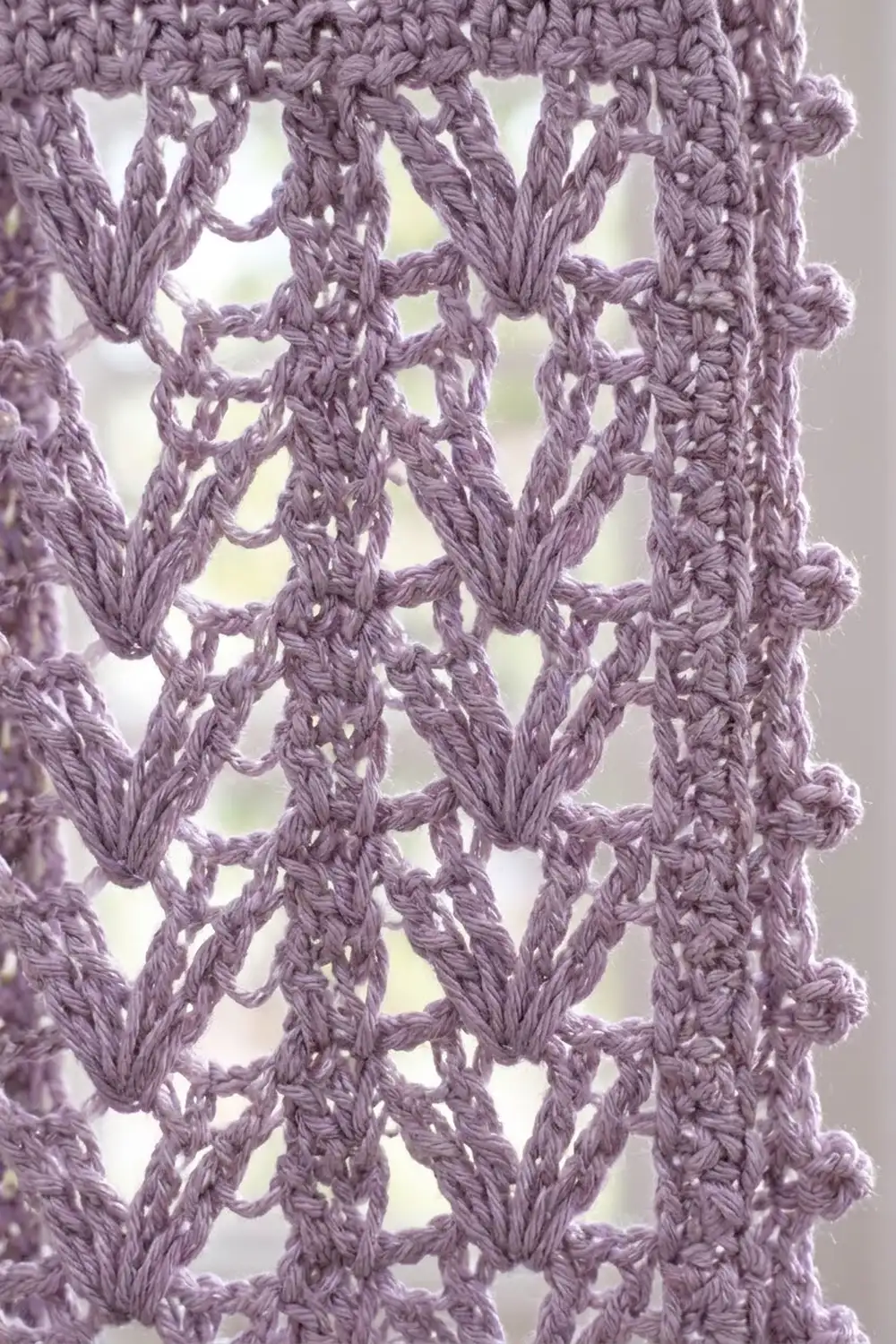
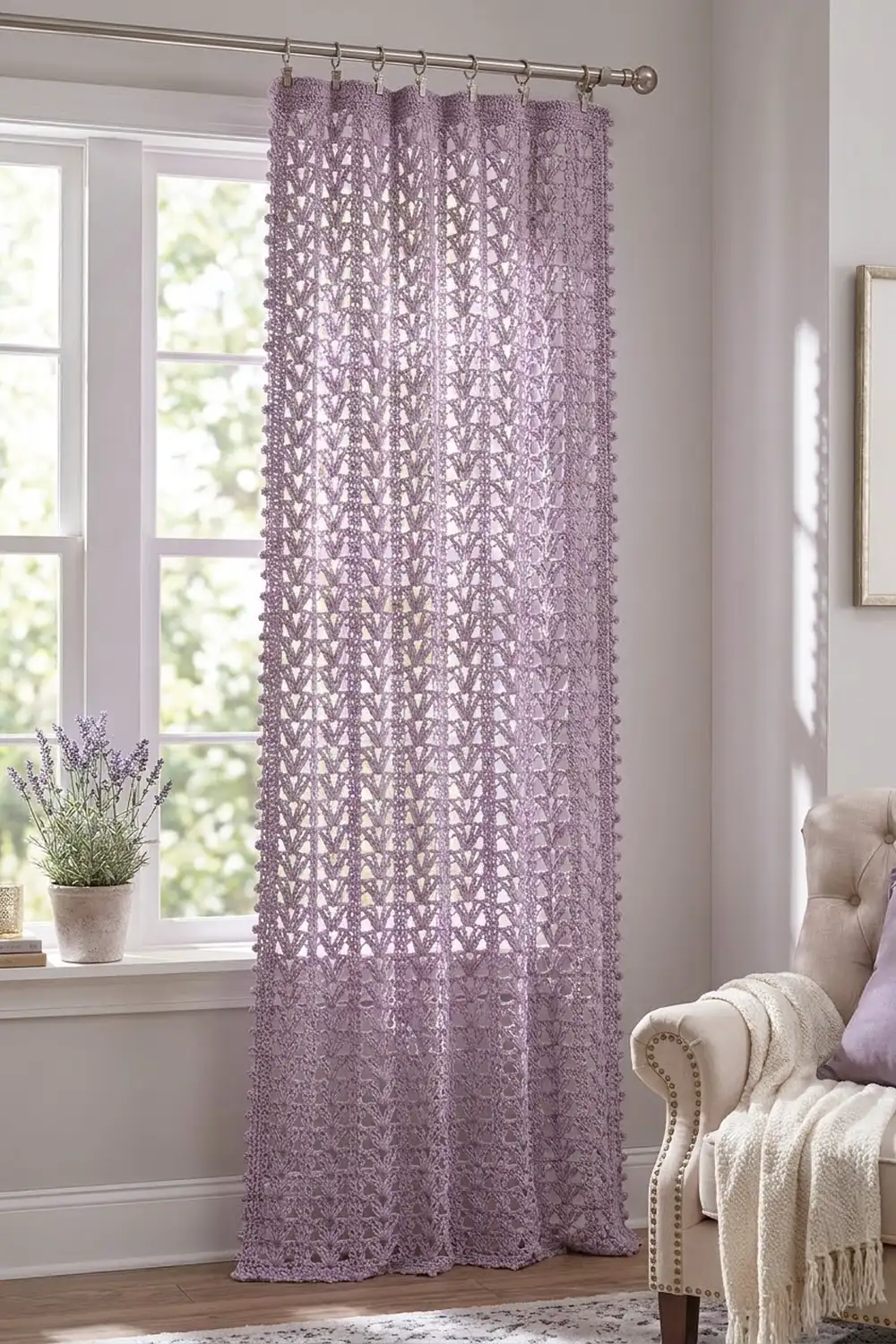
This Lavender Spray lace curtain panel is a light, airy window covering made from one rectangular piece. Stacked fan-shaped shells open upward like little sprays of lavender. They sit in neat vertical columns, separated by chain arcs that let soft light through.
The panel is worked in one soft lavender shade for a calm, cottage-style look. A solid single crochet header runs across the top and gives curtain clip rings a firm place to grip. A narrow single crochet border frames the sides and bottom, and small picots are spaced along its outer edge.
This pattern uses US crochet terms. The finished panel measures 40 in (101.6 cm) wide by 83.75 in (212.7 cm) long after blocking. For a pair of curtains, make two identical panels.
Construction is simple. You chain a foundation and work a two-row lace repeat from the bottom up. Then you switch to solid single crochet for the header and finish with a five-round border worked all the way around.
Finished Size and Construction
- Finished size: 40 in (101.6 cm) wide x 83.75 in (212.7 cm) long
- Skill level: Easy-intermediate
- Terminology: US crochet terms
- Yarn weight: DK (light worsted, #3)
- Hook: 4.0 mm (G-6)
- Number of pieces: 1 (one single panel)
- Layout: 19 shell columns across, 58 shell rows tall
- Lace section size: 38 in (96.5 cm) wide x 79.75 in (202.6 cm) long
- Size before border (lace + header): 38 in (96.5 cm) x 81.75 in (207.6 cm)
- Border depth: 1 in (2.5 cm) on every side, not counting the picots
Materials
Choose a smooth DK cotton or cotton blend. Cotton holds the shell shapes crisply, blocks well, and does not fuzz in sunlight. Avoid very splitty yarns, since you will work many stitches into chain spaces.
- Lavender DK cotton: about 1,500 g (approximately 3,450 m), or 30 balls of 50 g / 115 m each
- 4.0 mm (G-6) crochet hook
- Locking stitch markers (at least 4)
- Tapestry needle
- Scissors
- Measuring tape
- Rust-proof blocking pins and a large blocking surface, such as foam mats or a clean bed covered with towels
- Optional: 12 curtain clip rings and a curtain rod
The yarn quantity includes a margin of about 10% for the gauge swatch, small differences in tension, and weaving in ends. Buy all your yarn from the same dye lot, because color shifts show clearly on a long panel.
Abbreviations (US Terms)
- ch – chain
- sl st – slip stitch
- sc – single crochet
- dc – double crochet
- sk – skip
- sp – space
- st(s) – stitch(es)
- rep – repeat
- RS / WS – right side / wrong side
Special stitches
- Shell: 5 dc in the same stitch. All five stitches share one base, so the shell forms a fan with its point at the bottom and opens at the top.
- Picot: ch 3, sl st in 3rd ch from hook. Picots do not count as stitches.
Counting note: In the lace rows, every chain counts as one stitch. This keeps each 8-stitch repeat easy to check.
Gauge and Checkpoints
Make a test swatch before you start the panel. The panel is large, so a small gauge error adds up to inches by the end.
Lace gauge swatch: Ch 26. Work Row 1 as written below. You will have 25 sts and 3 shells. Work Rows 2–3 three more times, then work Row 2 once more (8 rows total). Block the swatch.
- Target: 3 repeats (24 sts) = 6 in (15.2 cm) wide; 8 rows = 5.5 in (14.0 cm) tall
- That means 1 repeat = 2 in (5.1 cm) and 4 rows = 2.75 in (7.0 cm)
Single crochet gauge: 18 sc and 20 rows = 4 in (10.2 cm). This gauge is used for the header and border.
If your swatch is too big, use a hook 0.5 mm smaller. If it is too small, use a hook 0.5 mm larger. Get the width right first, because you can’t change the width later without starting over.
Checkpoints for the panel (always measure it flat, never hanging):
- After Row 1: width 38 in (96.5 cm)
- After Row 20: length 13.75 in (34.9 cm)
- After Row 40: length 27.5 in (69.9 cm)
- After Row 80: length 55 in (139.7 cm)
- After Row 116: length 79.75 in (202.6 cm)
- After the header: length 81.75 in (207.6 cm)
- After the border: 40 in (101.6 cm) x 83.75 in (212.7 cm)
Lace Body
The lace is worked in rows from the bottom up. The stitch pattern is a multiple of 8 sts + 1, plus 1 extra turning ch for the foundation.
Foundation: Ch 154.
Row 1 (RS, shell row): Sc in 2nd ch from hook. Ch 1, sk 3 ch, shell in next ch, ch 1, sk 3 ch, sc in next ch; rep from * across. Turn.
Count:* 153 sts (1 sc + 19 repeats of 8 sts). 19 shells.
Each repeat is ch 1, 5 dc, ch 1, and 1 sc, for 8 sts.
Row 2 (WS, mesh row): Ch 3 (counts as dc). Ch 3, sk ch-1 sp and next 2 dc, sc in center dc of shell, ch 3, sk next 2 dc and ch-1 sp, dc in next sc; rep from * across. Turn.
Count:* 153 sts (1 dc + 19 repeats of 8 sts).
Each repeat is now ch 3, sc, ch 3, and dc, which is still 8 sts. The sc sits exactly on the center of the shell below, and that is what stacks the fans into straight columns.
Row 3 (RS, shell row): Ch 1, sc in first dc. Ch 1, sk 3 ch, shell in next sc, ch 1, sk 3 ch, sc in next dc; rep from * across, working the last sc in the top of the turning ch-3. Turn.
Count:* 153 sts. 19 shells.
Rows 4–116: Rep Rows 2–3 in order, ending with a Row 2 (mesh row) on Row 116.
Count: 153 sts on every row. Odd-numbered rows are shell rows and even-numbered rows are mesh rows.
You now have 58 shell rows stacked in 19 columns. The lace measures 38 in (96.5 cm) x 79.75 in (202.6 cm). Do not fasten off.
The edge sc of each shell row and the edge dc of each mesh row line up vertically. They form the solid bars that divide one shell column from the next.
Header
The header is a solid band of sc across the top of the panel. Single crochet is denser than the lace, so the first header row adds stitches to keep the header as wide as the lace.
Header Row 1 (RS, conversion row): Ch 1, sc in first dc. 4 sc in next ch-3 sp, sc in next sc, 3 sc in next ch-3 sp, sc in next dc; rep from * across, working the last sc in the top of the turning ch-3. Turn.
Count:* 153 sts worked 1-per-existing-stitch + 19 added (1 per repeat) = 172 sc.
Each repeat grows from 8 sts to 9 sts. At 4.5 sc per inch, 172 sc is 38.2 in. That matches the 38 in (96.5 cm) lace width within blocking tolerance.
Header Rows 2–10: Ch 1, sc in each st across. Turn.
Count: 172 sc on every row.
The header is 2 in (5.1 cm) deep. The panel now measures 38 in (96.5 cm) x 81.75 in (207.6 cm). Fasten off.
Border
The border is 5 rounds of sc worked around all four sides, with a ch-2 space at each corner. In the last round, picots go along the two long sides and the bottom edge. The top edge stays plain so the clip rings can grip it.
Border gauge: 18 sc and 20 rounds = 4 in (10.2 cm), so 5 rounds = 1 in (2.5 cm).
Counting rule: The per-side counts below are the sc between the corner ch-2 spaces. The ch-2 spaces themselves are not counted. An sc worked into a corner space counts toward the side it sits on.
Round 1: With RS facing, join yarn with sc in the first st of Header Row 10 (top right corner).
- Top: Sc in each st across. 172 sc.
- Corner: Ch 2.
- Long side: Work 1 sc in each of the 10 header row ends, then 3 sc in each of the 116 lace row ends. 10 + 348 = 358 sc.
- Corner: Ch 2.
- Bottom: Working into the foundation ch bases, sc in first ch. *Sc in next 3 ch, 2 sc in next ch (the base of a shell), sc in next 3 ch, sc in next ch; rep from * across. 153 sts worked 1-per-stitch + 19 added = 172 sc.
- Corner: Ch 2.
- Long side: Work as for the first long side. 358 sc.
- Corner: Ch 2. Sl st to first sc.
Count: 172 / 358 / 172 / 358 = 1,060 sc, plus 4 corner ch-2 sps.
Round 2: Ch 1, sc in each sc around, working (sc, ch 2, sc) in each corner ch-2 sp. Sl st to first sc.
Count: 174 / 360 / 174 / 360 = 1,068 sc. Each side gains 2 sc, one from each corner.
Round 3: Rep Round 2.
Count: 176 / 362 / 176 / 362 = 1,076 sc.
Round 4: Rep Round 2.
Count: 178 / 364 / 178 / 364 = 1,084 sc.
Round 5 (picot round): Ch 1. Work each side as follows, with (sc, ch 2, sc) in every corner sp as before.
- Top (plain): Sc in each st across. 180 sc.
- Long side: Sc in corner sp, sc in next 2 sts. *Picot, sc in next 10 sts; rep from * 35 more times (36 picots). Sc in next 2 sts, sc in corner sp. 3 + 360 + 3 = 366 sc.
- Bottom: Sc in corner sp, sc in next 4 sts. *Picot, sc in next 10 sts; rep from * 16 more times (17 picots). Sc in next 4 sts, sc in corner sp. 5 + 170 + 5 = 180 sc.
- Other long side: Work as for the first long side. 366 sc.
Sl st to first sc. Fasten off.
Count: 180 / 366 / 180 / 366 = 1,092 sc, plus 89 picots.
Why the math works:
- The top and bottom both start at 172 sc, so the hem doesn’t flare and the panel keeps a straight rectangular shape.
- On the long sides, 3 sc per lace row end gives 12 sc per 2.75 in (7.0 cm), or about 4.4 sc per inch. That is very close to the sc gauge of 4.5 sc per inch, so the sides lie flat without rippling or pulling in.
- Each round adds exactly 2 sc per side, one from each corner, so the corners stay square at 90 degrees.
- The picot round uses exactly the stitches available from Round 4. On each long side that is 2 + (36 x 10) + 2 = 364 sts, and on the bottom it is 4 + (17 x 10) + 4 = 178 sts. Picots fall about every 2.3 in (5.8 cm).
- The border adds 1 in (2.5 cm) on every side. The width becomes 38 + 2 = 40 in (101.6 cm) and the length becomes 81.75 + 2 = 83.75 in (212.7 cm).
Final Blocking
- Weave in all ends along the solid bars or inside the border. Never weave across the open mesh, where ends would show against the light.
- Soak the panel in cool water with a little wool wash or mild detergent for 15 to 20 minutes.
- Gently press out the water. Do not wring or twist.
- Roll the panel in large towels and press to remove more water.
- Lay it flat on your blocking surface. Do not hang it while wet, because the weight of wet cotton will stretch it well beyond its size.
- Pin the corners first to 40 in (101.6 cm) x 83.75 in (212.7 cm).
- Pin along the edges every 4 in (10.2 cm), keeping the border straight.
- Open each shell column so the fans spread evenly and the ch-3 arcs sit straight.
- Pin each picot into a small round nub.
- Let the panel dry completely, which can take 24 to 48 hours.
Final Quality-Control Checklist
- [ ] Every lace row has 153 sts and every shell row has 19 shells
- [ ] Shells stack in 19 straight vertical columns
- [ ] Each of the 10 header rows has 172 sc
- [ ] Border Round 5 counts are 180 / 366 / 180 / 366
- [ ] Each long side has 36 picots, the bottom has 17, and the top has none
- [ ] Corners are square and lie flat
- [ ] Panel measures 40 in (101.6 cm) x 83.75 in (212.7 cm) after blocking
- [ ] All ends are woven in securely and hidden
Troubleshooting
Shells lean to one side instead of stacking. The sc in the mesh row is not in the center (3rd) dc of the shell. Count the 5 dc carefully in every repeat.
Stitch count drifts in a mesh row. Make sure you skip exactly the ch-1 sp and 2 dc on each side of the center dc. For a few rows, place a marker in the first st of every repeat.
Header is narrower than the lace. You may have missed some of the 19 stitches added in Header Row 1. Recount to 172.
Long sides ripple. Your row-end stitches are too loose. Keep the same counts, but work Border Round 1 with a hook 0.5 mm smaller.
Panel gets longer when hung. Heavy cotton lace normally stretches when it hangs. Measure it flat. If needed, stop 2 or 4 rows early (still ending on a mesh row) before the header.
Picots flop. Pin them during blocking and keep the sl st snug.
Care
Hand wash in cool water, or machine wash on a gentle cycle inside a mesh laundry bag. Then lay the panel flat to dry, reshaping it to full size while damp, and keep it out of hot dryers.
Final Notes
Every measurement in this panel builds on the one before it. Your swatch sets the base: 1 repeat = 2 in (5.1 cm) and 4 rows = 2.75 in (7.0 cm). That gives 19 repeats across for 38 in (96.5 cm) of lace and 116 rows for 79.75 in (202.6 cm) of length. The 172-stitch header adds 2 in (5.1 cm) and keeps the width at 38 in (96.5 cm). The five-round border adds 1 in (2.5 cm) on every side, for a finished panel of 40 in (101.6 cm) x 83.75 in (212.7 cm).
Check your counts at each checkpoint and block the panel flat. Your Lavender Spray panel will then hang straight and softly filter the light.
Happy crocheting!