

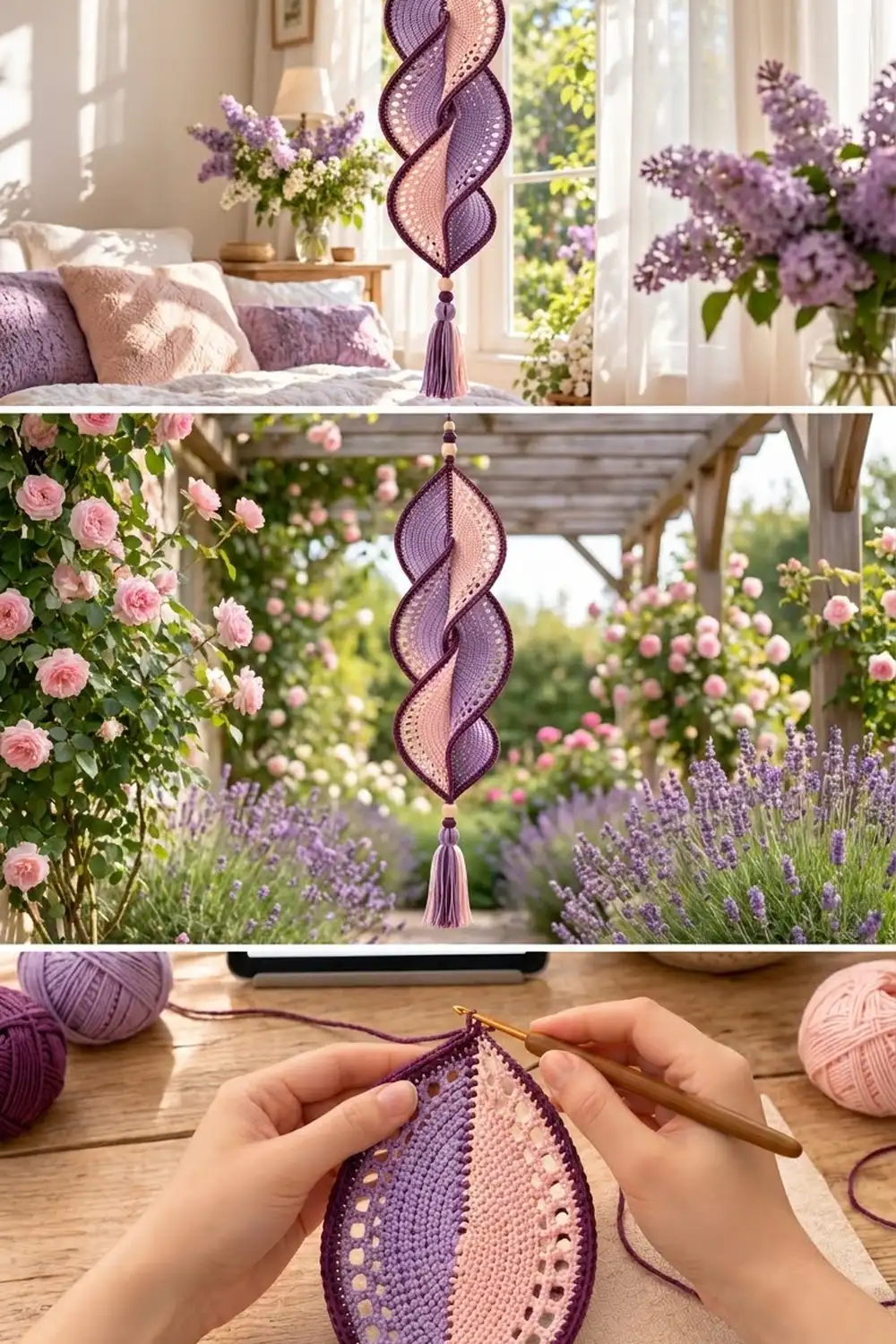
The Lavender Twist Spinner is a soft, airy hanging decoration made from three two-tone leaf panels. Each leaf is half lavender and half blush pink, split down the center by a raised dark plum spine and outlined with a rope-textured plum edge. When the leaves are stacked and turned against each other, they make a twisting spiral that catches light and turns gently in a breeze.
The look is calm and cottage-garden pretty. A single row of eyelets near each outer edge lets light through, and the beads and three-color tassel finish the spinner off. It works by a sunny window, on a porch hook, or in a nursery corner out of reach.
This pattern uses US crochet terms throughout. Each finished leaf measures about 4.5 in (11.4 cm) wide by 9.75 in (24.8 cm) long. The assembled spinner body is about 24.75 in (62.9 cm) long, and the overall length with hanger and tassel is about 33.75 in (85.7 cm).
Construction is simple. You crochet six half-leaves in rows, seam them in pairs with a plum single crochet spine, edge each leaf in plum, then block, stack and tack the leaves into a spiral. Finally, you add a beaded hanger and a tassel.
Finished Size and Construction
- Finished leaf size: 4.5 in (11.4 cm) wide x 9.75 in (24.8 cm) long
- Spinner body: about 24.75 in (62.9 cm) long
- Overall length with hanger and tassel: about 33.75 in (85.7 cm)
- Skill level: Easy-intermediate
- Terminology: US crochet terms
- Yarn weight: DK (light worsted, #3) cotton or cotton blend
- Hook: 3.5 mm (E-4)
- Number of pieces: 6 half-leaves (3 lavender, 3 pink), joined into 3 leaves
- Layout: 3 leaves stacked vertically, overlapping 2.25 in (5.7 cm) at each join
- Half-leaf size: 9 in (22.9 cm) long x 1.8 in (4.6 cm) wide
- Leaf size before border: 9 in (22.9 cm) x 3.8 in (9.7 cm)
- Border depth: about 3/8 in (1.0 cm) per side
Materials
Choose a smooth, mercerized or matte DK cotton. Cotton holds the leaf shape after blocking and won’t fuzz outdoors. Avoid very soft acrylics, which tend to droop in a hanging piece.
- Lavender: 20 g, about 44 m
- Blush pink: 20 g, about 44 m
- Dark plum: 25 g, about 55 m
These quantities include a margin for your gauge swatch, the tassel strands and the hanging cord.
Tools:
– 3.5 mm (E-4) crochet hook
– Tapestry needle
– Scissors
– Stitch markers (4)
– 2 plum wooden beads, 12 mm, with holes large enough for doubled yarn
– 3 natural wooden beads, 12 mm
– Stiff card 4 in (10.2 cm) wide, for the tassel
– Blocking mat, rustproof pins and spray bottle
– Optional: diluted fabric stiffener
Abbreviations (US Terms)
- ch – chain
- sc – single crochet
- sl st – slip stitch
- sk – skip
- sp – space
- st(s) – stitch(es)
- sc2tog – single crochet 2 together (1 st decreased)
- sc3tog – single crochet 3 together (2 sts decreased)
- RS / WS – right side / wrong side
Special stitch – reverse sc (crab stitch): Working from left to right (right-handers), insert the hook into the next stitch to the right, yarn over, pull up a loop, yarn over and draw through both loops. This makes the rope-like plum outline.
Gauge and Checkpoints
Gauge: 20 sc and 22 rows = 4 in (10.2 cm) in sc rows. That is 5 sc and 5.5 rows per 1 in (2.5 cm).
Make one complete half-leaf before starting the others. It is your real gauge test.
Checkpoints:
– After Row 1: 45 sc should measure 9 in (22.9 cm).
– After Row 10: the half-leaf should be 1.8 in (4.6 cm) wide at the center, and the last row (17 sts) should measure 3.4 in (8.6 cm).
– After the spine seam: the leaf should be about 3.8 in (9.7 cm) wide.
– After the border: the leaf should be about 4.5 in (11.4 cm) x 9.75 in (24.8 cm).
Too big? Go down to a 3.25 mm hook. Too small? Go up to a 3.75 mm hook. Small differences of 0.25 in (0.6 cm) are fine, as long as all three leaves match each other.
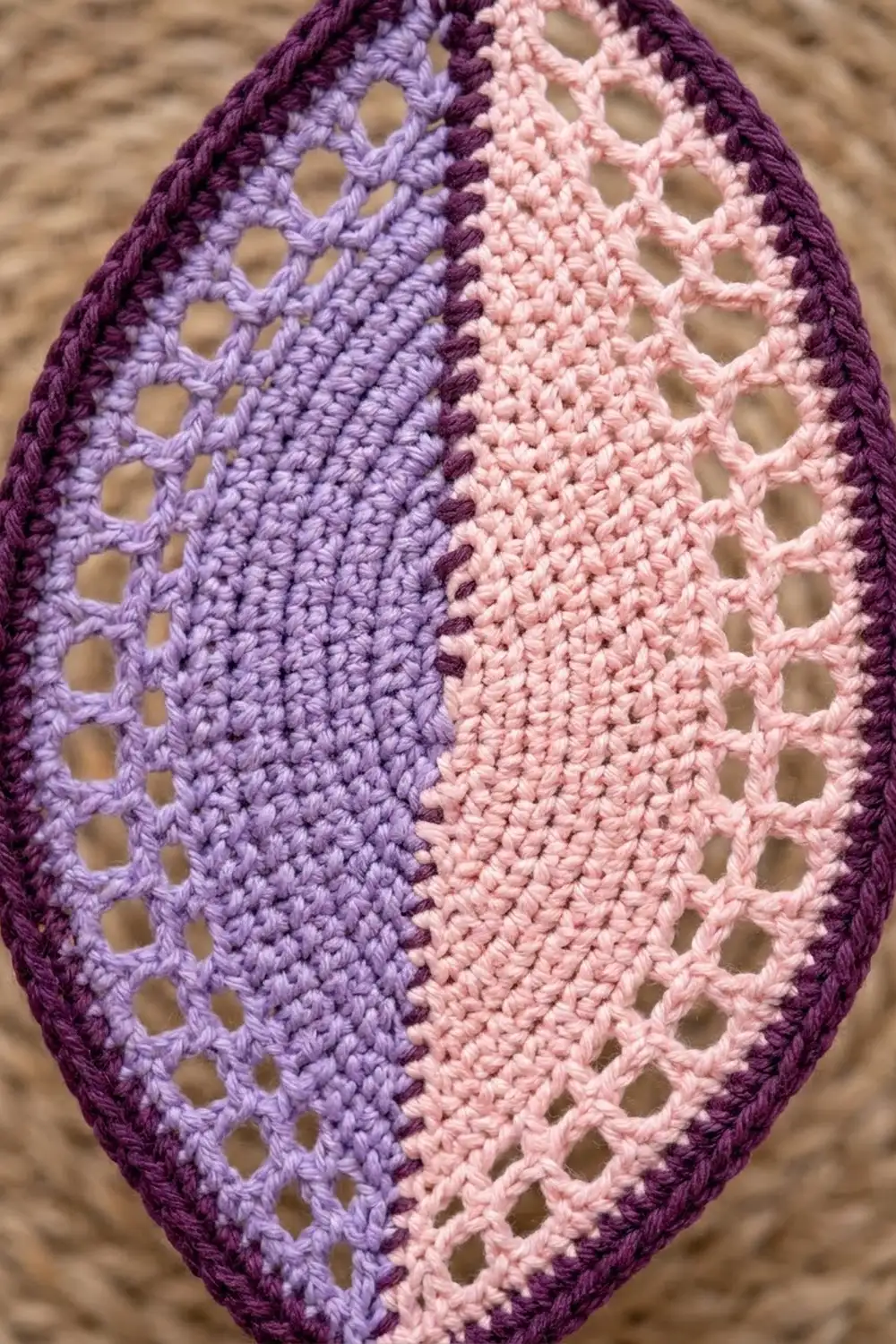
Half-Leaf (Make 6: 3 Lavender, 3 Pink)
Each half-leaf is worked in turned rows from the straight spine edge outward. Decreases at both ends shape the pointed tips. The ch-1 at the start of each row does not count as a stitch.
Foundation: Ch 46.
Row 1 (RS): Sc in 2nd ch from hook and in each ch across. (45 sts)
Row 2: Ch 1, turn. Sc2tog, sc in each st to last 2 sts, sc2tog. (43 sts)
Row 3: Ch 1, turn. Sc2tog, sc in each st to last 2 sts, sc2tog. (41 sts)
Row 4: Repeat Row 3. (39 sts)
Row 5: Repeat Row 3. (37 sts)
Row 6: Ch 1, turn. Sc3tog, sc in each st to last 3 sts, sc3tog. (33 sts)
Row 7 (eyelet row): Ch 1, turn. Sc3tog, sc in next st, [ch 1, sk next st, sc in next st] 13 times, sc3tog. (29 sts: 2 sc3tog, 14 sc, 13 ch-1 sps)
The middle section uses 27 stitches: 1 sc plus 13 repeats of 2. That keeps the 13 eyelets centered.
Row 8: Ch 1, turn. Sc3tog, sc in each sc and each ch-1 sp to last 3 sts, sc3tog. (25 sts)
Row 9: Ch 1, turn. Sc3tog, sc in each st to last 3 sts, sc3tog. (21 sts)
Row 10: Repeat Row 9. (17 sts)
Fasten off and weave in the ends. The half-leaf is a long, flat-bottomed crescent: 9 in (22.9 cm) along the foundation edge and 1.8 in (4.6 cm) high. The single decreases in Rows 2–5 and the double decreases in Rows 6–10 give a curve that steepens toward the outer edge. Blocking turns those steps into the smooth pointed-oval outline.
Checkpoint: Count the eyelets (13) and confirm the Row 10 width of 3.4 in (8.6 cm) before making the rest.
Make All Pieces
- Lavender: 3 half-leaves
- Pink: 3 half-leaves
- Total: 6 half-leaves, joined into 3 leaves
Layout (top to bottom, RS facing):
Leaf 1:  [ Lavender | plum spine | Pink     ]
Leaf 2:  [ Pink     | plum spine | Lavender ]
Leaf 3:  [ Lavender | plum spine | Pink     ]
Swapping the colors on Leaf 2 makes the colors alternate down the spiral, so lavender and pink seem to wrap around each other.
Joining the Halves (Spine Seam)
Method: Plum single crochet seam through the free loops of both foundation chains.
- Place a lavender half and a pink half with WS together and foundation edges lined up. The tips must match exactly.
- With plum, insert the hook through the first free loop of the foundation chain on both pieces. Pull up a loop and ch 1.
- Sc through both layers in each free loop across. (45 sc)
- Fasten off and weave in the ends.
Stitch-to-stitch logic: Each half has 45 free loops along the foundation (46 ch minus the turning ch). You pair loop 1 with loop 1 and continue through loop 45. No stitches are added or skipped, so the seam stays the same 9 in (22.9 cm) length as the halves.
Tension: Work the seam at the same tension as your sc rows. If the seam is tight, the leaf will bow lengthwise. If it is loose, the spine will wave. Leave a raised plum ridge on the RS; that ridge is the visible center spine.
Checkpoint: The flat leaf should be about 3.8 in (9.7 cm) wide (1.8 in + 0.2 in spine + 1.8 in, or 4.6 cm + 0.5 cm + 4.6 cm) and 9 in (22.9 cm) long.
Border
Border gauge: 5 sc per 1 in (2.5 cm), matching the body. Each round adds about 3/16 in (0.5 cm), so the 2-round border is about 3/8 in (1.0 cm) deep.
Each leaf has four border sections:
– the top tip
– Half A’s outer edge
– the bottom tip
– Half B’s outer edge
Each outer edge is one slanted edge (row ends of Rows 1–10), then the top of Row 10, then the second slanted edge (row ends of Rows 10–1).
Round 1 (RS): Join plum at the end of the spine seam at the top tip, ch 1.
- Top tip: Work 3 sc in the tip. Mark the center sc.
- Half A, first slanted edge: 1 sc in each row-end of Rows 1–5, then 2 sc in each row-end of Rows 6–10. (15 sc)
- Across Row 10: Sc in each st. (17 sc)
- Half A, second slanted edge: 2 sc in each row-end of Rows 10–6, then 1 sc in each row-end of Rows 5–1. (15 sc)
- Half A edge total: 47 sc.
- Bottom tip: Work 3 sc in the tip at the other end of the spine. Mark the center sc.
- Half B: Repeat steps 2–4. (47 sc)
- Sl st to the first sc. (100 sts: 3 + 47 + 3 + 47)
Round 2 (conversion round to rope edge): Ch 1. Reverse sc in each st around, working 2 reverse sc in each marked tip st. Sl st to join. (100 worked 1-per-st + 2 added = 102 sts)
Fasten off, leaving a 12 in (30.5 cm) plum tail on Leaves 1 and 2 for tacking. Weave in all ends on Leaf 3.
Why the math works: Rows 1–5 step in by 1 st each, so 1 sc per row-end matches their short edges. Rows 6–10 step in by 2 sts each, so their edges are about twice as long and get 2 sc per row-end.
The 15 sc on each slanted edge measure 3 in (7.6 cm) at 5 sc/in. The stepped edge is a little longer than that, so the border eases it in slightly. This rounds the steps into a smooth curve and keeps the plum outline taut instead of ruffled. The 17 sc across Row 10 match its 17 sts one-to-one. Each outer edge totals 47 sc, or 9.4 in (23.9 cm). The 3-sc tips and the 2 extra reverse sc in Round 2 sharpen the points without cupping.
Assemble the Spinner
Block all three leaves (see below) before assembling.
- Stack: Lay Leaf 1 above Leaf 2 so the bottom tip of Leaf 1 overlaps the top of Leaf 2’s spine by 2.25 in (5.7 cm).
- Twist: Turn Leaf 2 a quarter turn, so its spine crosses Leaf 1’s spine at a right angle when viewed from above. With the plum tail, tack Leaf 1’s bottom tip securely to Leaf 2’s spine with 4–5 small stitches through the spine sc.
- Repeat to attach Leaf 3 below Leaf 2, also turned a quarter turn. The leaves now spiral around a common center line.
- Hanger: Cut two strands of plum 20 in (50.8 cm) long and fold them in half together. Thread the fold through the top tip of Leaf 1 and pull the ends through the loop (lark’s head). Thread the strands through a natural bead, a plum bead, a natural bead and a plum bead. Knot an overhand hanging loop about 4 in (10.2 cm) above the leaf.
- Tassel: Wrap 15 strands of each color around the 4 in (10.2 cm) card. Tie the top with a 10 in (25.4 cm) plum strand and cut the bottom loops. Wrap a plum strand tightly around the tassel 0.5 in (1.3 cm) below the top. Trim the ends evenly to 4 in (10.2 cm).
- Attach the tassel: Thread the tassel tie strands through a natural bead and a small plum bead, then through the bottom tip of Leaf 3. Knot securely so the beads sit about 1 in (2.5 cm) below the leaf, then bury the ends inside the tassel.
Final Blocking
- Lightly mist each leaf (before assembly) until damp, not soaked.
- Pin the leaf RS up to a pointed-oval outline 4.5 in (11.4 cm) x 9.75 in (24.8 cm). Pin both tips first, then the widest point of each half.
- Ease the stepped edges into a smooth curve, pinning every 0.75 in (1.9 cm) along the plum border.
- Open each eyelet gently with a hook tip so all 13 look even.
- Keep the spine straight. Check this with a ruler along the plum ridge.
- Optional: brush on diluted fabric stiffener for outdoor use, so the leaves keep their shape in wind.
- Let the leaves dry completely, at least 12 hours, before unpinning and assembling.
Final Quality-Control Checklist
- All 6 halves have 17 sts in Row 10 and 13 eyelets.
- Each spine has 45 sc and lies flat without puckering.
- Border Round 1 has 100 sts and Round 2 has 102 sts on every leaf.
- All three leaves measure 4.5 in (11.4 cm) x 9.75 in (24.8 cm) within 0.25 in (0.6 cm).
- Colors alternate down the spinner: lavender, pink and lavender on the left side.
- Each tacked join overlaps 2.25 in (5.7 cm) and holds firmly.
- The spinner body measures about 24.75 in (62.9 cm).
- The hanger knot and tassel knot are secure and all ends are hidden.
Troubleshooting
The half-leaf curls toward the spine. Your foundation chain is too tight. Chain with a hook one size larger, then switch back for Row 1.
The tips are blunt. Check that Rows 6–10 use sc3tog, not sc2tog. Re-pin the tips sharply during blocking.
Eyelets are uneven. Keep the ch-1 relaxed and work Row 8 into the ch-1 sp, not the chain stitch itself.
The border ruffles. You may be working 2 sc into Rows 1–5. Use 1 sc there and recount to 47 per edge.
The border cups the leaf. Loosen your reverse sc. The rope edge tends to tighten.
The spinner hangs crooked. The tacks are off-center. Re-tack each tip exactly on the spine ridge.
Care
Hand wash in cool water with mild soap, press out the water in a towel, and reshape the leaves flat to dry. If you used stiffener, reapply it after washing.
Final Notes
The measurement chain is short and reliable:
– 20 sc = 4 in (10.2 cm), so 45 sc = 9 in (22.9 cm).
– Ten tapering rows give a 1.8 in (4.6 cm) half-leaf.
– Two halves plus a plum spine make a 3.8 in (9.7 cm) leaf.
– A 100-then-102-stitch border brings each leaf to 4.5 in (11.4 cm) x 9.75 in (24.8 cm).
– Three leaves overlapping 2.25 in (5.7 cm) make a 24.75 in (62.9 cm) spiral, and about 33.75 in (85.7 cm) with hanger and tassel.
Check your measurements at each stage and the spinner will hang straight and twist evenly. Happy crocheting!