

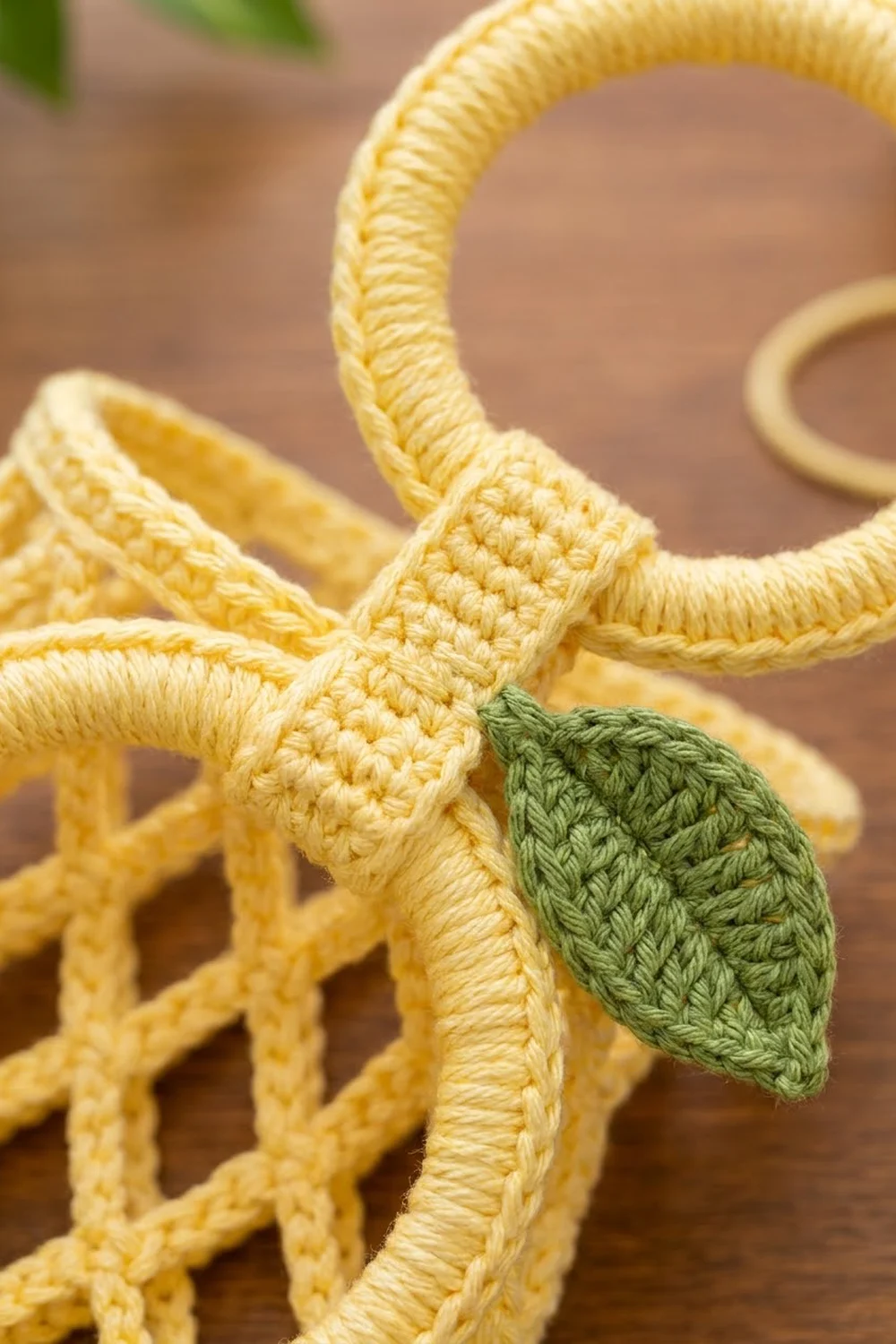
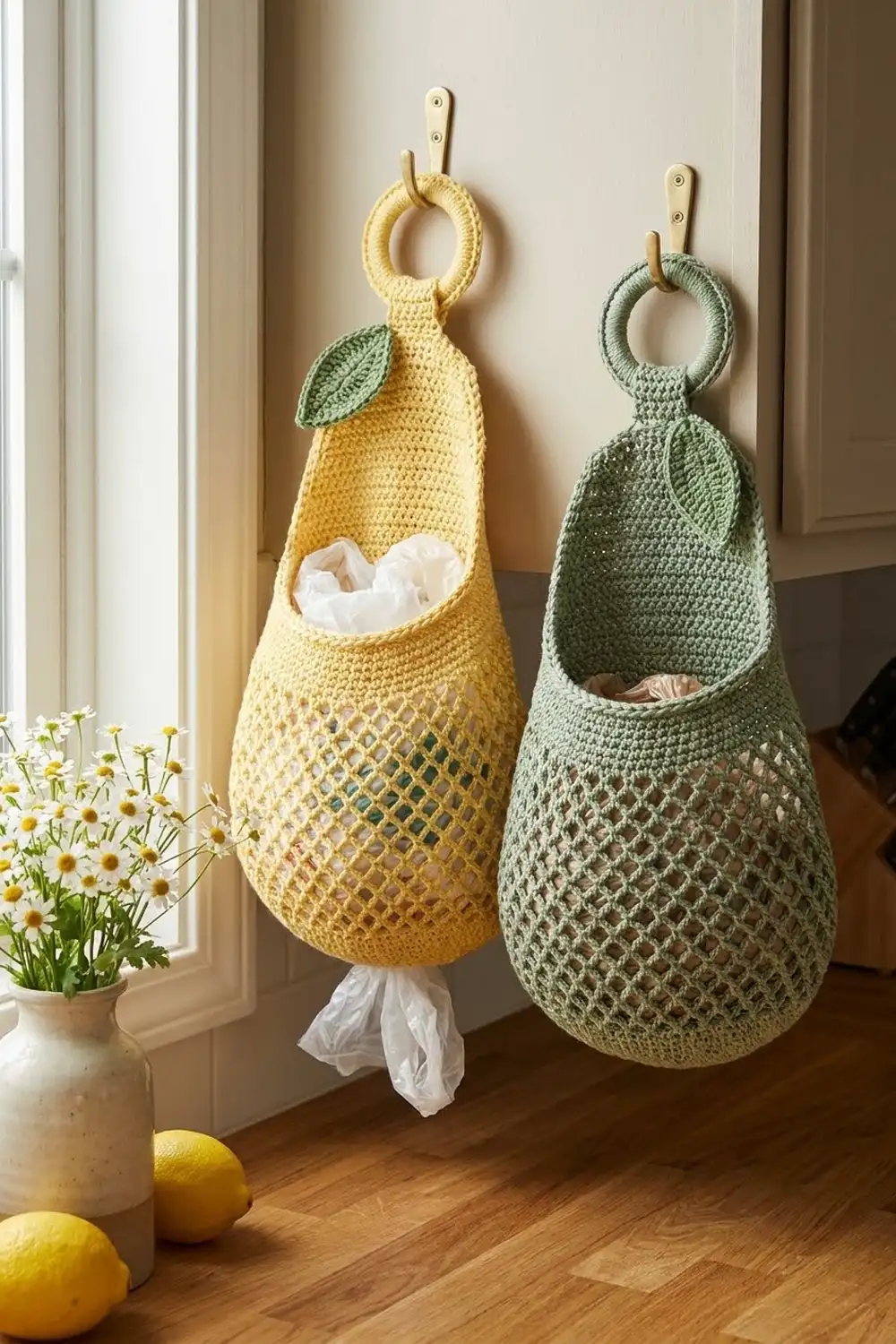
This pear-shaped bag holder keeps your plastic bags tidy. The body is an open diamond mesh that widens from a narrow bottom opening to a round belly, then narrows again to a neat top rim. A covered ring and a short tab let it hang from a hook. A small green leaf sits at the top like a stem.
The sample uses soft butter yellow cotton for the body, ring and tab, plus a little leaf green for the leaf. The look is light, airy and farmhouse-simple. A sage green version with a matching leaf works just as well if you’d like a second holder for the pantry.
This pattern uses US crochet terms. The finished body is about 9 in (22.9 cm) wide at the widest point when laid flat and about 12 in (30.5 cm) tall. With the tab and ring added, the holder hangs about 16 in (40.6 cm) long.
You work the body in the round from the bottom up. First comes a solid single crochet band, then 17 rounds of chain-loop mesh, then a solid top band. The pear shape comes from changing the chain length of the loops, not the number of loops. A round of crab stitch finishes both edges. Then you cover a ring, make a tab and a leaf, and sew everything together. Push bags in at the top and pull them out through the bottom.
Finished Size and Construction
- Finished size: body about 9 in (22.9 cm) wide flat x 12 in (30.5 cm) tall; about 16 in (40.6 cm) total hanging length
- Skill level: Easy / Advanced beginner
- Terminology: US crochet terms
- Yarn weight: worsted (#4) cotton
- Hook: 4.5 mm (US 7)
- Number of pieces: 4 parts (body, covered ring, tab, leaf) sewn into one holder
- Layout: tab centered on the top rim, ring through the tab, leaf beside the tab
- Top and bottom openings: 48 sts each, about 6 in (15.2 cm) wide flat
- Size before border: about 9 in (22.9 cm) wide x 11.5 in (29.2 cm) tall
- Border depth: about 0.25 in (0.6 cm) at each edge
Materials
Choose a smooth, firm worsted weight cotton or cotton blend. Cotton holds the mesh shape well and won’t stretch out under the weight of the bags. Avoid yarn that splits easily or is very fuzzy, because the diamonds will lose their crisp outline.
- Yellow (body, ring, tab): 100 g, about 190 m (208 yd)
- Green (leaf): 5 g, about 10 m (11 yd)
These amounts include a margin of about 15 to 20 percent for your gauge swatch and small differences in tension.
Tools:
- 4.5 mm (US 7) crochet hook
- 1 plastic or wooden ring, 2.75 in (7.0 cm) outer diameter
- 2 locking stitch markers
- Tapestry needle
- Measuring tape
- Rust-proof pins and a spray bottle
Abbreviations (US Terms)
- ch – chain
- sl st – slip stitch
- sc – single crochet
- hdc – half double crochet
- dc – double crochet
- tr – treble crochet
- fsc – foundation single crochet
- st(s) – stitch(es)
- sp – space
- rnd – round
Special stitch – Crab stitch (reverse sc): Work from left to right (if you’re right-handed). Insert the hook into the next st to the right, yarn over, pull up a loop, yarn over, and draw through both loops on the hook.
Mesh joins: Each mesh round ends with a short chain plus a taller stitch into the first sc. Together they stand in for the last loop and leave your hook at the middle of that loop.
- ch-4 loop: ch 1, dc in first sc
- ch-5 loop: ch 2, dc in first sc
- ch-6 loop: ch 3, dc in first sc
- ch-7 loop: ch 3, tr in first sc
Gauge and Checkpoints
Gauge: 16 sc and 18 rnds = 4 in (10.2 cm) in sc worked in the round.
Do a test first by working Rnds 1 to 4 of the body. Flattened, the band should be about 6 in (15.2 cm) across and about 0.9 in (2.3 cm) tall. This is the most important checkpoint, because the whole mesh is built on this count.
Always measure the mesh relaxed, never stretched.
Checkpoints (height from bottom edge, before border):
- After Rnd 4: 6 in (15.2 cm) wide, 0.9 in (2.3 cm) tall
- After Rnd 7: about 6.5 in (16.5 cm) wide, 2.4 in (6.1 cm) tall
- After Rnd 10: about 7.25 in (18.4 cm) wide, 4.2 in (10.7 cm) tall
- After Rnd 15: about 9 in (22.9 cm) wide, 7.4 in (18.8 cm) tall
- After Rnd 21: about 6.5 in (16.5 cm) wide, 10.4 in (26.4 cm) tall
- After Rnd 26: 6 in (15.2 cm) wide, 11.5 in (29.2 cm) tall
If your band is too big, go down a hook size. If it’s too small, go up a hook size. If the band is right but the belly is narrower than 8.5 in (21.6 cm), add 1 ch to each loop in Rnds 11 to 15. If the belly is wider than 9.5 in (24.1 cm), take 1 ch off each loop in those rounds and change the joins to match.
Body
Work in joined rounds with the right side facing. Don’t turn. Put a marker in the first st of each round.
Bottom Band
Rnd 1: With yellow, fsc 48. Join with sl st to the first fsc. Make sure the strip isn’t twisted. (48 sts)
Rnds 2–4: Ch 1, sc in each st around, join with sl st to first sc. (48 sts)
Checkpoint: 6 in (15.2 cm) flat, 0.9 in (2.3 cm) tall.
Mesh Body
Every mesh round has 16 sc and 16 chain loops. Only the loop length changes.
Rnd 5 (set-up): Ch 1, sc in same st as join, *ch 5, skip 2 sts, sc in next st; rep from * 14 more times, ch 2, skip last 2 sts, dc in first sc. (16 sc, 16 ch-5 loops)
Stitch check: 1 sc + 15 repeats of 3 sts + 2 skipped sts = 48 sts used.
Rnds 6–7: Ch 1, sc in top of joining dc, *ch 5, sc in next ch-5 sp; rep from * 14 more times, ch 2, dc in first sc. (16 sc, 16 ch-5 loops)
Rnds 8–10: Ch 1, sc in top of joining st, *ch 6, sc in next loop; rep from * 14 more times, ch 3, dc in first sc. (16 sc, 16 ch-6 loops)
Rnds 11–15: Ch 1, sc in top of joining st, *ch 7, sc in next loop; rep from * 14 more times, ch 3, tr in first sc. (16 sc, 16 ch-7 loops)
This is the widest part of the pear. Checkpoint: about 9 in (22.9 cm) flat, with 8 diamonds across the front, each about 1.125 in (2.9 cm) wide.
Rnds 16–17: Ch 1, sc in top of joining st, *ch 6, sc in next loop; rep from * 14 more times, ch 3, dc in first sc. (16 sc, 16 ch-6 loops)
Rnds 18–19: Ch 1, sc in top of joining st, *ch 5, sc in next loop; rep from * 14 more times, ch 2, dc in first sc. (16 sc, 16 ch-5 loops)
Rnd 20: Ch 1, sc in top of joining st, *ch 4, sc in next loop; rep from * 14 more times, ch 1, dc in first sc. (16 sc, 16 ch-4 loops)
Rnd 21: Ch 1, sc in top of joining st, *ch 4, sc in next loop; rep from * 14 more times, ch 4, sl st in first sc. (16 sc, 16 ch-4 loops)
Rnd 21 ends with a full ch-4 and a sl st, so the next round starts on top of an sc.
Top Band
Rnd 22 (conversion): Ch 1, sc in same sc, 2 sc in next ch-4 sp, *sc in next sc, 2 sc in next ch-4 sp; rep from * 14 more times, join with sl st to first sc. (16 sc worked 1 in each existing sc + 32 sc worked into loops = 48 sts)
Rnds 23–26: Ch 1, sc in each st around, join. (48 sts)
Fasten off. Checkpoint: top opening 6 in (15.2 cm) flat, body 11.5 in (29.2 cm) tall.
Covered Ring
Rnd 1: With yellow, make a slip knot on the hook. Working over the ring, *insert hook through the center of the ring, yarn over, pull up a loop, yarn over and draw through both loops; rep from * until the ring is fully covered, about 60 sc. Join with sl st to first sc.
Push the sts close together so the ring doesn’t show through. Packed, even stitches matter more than hitting exactly 60. Fasten off. The covered ring is about 3 in (7.6 cm) across.
Tab
Row 1: With yellow, ch 7, sc in 2nd ch from hook and in each ch across, turn. (6 sts)
Rows 2–14: Ch 1, sc in each st across, turn. (6 sts)
Fasten off, leaving a 12 in (30.5 cm) tail. The tab is about 1.5 in (3.8 cm) wide x 3 in (7.6 cm) long.
Leaf
Rnd 1: With green, ch 10. Start in the 2nd ch from the hook and work in the back bumps of the chain: sc, hdc, dc in next 4 ch, hdc, sc, 3 sc in last ch. Rotate and work along the other side of the chain: sc, hdc, dc in next 4 ch, hdc, sc. Sl st in first sc. (19 sts)
Tip: Ch 3, sl st in 2nd ch from hook and in next ch, sl st in same st as the last sl st of Rnd 1.
Vein: Surface sl st down the center of the leaf, from the tip to the base.
Fasten off, leaving a 10 in (25.4 cm) tail. The leaf is about 2.25 in (5.7 cm) long and 1 in (2.5 cm) wide.
Border
The border is one round of crab stitch on each opening. It firms up the edges so they don’t flare when you push bags through.
Border gauge: You work 1 crab stitch in each sc, so the border keeps the band gauge of 4 sts per inch (16 sts per 10.2 cm). Each opening stays 6 in (15.2 cm) wide flat.
Top border: Join yellow in any st of Rnd 26. Ch 1, crab stitch in each st around, join with sl st. (48 sts: 24 across the front, 24 across the back)
Bottom border: Join yellow in any st on the underside of Rnd 1 (the fsc edge). Ch 1, crab stitch in each st around, join. (48 sts: 24 across the front, 24 across the back)
Why the math works: Both openings start with exactly 48 sts. Rnd 1 has 48 fsc, and Rnd 22 brings 16 sc plus 32 loop sts back to 48. Crab stitch adds no stitches, so each edge lies flat at 24 sts per side, or 6 in (15.2 cm). Each border adds about 0.25 in (0.6 cm), which takes the body from 11.5 in (29.2 cm) to 12 in (30.5 cm) tall.
Assembly
- Flatten the body so the round joins sit at one side. Mark the center front of the top band.
- Slide the tab through the covered ring and fold the tab in half around it.
- Put one tab end on the outside of the top band and the other on the inside, both centered on the marker. The ring should sit about 1 in (2.5 cm) above the top border.
- Whipstitch both tab ends through all layers. Then sew across the tab just below the ring to hold the ring in place.
- Sew the leaf just to the right of the tab, pointing up, along its base and center vein.
Final Blocking
- Weave in all ends.
- Mist the holder lightly until it’s damp but not soaked.
- Stuff the body with a rolled towel so it holds its pear shape.
- Smooth the diamonds so every loop sits at a similar angle.
- Check that the widest point is about 9 in (22.9 cm) flat and the height is 12 in (30.5 cm).
- Pin the leaf flat if it curls.
- Let everything dry completely before you hang it.
Final Quality-Control Checklist
- Every mesh round has 16 sc and 16 loops.
- The top and bottom openings each have 48 sts.
- The bottom band isn’t twisted.
- The diamonds line up in straight diagonal columns.
- The ring is fully covered.
- The tab is centered and sewn through both layers.
- The leaf is secure and lies flat.
- The body is about 9 in (22.9 cm) x 12 in (30.5 cm).
- All ends are woven in.
Troubleshooting
The mesh slants to one side. Work each new sc into the center of the loop, and start every round on top of the joining dc or tr.
The belly is too flat. Your chains are tight. Add 1 ch to each loop in Rnds 11 to 15.
The bottom opening flares. Redo the crab stitch border with a smaller hook.
The top band ruffles. Recount Rnd 22. It should have exactly 48 sts.
The ring shows through. Add more sc and push them closer together.
Care
Hand wash in cool water with mild soap. Reshape the pear while it’s damp and lay it flat to dry.
Final Notes
Each measurement depends on the one before it. The 48-st band sets the 6 in (15.2 cm) openings. The mesh always has 16 loops, and loop lengths from ch-4 to ch-7 build the 9 in (22.9 cm) belly. The top band comes back to 48 sts, and the crab stitch borders bring the body to 12 in (30.5 cm). Once you add the tab and ring, the holder hangs about 16 in (40.6 cm) long.
Happy crocheting!