

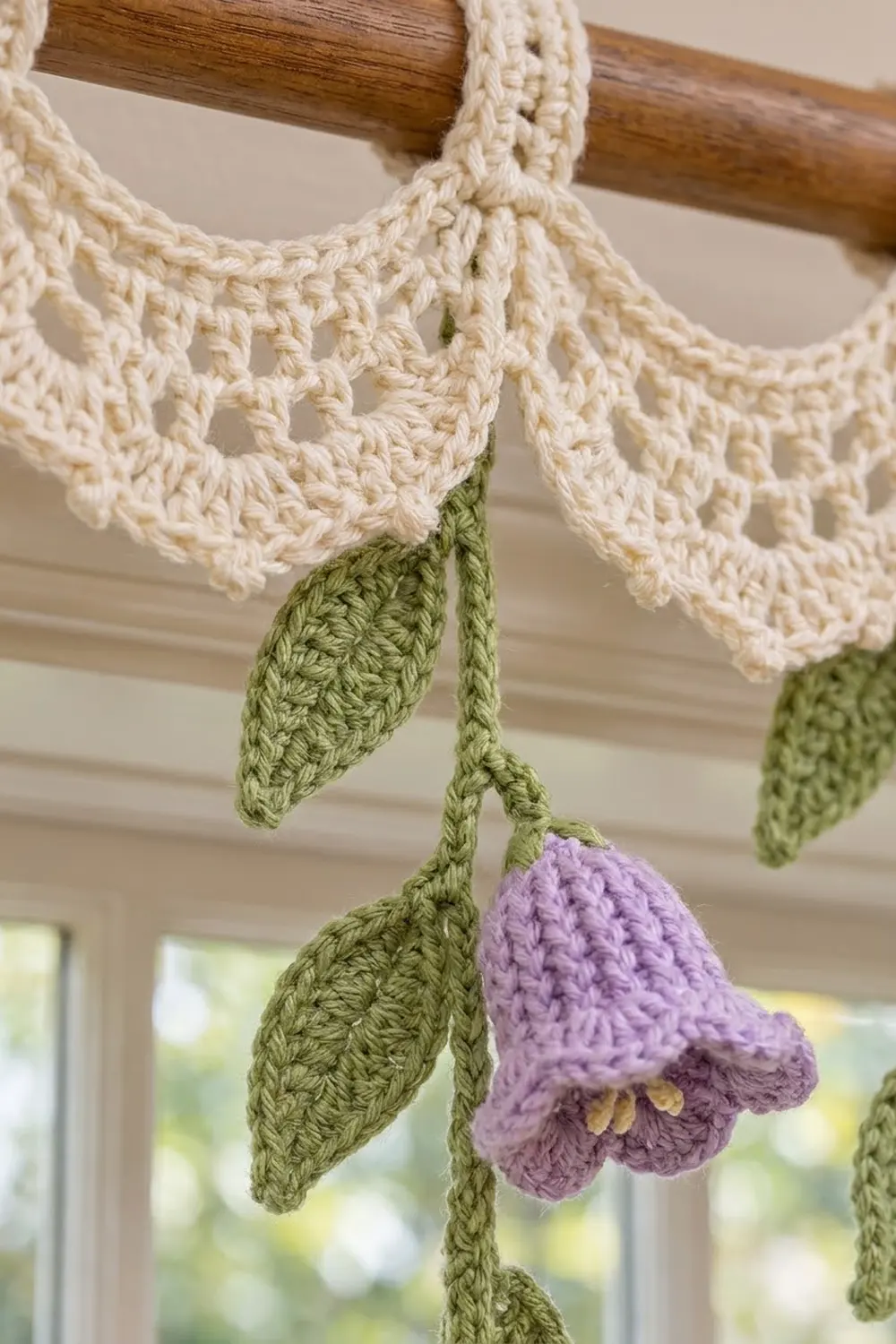
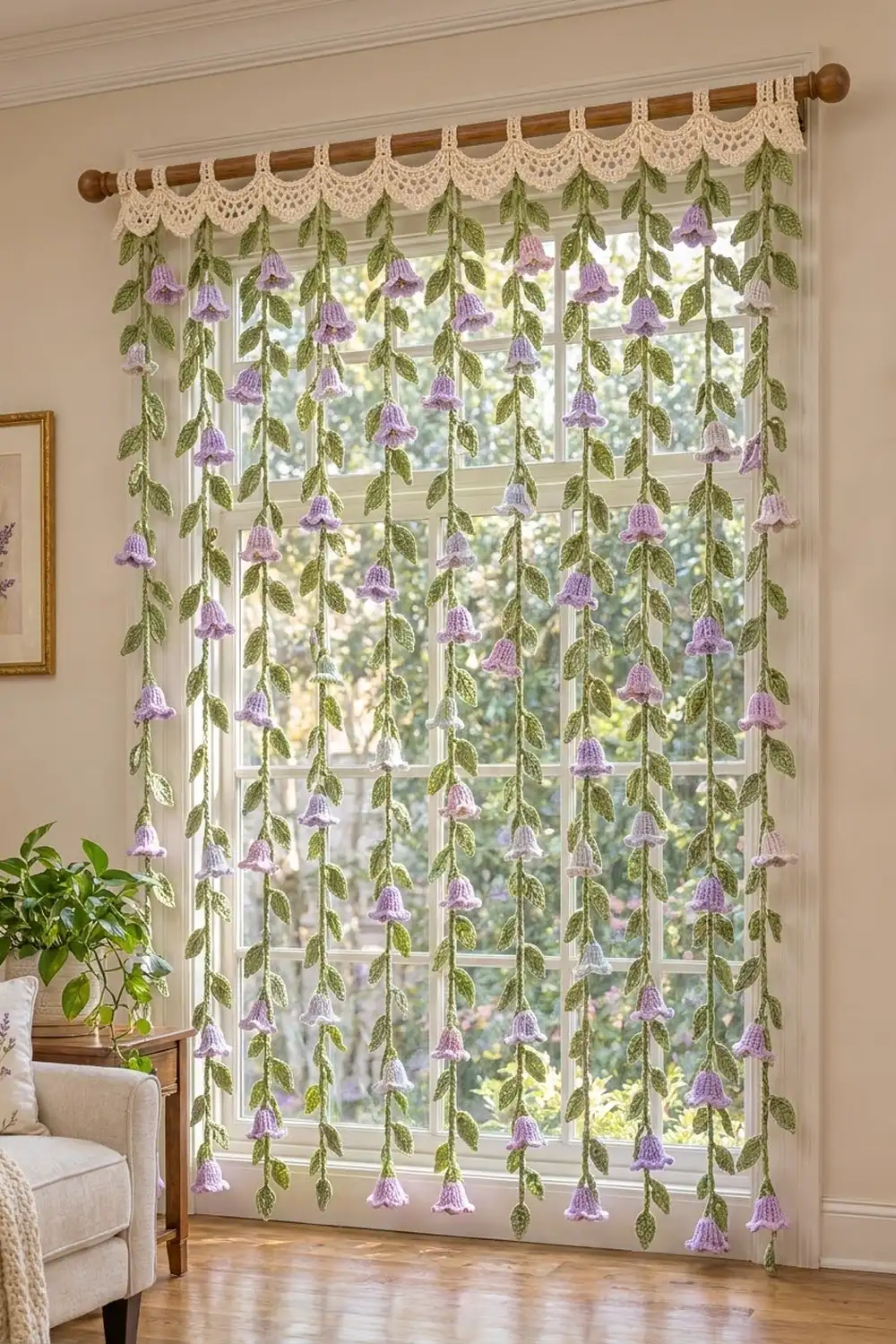
This curtain is a cascade of lilac bellflowers and soft green leaves hanging from a lacy cream header. Twelve leafy vines drop from the scallops. Each vine carries nine ribbed bells with flared, five-petal hems and a tiny yellow stamen inside.
The palette is soft and cottage-style: cream for the header, sage green for the stems and leaves, lilac for the bells, and a touch of pale yellow. Light filters between the vines, so the curtain softens a window without blocking it.
All terms are US crochet terms. The finished curtain is 36¼ in (92.1 cm) wide across the header. It is about 60¾ in (154.3 cm) long from the top edge of the header to the tips of the lowest bells, not counting the hanging tabs.
You work the header flat in rows, ending with twelve shell scallops. Each vine is one long chain that you work back up in slip stitches, adding leaves and bell stalks as you go. You make the bells separately and sew them on. Last, you attach the vines to the scallop centers and add the top trim and the tabs.
Finished Size and Construction
- Finished size: 36¼ in (92.1 cm) wide x about 60¾ in (154.3 cm) long, plus tabs
- Skill level: Intermediate
- Terminology: US
- Yarn weight: Worsted (#4) cotton
- Hook: 4.5 mm (US 7)
- Number of pieces: 1 header, 12 vines, 108 bells, 108 stamens
- Layout: 12 vines across, one at each scallop center, 3 in (7.6 cm) apart
- Vine size: 56 in (142.2 cm) stem; about 58 in (147.3 cm) including the bottom bell
- Header size before border: 36¼ x 2½ in (92.1 x 6.4 cm)
- Border depth: The trim adds ¼ in (0.6 cm), for a header 2¾ in (7.0 cm) deep. The tab loops sit above this.
Materials
Use a smooth worsted cotton of about 170 m per 100 g. Cotton keeps the bells crisp and resists stretching under the weight of the vines.
- Cream: 140 g (238 m), for the header, trim, and tabs
- Sage green: 575 g (978 m), for the vines and leaves
- Lilac: 950 g (1615 m), for the bells
- Pale yellow: 40 g (68 m), for the stamens
All quantities include a margin of about 15 percent for swatching and joining.
Tools: 4.5 mm (US 7) hook, tapestry needle, stitch markers, scissors, measuring tape, rust-proof pins, spray bottle.
Abbreviations (US Terms)
- ch: chain
- sl st: slip stitch
- sc: single crochet
- hdc: half double crochet
- dc: double crochet
- sp: space
- st(s): stitch(es)
- MR: magic ring
- RS / WS: right side / wrong side
Knit stitch (ksc): Insert your hook through the center of the “V” of the stitch below, between its two front legs, and out the back. Yarn over, pull up a loop, yarn over, and pull through both loops. In rounds, ksc stacks into vertical knit-look columns. These columns are the bell’s ribbing.
Picot: Ch 3, sl st in the 3rd ch from the hook.
Gauge and Checkpoints
Gauge: 16 sc and 18 rows = 4 in (10.2 cm). On the vine, 4 ch = 1 in (2.5 cm) after you work back along the chain in sl st.
Before you start the whole curtain, make one bell and one 7 in (17.8 cm) vine segment and check them:
- Bell: 2¼ in (5.7 cm) long, about 2 in (5.1 cm) across the hem
- Bell body (Rnds 4–9): 1¼ in (3.2 cm) wide when flattened
- Leaf: 2 in (5.1 cm) long
- Vine segment: 7 in (17.8 cm) after a light steam
Too big? Go down 0.5 mm. Too small? Go up 0.5 mm.
If only the vine measures wrong, change how tightly you chain rather than changing the hook. Long chains drift more than anything else in this pattern.
Header
With cream, ch 146.
Row 1: Sc in the 2nd ch from the hook and in each ch across, turn. (145 sc)
Row 2: Ch 3 (counts as dc), dc in the next st and in each st across, turn. (145 dc)
Row 3: Ch 1, sc in each st across, turn. (145 sc)
Checkpoint: 36¼ in (92.1 cm) wide, 1 in (2.5 cm) deep.
Row 4 (shells): Ch 1, sc in the first st, *skip 5 sts, 11 dc in the next st, skip 5 sts, sc in the next st; repeat from * 11 more times, turn. (12 shells of 11 dc; 13 sc)
Each repeat uses 12 sts, plus 1 st for the first sc: 12 x 12 + 1 = 145.
Row 5 (open fans): Ch 1, sc in the first sc, *ch 2, dc in the first dc of the shell, (ch 1, dc in the next dc) 10 times, ch 2, sc in the next sc; repeat from * across, turn.
Each scallop now has 11 dc, 10 ch-1 sps, and 2 ch-2 sps. The row has 13 sc in total.
Row 6 (picot edge): Ch 1, sc in the first sc, *2 sc in the ch-2 sp, sc in the next dc, (sc in the ch-1 sp, sc in the next dc) 10 times, 2 sc in the ch-2 sp, sc in the next sc; repeat from * across. In every scallop, work a picot right after the sc you make in the 2nd, 4th, 6th, 8th, and 10th dc. Fasten off.
Each scallop has 25 sc, so the row has 12 x 25 + 13 = 313 sc and 60 picots. The picots sit on scallop sc 5, 9, 13, 17, and 21, which makes each scallop symmetrical. Sc 13 is on the center dc and has the middle picot. Mark it, because this is where a vine will hang.
Checkpoint: 36¼ x 2½ in (92.1 x 6.4 cm), measured at the scallop centers.
Bell (make 108)
With lilac, make a MR.
Rnd 1: 6 sc in the MR. (6)
Rnd 2: 2 sc in each st. (12)
Rnd 3: (Ksc in the next 3 sts, 2 ksc in the next st) 3 times. (15)
Rnds 4–9: Ksc in each st. (15)
Rnd 10: (Ksc in the next 2 sts, 2 ksc in the next st) 5 times. (20)
Rnd 11: (Ksc in the next 3 sts, 2 ksc in the next st) 5 times. (25)
Rnd 12 (petals): *Sl st in the next st, hdc in the next st, (dc, picot, dc) in the next st, hdc in the next st, sl st in the next st; repeat from * 4 more times. (5 petals: 30 sts plus 5 picots) Fasten off, leaving a 10 in (25.4 cm) tail.
Rnds 10 and 11 flare the hem. Rnd 12 shapes those 25 sts into five pointed, slightly ruffled lobes.
Stamen (make 108): With pale yellow, leave a 4 in (10.2 cm) tail and ch 6. Sl st in the 2nd ch from the hook and in the next 4 ch. (5 sl st) Fasten off.
Tie an overhand knot in the starting tail, right against the chain, and trim the tail. This knot is the yellow tip.
Thread the other tail from inside the bell up through the MR, so the stamen hangs inside the bell.
Vine (make 12)
With green, ch 225. You will work back up this chain from the bottom tip. Work every stem sl st in the back bump of the chain.
Leaf:
1. Ch 9.
2. Working back toward the stem, sl st in the back bump of the 2nd ch from the hook and of the next 7 ch. (8 sl st) These sl sts form the raised center vein.
3. Rotate the leaf. Working toward the tip in the free loops of the chain: sc, hdc, dc in the next 3, hdc, sc. (7 sts)
4. In the skipped ch at the tip, work (sc, ch 2, sc).
5. Work back toward the stem along the other edge, in the back loops of the vein sl sts, skipping the sl st at the tip: sc, hdc, dc in the next 3, hdc, sc. (7 sts)
6. Sl st in the stem ch at the base of the leaf.
Leaf pair: Work 2 leaves from the same stem ch, one pointing to each side.
Bell stalk: Ch 5, sl st in the 2nd ch from the hook and in the next 3 ch (4 sl st), then sl st in the same stem ch. The stalk is 1 in (2.5 cm) long.
Segment (28 stem ch): Sl st in the next 6 ch, leaf pair, sl st in the next 7 ch, bell stalk, sl st in the next 7 ch, leaf pair, sl st in the next 8 ch.
To work the vine: Sl st in the 2nd ch from the hook. This sl st is the bottom tip, and it is the first of the 6 sl sts in Segment 1. Sl st in the next 5 ch, then finish Segment 1 starting from the first leaf pair. Work 7 more full segments.
Each segment uses 6 + 7 + 7 + 8 = 28 ch, so 8 segments use 224 ch. Add the 1 skipped ch and you have used all 225. Fasten off, leaving a 12 in (30.5 cm) tail.
Each vine has 32 leaves, 8 stalks, and 1 bottom tip.
Checkpoint: The stem is 56 in (142.2 cm), and each segment is 7 in (17.8 cm) ± ¼ in (0.6 cm). To make the curtain longer, add segments. Each one adds 28 ch and 7 in (17.8 cm).
Make All Pieces
- Cream: 1 header
- Green: 12 vines (384 leaves and 96 stalks in total)
- Lilac: 108 bells (9 per vine: 8 on stalks, 1 at the tip)
- Yellow: 108 stamens
Layout grid (T = tab, S = scallop, V = vine, B = bell):
T  S  T  S  T  S  T  S  T  S  T  S  T  S  T  S  T  S  T  S  T  S  T  S  T
   V     V     V     V     V     V     V     V     V     V     V     V
  8B    8B    8B    8B    8B    8B    8B    8B    8B    8B    8B    8B   (stalk bells)
   B     B     B     B     B     B     B     B     B     B     B     B   (tip bells)
Joining
Bells to vines: Hold the lilac and yellow tails together. Sew the top of a bell (Rnd 1) to the end of each stalk, and sew one bell to the bottom tip of each vine. Pass the needle through the stalk end twice, then knot the tails inside the bell.
Vines to header:
1. Lay the header WS up.
2. Line up the top end of each vine (its last sl st) with a marked center sc, which is sc 13 of 25 in its scallop.
3. With the green tail, whipstitch the top ¼ in (0.6 cm) of the stem to the back of that sc and its center picot.
Each vine attaches at a single stitch, so the header count stays exactly 313 sc.
Tension: Sew firmly but don’t pucker the scallop. Hang the header on a rod while you work so the vines settle under their own weight.
Checkpoint: The vines are 3 in (7.6 cm) apart, center to center. The tip bells line up with each other within ½ in (1.3 cm).
Border: Top Trim and Hanging Tabs
Border gauge: 4 sc = 1 in (2.5 cm), the same as the header.
Trim row: With RS facing, join cream in the first free loop of the foundation chain. Ch 1, sc in each free loop across. (145 sc)
Tabs (make 13): Join cream at the first st of the tab position. Work over 5 sts: ch 1, sc in each of the 5 sts, turn. Repeat this row until the tab has 22 rows, about 5 in (12.7 cm). Fasten off. Fold the tab to the back and sew its last row to the back of the trim row.
Tab placement:
– Tab 1: sts 1–5
– Tabs 2–12: sts 11–15, 23–27, and so on through 131–135, each centered on a scallop junction
– Tab 13: sts 141–145
Why the math works:
– The 13 tabs use 13 x 5 = 65 sts.
– The two outer gaps (between Tabs 1 and 2, and between Tabs 12 and 13) have 5 sts each: 10 sts.
– The 10 inner gaps have 7 sts each: 70 sts.
– 65 + 10 + 70 = 145, which is exactly the trim count.
The inner tabs are 12 sts, or 3 in (7.6 cm), apart from center to center, so each vine hangs between two tabs. The end tabs sit flush with the side edges.
Each folded tab fits a rod up to 1⅜ in (3.5 cm) in diameter.
Final Blocking
- Lay the header WS up on a towel.
- Pin it to 36¼ x 2¾ in (92.1 x 7.0 cm). Curve the scallops evenly and open each picot.
- Mist it with water and let it dry completely.
- Hang the curtain on its rod.
- Steam the vines from 1 in (2.5 cm) away without pressing. Smooth the leaves flat with your fingers.
- Shape each bell over a fingertip and fan out its five petals.
- Leave the curtain hanging for 24 hours so the vines settle to their final length.
Final Quality-Control Checklist
- The header is 36¼ in (92.1 cm) wide, with 12 even scallops.
- There are 13 evenly spaced tabs, and each one fits the rod.
- There are 12 vines, each 56 in (142.2 cm) long with 32 leaves.
- There are 108 bells, each with 5 petals and a yellow stamen.
- No leaf or bell is twisted to the WS.
- All ends are woven in at least 1 in (2.5 cm) and trimmed.
Troubleshooting
- Vine too long: Your chain is loose. Rework it with a tighter chain, or remove the last segment.
- Vine curls: Steam it while it hangs. Check that every stem sl st went into a back bump.
- Bell doesn’t flare: Recount Rnds 10 and 11. They should have 20 and 25 sts.
- Knit stitches too tight: Go up 0.5 mm for the bells only, and keep the loops loose on your hook.
- Scallops ripple: The shells are too full for your tension. Work 9 dc per shell in Row 4, then (ch 1, dc) 8 times in Row 5 and (sc in sp, sc in dc) 8 times in Row 6.
- Header sags between tabs: Make sure each tab is centered and sewn flat.
Care
Hand wash in cool water. Roll the curtain in a towel to remove the water, dry it flat, and reshape the bells while they’re still damp.
Final Notes
Each measurement leads to the next:
– At 16 sc to 4 in (10.2 cm), 145 sts make a 36¼ in (92.1 cm) header.
– Twelve 12-st repeats make twelve 3 in (7.6 cm) scallops.
– Eight 28-ch segments make a 56 in (142.2 cm) vine.
– Nine bells on each of 12 vines make 108 bells.
– The 145-st trim fits the 13 tabs exactly.
Check each stage against its checkpoint as you go, and the curtain will hang straight and even.
Happy crocheting!