

Lilac Flutter is a light, airy curtain made from strands of lace butterflies. The butterflies hang on a simple cream chain lattice. Sunlight shows through the open wing fans, and the scalloped lilac edges give each butterfly a crisp outline against a window or doorway.
The palette has two colors: soft lilac for the wings and warm cream for the bodies, antennae, and all of the lattice chains. The style is romantic and cottage-like, but the construction stays simple and repetitive. The pattern uses US crochet terms throughout.
The finished curtain measures about 44.5 in (113.0 cm) wide by 77.5 in (196.9 cm) long. It has 10 strands with 15 butterflies on each strand. Each bordered butterfly measures 4 in (10.2 cm) wide by 3.5 in (8.9 cm) tall.
Construction overview:
– Each butterfly is one cream body plus four lilac wing pieces (two upper, two lower). You work the wing fans first, edge them with a scalloped border, and then sew them to the body.
– Butterflies are joined into strands with three passes of cream chain: a central spine and two side chains.
– The strands then hang individually from a rod.
Finished Size and Construction
- Finished curtain: 44.5 in × 77.5 in (113.0 cm × 196.9 cm)
- Skill level: Intermediate
- Terminology: US crochet terms
- Yarn weight: Sport (#2) mercerized cotton
- Hook: 3.0 mm (US C/2–D/3)
- Number of pieces: 150 bodies, 300 upper wings, 300 lower wings; 10 strands
- Layout: 10 strands × 15 butterflies, strands spaced 4.5 in (11.4 cm) apart, center to center
- Piece size (bordered butterfly): 4 in × 3.5 in (10.2 cm × 8.9 cm)
- Size before border: 3 in × 2.5 in (7.6 cm × 6.4 cm)
- Border depth: 0.5 in (1.3 cm) on every wing edge
Materials
Choose a smooth, mercerized sport-weight cotton. It shows spoke stitches clearly, holds the shells crisp, and won’t stretch much as the strands hang. Avoid fuzzy or very stretchy fibers, because long strands will grow over time.
- Lilac (wings): 350 g / 1,085 m (seven 50 g / 155 m balls)
- Cream (bodies, antennae, lattice): 250 g / 775 m (five 50 g / 155 m balls)
Tools:
– 3.0 mm crochet hook
– Tapestry needle
– Stitch markers
– Tape measure
– Blocking mats and rustproof pins
– Spray bottle
– Curtain rod at least 46 in (116.8 cm) long
The quantities above include a margin of about 15–20% for gauge differences and test pieces.
Abbreviations (US Terms)
- ch – chain
- sl st – slip stitch
- sc – single crochet
- hdc – half double crochet
- dc – double crochet
- tr – treble crochet
- dtr – double treble crochet
- sp – space
- st(s) – stitch(es)
- RS / WS – right side / wrong side
Special stitch – Scallop: (hdc, 3 dc, hdc) all worked into the same chain space. One scallop is 5 stitches.
Spoke: a single tr or dtr worked into the magic ring. Each spoke forms one of the thin vein lines in a wing fan.
Gauge and Checkpoints
Gauge: 24 sc and 24 rows = 4 in (10.2 cm). That works out to 6 sc and 6 rows per 1 in (2.5 cm). Chain gauge is 6 ch = 1 in (2.5 cm) when the chain is relaxed.
Test one full butterfly before you make anything in bulk, and measure at each stage:
- Body: 0.5 in × 2 in (1.3 cm × 5.1 cm), not counting the antennae.
- Upper wing frame: spokes 1.25 in (3.2 cm) long from the ring.
- Lower wing frame: spokes 0.9 in (2.3 cm) long from the ring.
- Assembled butterfly before border: 3 in × 2.5 in (7.6 cm × 6.4 cm).
- Bordered butterfly: 4 in × 3.5 in (10.2 cm × 8.9 cm).
If the butterfly is more than 0.25 in (0.6 cm) too big, go down one hook size. If it is too small, go up one hook size. Get the body to gauge first, because all of the lattice chain lengths depend on it.
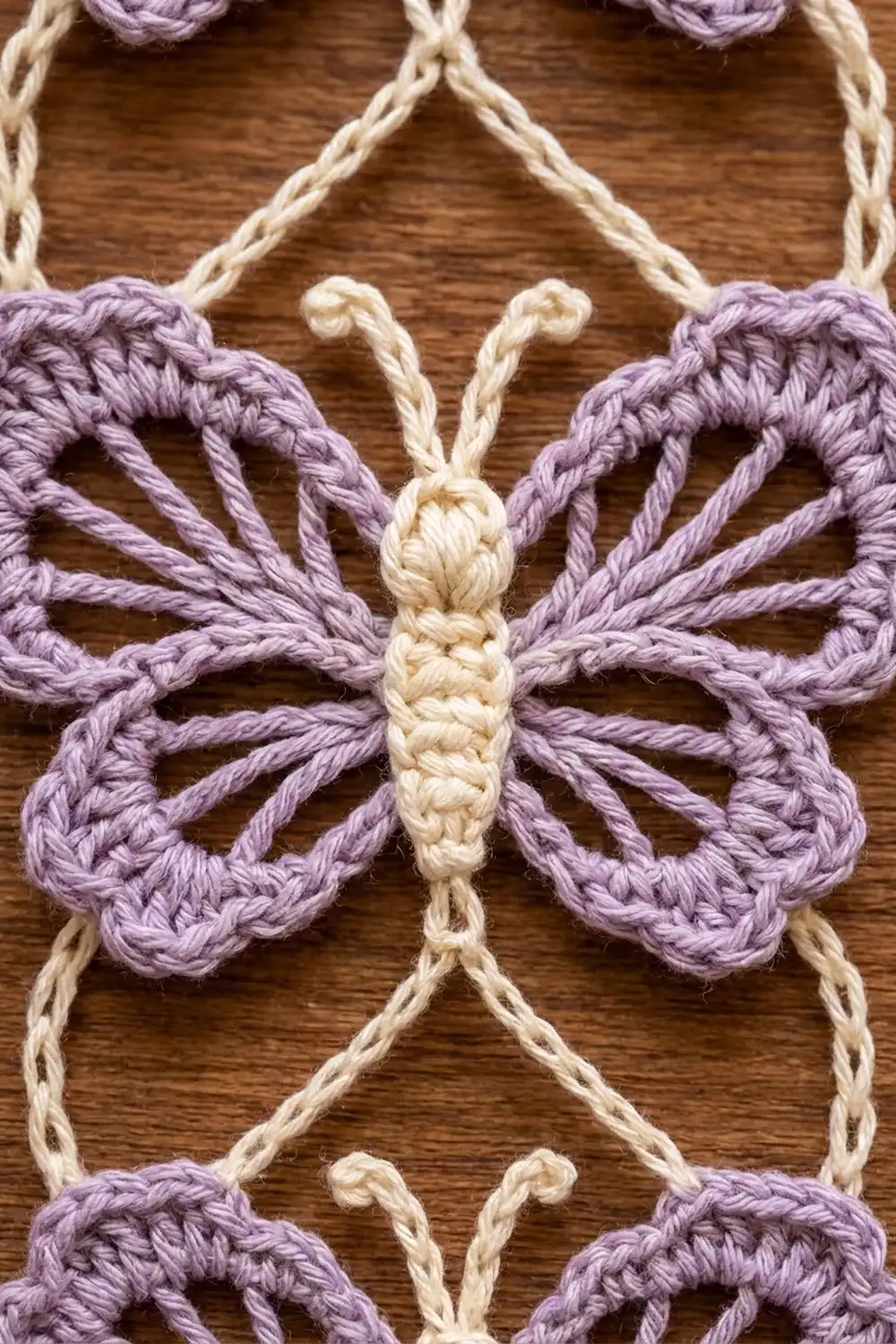
Butterfly Body (Cream)
Make 1 per butterfly.
Row 1: Ch 4, sc in 2nd ch from hook and in next 2 ch. (3 sc)
Rows 2–12: Ch 1, turn, sc in each st across. (3 sc per row)
The turned rows build horizontal ridges, which give the body its segmented look. Row 12 is the head end.
Antennae (continue without fastening off):
1. Ch 7. Work 3 sc in the 2nd ch from hook to make the curled knob, then sl st in each of the next 5 ch. Sl st in the same first st of Row 12.
2. Skip the center st. Sl st in the 3rd st.
3. Ch 7, 3 sc in 2nd ch from hook, sl st in next 5 ch, sl st in the same 3rd st.
Fasten off. Weave in the ends.
Checkpoint: the body measures 0.5 in × 2 in (1.3 cm × 5.1 cm), and the antennae add 0.75 in (1.9 cm) above the head.
Upper Wing Frame (Lilac)
Make 2 per butterfly.
Row 1: Make a magic ring. Ch 5 (counts as the first dtr), then [ch 3, dtr in ring] 6 times. (7 dtr, 6 ch-3 sps)
Pull the ring snug, leaving a small center hole. The beginning ch-5 is spoke 1.
Checkpoint: the spokes measure 1.25 in (3.2 cm). The fan spreads a little more than a quarter circle.
Lower Wing Frame (Lilac)
Make 2 per butterfly.
Row 1: Make a magic ring. Ch 4 (counts as the first tr), then [ch 2, tr in ring] 4 times. (5 tr, 4 ch-2 sps)
Pull the ring snug. The beginning ch-4 is spoke 1.
Checkpoint: the spokes measure 0.9 in (2.3 cm).
Now work the Wing Border (see the Border section below) on all four frames. Then come back here to assemble the butterfly.
Assemble the Butterfly
- Lay the body RS up with the head at the top.
- Right upper wing: place the lower ring against the body’s right edge at Rows 7–10, with spoke 1 pointing straight up alongside the body.
- Right lower wing: place the lower ring at Rows 3–5, with spoke 1 pointing straight out to the side, tucked just under the upper wing. The last spoke points down.
- Left side: flip both left lobes over to mirror the right side, so spoke 1 sits the same way. Both faces of these lobes look almost the same.
- Sew each ring to the row ends of the body with the lilac tail, using 3–4 small stitches. Weave in all ends.
Checkpoint: the butterfly measures 4 in × 3.5 in (10.2 cm × 8.9 cm). The upper wings and antennae reach 0.75 in (1.9 cm) above the head. The lower wings hang 0.75 in (1.9 cm) below the tail.
Wing tips used for joining:
– Upper tip: the center 2-sc increase of scallop 3 on the upper lobe, counting from spoke 1. It sits 0.5 in (1.3 cm) below the top of the butterfly.
– Lower tip: the center increase of scallop 3 on the lower lobe. It sits 1 in (2.5 cm) above the bottom of the butterfly.
Make All Pieces
For one strand, make:
– 15 cream bodies
– 30 lilac upper wings
– 30 lilac lower wings
For the full curtain (10 strands), make:
– 150 cream bodies
– 300 lilac upper wings
– 300 lilac lower wings
Assemble all 150 butterflies before you start joining.
Layout grid (each B is one butterfly; columns are strands S1–S10):
      S1 S2 S3 S4 S5 S6 S7 S8 S9 S10
R1    B  B  B  B  B  B  B  B  B  B
R2    B  B  B  B  B  B  B  B  B  B
...   (rows 3–14 repeat the same)
R15   B  B  B  B  B  B  B  B  B  B
Joining: Building a Strand
Each strand is joined with three passes of cream chain. Keep all chains relaxed: they should drape, not pull. Count chains exactly. Then hold the section up and check that the butterflies hang level before you go on.
Pass 1 – Loop and Central Spine
1. Ch 30 and sl st in the first ch to form the hanging loop. The loop is 5 in (12.7 cm) around and 2.5 in (6.4 cm) long when laid flat.
2. Ch 12 and sl st in the center st of Row 12 of Butterfly 1. This chain drops 2 in (5.1 cm) to the head, between the antennae.
3. Turn to the WS. Sl st in the center st of each row down the body, Rows 11 through 1. (11 sl sts)
4. Ch 18 and sl st in the center st of Row 12 of the next butterfly. Then work 11 sl sts down that body on the WS. Repeat from * through Butterfly 15.
5. Ch 6 for the tail and fasten off.
The ch-18 spine is 3 in (7.6 cm) long. It covers the 0.75 in (1.9 cm) of lower wing, a 1.5 in (3.8 cm) open gap, and the 0.75 in (1.9 cm) of upper wing and antennae on the next butterfly.
Pass 2 – Right Side Chain
1. Join cream with a sl st at the base of the loop.
2. Ch 15 and sl st in the right upper tip of Butterfly 1. This is the diagonal side of the V.
3. On the WS, ch 12 and sl st in the right lower tip of the same butterfly. The chain runs 2 in (5.1 cm) behind the wing and supports it.
4. Ch 18 and sl st in the right upper tip of the next butterfly. Ch 12 on the WS and sl st in that butterfly’s lower tip. Repeat from * through Butterfly 15.
5. Fasten off.
The ch-18 side chain spans 3 in (7.6 cm): 1 in (2.5 cm) below the lower tip, plus the 1.5 in (3.8 cm) gap, plus 0.5 in (1.3 cm) down to the next upper tip. The space between this chain and the curved wings forms the open diamond windows.
Pass 3 – Left Side Chain: work the same as Pass 2, using the left wing tips.
Tension advice: if a side chain pulls the wing tips inward, add 1 ch. If it sags past the wing edge, remove 1 ch. Keep the same count on both sides.
Size checkpoint: after 2 butterflies, the strand measures 12.25 in (31.1 cm) from the top of the loop to the bottom of Butterfly 2. That is 3.75 in (9.5 cm) of header, plus 3.5 in (8.9 cm) + 1.5 in (3.8 cm) + 3.5 in (8.9 cm). A full strand measures 77.5 in (196.9 cm).
Border: Scalloped Wing Edging
Work this border on each wing frame before you assemble the butterfly. It is described here because its stitch math sets the finished butterfly size.
Border gauge: Rows 2 and 3 together add 0.5 in (1.3 cm) beyond the spoke tips. One scallop spans one chain space.
Upper wing (each frame):
Row 2: Ch 1, turn. Sc in the first dtr. Work 1 scallop in the next ch-3 sp, sc in the next dtr. Repeat from * 5 more times. Your last sc goes in the 5th ch of the beginning ch-5. (37 sts: 7 sc + 6 scallops × 5 sts)
Row 3: Ch 1, turn. Sc in each st across, working 2 sc in the center dc of each scallop. (37 sts worked 1-per-stitch + 6 extra = 43 sc)
Fasten off, leaving an 8 in (20.3 cm) tail for sewing.
Lower wing (each frame):
Row 2: Ch 1, turn. Sc in the first tr. Work 1 scallop in the next ch-2 sp, sc in the next tr. Repeat from * 3 more times. Your last sc goes in the 4th ch of the beginning ch-4. (25 sts: 5 sc + 4 scallops × 5 sts)
Row 3: Ch 1, turn. Sc in each st across, working 2 sc in the center dc of each scallop. (25 sts worked 1-per-stitch + 4 extra = 29 sc)
Fasten off, leaving an 8 in (20.3 cm) tail.
Counts per side: each wing side has 43 + 29 = 72 border sts. The whole butterfly has 144.
Why the math works:
– Each sc sits on top of a spoke, which anchors the scallops so the fan can’t stretch out of shape.
– The 5-st scallop fills a ch-3 or ch-2 space without gaps.
– The Row 3 outline follows each shell’s curve, which is longer than the straight chord between spokes. Adding exactly 1 extra sc at each peak keeps the shells rounded without ruffling.
– The border adds 0.5 in (1.3 cm) to each side. The width grows from 3 in (7.6 cm) to 4 in (10.2 cm), and the height grows from 2.5 in (6.4 cm) to 3.5 in (8.9 cm).
Final Blocking
- Before joining, spray each butterfly lightly until it is damp.
- Pin it to 4 in × 3.5 in (10.2 cm × 8.9 cm). Put one pin at the end of each spoke and one at each scallop peak.
- Open the antenna curls with your fingertip.
- Let the butterflies dry completely before joining.
- After joining, hang each strand and mist the lattice lightly. Let it hang for 24 hours so the chains settle to their final length.
- If a strand hangs crooked, re-mist it and straighten the chains by hand.
Final Quality-Control Checklist
- Every body has 12 rows of 3 sc and two curled antennae.
- Each upper lobe has 7 spokes and 43 border sc. Each lower lobe has 5 spokes and 29 border sc.
- Spoke 1 points up on the upper lobes and out to the side on the lower lobes, on both sides.
- Every butterfly measures 4 in × 3.5 in (10.2 cm × 8.9 cm).
- The spine chains are ch 18 and the side chains are ch 18 and ch 12, with the same counts on both sides.
- Every strand measures 77.5 in (196.9 cm).
- Strands hang 4.5 in (11.4 cm) apart, center to center, for a total width of 44.5 in (113.0 cm).
- All ends are woven in securely.
Troubleshooting
- Wing fan cups or curls: the ring may be pulled too tight, or the spokes are short. Loosen the ring slightly, or check your yarn-overs on the dtr.
- Scallops ruffle: you added extra sts in Row 3. Use exactly 1 increase per scallop.
- Scallops pull flat: your Row 3 tension is tight. Go up a hook size for the border only.
- Butterflies tilt on the strand: the side chain counts don’t match. Recount both sides.
- Strand is too long: the chains are loose. Remove 1 ch from each ch-18 spine and side chain together.
- Strand is too short: add 1 ch to each ch-18 spine and side chain together.
- Antennae droop: work the 3-sc knob more tightly and add a drop of starch.
Care
Hand wash in cool water with mild soap. Roll each strand in a towel to remove water, then hang it to dry. Dust it occasionally with a hairdryer on its cool setting.
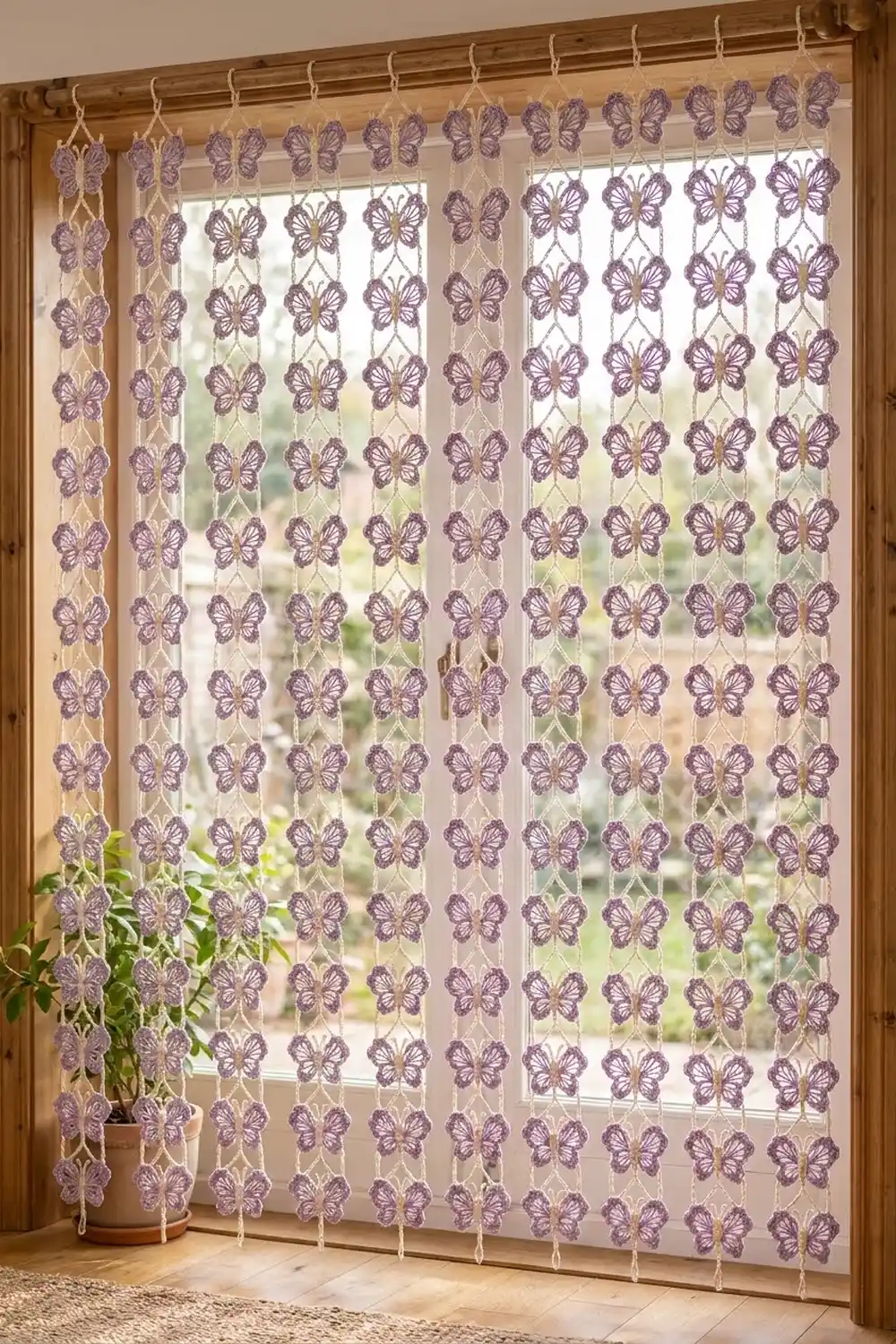
Final Notes
The measurement chain is simple:
1. The 0.5 in × 2 in (1.3 cm × 5.1 cm) body and the 1.25 in (3.2 cm) and 0.9 in (2.3 cm) spokes give a 3 in × 2.5 in (7.6 cm × 6.4 cm) butterfly.
2. The 0.5 in (1.3 cm) border brings it to 4 in × 3.5 in (10.2 cm × 8.9 cm).
3. Fifteen butterflies with 1.5 in (3.8 cm) gaps, plus the header and tail, make a 77.5 in (196.9 cm) strand.
4. Ten strands spaced 4.5 in (11.4 cm) apart fill 44.5 in (113.0 cm).
Check each link in that chain, and the curtain will hang straight and even. Happy crocheting!