
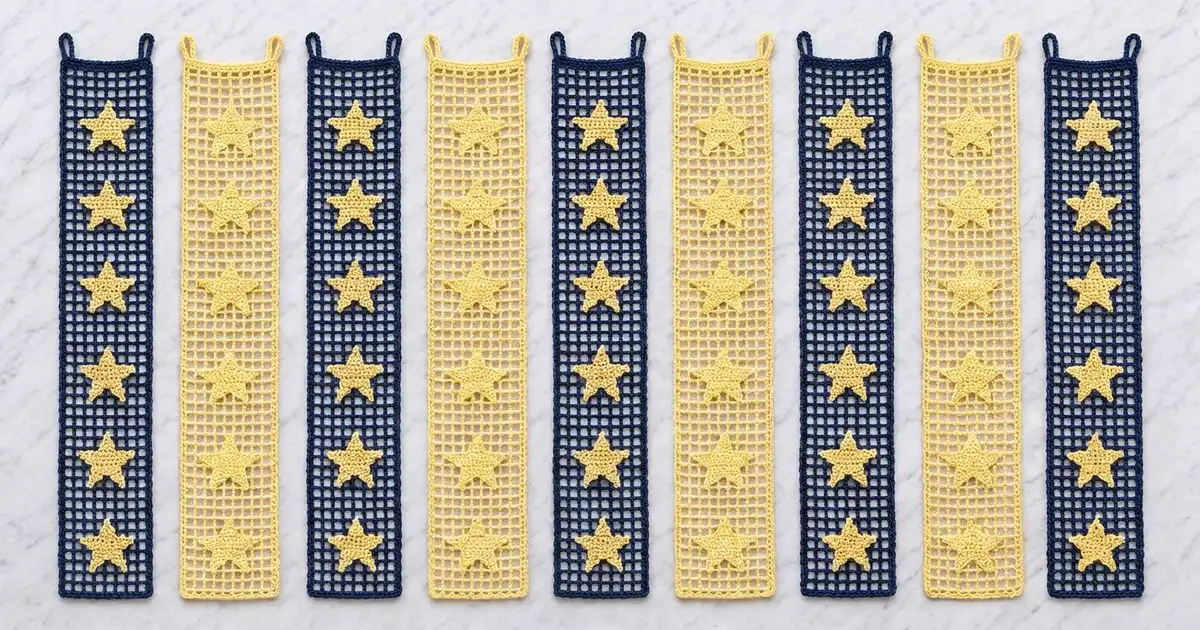
The Midnight Star Filet Door Curtain is made of seven narrow mesh strips that hang side by side from a rod. Every strip shows a column of eight five-point stars. Four strips are deep navy with bright yellow star appliqués. Three strips are butter yellow with tonal filled-block stars.
The look is classic filet crochet: an open grid of double crochet posts and chain spaces, with some squares filled in to draw a picture. On the navy strips, a small crocheted yellow star is sewn over each filled star for extra contrast. A slim border finishes the edges, and two chain loops at the top of each strip slide onto the rod.
This pattern uses US crochet terms. One finished strip measures 5 in (12.7 cm) wide by 72 in (182.9 cm) long, not counting the hanging loops. Seven strips hung edge to edge cover 35 in (88.9 cm), which suits a standard interior doorway.
You work each strip flat in rows from the bottom up, following a written star chart. Then you add a two-round border and two hanging loops. The strips are never seamed together; they hang on their own.
Finished Size and Construction
- Finished strip size: 5 in x 72 in (12.7 cm x 182.9 cm)
- Strip size before border: 4.5 in x 71.5 in (11.4 cm x 181.6 cm)
- Border depth: 0.25 in (0.6 cm) on each edge
- Hanging loops: 2 in (5.1 cm) above the top edge
- Assembled curtain: 35 in (88.9 cm) wide, about 74 in (188.0 cm) long including loops
- Skill level: Intermediate (basic filet crochet)
- Terminology: US
- Yarn weight: DK (#3) cotton
- Hook: 4 mm (G-6)
- Number of pieces: 7 strips (4 navy, 3 yellow) plus 32 yellow star appliqués
- Layout: 7 strips in one row, alternating navy and yellow, navy at both ends
- Grid per strip: 9 squares wide x 143 rows tall
Materials
Choose a smooth DK cotton. Cotton holds the grid shape and stretches less than acrylic over a long hanging length. Clear stitch definition helps the filled stars stand out from across the room.
- Navy (Color A): 500 g, about 1,150 m (4 strips)
- Yellow (Color B): 500 g, about 1,150 m (3 strips and 32 appliqués)
Quantities assume about 115 m per 50 g and include a margin of roughly 10 to 15 percent.
Tools:
- 4 mm (G-6) crochet hook
- Tapestry needle
- Stitch markers
- Measuring tape
- Rust-proof pins and a blocking surface
- Spray bottle
- Curtain rod up to 1 in (2.5 cm) in diameter
Abbreviations (US Terms)
- ch – chain
- sl st – slip stitch
- sc – single crochet
- hdc – half double crochet
- dc – double crochet
- tr – treble crochet
- sk – skip
- sp – space
- st(s) – stitch(es)
- RS / WS – right side / wrong side
Special stitches (filet squares):
- Open square (O): ch 2, sk the next ch-2 sp (or next 2 dc), dc in next dc.
- Block (B): 2 dc in the next ch-2 sp (or dc in each of the next 2 dc), dc in next dc.
Each square uses 3 sts. A row of 9 squares always has 10 dc posts and 18 filler sts (chains or dc), for 28 sts total. The turning ch counts as the first dc post.
Gauge and Checkpoints
Filet gauge: 4 squares and 4 rows = 2 in (5.1 cm), so each square is 0.5 in (1.3 cm) wide and tall.
Border gauge: 12 sc = 2 in (5.1 cm), or 6 sc per inch.
Test one strip first. Work Rows 1 to 12, which completes the first star, and check:
- After Row 1: width is 4.5 in (11.4 cm).
- After Row 12: length is 6 in (15.2 cm); the star is 3.5 in (8.9 cm) wide.
- After Row 30: length is 15 in (38.1 cm), two stars complete.
- After Row 66: length is 33 in (83.8 cm), four stars complete.
- After Row 143: 4.5 in x 71.5 in (11.4 cm x 181.6 cm).
If the strip is too wide, go down one hook size. If it is too narrow, go up one size. If the width is right but the rows are short, pull up your dc loops a little taller. Small errors add up over 143 rows, so fix row height early.

The Strip (make 7)
Make 4 strips in navy and 3 in yellow. All strips follow the same instructions.
Star Chart
Columns are numbered 1 to 9. Columns 1 and 9 are always open. The star fills columns 2 to 8 and is 7 rows tall. It is symmetrical, so it reads the same on RS and WS rows.
- Star Row 1 (feet): O, B, B, O, O, O, B, B, O (4 blocks)
- Star Row 2 (legs): O, O, B, B, O, B, B, O, O (4 blocks)
- Star Row 3 (waist): O, O, O, B, B, B, O, O, O (3 blocks)
- Star Row 4 (body): O, O, B, B, B, B, B, O, O (5 blocks)
- Star Row 5 (arms): O, B, B, B, B, B, B, B, O (7 blocks)
- Star Row 6 (neck): O, O, O, B, B, B, O, O, O (3 blocks)
- Star Row 7 (tip): O, O, O, O, B, O, O, O, O (1 block)
Every star row still has 28 sts: 10 dc posts plus 18 filler sts.
Starting Rows
Foundation: Ch 32.
Row 1 (RS, open): Dc in 8th ch from hook (the 7 skipped ch count as dc, ch 2 and 2 base ch), ch 2, sk 2 ch, dc in next ch; repeat from * 7 more times. Turn. (9 open squares; 28 sts: 10 dc + 18 ch)*
Row 2 (open): Ch 5 (counts as dc and ch 2), dc in next dc, ch 2, dc in next dc; repeat from * 6 more times, ch 2, dc in 3rd ch of turning ch. Turn. (9 open squares; 28 sts)*
Rows 3 to 5: Repeat Row 2. (28 sts each)
Working a Star Row
Begin with ch 5 (counts as dc and ch 2), dc in next dc. This is square 1, which is always open. Work squares 2 to 8 as charted. Finish square 9 with ch 2, dc in 3rd ch of turning ch. Turn.
Block over block: dc in each of the next 3 dc. Open over block: ch 2, sk 2 dc, dc in next dc.
Full Row Plan
- Rows 1 to 5: open
- Rows 6 to 12: Star 1 (Star Rows 1 to 7)
- Rows 13 to 23: open (11 rows)
- Rows 24 to 30: Star 2
- Rows 31 to 41: open
- Rows 42 to 48: Star 3
- Rows 49 to 59: open
- Rows 60 to 66: Star 4
- Rows 67 to 77: open
- Rows 78 to 84: Star 5
- Rows 85 to 95: open
- Rows 96 to 102: Star 6
- Rows 103 to 113: open
- Rows 114 to 120: Star 7
- Rows 121 to 131: open
- Rows 132 to 138: Star 8
- Rows 139 to 143: open (5 rows)
Check: 5 + 7 + (11 + 7) x 7 + 5 = 143 rows. A new star starts every 18 rows, or 9 in (22.9 cm). Do not fasten off after Row 143; go straight into the border.
Star Appliqué (make 32, yellow)
The appliqués go over the navy filled stars only, 8 per navy strip.
Rnd 1: Magic ring, ch 1, 10 sc in ring, sl st to first sc. (10 sc)
Rnd 2: Ch 1, 2 sc in each sc around, sl st to first sc. (20 sc)
Rnd 3 (points): Ch 5, sc in 2nd ch from hook, hdc in next ch, dc in next ch, tr in next ch, sk next 3 sc of Rnd 2, sl st in next sc; repeat from * 4 more times, placing the last sl st in the first sl st. (5 points; 5 x 4 sts of Rnd 2 = 20)*
Fasten off, leaving a 12 in (30.5 cm) tail. The appliqué measures about 3.5 in (8.9 cm) across, matching the 7-square filet star.
Make All Pieces
- Navy (Color A): 4 strips
- Yellow (Color B): 3 strips and 32 star appliqués
Layout, front view (N = navy, Y = yellow):
| N | Y | N | Y | N | Y | N |
| 1 | 2 | 3 | 4 | 5 | 6 | 7 |
Each cell is one 5 in x 72 in (12.7 cm x 182.9 cm) strip. Seven strips x 5 in = 35 in (88.9 cm).
Joining (Appliqués and Hanging)
The strips are not seamed to each other. Each one hangs from its own two loops, so the curtain parts easily when someone walks through. Because nothing is joined, each border goes around one strip only. Its counts come from that strip’s own 9 squares and 143 rows, and no seam stitches are added anywhere.
Attaching appliqués: After blocking, lay a navy strip RS up. Center a yellow star over each filled navy star, with the top point over the Star Row 7 block and the lower points over the Star Row 1 feet. Pin the five tips and the center. Whipstitch around the outer edge with the tail, catching the navy dc posts underneath. Keep the stitches relaxed so the mesh does not pucker.
Size checkpoint: After sewing, the strip should still lie flat at 5 in (12.7 cm) wide. If the edges draw in, resew more loosely.
Border
Border gauge: 6 sc per inch. Each row is 0.5 in (1.3 cm) tall, so each row-end takes 0.5 x 6 = 3 sc.
Rnd 1 (sc): With RS facing, ch 1, 3 sc in last dc made (corner). Across the top, work 2 sc in each ch-2 sp and 1 sc in each interior dc, then 3 sc in 3rd ch of turning ch (corner). Down the long side, work 3 sc around each row-end. Across the bottom, work 3 sc in the outer dc base (corner), 2 sc in each ch-2 sp, 1 sc in each interior dc base, and 3 sc in the last base (corner). Up the second side, work 3 sc around each row-end. Sl st to first sc.
- Top: 26 sc between corner groups (9 spaces x 2 + 8 interior dc x 1)
- Bottom: 26 sc between corner groups
- Each long side: 429 sc between corner groups (143 rows x 3)
- Corners: 4 groups x 3 sc = 12
- Total: 26 + 26 + 429 + 429 + 12 = 922 sc
Rnd 2 (sl st): Sl st loosely in each sc around, with no extra corner stitches. (922 sl st) Fasten off.
Why the math works: Each short edge holds 26 sc plus the center sc of each corner group. That makes 28 sts, one per grid stitch, across 4.5 in (11.4 cm). The long sides get exactly 6 sc per inch, which matches the border gauge. The sl st round adds height but no stitches, so each edge grows by 0.25 in (0.6 cm) and the strip finishes at 5 in x 72 in (12.7 cm x 182.9 cm).
Hanging Loops (2 per strip)
With RS facing, join yarn in the 3rd sl st after the top-right corner. Ch 24, sl st in the same st to form a ring. Ch 1, work 30 sc into the ring, sl st to first sc. Fasten off. Repeat at the 3rd sl st before the top-left corner.
Each loop is about 4 in (10.2 cm) around and stands 2 in (5.1 cm) above the strip.
Final Blocking
- Weave in ends along dc posts so they don’t show through open squares.
- Lay each strip flat, working in sections if needed.
- Mist evenly until damp but not soaked.
- Pin the long edges straight at 5 in (12.7 cm) wide, one pin every 4 in (10.2 cm).
- Nudge the dc posts upright so every square is even.
- Check the length: 72 in (182.9 cm). Ease gently if short, but don’t overstretch.
- Let dry completely before unpinning.
- Sew on the navy appliqués, then steam them lightly from above.
Final Quality-Control Checklist
- Every row has 10 dc posts and 28 sts.
- Columns 1 and 9 are open in every row.
- Stars begin at Rows 6, 24, 42, 60, 78, 96, 114 and 132.
- Five open rows sit below the first star and five above the last.
- Border Rnd 1 has 922 sc; Rnd 2 has 922 sl st.
- All 7 strips measure 5 in x 72 in (12.7 cm x 182.9 cm).
- Hanging loops sit in the same place on every strip.
- 32 appliqués are centered and flat on the navy strips.
Troubleshooting
Strip slants: You may be missing the last dc. Always end in the 3rd ch of the turning ch.
Stars look lopsided: Recount the blocks in each star row: 4, 4, 3, 5, 7, 3, 1.
Squares look like rectangles: Loosen your chains or pull up taller dc loops.
Border ruffles on the sides: Work 5 sc over every 2 row-ends instead of 6, evenly on both sides.
Border pulls in: Use a hook one size larger for Rnd 2.
Strips differ in length: Measure every 30 rows against the first strip. Blocking can correct about 1 in (2.5 cm).
Appliqué puckers the mesh: Sew through the dc posts only and keep your tension loose.
Care
Hand wash in cool water with mild soap, roll in a towel and dry flat. Re-block and rehang while slightly damp to keep the edges straight.

Final Notes
The whole curtain rests on one number: a 0.5 in (1.3 cm) filet square. Nine squares make a 4.5 in (11.4 cm) strip, and 143 rows make 71.5 in (181.6 cm). A 0.25 in (0.6 cm) border brings each strip to 5 in x 72 in (12.7 cm x 182.9 cm), and seven strips span 35 in (88.9 cm). Check your gauge early and count posts often, and the stars will line up across the doorway.
Happy crocheting!