

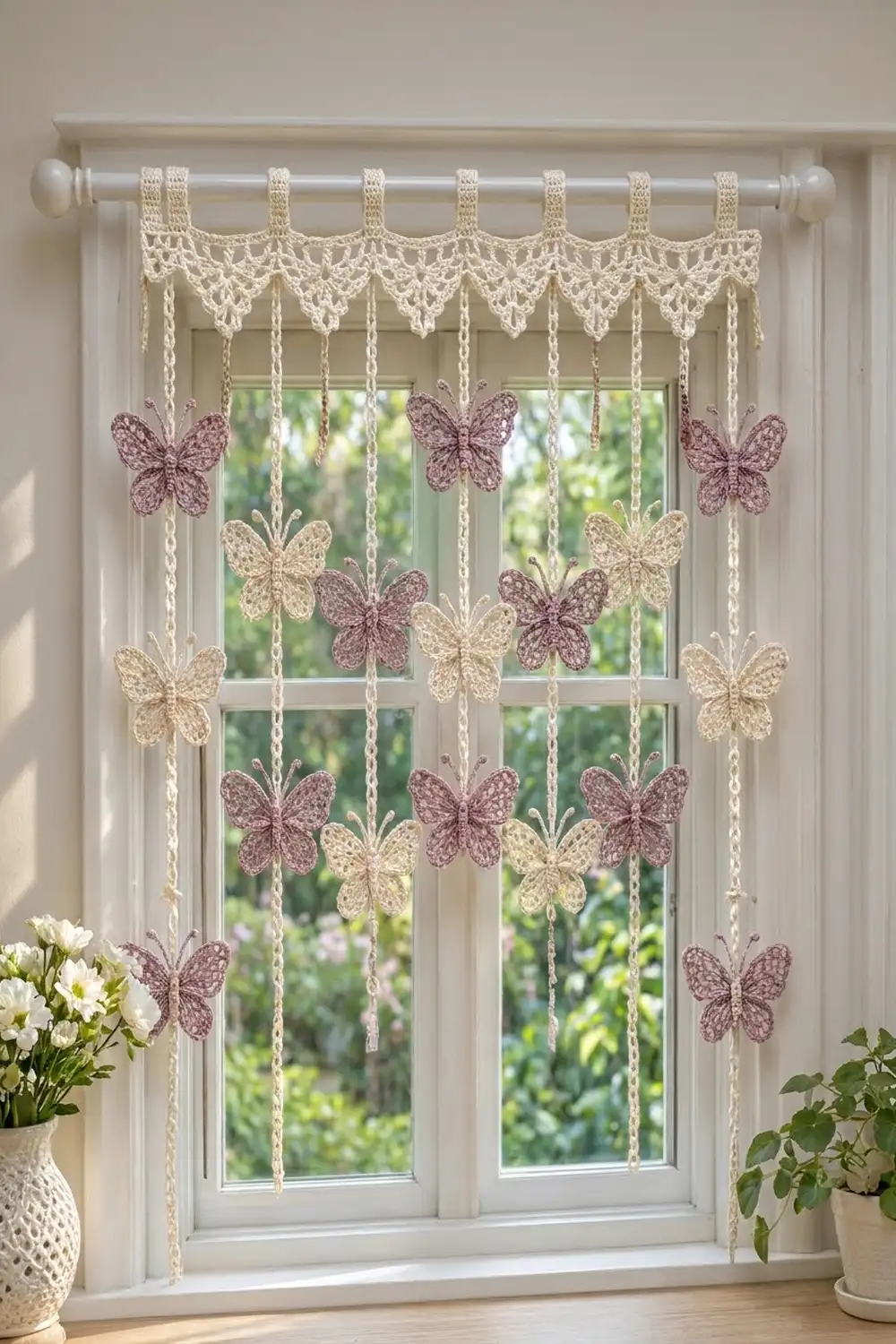
The Lilac Flutter Valance is a light, airy window hanging. It has an ivory lace header with pointed edging, seven chain strands that fall from the point tips, and eighteen lacy butterflies placed down the strands.
Two colors carry the design. Ivory is used for the valance, the strands, and half the butterflies. Dusty mauve is used for the other half. Each butterfly has open mesh wings with a solid outline, a padded segmented body, and two curled antennae with knot tips. The style is cottage-romantic, with simple shapes and a clear rhythm.
This pattern uses US crochet terms. The finished valance is 28 in (71.1 cm) wide and 4.25 in (10.8 cm) deep, not counting the tabs. The strands add 36 in (91.4 cm), so the whole piece drops 40.25 in (102.2 cm) from the top edge.
The piece is built in parts. You make the butterflies in rounds and add a separate body to each. Then you chain the strands and sew the butterflies onto them. Next you crochet the valance band in rows, work seven lace points as the border, add rod tabs, and hang one strand from each point tip.
Finished Size and Construction
- Finished size: 28 in (71.1 cm) wide x 40.25 in (102.2 cm) total drop
- Skill level: Intermediate
- Terminology: US crochet terms
- Yarn weight: DK (#3 light) cotton
- Hook: 3.5 mm (E-4)
- Number of pieces: 1 valance, 7 strands, 18 butterflies (each with wings and a separate body)
- Layout: 7 strands spaced 4 in (10.2 cm) apart, each carrying 3 or 2 butterflies
- Butterfly size: 4.5 in (11.4 cm) wide x 3.5 in (8.9 cm) tall
- Valance band before border: 28 in (71.1 cm) x 1.5 in (3.8 cm)
- Border depth (lace points): 2.75 in (7.0 cm)
Materials
Use a smooth mercerized DK cotton. It shows the lace clearly, keeps the butterfly shape after blocking, and stretches very little when it hangs. The amounts below assume about 2.4 m per gram (roughly 120 m per 50 g).
- Color A, Ivory: 175 g (420 m), for the valance, the strands, and 9 butterflies
- Color B, Dusty Mauve: 90 g (216 m), for 9 butterflies
These amounts include a margin of about 25% for swatching, yarn tails, and differences in tension.
Tools: 3.5 mm (E-4) hook, tapestry needle, stitch markers, yarn scraps for stuffing, blocking mat, rust-proof pins, spray bottle, tape measure, and a curtain rod no thicker than 0.75 in (1.9 cm) in diameter.
Abbreviations (US Terms)
- ch: chain
- sl st: slip stitch
- sc: single crochet
- dc: double crochet
- sc2tog: single crochet 2 together
- sk: skip
- sp(s): space(s)
- st(s): stitch(es)
- rnd(s): round(s)
- RS: right side
- MR: magic ring
Special stitch: Puff. (Yarn over, insert hook in indicated st, yarn over and pull up a loop) 3 times, yarn over and pull through all 7 loops on hook.
Gauge and Checkpoints
Gauge: 21 sc and 24 rows = 4 in (10.2 cm). One mesh row of dc is 0.5 in (1.3 cm) tall. A chain made with two strands held together measures 4 ch per 1 in (2.5 cm).
Make one complete butterfly first. It is the quickest gauge test, and it uses every stitch in the pattern.
Checkpoints:
- Butterfly after Rnd 3: 3.25 in (8.3 cm) wide
- Butterfly after Rnd 5: 4.5 in (11.4 cm) wide x 3.5 in (8.9 cm) tall
- Body: 2.25 in (5.7 cm) long
- Valance band after Row 5: 28 in (71.1 cm) x 1.5 in (3.8 cm)
- Each lace point: 4 in (10.2 cm) wide at the top and 2.75 in (7.0 cm) deep after edging
If a piece comes out too big, go down one hook size. If it is too small, go up one hook size. Change the hook, not the stitch counts.

Butterfly Wings
Make 9 in Color A and 9 in Color B. The wings are one piece, worked in rounds out from a small center ring.
Rnd 1: MR, ch 1, 8 sc in ring, sl st to first sc. Pull the ring tight. (8 sc)
Rnd 2 (wing frames): Ch 1, sc in st 1, ch 13, sc in st 2, sc in st 3, ch 9, sc in st 4, sc in st 5, ch 9, sc in st 6, sc in st 7, ch 13, sc in st 8, sl st to first sc. (8 sc, 2 ch-13 loops, 2 ch-9 loops)
The ch-13 loops become the upper wings and the ch-9 loops become the lower wings. The gap between st 8 and st 1 is the top center, and the gap between st 4 and st 5 is the bottom center.
Rnd 3 (wing fans): In the first ch-13 loop, work dc, (ch 2, dc) 8 times. Sl st in sc 2 and sc 3. In the ch-9 loop, work dc, (ch 2, dc) 5 times. Sl st in sc 4 and sc 5. Repeat the ch-9 fan in the next loop, then sl st in sc 6 and sc 7. Repeat the ch-13 fan in the last loop, then sl st in sc 8 and sc 1.
Each upper wing has 9 dc and 8 ch-2 sps. Each lower wing has 6 dc and 5 ch-2 sps. (30 dc, 26 ch-2 sps, 8 sl sts)
Rnd 4 (mesh): Sl st in the first dc of the first upper wing. Sc in the same dc, then (ch 4, sc in next dc) 8 times. For each lower wing, sc in the first dc, then (ch 3, sc in next dc) 5 times. Work the second upper wing like the first. Sl st to first sc.
Each upper wing has 9 sc and 8 ch-4 loops. Each lower wing has 6 sc and 5 ch-3 loops. (30 sc, 16 ch-4 loops, 10 ch-3 loops)
Rnd 5 (solid outline): Work 5 sc in each ch-4 loop and 4 sc in each ch-3 loop. Where two wings meet, sl st in the last sc of one wing and the first sc of the next. Sl st to first sc and fasten off.
Each upper wing has 40 sc and each lower wing has 20 sc. (120 sc) This round makes the thick, rounded outline around the radiating mesh holes.
Butterfly Body and Antennae
Make 18 bodies, each in the same color as its wings. Work in continuous spirals and mark the first st of each round.
Rnd 1 (head): MR, 6 sc in ring. (6)
Rnd 2: Sc in each st. (6)
Rnd 3 (neck): Sc2tog 3 times. (3)
Rnd 4: 2 sc in each st. (6)
Rnds 5-13: Sc in each st. (6) Stuff lightly with scraps as you go.
Rnd 14: Sc2tog 3 times. (3) Fasten off, leaving a 16 in (40.6 cm) tail. Close the opening.
Segments: Use the tail to wrap the body tightly at 4 points spaced 0.4 in (1.0 cm) apart. This makes the ridged, segmented look.
Antennae (make 2): Join yarn at the top of the head. Ch 9, work a puff in the 2nd ch from the hook, then sl st in each of the next 7 ch. Sl st back into the head and fasten off. Curl each antenna outward. Each one is about 1.25 in (3.2 cm) long.
Attach the body: Lay the body over the wings from the top center gap to the bottom center gap, with the head just above the upper wings. Sew it down through Rnds 1 and 2 so that it covers the center ring.
Hanging Strands
Make 7 in Color A, holding two strands of yarn together.
Leave a 10 in (25.4 cm) tail and ch 144. The strand should measure 36 in (91.4 cm). Fasten off, leaving another 10 in (25.4 cm) tail. Knot the bottom end and trim it to 0.5 in (1.3 cm).
Valance Band
Make 1 in Color A.
Row 1 (RS): Ch 148, sc in 2nd ch from hook and in each ch across. Turn. (147 sc)
Row 2 (mesh): Ch 4 (counts as dc and ch 1), sk next st, (dc in next st, ch 1, sk next st) 72 times, dc in last st. Turn. (74 dc, 73 ch-1 sps = 147 sts)
Row 3: Ch 1, sc in each dc and each ch-1 sp across. Turn. (147 sc)
Row 4: Repeat Row 2. (74 dc, 73 ch-1 sps)
Row 5: Repeat Row 3. Fasten off. (147 sc)
Checkpoint: the band measures 28 in (71.1 cm) x 1.5 in (3.8 cm).
Make All Pieces
- Color A: 9 butterflies, 7 strands, 1 valance
- Color B: 9 butterflies
- Total: 18 butterflies
Butterfly centers are measured down from the top of each strand. A = Ivory, B = Mauve, dash = no butterfly.
Drop    S1  S2  S3  S4  S5  S6  S7
6 in    B   -   A   -   B   -   A
12 in   -   A   -   B   -   A   -
18 in   A   -   B   -   A   -   B
24 in   -   B   -   A   -   B   -
30 in   B   -   A   -   B   -   A
The drops are 6 in (15.2 cm), 12 in (30.5 cm), 18 in (45.7 cm), 24 in (61.0 cm), and 30 in (76.2 cm). Odd-numbered strands carry 3 butterflies and even-numbered strands carry 2. That gives 12 + 6 = 18 butterflies, 9 in each color.
Joining
Method: The butterflies are sewn on, not crocheted on. Lay one strand flat without stretching it, and mark each drop from the grid. Center a butterfly body over the strand at each mark, head up.
Stitch-to-stitch logic: Sew through the back of the body and both yarn strands of the chain. Catch 3 chains under the head, 3 at the middle, and 3 near the tail. Never sew through the wings, so the mesh stays open.
Tension: Sew snugly but not tightly. If the chain puckers behind a body, loosen those stitches.
Checkpoint: Each finished strand lies flat at 36 in (91.4 cm), with the butterflies centered and the wings level.
Border: Lace Points and Rod Tabs
Border gauge: Each lace point uses 21 sts of Row 5, which is 4 in (10.2 cm). The edging uses 2 sc per dc row end.
Divide Row 5 into 7 sections of 21 sts: section 1 is sts 1-21, section 2 is sts 22-42, and so on through section 7 (sts 127-147). Work each point separately with the RS facing.
Row P1: Join with sl st in the first st of the section, ch 4 (counts as dc and ch 1), sk next st, (dc in next st, ch 1, sk next st) 9 times, dc in the last st of the section. Turn. (11 dc, 10 ch-1 sps)
Row P2: Sl st in the first ch-1 sp and the next dc, ch 4 (counts as dc and ch 1), (dc in next dc, ch 1) 7 times, dc in next dc. Leave the last dc unworked. Turn. (9 dc, 8 ch-1 sps)
Row P3: Work as Row P2, with the bracket worked 5 times. (7 dc, 6 ch-1 sps)
Row P4: Work as Row P2, with the bracket worked 3 times. (5 dc, 4 ch-1 sps)
Row P5: Work as Row P2, with the bracket worked 1 time. (3 dc, 2 ch-1 sps) Fasten off.
Repeat for all 7 sections. Each row drops 1 dc at each side, which gives a straight-sided triangle.
Edging Row: With the RS facing, join with sl st in st 1 of Row 5. For each point:
- Left slant: 2 sc around each row-end post of Rows P1-P5. (10 sc)
- Tip: sc in first dc of P5, sc in ch-1 sp, (sc, ch 4, sc) in center dc, sc in ch-1 sp, sc in last dc. (6 sc and 1 ch-4 loop)
- Right slant: 2 sc around each row-end post of Rows P5-P1. (10 sc)
- Between points: sl st into the valley where the two points meet.
After the last point, sl st in st 147 of Row 5 and fasten off. Each point has 26 sc and 1 tip loop. (182 sc, 7 ch-4 loops, 6 valley sl sts)
Rod Tabs: Work 7 tabs along the top edge, into the free loops of the foundation chain. Tab k uses sts (21k – 12) to (21k – 8). So tab 1 uses sts 9-13, tab 2 uses sts 30-34, and tab 7 uses sts 135-139.
- Row 1: Join in the first st, ch 1, sc in the same st and the next 4 sts. (5 sc)
- Rows 2-18: Ch 1, turn, sc in each st. (5 sc)
Fasten off, leaving a 10 in (25.4 cm) tail. Each tab is 1 in (2.5 cm) wide and 3 in (7.6 cm) long. Fold it to the back and sew Row 18 to the back of Row 1 of the band. This makes a loop 1.5 in (3.8 cm) tall.
Hang the strands: Pull the top tail of each strand through a ch-4 tip loop and tie a square knot. Sew the tails into the chain and trim.
Why the math works: 7 points x 21 sts = 147 sts, which is exactly the Row 5 count, so no stitches are added or skipped. The mesh needs an odd number of stitches, and 147 is odd. At gauge, each point is 4 in (10.2 cm) wide, so the band is 28 in (71.1 cm). Each point loses 2 dc per row (11, 9, 7, 5, 3), so the center dc of P5 sits right over st 11 of its section. That is also the center of each tab (21k – 10), so the tabs, tips, and strands all line up 4 in (10.2 cm) apart.
Final Blocking
- Weave in all remaining ends.
- Pin the valance flat at 28 in (71.1 cm) wide, with the band 1.5 in (3.8 cm) deep.
- Pin each tip so the points are 2.75 in (7.0 cm) deep and evenly spaced.
- Pin each butterfly through the wing outlines to 4.5 in (11.4 cm) x 3.5 in (8.9 cm), opening every mesh hole.
- Mist lightly until damp.
- Let everything dry completely, about 12 hours.
- Unpin, re-curl the antennae, and hang the valance.
Final Quality-Control Checklist
- Band is 147 sts and measures 28 in (71.1 cm)
- All 7 points have 5 rows and a ch-4 tip loop
- Edging has 26 sc per point
- 7 tabs are centered over the points
- 7 strands measure 36 in (91.4 cm) each
- 18 butterflies, 9 of each color, placed as in the grid
- Every body is segmented, and the antennae are curled
- Total drop is 40.25 in (102.2 cm)
Troubleshooting
Wings cup: The Rnd 3 dc are too tight. Loosen your chains or go up half a hook size.
Wings ruffle: The ch-13 and ch-9 loops are too loose. Tighten your chains or go down one hook size.
Band is short: Check your sc gauge and rework with a larger hook. Do not add stitches.
Points lean: Check that each section starts on the correct stitch, and that you left the last dc unworked in Rows P2-P5.
Strands twist: Keep both yarn strands flat as you chain, and block the strands hanging with a light weight at the end.
Care
Hand wash in cool water with mild soap, then lay flat to dry, reshaping the butterflies. Do not wring or tumble dry.
Final Notes
Gauge sets each point at 21 sts and 4 in (10.2 cm). Seven points make a 147-st band that is 28 in (71.1 cm) wide and 1.5 in (3.8 cm) deep. The lace border adds 2.75 in (7.0 cm), for a 4.25 in (10.8 cm) valance. Seven 36 in (91.4 cm) strands carry eighteen 4.5 in (11.4 cm) butterflies, for a total drop of 40.25 in (102.2 cm). Check each stage before moving on, and the valance will hang straight and even.
Happy crocheting!