

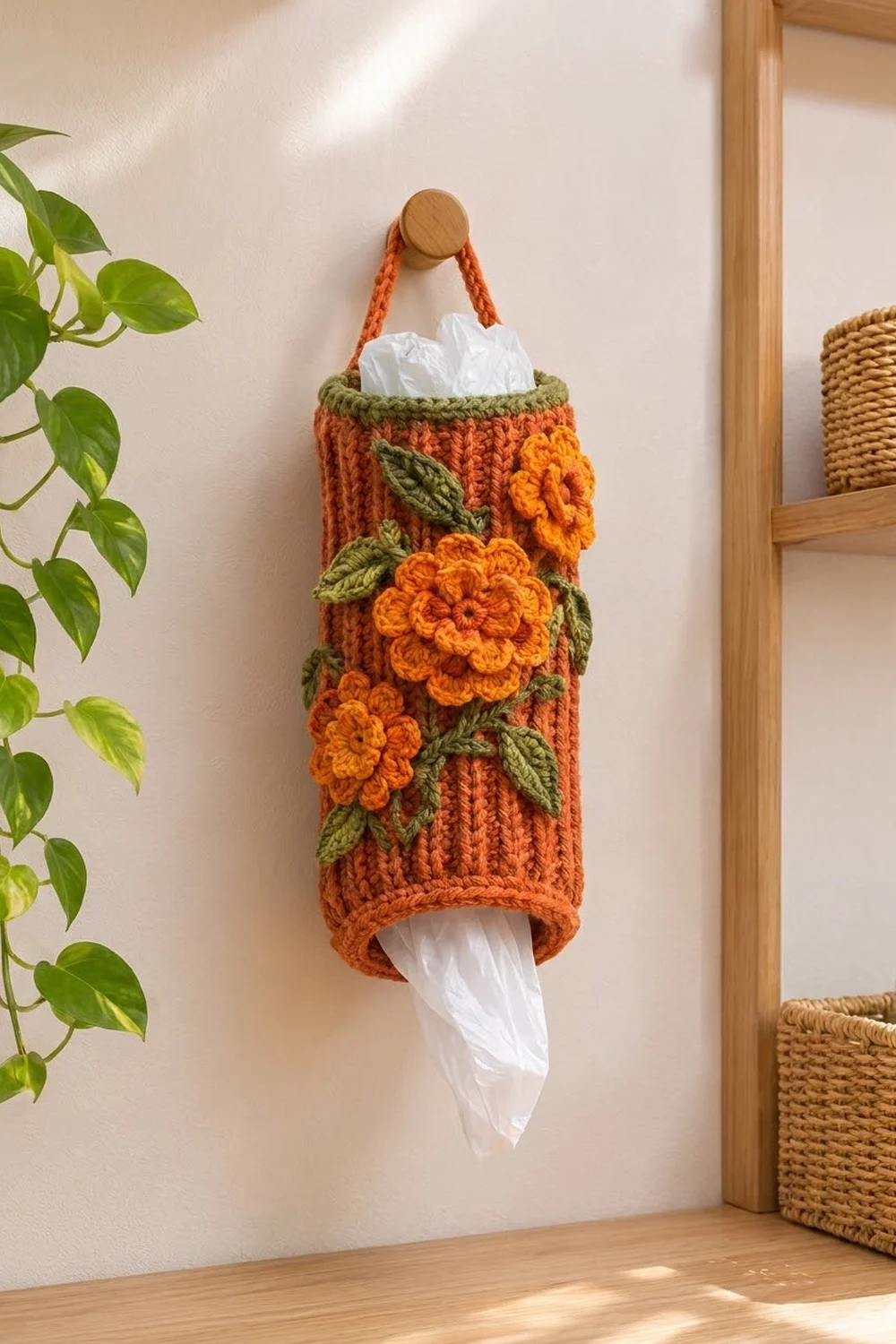
This bag holder keeps grocery bags tidy and is nice enough to leave on show in the kitchen. It is a ribbed tube that looks like knitting, worked in warm rust orange. The top has an olive green rim, and a cluster of marigold flowers with leaves and vines climbs up the front.
The palette is three earthy colors: rust for the body and handle, olive for the rim, leaves, and vines, and bright marigold for the flowers. The style is cottage-garden. The rib gives the tube structure, and the layered flowers stand out in raised relief against it.
All terms are US crochet terms. The holder measures 5.5 in (14.0 cm) wide when flat, 11 in (27.9 cm) around, and 13.75 in (34.9 cm) tall, not counting the handle.
You start with a single crochet band at the bottom, then increase once and work the body in front post/back post rib. An olive rim finishes the top. Last, you sew on a separate handle strap, three flowers, and seven leaves, and add vines in surface slip stitch.
Finished Size and Construction
- Finished size: 5.5 in (14.0 cm) wide flat × 13.75 in (34.9 cm) tall
- Circumference: 11 in (27.9 cm) body; 10 in (25.4 cm) bottom opening
- Skill level: Intermediate
- Terminology: US crochet terms
- Yarn weight: Worsted (#4)
- Hook: 5.0 mm (H-8)
- Number of pieces: 1 tube body, plus 1 handle, 3 flowers, and 7 leaves sewn on
- Layout: Single tube, appliqués on the front face only
- Body size before rim: 5.5 in (14.0 cm) flat × 13 in (33.0 cm) tall
- Rim depth: 0.75 in (1.9 cm)
- Handle: 0.75 in (1.9 cm) wide × 10 in (25.4 cm) long
Materials
Use a smooth worsted-weight acrylic or cotton blend. The holder hangs in a kitchen and gets pulled on, so a firm, low-fuzz yarn will keep the rib crisp and slide past the bags easily. Avoid splitty yarn, because the post stitches show every snag. Pick a marigold that is clearly brighter than the rust so the flowers don’t blend into the body.
- Rust (Color A): 120 g / 220 m (body, handle)
- Olive (Color B): 25 g / 45 m (rim, leaves, vines)
- Marigold (Color C): 25 g / 45 m (flowers)
All quantities include a margin of roughly 15% for swatching and finishing.
Tools:
– 5.0 mm (H-8) crochet hook
– Locking stitch markers (at least 4)
– Tapestry needle
– Scissors
– Measuring tape
– Rust-proof pins and a spray bottle for blocking
Abbreviations (US Terms)
- ch: chain
- sl st: slip stitch
- sc: single crochet
- hdc: half double crochet
- dc: double crochet
- fpdc: front post double crochet
- bpdc: back post double crochet
- rev sc: reverse single crochet (crab stitch)
- st(s): stitch(es)
- sp: space
Special stitches:
- fpdc: Yarn over, insert the hook from front to back to front around the post of the stitch below, and complete a dc.
- bpdc: Yarn over, insert the hook from back to front to back around the post of the stitch below, and complete a dc.
- rev sc: Work sc from left to right (right-handed), inserting the hook into the next stitch to the right.
- Surface slip stitch: Hold the yarn behind the fabric. Insert the hook from front to back between stitches, pull up a loop, and draw it through the loop on the hook.
Gauge and Checkpoints
- Single crochet in rounds: 16 sts and 16 rounds = 4 in (10.2 cm)
- Fpdc/bpdc rib in rounds: 16 sts and 10 rounds = 4 in (10.2 cm)
The bottom band itself works as your gauge test, so check it before committing to the full tube. Measure flat without stretching. A tube measured flat shows half its circumference, so 5 in (12.7 cm) flat means 10 in (25.4 cm) around.
Checkpoints:
– After Round 4: 5 in (12.7 cm) flat, 1 in (2.5 cm) tall
– After Round 5: 5.5 in (14.0 cm) flat, 1.4 in (3.6 cm) tall
– After Round 14: 5.5 in (14.0 cm) flat, 5 in (12.7 cm) tall
– After Round 34: 5.5 in (14.0 cm) flat, 13 in (33.0 cm) tall
– After Round 37: 5.5 in (14.0 cm) flat, 13.75 in (34.9 cm) tall
If the piece is too big, go down to a 4.5 mm hook. If it is too small, go up to a 5.5 mm hook. Rib that measures under 5.5 in (14.0 cm) flat will squeeze the bags and make them hard to pull out. Rib that measures over 6 in (15.2 cm) flat will go slack.

Body
Make the body with Color A. Join every round with a sl st to the first stitch. The beginning ch does not count as a stitch.
Round 1: Ch 40 and join into a ring with a sl st, taking care not to twist the chain. Ch 1, then sc in each ch around. Join. (40 sts)
Rounds 2–4: Ch 1, sc in each st around. Join. (40 sts)
At this point the bottom band is 1 in (2.5 cm) tall and 10 in (25.4 cm) around. It stays slightly narrower than the body so the bags feed out one at a time.
Round 5 (conversion round): Ch 2, dc in each of the next 9 sts, 2 dc in the next st; repeat from * 3 more times. Join. (40 + 4 = 44 sts)
Round 6 (rib set-up): Ch 2, fpdc around the next st, bpdc around the next st; repeat from * around. Join to the first fpdc. (44 sts: 22 fpdc, 22 bpdc)
Rounds 7–34: Ch 2, fpdc around the next fpdc, bpdc around the next bpdc; repeat from * around. Join. (44 sts in each round)
The fpdc columns stand out as raised knit-look ribs and the bpdc columns sink behind them, which creates the vertical texture. Rounds 5–34 make 30 dc-height rounds, which come to 12 in (30.5 cm). Add the 1 in (2.5 cm) band and the body measures 13 in (33.0 cm). Fasten off Color A.
Tip: Keep a marker in the first fpdc of every round and move it up as you go. Joining into that marked stitch keeps the seam line straight and stops the tube from spiraling.
Place markers in st 1 and st 23 of Round 34. These two points sit directly opposite each other and will become the side folds and the handle points. Stitches 1–22 make the front face, and stitches 23–44 make the back.
Handle
Use Color A.
Row 1: Ch 4, then sc in the 2nd ch from the hook and in each remaining ch. (3 sts)
Rows 2–40: Ch 1, turn, and sc in each st across. (3 sts)
Fasten off and leave a 12 in (30.5 cm) tail. The strap measures 0.75 in (1.9 cm) wide × 10 in (25.4 cm) long. Sew it on after the rim is done (see Border).
Large Flower (make 1)
Use Color C.
Round 1: Magic ring, then work 10 sc into the ring. Join. (10 sts)
Round 2: Sc in the next st, ch 3, skip the next st; repeat from * around. Join. (5 sc, 5 ch-3 sps)
Round 3 (inner petals): In each ch-3 sp, work (sc, hdc, 3 dc, hdc, sc). Join. (5 petals)
Round 4: Working behind the petals, ch 4, sc around the post of the next sc from Round 2; repeat from * around. (5 ch-4 loops)
Round 5 (middle petals): In each ch-4 loop, work (sc, hdc, 5 dc, hdc, sc). Join. (5 petals)
Round 6: Working behind the petals, ch 5, sc around the post of the next sc from Round 4; repeat from * around. (5 ch-5 loops)
Round 7 (outer petals): In each ch-5 loop, work (sc, hdc, 7 dc, hdc, sc). Join. (5 petals)
Fasten off and leave a 16 in (40.6 cm) tail. The flower measures 3.5 in (8.9 cm) across, with three stacked layers of petals that get bigger from the center out.
Small Flowers (make 2)
Work Rounds 1–5 of the Large Flower, then fasten off and leave a 12 in (30.5 cm) tail. Each small flower has two petal layers and measures 2.25 in (5.7 cm) across.
Leaves (make 7)
Use Color B.
Foundation: Ch 9.
Side 1: Starting in the 2nd ch from the hook, work sc, hdc, dc, dc, dc, hdc, sc, then sl st in the last ch. (8 sts)
Tip: Ch 2, then rotate the piece so you can work into the underside of the foundation chain.
Side 2: Work sc, hdc, dc, dc, dc, hdc, sc, then sl st in the last ch. (8 sts)
Fasten off and leave a 10 in (25.4 cm) tail. Each leaf comes to a point at both ends and is 2 in (5.1 cm) long. The foundation chain running down the middle makes the center line.
Border
The border is the olive rim at the top of the tube. Work it with Color B in sc. The rim gauge is 16 sts = 4 in (10.2 cm), the same stitch gauge as the rib.
Round 35: Join Color B in the top of any st of Round 34. Ch 1, then sc in each st around. Join. (44 sts: 22 per flattened side)
Round 36: Ch 1, sc in each st around. Join. (44 sts: 22 per flattened side)
Round 37: Ch 1, rev sc in each st around. Join. (44 sts: 22 per flattened side)
Fasten off and weave in the ends. The rim is 0.75 in (1.9 cm) deep, and the rev sc rolls it into a rounded cord.
Why the math works: The rib has 44 sts at 16 sts per 4 in (10.2 cm), so it is 11 in (27.9 cm) around. The rim also has 44 sts at 16 sts per 4 in, so it is also 11 in around. With no increases or decreases, each flattened side stays at 22 sts, or 5.5 in (14.0 cm), and the rim neither flares nor pulls in.
Attach the handle: Line one end of the strap up with the marker at st 1. Lay 1 in (2.5 cm) of the strap against the inside wall just below the rim and whipstitch it down firmly. Do the same with the other end at st 23. The free strap is 8 in (20.3 cm) long and rises about 3.5 in (8.9 cm) above the rim.
Attach the appliqués: Flatten the tube with the markers at the side folds. Pin everything to the front face before you sew.
- Large flower: Center it 5.5 in (14.0 cm) below the rim, slightly left of center.
- Small flower 1: Center it 2 in (5.1 cm) below the rim, near the right fold.
- Small flower 2: Center it 8.5 in (21.6 cm) below the rim, near the left fold.
- Leaves: Tuck 2 under the large flower, 2 beside each small flower, and 1 alone near the top left.
Sew around the base of each flower and leaf, going through the front layer only, so the petals stay free. Then work surface slip stitch vines in Color B from below small flower 2 up to the large flower and on to small flower 1. Pass through the base of each leaf so the vines link everything together.
Final Blocking
- Slide a cardboard tube or a rolled towel that is 11 in (27.9 cm) around inside the body.
- Mist the rib lightly with water, keeping the flowers dry.
- Smooth the rib columns so they run straight up and down, and check that the piece is 13.75 in (34.9 cm) tall.
- Pinch the flower petals into shape and pin the leaf tips flat.
- Let it dry completely, at least 12 hours, before taking out the form.
Final Quality-Control Checklist
- Every rib round has 44 sts, 22 fpdc and 22 bpdc
- The rib columns are straight, not spiraling
- The bottom opening is 10 in (25.4 cm) around and the body is 11 in (27.9 cm) around
- The rim is 44 sts and lies flat without flaring
- The handle is sewn on at st 1 and st 23, with the strap ends hidden inside
- The appliqués are stitched through the front layer only
- All ends are woven in and secure
Troubleshooting
- The rib is spiraling: Make sure you join every round and that the ch-2 is not counted as a stitch.
- The ribs are fpdc over bpdc: You are off by one stitch. Recount and place a marker in the first fpdc.
- The rim is flaring: Go down 0.5 mm in hook size for the rim only.
- The bags are hard to pull out: The band is too tight. Rework Round 1 with a looser chain.
- The flower is cupping: Work the ch loops one chain longer.
- The handle is stretching: Sew it on with more stitches through the rim.
Care
Hand wash in cool water, press out the water in a towel, and dry flat over a form. Don’t wring the flowers.
Final Notes
The measurements all build on each other. Swatch at 16 sts per 4 in (10.2 cm) to get a 10 in (25.4 cm) bottom band and an 11 in (27.9 cm) body. Thirty dc rounds make 12 in (30.5 cm) of rib, the rim adds 0.75 in (1.9 cm), and the finished holder comes to 13.75 in (34.9 cm). Hit these checkpoints and the flowers and handle will land exactly where they should.
Happy crocheting!