

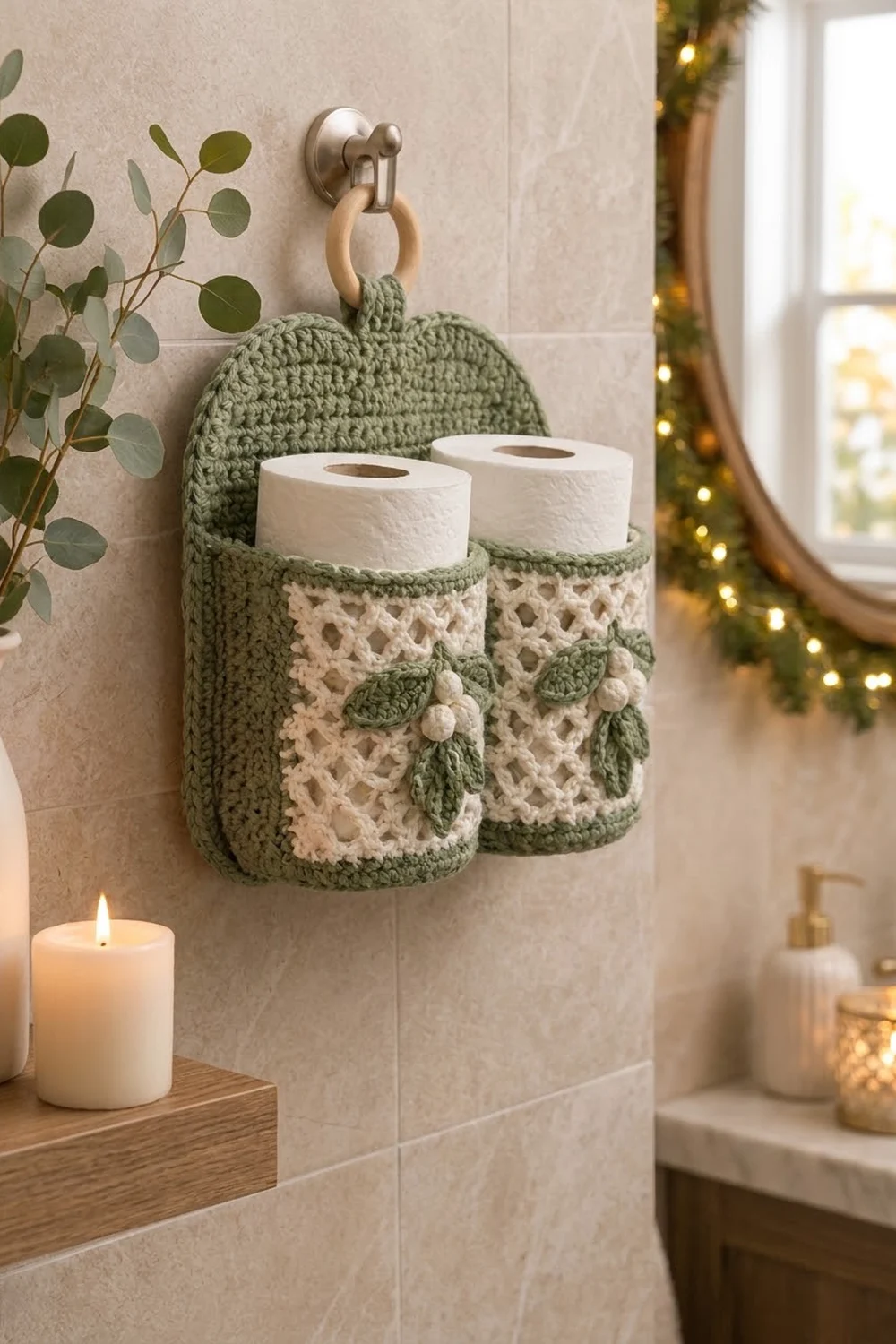
This wall-hanging toilet paper holder pairs a solid sage green back panel with two cream lattice pockets. Each pocket carries a little mistletoe sprig of four green leaves and three round cream berries. A short green tab and a natural wooden ring let it hang from a towel hook, and each pocket holds one standard roll.
The colors are seasonal but quiet: sage green, warm cream, and the honey tone of the wooden ring. You can see the roll through the open mesh, and the green edging on each pocket gives the lattice a clean frame.
The pattern uses US crochet terms. The finished holder measures 14 in (35.6 cm) wide and 14 in (35.6 cm) tall at the humps, not counting the hanging tab and ring.
Construction is simple:
- Work a shaped back panel in rows of single crochet.
- Make two flat mesh pockets with green edging.
- Add a gusset strip to each pocket so it has room for a roll.
- Sew the pockets on.
- Finish with the appliqués, a border, and the tab.
Finished Size and Construction
- Finished size: 14 in x 14 in (35.6 cm x 35.6 cm), plus the tab and ring
- Skill level: Intermediate
- Terminology: US
- Yarn weight: Worsted (#4)
- Hook: 5.0 mm (H-8)
- Number of pieces: 1 back panel, 2 pockets, 2 gussets, 1 tab, 8 leaves, 6 berries
- Layout: 2 pockets side by side across the lower part of the back panel
- Pocket size: 6.25 in x 7.75 in (15.9 cm x 19.7 cm) with edging
- Back panel before border: 13 in x 13 in (33.0 cm x 33.0 cm)
- Border depth: 0.5 in (1.3 cm) per side
Materials
Choose a smooth worsted cotton or cotton blend. Cotton keeps the mesh crisp and holds its shape in a humid bathroom. Acrylic also works, but the pockets will be a little softer.
- Sage green: 160 g (about 290 m)
- Cream: 60 g (about 110 m)
- 5.0 mm (H-8) crochet hook
- 1 wooden ring, 2 in (5.1 cm) across
- Tapestry needle
- Stitch markers
- Rust-proof pins
- A small amount of fiberfill or cream yarn scraps for the berries
These amounts include about 15 percent extra for swatching and sewing.
Abbreviations (US Terms)
- ch – chain
- sl st – slip stitch
- sc – single crochet
- hdc – half double crochet
- dc – double crochet
- sc2tog – single crochet 2 together
- sp – space
- st(s) – stitch(es)
- rnd – round
- rev sc – reverse single crochet
Special stitch – rev sc (crab stitch): Work from left to right (if you are right-handed). Insert the hook in the next st to the right, yo, pull up a loop, yo, pull through both loops. This makes the rolled, corded edge on the back panel.
Gauge and Checkpoints
Gauge: 16 sc and 18 rows = 4 in (10.2 cm) with a 5.0 mm hook.
Make one pocket first. It is the best swatch because it has both sc and mesh.
- After Row 1 of the pocket: 5.25 in (13.3 cm) wide.
- After Row 12 of the pocket: 6.5 in (16.5 cm) tall.
- After Row 13: 5.25 in x 6.75 in (13.3 cm x 17.1 cm).
- After the pocket edging: 6.25 in x 7.75 in (15.9 cm x 19.7 cm).
If your pocket is too big, use a hook 0.5 mm smaller. If it is too small, use one 0.5 mm larger. Use the same hook for every piece so the gussets and back panel match the pockets.

Back Panel
Use sage green. The ch 1 at the start of each row does not count as a st.
Row 1: Ch 47, sc in 2nd ch from hook and in each ch across, turn. (46 sc)
Row 2: Ch 1, 2 sc in first st, sc in each st to last st, 2 sc in last st, turn. (48 sc)
Row 3: Repeat Row 2. (50 sc)
Row 4: Repeat Row 2. (52 sc)
These three increase rows round off the bottom corners.
Checkpoint: the panel is 13 in (33.0 cm) wide.
Rows 5–52: Ch 1, sc in each st across, turn. (52 sc)
Checkpoint: the panel is about 11.5 in (29.2 cm) tall.
Top Humps
The top splits into two humps. The V where they meet becomes the center dip for the tab.
First hump, Row 53: Ch 1, sc2tog, sc in next 22 sts, sc2tog, turn. (24 sc, worked over the first 26 sts of Row 52)
Rows 54–58: Ch 1, sc2tog, sc to last 2 sts, sc2tog, turn. (22, 20, 18, 16, 14 sc)
Fasten off.
Second hump: Join green in the next unworked st of Row 52 (st 27). Work Rows 53–58 the same way over the remaining 26 sts. Fasten off.
Checkpoint: the panel measures 13 in (33.0 cm) wide and 13 in (33.0 cm) tall at the humps.
Pockets (Make 2)
Mesh Panel
Use cream.
Row 1: Ch 22, sc in 2nd ch from hook and in each ch across, turn. (21 sc)
Row 2: Ch 1, sc in first st, ch 5, skip 3 sts, sc in next st; repeat from * 4 more times, turn. (5 ch-5 loops, 6 sc)
Row 3 (offset row): Ch 5 (counts as dc + ch 2), sc in first ch-5 sp, ch 5, sc in next ch-5 sp; repeat from * 3 more times, ch 2, dc in last sc, turn. (4 full loops plus 2 half loops)
Row 4 (full row): Ch 1, sc in first dc, ch 5, sc in next ch-5 sp; repeat from * 3 more times, ch 5, sc in 3rd ch of turning ch, turn. (5 ch-5 loops, 6 sc)
Rows 5–12: Repeat Rows 3 and 4 four more times. Row 12 is a full row.
Checkpoint: 6.5 in (16.5 cm) tall.
Row 13 (conversion row): Ch 1, sc in first sc, 3 sc in next ch-5 sp, sc in next sc; repeat from * 4 more times. (21 sc = 6 sc worked one in each existing sc + 15 sc added in the loops)
Fasten off. The mesh panel is 5.25 in x 6.75 in (13.3 cm x 17.1 cm).
Pocket Edging
Use sage green. In each 3-sc corner, the center sc is the corner st.
Rnd 1: Join in the first st of Row 13. Work around the panel:
- 3 sc in first st, sc in next 19 sts, 3 sc in last st.
- Work 26 sc evenly down the row ends.
- 3 sc in the first foundation ch, sc in next 19 ch, 3 sc in last ch.
- Work 26 sc evenly up the other side.
Join with sl st. (102 sc)
Per side, counting both corner sts: 23 sc each on the top and bottom, 30 sc on each side. Check: 23 + 30 + 23 + 30 − 4 shared corners = 102.
Rnd 2: Ch 1, sc in each st around, working 3 sc in each corner st. Join. (110 sc)
Per side: 25 sc on the top and bottom, 32 sc on each side. Check: 25 + 32 + 25 + 32 − 4 = 110.
Fasten off. Pocket: 6.25 in x 7.75 in (15.9 cm x 19.7 cm).
Gusset (Make 2)
The gusset wraps around the sides and bottom of the pocket, so the pocket is deep enough for a roll.
It covers the pocket edge from one top corner, down the side, across the bottom, and up the other side: 32 + 25 + 32 − 2 shared corners = 87 sts.
Row 1: With sage green, ch 88, sc in 2nd ch from hook and in each ch across, turn. (87 sc)
Rows 2–10: Ch 1, sc in each st across, turn. (87 sc)
Fasten off. The gusset is 21.75 in (55.2 cm) long and about 2.25 in (5.7 cm) deep.
Appliqués
Leaves (Make 8)
Use sage green.
Ch 8. Sc in 2nd ch from hook, hdc in next ch, dc in next 3 ch, hdc in next ch, sc in last ch, ch 2 for the tip. Working along the other side of the foundation ch, sc in first ch, hdc in next ch, dc in next 3 ch, hdc in next ch, sc in last ch, sl st to the first sc. (14 sts plus ch-2 tip)
Leave a 10 in (25.4 cm) tail. Each leaf is about 1.75 in (4.4 cm) long.
Berries (Make 6)
Use cream.
Rnd 1: 6 sc in a magic ring. (6 sc)
Rnd 2: 2 sc in each st. (12 sc)
Rnd 3: Sc in each st. (12 sc)
Rnd 4: Sc2tog 6 times. (6 sc)
Stuff firmly, close the hole, and leave a tail. Each berry is about 0.75 in (1.9 cm) across.
Make All Pieces
| Piece | Color | Quantity |
|---|---|---|
| Back panel | Sage green | 1 |
| Pocket mesh panel | Cream, with sage green edging | 2 |
| Gusset | Sage green | 2 |
| Tab | Sage green | 1 |
| Leaf | Sage green | 8 |
| Berry | Cream | 6 |
Tab: With sage green, ch 7, sc in 2nd ch from hook and in each ch across. (6 sc) Work 13 more rows of 6 sc. (14 rows, about 3 in / 7.6 cm long) Fasten off.
Layout on the back panel (front view):
   ___ hump ___  tab  ___ hump ___
  |                                |
  |   back panel, sage green       |
  |  +-------------+-------------+ |
  |  |  pocket 1   |  pocket 2   | |
  |  | leaf   leaf | leaf   leaf | |
  |  |   o o o     |   o o o     | |
  |  | leaf   leaf | leaf   leaf | |
  |  +-------------+-------------+ |
  |________________________________|
Joining
Appliqués to Pockets
Do this before you sew the pockets to the panel.
On each pocket:
- Center the 3 berries in a triangle about 3.5 in (8.9 cm) above the bottom edge.
- Place 2 leaves above the berries, tips angled up and out.
- Place 2 leaves below the berries, tips pointing down and slightly apart.
- Embroider a short green chain-stitch stem from the berries down between the lower leaves.
Sew each piece through the solid sts and the mesh bars. Never sew across an open loop, or the appliqué will sag.
Gussets to Pockets
Hold a gusset along the pocket edge, wrong sides together. Start at the top-left corner st of the pocket.
Whipstitch through the back loops, joining 1 gusset st to 1 pocket st: 32 sts down the side, 25 across the bottom, and 32 up the other side. Each bottom corner st is counted only once, so the totals match: 87 = 87.
Pockets to Back Panel
Mark two outlines on the panel where the pockets will sit, each 6.25 in x 7.75 in (15.9 cm x 19.7 cm). Place them side by side with no gap between them. Center them across the panel width, with their bottom edge 0.75 in (1.9 cm) above the panel’s bottom edge.
The pocket tops will then sit 8.5 in (21.6 cm) above the bottom edge. That leaves 4.5 in (11.4 cm) of green panel showing above them, up to the humps.
Pin the free long edge of each gusset to its outline.
- Bottom: Sew 1 gusset st to each panel st (25 sts).
- Sides: The 32 gusset sts cover about 35 panel rows, so skip 1 panel row after every 10 or 11 sts.
Keep the tension snug but not tight. The panel should stay flat, with no puckering behind the pockets.
Checkpoint: each pocket opening measures 6.25 in (15.9 cm) across the front, and the panel still measures 13 in (33.0 cm) wide.
Border
Border gauge: 4 sc per 1 in (2.5 cm) along stitches, and about 7 sc per 8 rows along row ends.
Rnd 1: With sage green, join in the first foundation ch at the bottom right. Work as follows:
- Bottom: 1 sc in each foundation ch (46 sc).
- Each long side: 5 sc along the curved row ends of Rows 1–4, plus 42 sc along the straight row ends of Rows 5–52 (47 sc).
- Each hump: 7 sc along the outer row ends, then 16 sc across the top (2 sc in the first st, sc in the next 12 sts, 2 sc in the last st), then 6 sc along the inner row ends (29 sc).
- Center dip: 1 sc2tog worked over the last inner row end of the first hump and the first inner row end of the second hump (1 st).
Join with sl st. (46 + 47 + 47 + 29 + 29 + 1 = 199 sc)
Rnd 2: Ch 1, rev sc in each st around. Join and fasten off. (199 rev sc)
Why the math works:
- The bottom has 46 sts at 4 sc per in, so it lies flat.
- The 48 straight side rows call for 48 x 16 ÷ 18 = 42.7 sts by gauge. Working 42 sc keeps the sides flat without flaring.
- The 2 increases at each hump top help the border follow the curve.
- The sc2tog keeps the center dip crisp instead of letting it stretch open.
- The two rounds add 0.5 in (1.3 cm) per side, taking the panel from 13 in (33.0 cm) to 14 in (35.6 cm).
Tab: Fold the tab through the wooden ring. Sew both ends to the wrong side of the center dip so the ring sits about 1.5 in (3.8 cm) above the dip.
Final Blocking
- Lightly mist the whole holder with water.
- Lay it flat, right side up, on a blocking mat.
- Pin the back panel to 14 in x 14 in (35.6 cm x 35.6 cm), making the two humps match.
- Gently open the mesh with your fingers so the diamonds are even.
- Shape the leaves to points and roll the berries round.
- Let it dry completely, for at least 24 hours.
- While it is still slightly damp, put a roll in each pocket to set the pocket shape.
Final Quality-Control Checklist
- The back panel measures 14 in x 14 in (35.6 cm x 35.6 cm) with the border.
- Each pocket measures 6.25 in x 7.75 in (15.9 cm x 19.7 cm).
- Each pocket edging has 110 sts and crisp corners.
- Each gusset has 87 sts, and all 87 are joined.
- The two mistletoe sprigs are placed the same way on both pockets.
- The berries are firm and sewn on securely.
- The tab is sewn through several layers and holds the ring without stretching.
- All yarn tails are woven in on the wrong side.
Troubleshooting
- Mesh is wider than the sc rows: Shorten the loops to ch 4, or use a smaller hook for the mesh rows only.
- Pocket edging ruffles: There are too many sts along the row ends. Rip back and work exactly 26 per side.
- Pocket edging cups: Check that you are working 3 sc in each corner.
- Gusset is too short: Recount the gusset and the pocket edge. Both should have 87 sts.
- Back panel puckers behind the pockets: Loosen the whipstitch, or skip a panel row now and then along the sides.
- Humps look uneven: Count the sts in each hump row. The two halves must match exactly.
- Roll falls through the mesh: Check that every mesh row is complete. A deeper gusset also helps.
Care
Hand wash in cool water and lay flat to dry. While it is damp, reshape each pocket with a roll inside.
Final Notes
Each pocket starts as a 21-st mesh panel measuring 5.25 in x 6.75 in (13.3 cm x 17.1 cm). The edging brings it to 6.25 in x 7.75 in (15.9 cm x 19.7 cm), and its 87-st gusset matches the 87 edge sts exactly.
The 52-st back panel measures 13 in (33.0 cm) square before the border and 14 in (35.6 cm) after it. The two pockets sit side by side on it, each with a mistletoe sprig, and the holder hangs from a wooden ring.
Happy crocheting!