

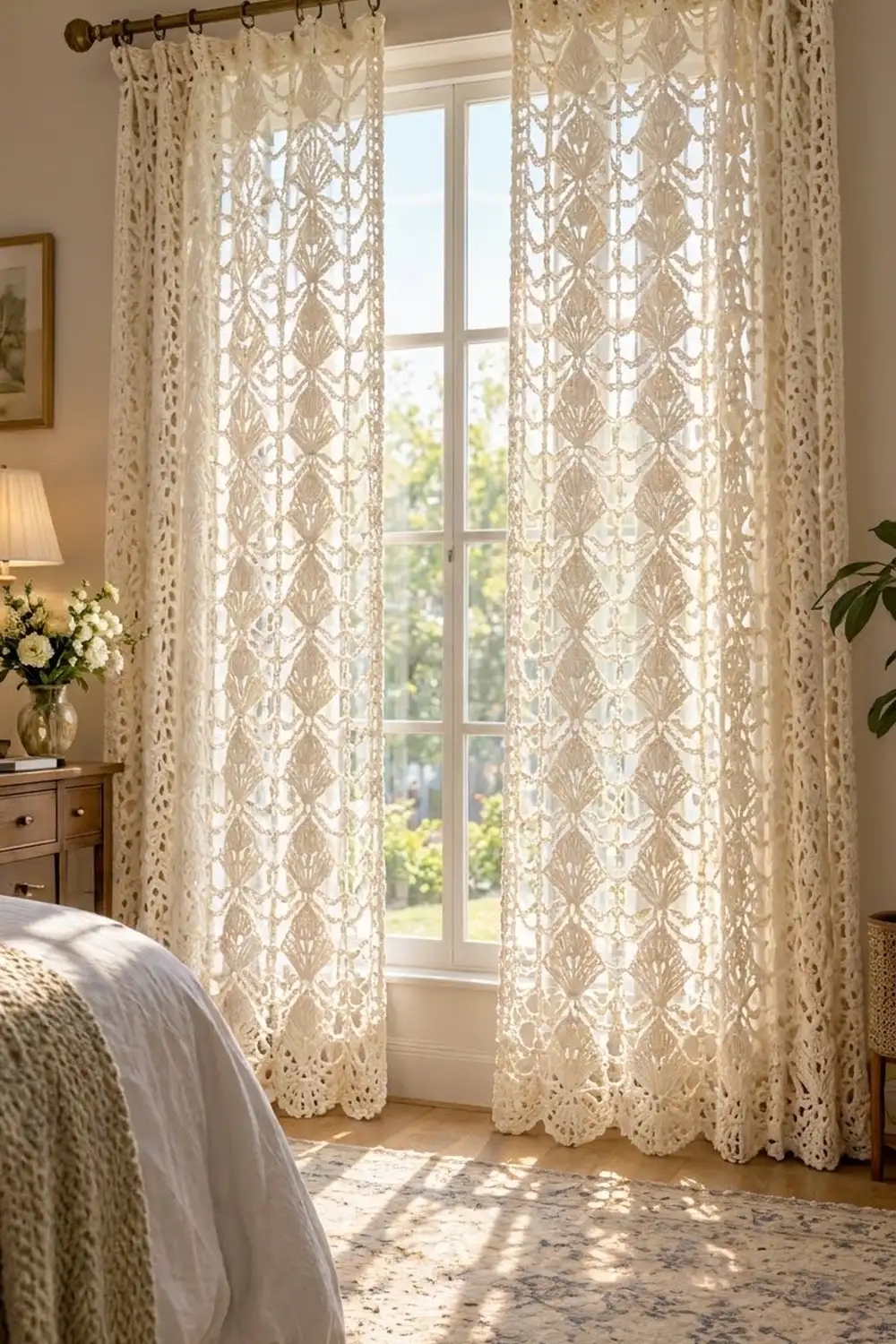
The Morning Fan Lace Curtains are a pair of floor-length panels in soft ivory cotton. Columns of fan motifs climb from hem to rod. Each fan opens upward, gets a crown of small chain arches, then closes into a point where the next fan begins. When light comes through the window, the open lace throws gentle patterned shadows across the room.
Each panel is a single color and a single piece. Narrow V-stitch spines run between the fan columns and keep the lace straight and orderly. A scalloped shell hem sits at the bottom, with one rounded scallop under each fan column. A firm band at the top grips the clip rings.
This pattern uses US crochet terms. Each finished panel measures 31 in (78.7 cm) wide by 84 in (213.4 cm) long, including the border. The pattern makes two identical panels.
You work each panel bottom-up. Start with a single crochet foundation row, then work the fan lace in a 4-row repeat and finish with a leveling row. After that, add a border around the panel, a scalloped hem along the bottom, and a hanging band across the top.
Finished Size and Construction
- Finished size (each panel): 31 in × 84 in (78.7 cm × 213.4 cm)
- Skill level: Intermediate
- Terminology: US crochet terms
- Yarn weight: #3 Light (DK) cotton
- Hook: 4.0 mm (G-6)
- Number of pieces: 2 separate panels, each worked in one piece and not joined
- Layout: one panel on each side of the window
- Lace body size (before border): 30 in × 81 in (76.2 cm × 205.7 cm)
- Border depth: 0.5 in (1.3 cm) at the sides, 1.5 in (3.8 cm) at the bottom (scallops), 1.5 in (3.8 cm) at the top (hanging band)
Materials
Yarn: Use a smooth, mercerized or combed cotton in DK weight. Cotton holds the lace shape, blocks crisply, and washes well. Avoid fuzzy or very stretchy yarns, because they blur the fans and can make the panels grow in length as they hang.
- Ivory/cream: 750 g (about 1,650 m) per panel, so 1,500 g (about 3,300 m) for the pair. This assumes about 110 m per 50 g.
These quantities include a margin of roughly 10% for your gauge swatch and blocking adjustments. Buy all the yarn from one dye lot.
Tools:
– 4.0 mm (G-6) crochet hook
– Tapestry needle
– Stitch markers (10 or more)
– Tape measure
– Rust-proof pins and clean sheets or towels for blocking
– 18 curtain clip rings (9 per panel)
Abbreviations (US Terms)
- ch – chain
- sl st – slip stitch
- sc – single crochet
- hdc – half double crochet
- dc – double crochet
- sk – skip
- sp – space
- st(s) – stitch(es)
- RS / WS – right side / wrong side
- rep – repeat
Special stitches:
– V-st (V): (dc, ch 1, dc) in the stitch or space indicated. A V counts as 3 sts.
– Edge V: ch 4 (counts as dc and ch 1), dc in the stitch or space indicated. This also counts as 3 sts.
– Fan: 7 dc in the stitch indicated.
Stitch counting: In this pattern every chain counts as a stitch. For example, “ch 3” adds 3 to the row total.
Gauge and Checkpoints
Gauge:
– 16 sc = 4 in (10.2 cm) in the foundation row
– One 12-st pattern repeat = 3 in (7.6 cm) wide
– One 4-row fan repeat (Rows 2–5) = 3.5 in (8.9 cm) tall
Test swatch: Ch 38, then work the foundation row (37 sc = 3 repeats + 1). Work Row 1, then Rows 2–5 twice. Block the swatch. It should measure 9 in (22.9 cm) wide by 8 in (20.3 cm) tall.
If your swatch is too big, go down one hook size. If it is too small, go up one hook size. Getting the width right matters most, because a too-narrow panel can’t be fixed later. If the width matches but the height is off, you can add or remove fan repeats.
Checkpoints for the panel (measured lightly stretched, as it will look after blocking):
– After the foundation row: 30 in (76.2 cm) wide
– After Row 1: 1 in (2.5 cm) tall
– After Row 41 (10 fan repeats): 36 in (91.4 cm) tall
– After Row 89 (22 fan repeats): 78 in (198.1 cm) tall
– After Row 93 (lace body complete): 81 in (205.7 cm) tall
– After the border: 31 in × 84 in (78.7 cm × 213.4 cm)
Lace Panel Pattern
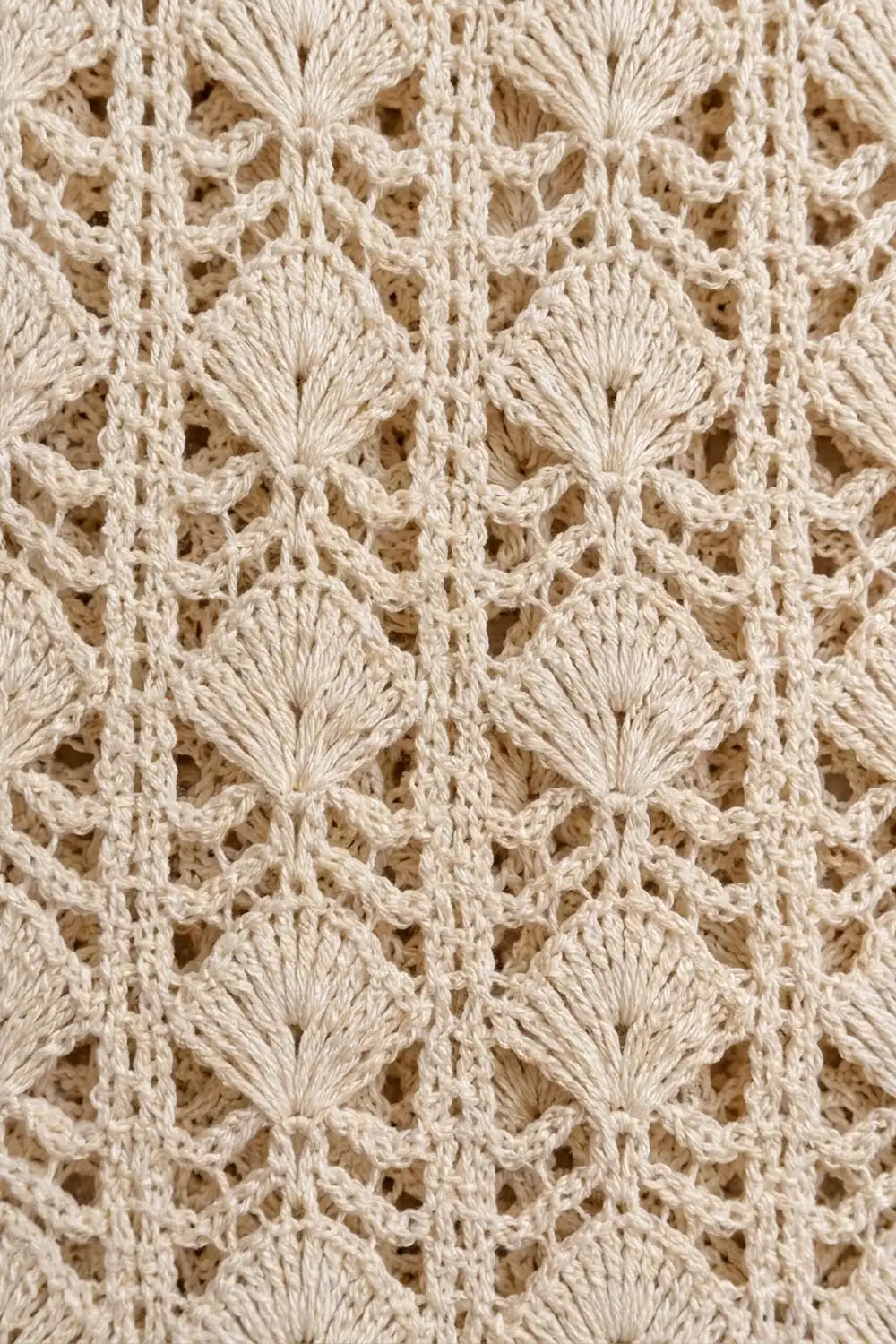
The panel has 10 fan columns. The stitch multiple is 12 + 1.
Foundation Row (WS): Ch 122. Sc in the 2nd ch from the hook and in each ch across. Turn. (121 sc)
Row 1 (RS): Edge V in the first sc. Ch 3, sk next 5 sc, fan in next sc, ch 3, sk next 5 sc, V in next sc. Rep from * 9 more times. Turn.
(163 sts: 3 for the edge V + 16 per repeat × 10)
The last V of the row lands in the last sc. Each fan sits in the 7th stitch of its 12-stitch section, which is the center of that fan column.
Row 2 (WS) – open the fans: Edge V in the ch-1 sp of the first V. Ch 3, sk ch-3 sp, dc in the first dc of the fan, (ch 1, dc in next dc) 6 times, ch 3, sk ch-3 sp, V in the ch-1 sp of next V. Rep from * 9 more times. The final V goes into the turning-chain space of the edge V. Turn.
(223 sts: 3 + 22 per repeat × 10)
Each fan now has 7 dc with 6 ch-1 sps between them, so it spreads into an open fan shape.
Row 3 (RS) – arch crown: Edge V in the first V’s ch-1 sp. Ch 4, sk ch-3 sp, sc in the first ch-1 sp of the fan, (ch 3, sc in next ch-1 sp) 5 times, ch 4, sk ch-3 sp, V in next V’s ch-1 sp. Rep from * 9 more times. Turn.
(323 sts: 3 + 32 per repeat × 10)
Each fan is now topped by 5 small ch-3 arches.
Row 4 (WS) – close the diamond: Edge V in the first V’s ch-1 sp. Ch 6, sk the ch-4 sp and the first 2 ch-3 sps, sc in the center (3rd) ch-3 sp, ch 6, sk the remaining 2 ch-3 sps and the ch-4 sp, V in next V’s ch-1 sp. Rep from * 9 more times. Turn.
(163 sts: 3 + 16 per repeat × 10)
The two long ch-6 arches pull the top of each fan into a point. Together with the fan below, they form the diamond outline.
Row 5 (RS) – new fan: Edge V in the first V’s ch-1 sp. Ch 3, sk ch-6 sp, fan in next sc, ch 3, sk ch-6 sp, V in next V’s ch-1 sp. Rep from * 9 more times. Turn.
(163 sts: 3 + 16 per repeat × 10)
The new fan comes out of the point of the diamond, so the motifs stack in a continuous column. Row 5 has the same structure and count as Row 1.
Rows 6–89: Rep Rows 2–5 another 21 times, for 22 fan repeats in total. Row 89 is a RS fan row with 163 sts.
Rows 90–92: Work Rows 2, 3, and 4 once more. This gives counts of 223, 323, and 163 sts.
Row 93 (RS) – leveling row: Ch 1. Sc in the first dc, sc in the ch-1 sp, sc in the next dc (3 sc over the edge V). 4 sc in the ch-6 sp, sc in the sc, 4 sc in the next ch-6 sp, then sc in the dc, sc in the ch-1 sp, and sc in the 3rd ch of the turning chain or in the dc of the next V. Rep from * 9 more times. Fasten off.
(123 sc: 3 + 12 per repeat × 10)
Working only 4 sc into each ch-6 arch keeps the top edge almost the same width as the 121-st foundation, so the top won’t flare. The lace body should now measure 30 in × 81 in (76.2 cm × 205.7 cm).
Make Both Panels
Work a second panel exactly like the first, matching the row count (93 rows plus the foundation) and the checkpoint measurements.
- Ivory/cream: 2 panels × 750 g = 1,500 g (about 3,300 m)
Layout at the window:
| Panel A |  window  | Panel B |
| 31 in   |          | 31 in   |
| 78.7 cm |          | 78.7 cm |
The panels are not joined. Each one hangs from its own 9 clip rings.
Border
Border gauge: At the top and bottom, work 1 sc in each stitch. Along the sides, work 3 sc into the end of each dc-height row (Rows 1–92) and 1 sc into the end of each sc row (the foundation row and Row 93). That works out to about 3.4 sc per 1 in (2.5 cm) of side edge, which keeps the sides flat without ruffling or pulling in.
The ch-2 corner spaces do not count as stitches. The per-side counts below are the stitches between the corner spaces.
Round 1 (RS): Join the yarn in the first sc of Row 93 at the top right corner.
– Top: sc in each of the 123 sts, then ch 2 at the corner.
– Left side: 278 sc (276 sc over Rows 92–1 + 1 sc over Row 93 + 1 sc over the foundation row), then ch 2.
– Bottom: sc in each of the 121 free loops of the foundation chain, then ch 2.
– Right side: 278 sc, then ch 2. Join with a sl st to the first sc.
Per side: top 123, sides 278 each, bottom 121. Total 800 sc + 4 ch-2 corner sps.
Round 2 (RS): Ch 1. Work (sc, ch 2, sc) in each ch-2 corner sp.
– Top: sc in each st = 123 + 2 corner sc = 125
– Sides: sc in each st = 278 + 2 corner sc = 280 each
– Bottom scallops: sc in the first sc, sk 5 sc, 11 dc in next sc, sk 5 sc, sc in next sc. Rep from * 9 more times. This makes 11 sc + 110 dc = 121 sts, plus 2 corner sc = 123.
Join with a sl st and fasten off.
Row 3 (bottom edge only, RS): Join the yarn with a sl st in the first sc of the scallop section, which is the sc right after the corner sc. Sc in next 5 dc, (sc, ch 3, sc) in next dc, sc in next 5 dc, sl st in next sc. Rep from * 9 more times. Fasten off.
(161 sts: 1 sl st + 16 per scallop × 10)
Top band, Rows 1–4: With RS facing, join the yarn in the top right corner sc.
– Row 1: Ch 2 (does not count), hdc in each of the 125 top sts. Turn. (125 hdc)
– Rows 2–4: Ch 2, hdc in each hdc across. Turn after each row. (125 hdc per row)
Fasten off after Row 4.
Why the math works:
– The 121-st foundation equals 10 repeats of 12 plus 1, so each 11-dc scallop lands in the same stitch (the 7th of each 12) as the fan above it. Every scallop is centered under a fan column.
– At the top, the 125-st band sits on 123 leveling sts plus 2 corner sc, so it measures about 31 in (78.7 cm). That matches the bordered width.
– The two side rounds add 0.5 in (1.3 cm) on each side, so 30 in (76.2 cm) + 1 in (2.5 cm) = 31 in (78.7 cm).
– The length is 81 in (205.7 cm) of lace + 1.5 in (3.8 cm) of hem + 1.5 in (3.8 cm) of top band = 84 in (213.4 cm).
Final Blocking
- Weave in all ends along the V-st spines or into the solid band, where they will stay hidden.
- Soak the panel in cool water with a little wool wash or mild soap for 15 minutes.
- Gently press out the water. Don’t wring it. Roll the panel in towels to remove more moisture.
- Lay clean sheets on the floor or a bed and spread the panel flat, working one section at a time.
- Pin the sides straight at 31 in (78.7 cm) wide. Check this measurement every 12 in (30.5 cm) down the length.
- Open each fan and pin the tip of each bottom scallop and its center picot so the scallops are even.
- Let the panel dry completely. As an alternative, you can hang the damp panel on the rod and smooth it by hand. It may relax and lengthen by up to 1 in (2.5 cm).
- Clip 9 rings to the top band. Place the first and last rings 0.5 in (1.3 cm) from the edges and space the rest about 3.75 in (9.5 cm) apart.
Final Quality-Control Checklist
- Both panels measure 31 in × 84 in (78.7 cm × 213.4 cm), within 0.5 in (1.3 cm) of each other.
- Each panel has 10 straight fan columns and 23 stacked fans per column. The extra fan is the one from Row 1.
- The V-st spines run straight from hem to top without drifting.
- There are 10 scallops along the hem, each centered under a fan column.
- The side edges are flat, with no waves or pulled-in sections.
- The top band is firm, flat, and straight.
- All ends are woven in securely.
Troubleshooting
Fans lean to one side: You probably put the fan into the wrong sc in Row 4 or Row 5. Count the ch-3 sps in Row 3. There must be exactly 5 per fan, and the Row 4 sc goes into the 3rd one.
Row counts don’t match: Count each repeat separately, using 22, 32, 16, and 16 sts per repeat for Rows 2–5. Place a marker after every repeat to make this easier.
Side edges ruffle: Work 2 sc per row end along the sides instead of 3. Side edges pull in: Loosen your tension, or work 4 sc in every third row end.
Panel growing too long: Cotton relaxes as it hangs. Skip the last fan repeat, or block the panel flat instead of hanging it.
Scallops cup: Work the 11 dc more loosely, or block the scallops open with pins.
Care
Hand wash in cool water, or machine wash on a delicate cycle inside a mesh laundry bag. Reshape the panels and dry them flat or hang them while damp. Don’t tumble dry.
Final Notes
The measurement chain runs like this. A 121-st foundation at 30 in (76.2 cm) becomes 10 fan columns. Twenty-two 3.5 in (8.9 cm) fan repeats plus the starting and closing rows give 81 in (205.7 cm) of lace. The border then adds 1 in (2.5 cm) to the width and 3 in (7.6 cm) to the length, for a final size of 31 in × 84 in (78.7 cm × 213.4 cm) per panel. If you check your gauge against each checkpoint, both panels will hang evenly at your window.
Happy crocheting!