
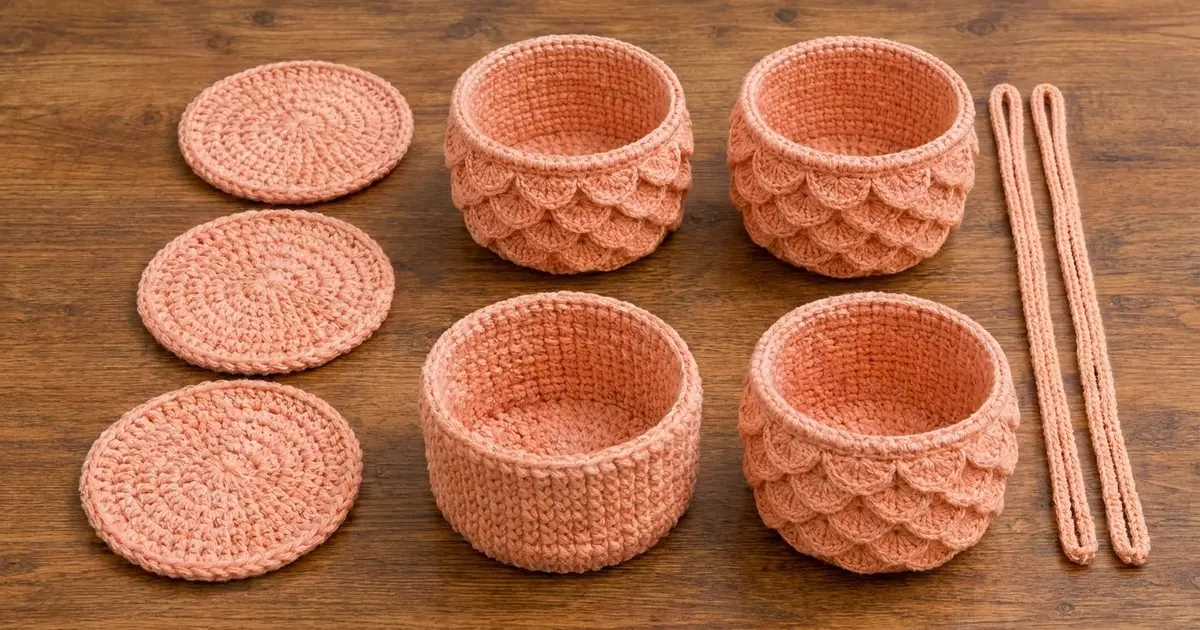
This hanging holder stacks three spare toilet rolls on the wall, so they’re out of the way but easy to reach. Each basket has a smooth, sturdy single-crochet wall covered with three tiers of overlapping scales. The scales are offset from one tier to the next, like fish scales.
The sample is made in one warm peach-salmon cotton. A single color shows off the scale texture, and cotton holds the basket’s shape better than acrylic. The pattern uses US crochet terms throughout.
Each basket measures 5.75 in (14.6 cm) across the wall and 3.75 in (9.5 cm) tall. Including the scales, it’s about 6.25 in (15.9 cm) across. Fully assembled, the holder hangs about 26.5 in (67.3 cm) from the peak to the bottom basket.
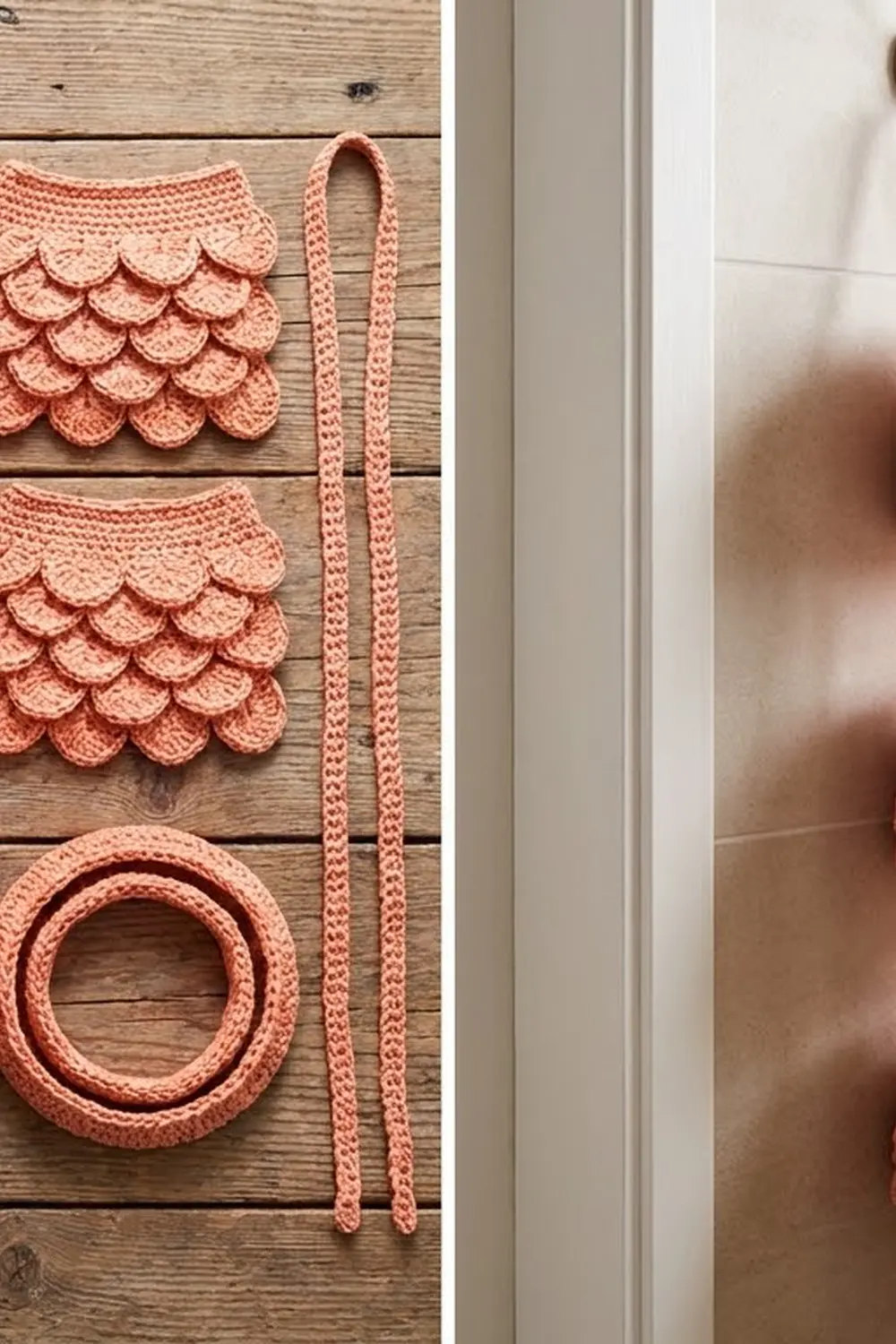
You make five pieces: three baskets and two cords. Each basket starts with a flat double-crochet base. A back-loop round turns it up into a single-crochet wall. Three back-loop rounds in the wall leave free front loops, and you work the scales into those loops at the end. The cords are sewn up opposite sides of the baskets, and their top ends overlap to form a hanging peak.
Finished Size and Construction
- Basket size: 5.75 in (14.6 cm) diameter × 3.75 in (9.5 cm) tall
- Size including scales: about 6.25 in (15.9 cm) across
- Overall hanging height: about 26.5 in (67.3 cm)
- Skill level: Intermediate
- Terminology: US
- Yarn weight: Worsted (#4) cotton
- Hook: 5.0 mm (US H-8)
- Number of pieces: 5 (3 baskets, 2 cords)
- Layout: 3 baskets in one vertical column, 2.5 in (6.4 cm) gaps between them
- Basket height before rim: 3.25 in (8.3 cm)
- Rim depth: about 0.5 in (1.3 cm)
Materials
Yarn: Use a smooth worsted-weight cotton or cotton blend. Its firm body keeps the walls upright and the scales crisp. Avoid fuzzy or very stretchy yarns, because the cords have to carry weight.
- Peach/salmon: 220 g, about 374 m (409 yd), based on 50 g = 85 m (93 yd)
- Each basket uses about 55 g and each cord about 12 g. These quantities include a margin of roughly 15%.
Tools:
– 5.0 mm (US H-8) crochet hook
– Tapestry needle
– 6 stitch markers
– Ruler or tape measure
– Scissors
– Rust-proof pins for blocking
Abbreviations (US Terms)
- ch – chain
- sl st – slip stitch
- sc – single crochet
- hdc – half double crochet
- dc – double crochet
- tr – treble crochet
- BLO – back loop only
- rev sc – reverse single crochet (crab stitch)
- st(s) – stitch(es)
- inc – 2 dc in the same stitch
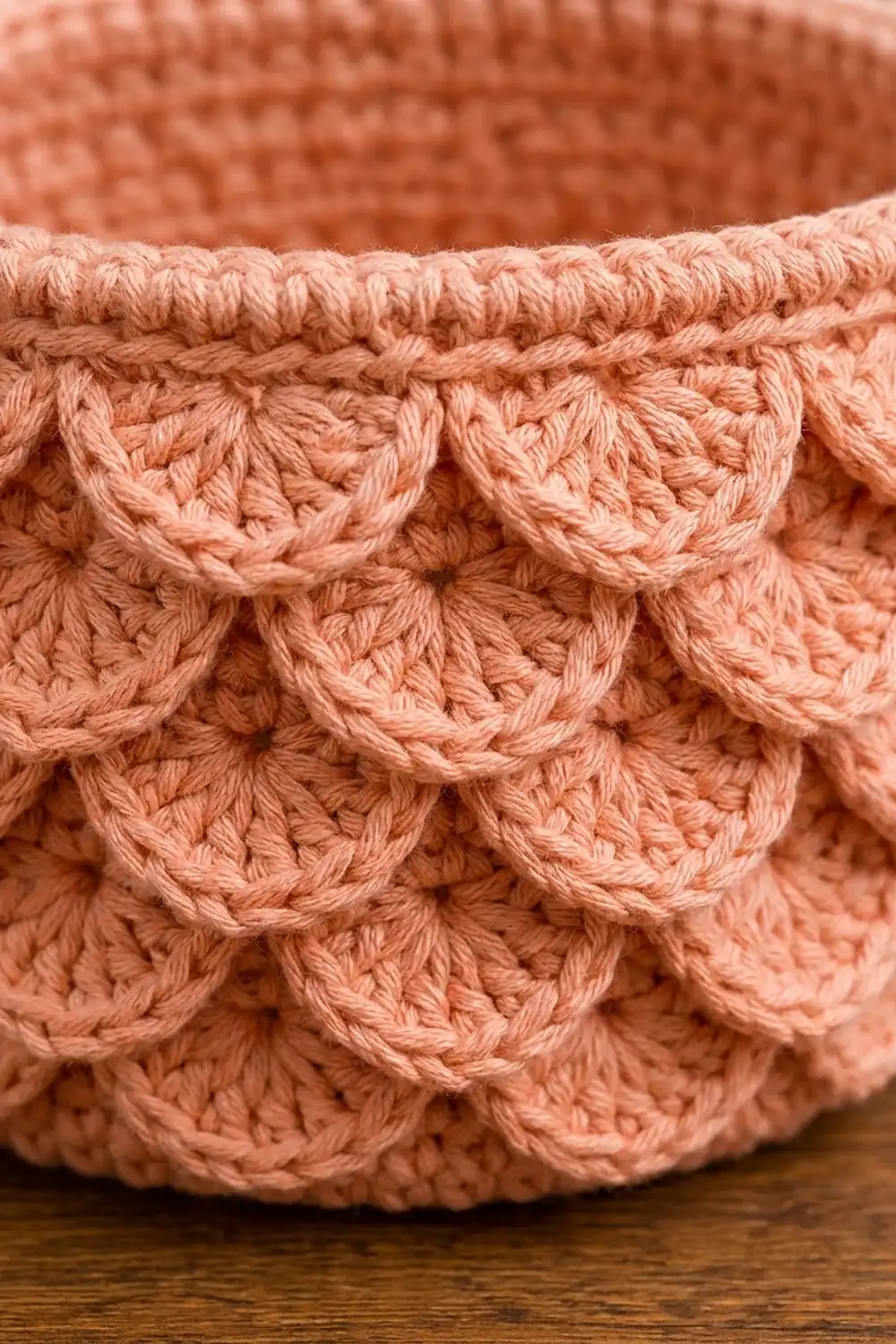
Special stitch – Scale: Work (hdc, dc, 2 tr, dc, hdc) all into one free front loop. That’s 6 stitches in a single loop, which makes a rounded fan.
Rev sc: Working left to right (for right-handers), insert the hook into the next stitch to the right, yarn over, pull up a loop, yarn over and pull through both loops.
Gauge and Checkpoints
Gauge: 16 sc × 18 rounds = 4 in (10.2 cm) in sc worked in joined rounds.
Make one complete basket before you start the others. It’s your real gauge swatch.
- After base Rnd 3: diameter 2.9 in (7.4 cm)
- After base Rnd 6: diameter 5.75 in (14.6 cm)
- After wall Rnd 13: wall is 1.5 in (3.8 cm) tall, measured from the ridge
- After wall Rnd 20: wall is 3.1 in (7.9 cm) tall from the ridge, and the total height is 3.25 in (8.3 cm)
- After rim: total height 3.75 in (9.5 cm)
If the base is too big: go down to a 4.5 mm hook. If it’s too small: go up to a 5.5 mm hook. If only the wall is off, change the hook for the wall rounds only.
A standard roll is about 4.5 in (11.4 cm) wide, so the basket’s inside must measure at least 4.75 in (12.1 cm).
Basket (Make 3)
Work in joined rounds and don’t turn. The ch 1 or ch 2 at the start of each round doesn’t count as a stitch. Work the first stitch into the same stitch as the join. Keep the join seam lined up, because it will be the back of the basket.
Base
Rnd 1: Make a magic ring, ch 2, then work 12 dc into the ring. Join with a sl st to the first dc. (12 sts)
Rnd 2: Ch 2, inc in each st around, join. (24 sts)
Rnd 3: Ch 2, dc in next st, inc in next st, repeat 12 times, join. (36 sts)
Checkpoint: 2.9 in (7.4 cm).
Rnd 4: Ch 2, dc in next 2 sts, inc, repeat 12 times, join. (48 sts)
Rnd 5: Ch 2, dc in next 3 sts, inc, repeat 12 times, join. (60 sts)
Rnd 6: Ch 2, dc in next 4 sts, inc, repeat 12 times, join. (72 sts)
Checkpoint: 5.75 in (14.6 cm). The base must lie flat. If it ruffles, your dc is too loose. If it cups, it’s too tight.
Wall
The wall stays at 72 sts the whole way up. Rounds 10, 14 and 18 are worked in BLO and leave a ring of free front loops for the scales.
Rnd 7: Ch 1, sc BLO in each st around, join. (72 sts) The wall now turns up from the base with a crisp ridge.
Rnds 8–9: Ch 1, sc in each st around, join. (72 sts)
Rnd 10 (scale tier 1 foundation): Ch 1, sc BLO in each st around, join. (72 sts; 72 free front loops)
Rnds 11–13: Ch 1, sc in each st, join. (72 sts)
Checkpoint: the wall is 1.5 in (3.8 cm) tall.
Rnd 14 (scale tier 2 foundation): Ch 1, sc BLO in each st, join. (72 sts; 72 free front loops)
Rnds 15–17: Ch 1, sc in each st, join. (72 sts)
Rnd 18 (scale tier 3 foundation): Ch 1, sc BLO in each st, join. (72 sts; 72 free front loops)
Rnds 19–20: Ch 1, sc in each st, join. (72 sts)
Checkpoint: the wall is 3.1 in (7.9 cm) tall from the ridge, and the basket is 3.25 in (8.3 cm) tall in total.
Go straight on to the Rim (see Border below), then come back for the scales.
Scales
Count the free front loops in each tier from the seam, starting with loop 1 and ending with loop 72.
Work the lowest tier first, so each higher tier lies over the top of the one below it. Hold the basket upside down (base on top) so the scales grow toward the base. When you turn the basket upright again, they hang downward.
Scale tier 1 (Rnd 10 loops): Join the yarn with a sl st in loop 1. Skip 2 loops, work a Scale in the next loop, skip 2 loops, sl st in the next loop. Repeat from * around. On the last repeat, finish with a sl st into the first sl st instead of a new loop. Fasten off.
Count: 12 Scales × 6 sts = 72 Scale sts, plus 12 sl sts, for 84 sts worked. The loop math works because 12 repeats × 6 loops = 72 loops. In this tier the Scales sit in loops 4, 10, 16 and so on, up to loop 70.
Scale tier 2 (Rnd 14 loops): Join in loop 4 and work the same repeat. Scales now land in loops 7, 13, 19 and so on, up to 67, and the last one goes in loop 1. Each tier 2 Scale sits centered between two tier 1 Scales. Count: 12 Scales, 84 sts worked.
Scale tier 3 (Rnd 18 loops): Join in loop 1 and work the same repeat as tier 1. Count: 12 Scales, 84 sts worked.
Each Scale is about 1.5 in (3.8 cm) wide and 0.9 in (2.3 cm) long. Tier 1 tips just reach the base edge. Each higher tier covers where the tier below is attached. Above tier 3, Rnds 19–22 form a smooth collar.
Cords (Make 2)
Foundation: Ch 113.
Row 1: Sc into the back bump of the 2nd ch from the hook and each ch across. (112 sc)
Row 2: Ch 1, turn, sl st BLO in each st across. (112 sts) Fasten off, leaving a 12 in (30.5 cm) tail for sewing.
Each cord is 28 in (71.1 cm) long and about 0.4 in (1.0 cm) wide. Checkpoint: 20 sc should measure 5 in (12.7 cm). Before assembly, gently stretch each cord and let it relax so it doesn’t stretch further once loaded.
Make All Pieces
- Baskets: 3, all in peach, about 55 g each
- Cords: 2, all in peach, about 12 g each
Layout grid (the front view):
            /\          peak: cord ends overlap 1 in (2.5 cm)
           /  \
       Cord A  Cord B   legs: 10.75 in (27.3 cm) each
         |  TOP   |     basket 3.75 in (9.5 cm)
         |  gap   |     2.5 in (6.4 cm)
         | MIDDLE |     basket 3.75 in (9.5 cm)
         |  gap   |     2.5 in (6.4 cm)
         | BOTTOM |     basket 3.75 in (9.5 cm)
Joining
Method: Whipstitch the cords to the outside of the baskets with the cord tails or a separate strand of the same yarn.
Placement: On each basket, put a marker in stitch 1 of the Rnd 7 ridge (at the seam) and another in stitch 37. These are exactly opposite each other: 72 ÷ 2 = 36 sts apart. Turn the seam so it faces the wall. Cord A goes on the left side and Cord B on the right.
Stitch-to-stitch logic:
1. Line up the bottom end of each cord with the Rnd 7 ridge of the bottom basket.
2. Run each cord straight up the basket to the rim. Tack it at Rnds 7, 10, 14, 18 and 22 by sewing through the cord, any Scale it crosses, and the wall behind it. Tacking at 5 points per side holds 3.75 in (9.5 cm) of cord.
3. Leave a free gap of 2.5 in (6.4 cm), then attach the middle basket the same way. Repeat for the top basket.
4. This uses 3 × 3.75 in + 2 × 2.5 in = 16.25 in (41.3 cm) of each cord.
5. Each cord has 28 − 16.25 = 11.75 in (29.8 cm) left over. That’s a 10.75 in (27.3 cm) leg plus a 1 in (2.5 cm) overlap. Overlap the two top ends by 1 in (2.5 cm) and sew them together firmly on all four edges to form the peak.
Tension: Sew firmly but don’t pucker the wall. Check that both cords hang straight and that the gaps match. Measure the gaps with the holder hanging, not lying flat.
Size checkpoint: Hung up with nothing in it, the holder should measure about 26.5 in (67.3 cm) from the peak to the bottom of the lowest basket.
Border (Rim)
Each basket gets its own rim. Since the baskets aren’t joined edge to edge, nothing is added at seams or corners. The rim count is simply that basket’s 72 wall stitches.
Rim gauge: The same as the wall, 16 sts = 4 in (10.2 cm). Rev sc adds a little bulk but no stitches.
Rnd 21: Ch 1, sc in each st around, join. (72 sts)
Rnd 22: Ch 1, rev sc in each st around, join. (72 sts) Fasten off and weave in the ends.
Why the math works: The wall’s 72 sts come from 12 increases per base round over 6 rounds (12 × 6 = 72). The rim keeps exactly 72 sts, so it doesn’t flare out or pull in. The rev sc rolls into a firm, rope-like edge that’s about 0.5 in (1.3 cm) deep with Rnd 21. That brings the basket from 3.25 in (8.3 cm) to 3.75 in (9.5 cm) tall.
Final Blocking
- Lightly mist each basket with water until it’s damp but not soaked.
- Stuff the basket with a toilet roll wrapped in a plastic bag so it keeps its round shape.
- Smooth each Scale down so it points toward the base and lies flat over the tier below.
- Press the base flat on a towel and check that it’s 5.75 in (14.6 cm) across.
- Pin each cord straight at 28 in (71.1 cm) and let it dry.
- Let everything dry completely, about 24 hours, before assembling.
Final Quality-Control Checklist
- Each base has 72 sts and measures 5.75 in (14.6 cm).
- The wall has 72 sts on every round, with no accidental increases.
- Each tier has 12 Scales, and tier 2 is offset from tiers 1 and 3.
- All three baskets are 3.75 in (9.5 cm) tall, give or take 0.25 in (0.6 cm).
- Both cords have 112 sts and measure 28 in (71.1 cm).
- The cords sit exactly opposite each other, at stitches 1 and 37.
- Both gaps measure 2.5 in (6.4 cm) when the holder is hanging.
- The peak overlap is securely sewn and all ends are woven in.
Troubleshooting
- The base cups or ruffles: Re-count Rnds 4–6. Each round must add exactly 12 sts.
- The wall slants outward: Your sc tension is loose. Go down a hook size for the wall.
- The Scales flip upward: You worked them with the basket upright. Block them face-down or rework the tier with the basket upside down.
- The Scales don’t overlap: Your rounds are short. Add one sc round between foundation rounds, keeping 72 sts.
- The holder tilts: The cord positions are uneven. Re-measure from the seam markers.
- The cords stretch over time: Pre-stretch them before sewing, or add a third row of sl st BLO.
- A roll won’t fit: The inside is under 4.75 in (12.1 cm). Remake the basket with a hook one size larger.
Care
Hand wash cold and lay flat to dry, reshaping the scales while damp. Don’t tumble dry, because heat can shrink cotton and weaken the cords.
Final Notes
The size of everything follows from your stitches. Gauge of 16 sc = 4 in (10.2 cm) gives a 72-st base that’s 5.75 in (14.6 cm) across. Fourteen wall rounds bring the basket to 3.25 in (8.3 cm), and the rim adds 0.5 in (1.3 cm) for a 3.75 in (9.5 cm) basket. Three baskets plus two 2.5 in (6.4 cm) gaps use 16.25 in (41.3 cm) of each 28 in (71.1 cm) cord. The remaining legs and overlap form the peak, for a holder about 26.5 in (67.3 cm) tall. If you check each step, the finished holder will come out the right size.
Happy crocheting!