

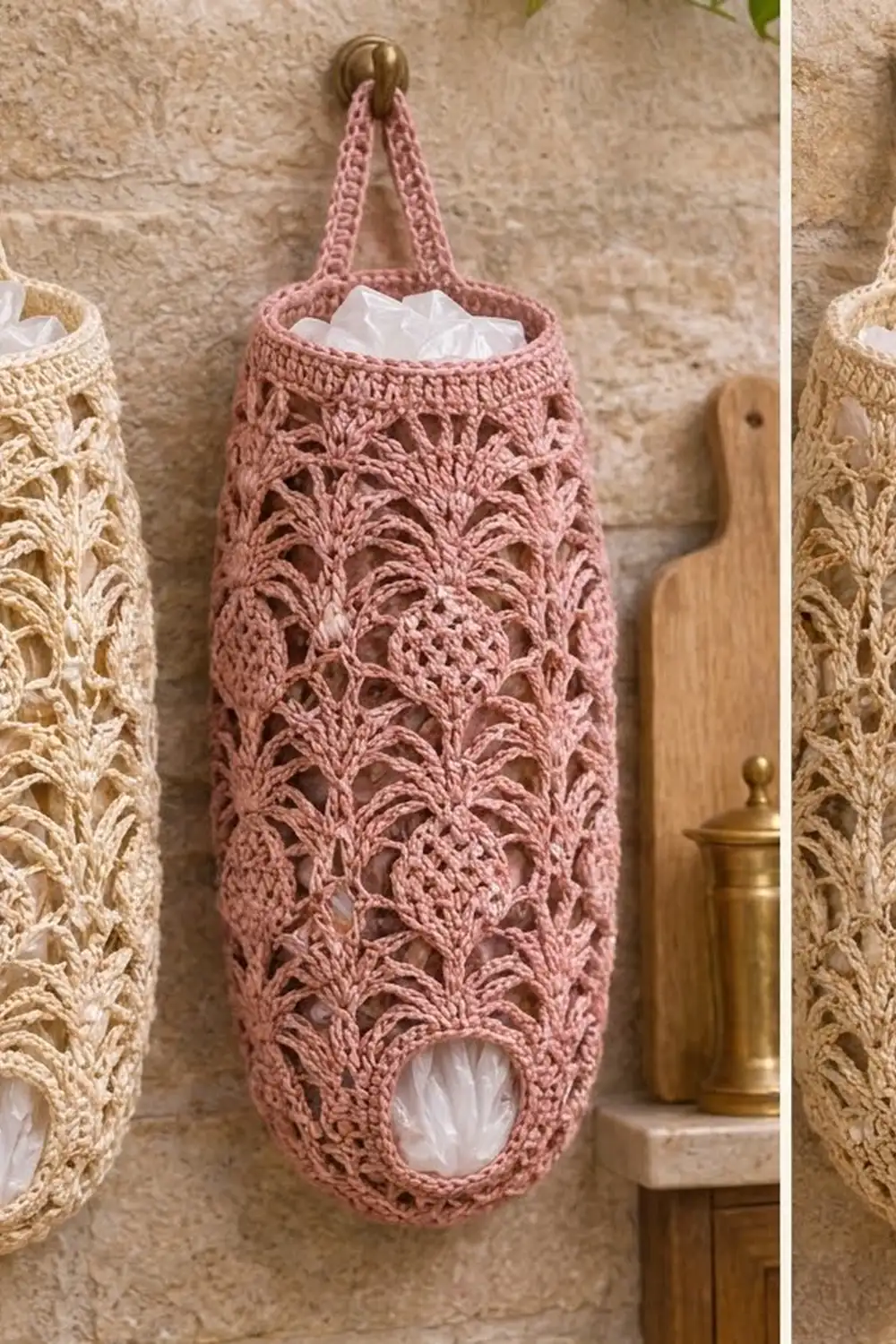
This Provence Pineapple plastic bag holder brings vintage lace into the kitchen. The body is covered in tiers of classic pineapples, separated by stacked shells. A neat oval base keeps the shape steady. You push bags in at the top and pull them out through a slot near the bottom.
The sample is in warm cream mercerized cotton. That colour suits stone walls, wood, and pale florals. Dusty rose works just as well, and the yardage is the same in any colour. The pattern uses US crochet terms throughout.
The holder measures about 7½ in (19.1 cm) wide when flat and about 15¼ in (38.7 cm) tall, not counting the handle. The handle is about 7 in (17.8 cm) long.
Construction is one seamless piece. You crochet an oval base in rounds, turn up the sides with a back-loop round, and leave a slot for the bags. Then you work four pineapple tiers, a solid top band, and finally a strap handle worked in rows and attached across the rim.
Finished Size and Construction
- Finished size: 7½ in (19.1 cm) wide when flat × 15¼ in (38.7 cm) tall, plus a 7 in (17.8 cm) handle
- Skill level: Intermediate
- Terminology: US crochet terms
- Yarn weight: DK (#3) mercerized cotton
- Hook: 3.5 mm (E-4)
- Number of pieces: 1 (worked in one piece; the handle is worked straight onto the rim)
- Layout: a single tube on an oval base; no motifs to join
- Base size: about 6¼ × 3 in (15.9 × 7.6 cm)
- Body circumference: 84 stitches, about 15¼ in (38.7 cm) around
- Size before top band: about 13½ in (34.3 cm) tall
- Top band depth: about 1¾ in (4.4 cm)
Materials
Yarn advice: Use a smooth, mercerized DK cotton or cotton blend. It shows the lace clearly, holds its shape, and doesn’t get fuzzy when bags rub against it. Avoid acrylic, which stretches and sags with weight.
- Cream (main colour): 120 g, about 270 m (295 yd)
- Optional variation, dusty rose: the same 120 g, about 270 m (295 yd), used in place of cream
Tools:
– 3.5 mm (E-4) crochet hook
– Tapestry needle
– 4 locking stitch markers
– Scissors
– Measuring tape
– Blocking form: a rolled towel or a 2 L bottle wrapped in a towel
– Spray bottle
Yarn quantities include a margin of about 15% for your gauge swatch and small tension differences.
Abbreviations (US Terms)
- ch – chain
- sl st – slip stitch
- sc – single crochet
- dc – double crochet
- dc2tog – double crochet 2 together
- BLO – back loop only
- sk – skip
- sp – space
- st(s) – stitch(es)
- rep – repeat
Special stitches:
– 2-dc shell: (2 dc, ch 2, 2 dc) in the stitch or space given.
– 3-dc shell: (3 dc, ch 2, 3 dc) in the stitch or space given.
Notes: In the base and solid rounds, the beginning ch 2 does not count as a stitch. In the lace rounds, the beginning ch 3 counts as the first dc. Join every round with a sl st and don’t turn.
Gauge and Checkpoints
Gauge: 22 dc and 11 rounds = 4 in (10.2 cm) in dc worked in the round.
Test one piece first. Work the base (Rounds 1–4) and measure it before going on. The base is a reliable gauge swatch.
Checkpoints:
– After Base Round 4: about 6¼ × 3 in (15.9 × 7.6 cm), with 84 sts.
– After Side Round 4: the sides stand about 1½ in (3.8 cm) tall.
– After each pineapple tier: each tier adds about 3 in (7.6 cm) once lightly stretched.
– After Tier 4: the body is about 13½ in (34.3 cm) from the base.
– After the top band: about 15¼ in (38.7 cm) total.
If the base is too big, go down a half size (3.25 mm). If it is too small, go up to 3.75 mm. Don’t change the stitch counts, because the pineapple repeat needs exactly 84 sts.
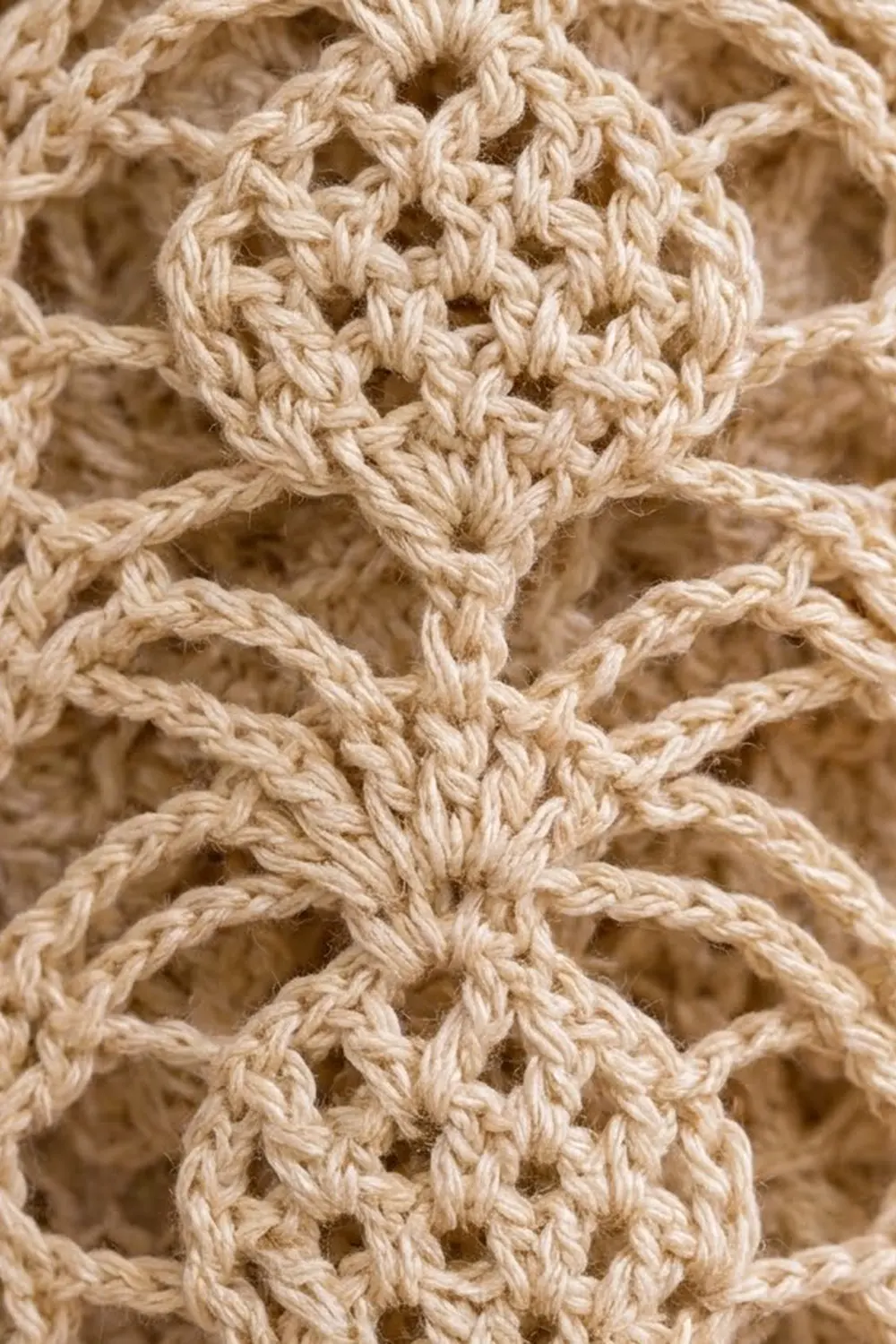
Oval Base
Ch 22.
Round 1: Work 6 dc in the 3rd ch from the hook. Dc in each of the next 18 ch, then 6 dc in the last ch. Rotate and work along the free loops of the foundation chain: dc in each of the next 18 ch. Join with a sl st to the first dc. (48 dc: 18 on each long side, 6 at each end.)
Round 2: Ch 2. Work 2 dc in each of the next 6 sts, dc in the next 18, 2 dc in each of the next 6, dc in the next 18. Join. (60 dc: 18 per side, 12 per end.)
Round 3: Ch 2. (Dc in the next st, 2 dc in the next st) 6 times, dc in the next 18; rep from * once more. Join. (72 dc: 18 per side, 18 per end.)*
Round 4: Ch 2. (Dc in the next 2 sts, 2 dc in the next st) 6 times, dc in the next 18; rep from * once more. Join. (84 dc: 18 per side, 24 per end.)*
The base should lie flat. Check it against the base checkpoint.
Sides and Dispenser Slot
Side Round 1: Ch 2, dc in BLO of each st. Join. (84 dc.) The unused front loops form a crisp ridge, so the sides stand up from the base.
Side Round 2: Ch 2, dc in each st. Join. (84 dc.)
Side Round 3 (slot round): Ch 2. Dc in the next 66 sts, ch 18, sk the last 18 sts. Join to the first dc. (66 dc + 18 ch = 84 sts.) The skipped 18 sts sit right above one long side of the base, which becomes the front of the holder.
Side Round 4: Ch 2. Dc in each of the 66 dc and 1 dc in each of the 18 ch. Join. (84 dc.)
Slot edging: Join the yarn at one end of the slot. Work 18 sc along the lower edge, 2 sc around the end post, 18 sc along the chain edge, and 2 sc around the other end post. Join and fasten off. (40 sc.)
The slot is about 3¼ in (8.3 cm) wide and stretches into a soft oval when you pull a bag through it.
Pineapple Tiers
Each tier is 8 rounds and uses a 14-stitch repeat. There are 6 repeats around: 6 × 14 = 84. Rounds 1–7 build the lace, and Round 8 brings the count back to 84 dc so the next tier can start on the same footing.
Tier Round 1: Ch 3, then (dc, ch 2, 2 dc) in the same st as the join (first 2-dc shell). Ch 2, sk 3 sts, dc in the next st, (ch 1, dc in the next st) 6 times, ch 2, sk 3 sts, 2-dc shell in the next st. Rep from * around, ending the last rep at . Join to the top of ch-3.
(6 shells and 6 fans; each fan has 7 dc and 6 ch-1 sps.)* Each repeat uses 1 + 3 + 7 + 3 = 14 sts.
Tier Round 2: Sl st in the next dc and in the ch-2 sp. Ch 3, then (dc, ch 2, 2 dc) in the same sp. Ch 2, sc in the first ch-1 sp, (ch 3, sc in the next ch-1 sp) 5 times, ch 2, 2-dc shell in the next shell sp. Rep from * around, ending at . Join.
(Per repeat: 6 sc and 5 ch-3 loops.)*
Tier Round 3: Start the same way as Round 2. Ch 2, sc in the next ch-3 loop, (ch 3, sc in the next loop) 4 times, ch 2, 2-dc shell in the next shell sp. Rep around, ending at . Join.
(Per repeat: 5 sc and 4 loops.)*
Tier Round 4: Sl st in the next dc and in the ch-2 sp. Ch 3, then (2 dc, ch 2, 3 dc) in the same sp. Ch 3, sc in the next loop, (ch 3, sc in the next loop) 3 times, ch 3, 3-dc shell in the next shell sp. Rep around, ending at . Join.
(Per repeat: 4 sc and 3 loops.)*
Tier Round 5: Sl st in the next 2 dc and in the ch-2 sp. Ch 3, then (2 dc, ch 2, 3 dc) in the same sp. Ch 3, sc in the next loop, (ch 3, sc in the next loop) 2 times, ch 3, 3-dc shell in the next shell sp. Rep around, ending at . Join.
(Per repeat: 3 sc and 2 loops.)*
Tier Round 6: Start the same way as Round 5. Ch 4, sc in the next loop, ch 3, sc in the next loop, ch 4, 3-dc shell in the next shell sp. Rep around, ending at . Join.
(Per repeat: 2 sc and 1 loop.)*
Tier Round 7: Start the same way as Round 5. Ch 4, sc in the ch-3 loop (the pineapple tip), ch 4, 3-dc shell in the next shell sp. Rep around, ending at . Join.
(Per repeat: 1 sc tip.)*
Tier Round 8 (conversion round): Sl st in the next 2 dc and in the ch-2 sp. Ch 3 (counts as dc) and work 1 dc in the same sp. Dc in the next 3 dc, 3 dc in each of the next 2 ch-4 sps (sk the tip sc), dc in the next 3 dc, 2 dc in the next shell sp. Rep around, ending at . Join.
(Per repeat: 6 dc worked 1-per-existing-dc + 2 dc in the shell sp + 6 dc in the ch-4 sps = 14; total 84 dc.)*
Round 8 begins in the shell space. That centres the next tier’s shells over the old ones and its pineapples over the old pineapples, so the columns stay straight.
Work Tier Rounds 1–8 four times in total. Check the height after each tier. After Tier 4 you have 84 dc, and the body measures about 13½ in (34.3 cm).
Top Band and Handle (Border)
The top band acts as the border. It firms up the rim and pulls the top in a little, matching the gentle taper in the photo.
Border gauge: the same 22 dc = 4 in (10.2 cm). With 72 sts, the rim is about 13 in (33.0 cm) around, or 6½ in (16.5 cm) wide when flat.
Band Round 1 (decrease): Ch 2. Dc in the next 5 sts, dc2tog; rep from * 12 times. Join.
(60 single dc + 12 dc2tog = 72 sts; 36 on the front half and 36 on the back half.)*
Band Rounds 2–4: Ch 2, dc in each st. Join. (72 dc each round; 36 per half.)
Band Round 5: Ch 1, sc in each st. Join. (72 sc; 36 per half.) Fasten off.
Why the math works: 84 ÷ 7 = 12 decrease groups, and each group loses exactly one stitch, so 84 − 12 = 72. That splits evenly into two halves of 36, which lets the handle sit exactly on the side folds.
Handle: Flatten the holder with the slot centred at the front. Place markers at the two side folds of Band Round 5. The folds are 36 sts apart.
- Row 1: Join the yarn 2 sts before the first fold marker. Ch 1, sc in the same st and in the next 4 sts. (5 sc, centred on the fold.)
- Rows 2–38: Ch 1, turn, sc in each sc. (5 sc.) The handle should be about 7 in (17.8 cm) long and 1 in (2.5 cm) wide.
- Attach: Line the last row up with the 5 sts centred on the opposite fold marker. Sl st through both layers across all 5 sts.
- Handle edging: Sc evenly down each long edge, 1 sc per row end, which gives 38 sc per side. Fasten off.
Final Blocking
- Weave in all ends along solid dc rounds, never through the open lace.
- Soak the holder in cool water for 10 minutes, then press out the water gently in a towel. Don’t wring it.
- Slide it over the blocking form so the base sits flat and the sides hang straight.
- Ease the pineapple columns so they stand vertical, and open each loop with your fingers.
- Check the measurements: 7½ in (19.1 cm) wide flat, 15¼ in (38.7 cm) tall.
- Shape the slot into a smooth oval and flatten the handle.
- Let it dry completely, about 24 hours, before hanging it up.
Final Quality-Control Checklist
- Base is 84 sts, lies flat, and measures about 6¼ × 3 in (15.9 × 7.6 cm).
- The back-loop ridge runs evenly around the bottom edge.
- The slot is 18 sts wide, centred on the front, and edged with 40 sc.
- 6 pineapples per tier, 4 tiers, all columns vertical.
- Every Tier Round 8 counted 84 dc.
- Top band has 72 sts and is 1¾ in (4.4 cm) deep.
- The handle sits exactly over both side folds, 36 sts apart.
- All ends are woven into solid rounds.
Troubleshooting
- The base curls into a bowl: tension is too tight on the end increases. Loosen up or go up a hook size.
- The base ruffles: tension is too loose. Go down a hook size.
- The stitch count is off in Round 8: check that you skipped the tip sc and worked into both ch-4 spaces.
- The pineapples lean in a spiral: start every lace round in the shell space as written, not in the join stitch.
- The slot gapes too much: work the slot edging more firmly, or reduce it to 16 sc along the chain edge.
- The handle twists: count 5 sts every row and block it flat.
Care
Hand wash in cool water with mild soap and dry it flat over a form. Don’t put it in the dryer, because the heat can shrink the cotton and distort the lace.
Final Notes
The measurements follow one simple chain. A gauge of 22 dc = 4 in (10.2 cm) gives an 84-stitch oval base about 6¼ × 3 in (15.9 × 7.6 cm). Those 84 sts carry the 1½ in (3.8 cm) sides and the 18-stitch slot. They also divide into six 14-stitch pineapple repeats. Four tiers of 3 in (7.6 cm) bring the body to 13½ in (34.3 cm). The band then decreases to 72 sts and adds 1¾ in (4.4 cm), for a total of 15¼ in (38.7 cm). The 36-and-36 split places the 7 in (17.8 cm) handle exactly over the side folds. If you check the base gauge, the tier heights, and the 84-stitch reset rounds, the finished holder will match these numbers.
Happy crocheting!