

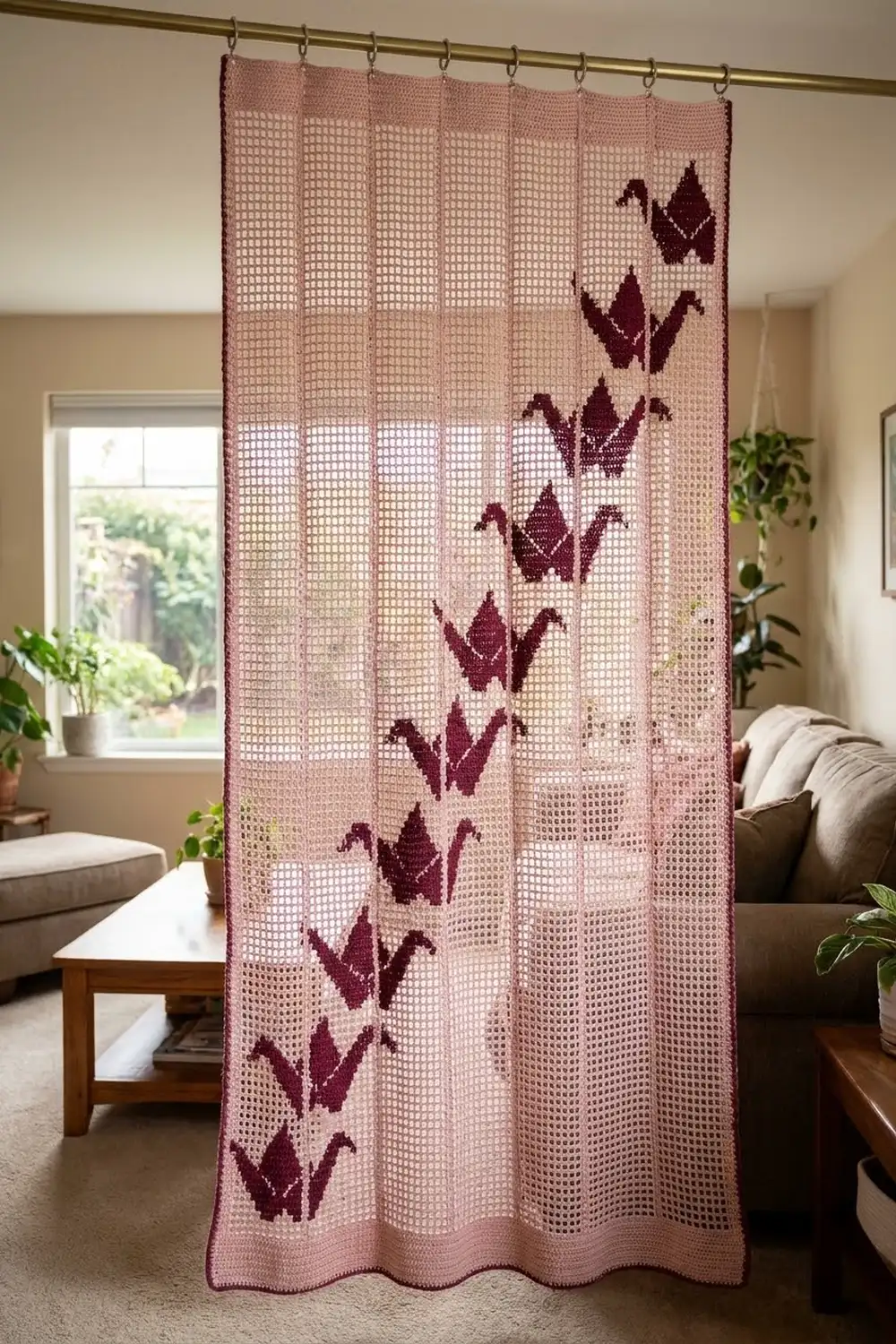
Paper cranes in deep burgundy fly upward across a soft pink mesh in this filet crochet curtain. Light passes through the open squares, and the solid burgundy blocks make each crane look like a folded paper silhouette against the window.
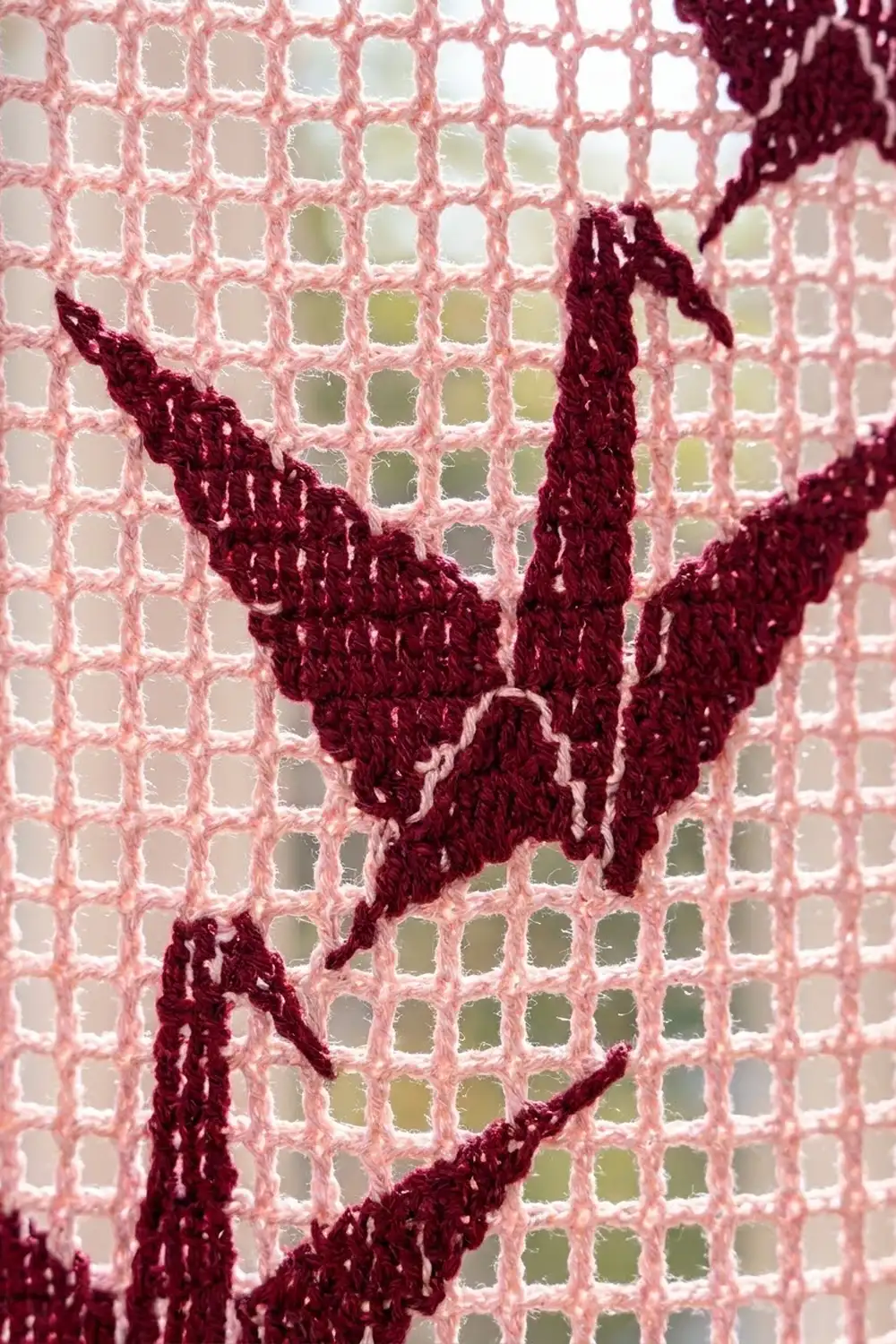
The curtain uses two colors: blush pink for the mesh and burgundy for the cranes. Each crane has a pointed body at the bottom, a long neck rising to a sharp tip on the left, and swept-back wings rising to the upper right. The cranes climb on a diagonal from lower left to upper right, so the whole curtain feels like a flock taking off.
This pattern uses US crochet terms. The finished curtain measures 41 in wide x 61 in long (104.1 x 154.9 cm) including the border.
You make four long filet strips, each worked bottom to top in rows. The strips are slip-stitched together side by side, and a 3-round edging finishes the outside. The curtain hangs from clip rings on a standard rod.
Finished Size and Construction
- Finished size: 41 x 61 in (104.1 x 154.9 cm)
- Skill level: Intermediate (filet mesh plus simple color changes)
- Terminology: US
- Yarn weight: #2 fine / sport-weight mercerized cotton
- Hook: 3.25 mm (US D/3)
- Number of pieces: 4 strips
- Layout: 4 strips side by side, 1 strip tall
- Strip size: 10 x 60 in (25.4 x 152.4 cm), 25 meshes x 150 rows
- Size before border: 40 x 60 in (101.6 x 152.4 cm)
- Border depth: 0.5 in (1.3 cm) on each side
Materials
Choose a smooth, mercerized cotton with clear stitch definition. Filet relies on crisp, square meshes, so avoid fuzzy or very stretchy fibers. The yardages below assume 50 g balls of about 155 m (170 yd).
- Pink (main color): 450 g, 9 balls, 1,395 m (1,526 yd)
- Burgundy (cranes): 100 g, 2 balls, 310 m (339 yd)
Quantities include a comfortable margin for gauge differences, bobbins, and weaving in.
Tools:
- 3.25 mm (US D/3) crochet hook
- 6 to 8 small yarn bobbins
- Locking stitch markers
- Tapestry needle
- Tape measure
- Blocking mats and rust-proof pins
- Spray bottle
- 13 curtain clip rings and a rod
Abbreviations (US Terms)
- ch – chain
- dc – double crochet
- sc – single crochet
- sl st – slip stitch
- rev sc – reverse single crochet (crab stitch)
- st(s) – stitch(es)
- sp – space
- RS / WS – right side / wrong side
Special terms:
- Mesh (open square): ch 2, skip 2 sts, dc in next st. Each mesh is 3 sts.
- Block (filled square): 3 dc worked over one mesh position: 2 dc in the ch-2 sp (or in the next 2 dc) and 1 dc in the next dc.
- Burgundy block: a block whose 3 sts are worked in burgundy. To switch colors, work the last dc before the change until 2 loops remain, then finish it with the new color.
Gauge and Checkpoints
Gauge: 10 meshes and 10 rows = 4 x 4 in (10.2 x 10.2 cm) in filet mesh, after blocking. One row of 25 meshes = 76 sts.
Make a swatch before starting: ch 39, then work Rows 1 to 12 below on 12 meshes (37 sts). Block it and measure 10 meshes across the center. It should be 4 in (10.2 cm). Ten rows should also measure 4 in (10.2 cm).
- Too big: go down to a 3.0 mm hook.
- Too small: go up to a 3.5 mm (US E/4) hook.
- Width right but rows too tall: pull each dc snug before the final yarn-over.
Checkpoints for each strip:
- After Row 10: 10 in (25.4 cm) wide, 4 in (10.2 cm) tall
- After Row 75: 30 in (76.2 cm) tall
- After Row 150: 60 in (152.4 cm) tall
Make your first strip completely and block it before starting the others. If it measures 10 x 60 in (25.4 x 152.4 cm), the remaining strips will match.
Strip Pattern
Columns are numbered 1 to 25 from the left edge as you look at the RS. Odd rows are RS rows and are worked from column 25 to column 1. Even rows are WS rows and are worked from column 1 to column 25.
Columns 1 and 25 are always open meshes, so every strip has a clean pink edge.
Foundation: With pink, ch 78.
Row 1 (RS, solid): Dc in 4th ch from hook (skipped ch count as first dc) and in each ch across. Turn. (76 sts)
Row 2 (WS, mesh): Ch 5 (counts as dc + ch 2), skip next 2 dc, dc in next dc; *ch 2, skip 2 dc, dc in next dc; repeat from * across, working last dc in top of turning ch. Turn. (25 meshes, 76 sts)
Rows 3–149: Work mesh rows as in Row 2 (ch 5 counts as dc + ch 2, skip the ch-2 sp, dc in next dc). Where the crane placement below calls for burgundy blocks, work those mesh positions as burgundy blocks. Every row stays at 76 sts. Turn at the end of each row.
Row 150 (solid): Ch 3 (counts as dc), *2 dc in next ch-2 sp, dc in next dc; repeat from * across. Fasten off. (76 sts)
Crane Motif
The crane is 12 meshes wide and 9 rows tall: 4.8 x 3.6 in (12.2 x 9.1 cm). In the grid, X = burgundy block and . = pink open mesh. Motif Row 1 is the lowest row. Motif columns 1 to 12 read left to right as seen from the RS.
R9: ..........XX
R8: X........XX.
R7: .X......XXX.
R6: ..X....XXX..
R5: ...X..XXXX.X
R4: ....XXXXXXX.
R3: .....XXXXX..
R2: ......XXX...
R1: .......X....
The diagonal on the left (Rows 5–8, ending at the Row 8 tip) is the neck. Rows 1–4 form the pointed body, the upper-right blocks form the swept wings, and the single block at the end of Row 5 is the tail tip. Each crane uses 35 burgundy blocks.
On RS (odd) rows, read each grid line from right to left. On WS (even) rows, read from left to right. Motif column c sits in strip column (start column + c − 1).
Color handling: Wind a small burgundy bobbin for each separate burgundy area in a row. Carry pink inside the burgundy blocks by working over it, then pick it up again at the next pink mesh. Never carry yarn across an open mesh. At the end of each motif, cut the bobbins, leaving 6 in (15.2 cm) tails.
Crane Placement
Make two versions so the cranes are staggered across the curtain.
Strip A (make 2):
| Crane | Strip rows | Start column |
|---|---|---|
| 1 | 12–20 | 2 |
| 2 | 40–48 | 4 |
| 3 | 68–76 | 7 |
| 4 | 96–104 | 10 |
| 5 | 124–132 | 13 |
Strip B (make 2):
| Crane | Strip rows | Start column |
|---|---|---|
| 1 | 26–34 | 3 |
| 2 | 54–62 | 6 |
| 3 | 82–90 | 9 |
| 4 | 110–118 | 11 |
| 5 | 138–146 | 13 |
The highest start column is 13, so a crane covers columns 13–24 at most, and column 25 stays open. Every motif row stays at 76 sts, because a block uses the same 3 sts as a mesh.
Strip checkpoint: 10 x 60 in (25.4 x 152.4 cm), 76 sts across Row 150, and 150 row ends along each long side.
Make All Pieces
- Strip A: 2 strips (10 burgundy cranes in total)
- Strip B: 2 strips (10 burgundy cranes in total)
- Total: 4 strips and 20 cranes. Pink covers all mesh, edges, seams, and border.
Layout (RS facing, top edge up):
+-------+-------+-------+-------+
|   A   |   B   |   A   |   B   |
+-------+-------+-------+-------+
Alternating A and B staggers the crane rows by 14 rows, or 5.6 in (14.2 cm), between neighboring strips.
Joining
Block all four strips to 10 x 60 in (25.4 x 152.4 cm) before joining.
Method: Place two strips with their RS together, matching Row 1 to Row 1 and Row 150 to Row 150. Insert stitch markers every 25 rows to keep the edges aligned. With pink, sl st through both layers, working 2 sl sts into each pair of matching row ends. Each seam has 300 sl sts.
Stitch-to-stitch logic: Row ends match one-to-one because every strip has exactly 150 rows. If the markers stop lining up, rip back to the last marker and rework that section.
Tension: Keep the sl sts loose enough that the seam lies flat and stretches the same amount as the mesh. If the seam puckers, go up one hook size for joining only.
Join A to B, B to A, and A to B, so the strips read A-B-A-B. Join all seams from the bottom edge up.
Size checkpoint: 40 x 60 in (101.6 x 152.4 cm). The slip-stitch seams add no measurable width.
Border
Border gauge: 7.5 sc = 1 in (2.5 cm), which matches the filet stitch density of 76 sts over 10 in (25.4 cm).
Round 1 (RS): With RS facing, join pink in the top right corner.
- Top edge: Ch 1, sc in each st across all four strips, 4 x 76 = 304 sc.
- Corner: Ch 2.
- Left side: Work 3 sc in each of the 150 row ends, 450 sc.
- Corner: Ch 2.
- Bottom edge: Work 1 sc in the base of each Row 1 st, 4 x 76 = 304 sc.
- Corner: Ch 2.
- Right side: 450 sc as for the left side.
- Corner: Ch 2. Sl st to the first sc.
No stitches are added at the seams. Round 1 has 1,508 sc plus 4 corner ch-2 sps.
Round 2: Ch 1, sc in each sc, and work (sc, ch 2, sc) in each corner ch-2 sp. Each side gains 2 sc: 306 sc on the top and bottom edges, 452 sc on each side. Sl st to the first sc. (1,516 sc + 4 corner sps)
Round 3: Ch 1, rev sc in each sc and 1 rev sc in each corner ch-2 sp. Sl st to the first st. Fasten off. (1,516 + 4 = 1,520 sts)
Why the math works: The top edge has 304 sc over 40 in (101.6 cm), or 7.6 per inch. Each side has 450 sc over 60 in (152.4 cm), or 7.5 per inch. Because the densities nearly match, the border lies flat without ruffling or cupping. Three rounds add 0.5 in (1.3 cm) to every edge, giving 41 x 61 in (104.1 x 154.9 cm).
Final Blocking
- Weave in all tails, running them through burgundy blocks wherever possible.
- Lay the curtain flat on blocking mats with the RS up.
- Pin the corners first to 41 x 61 in (104.1 x 154.9 cm).
- Pin along every edge every 2 in (5.1 cm), keeping the border straight.
- Square the meshes by running a long ruler along the mesh columns and rows.
- Spray the curtain evenly until damp but not dripping.
- Let it dry completely before you unpin it, usually 12 to 24 hours.
- Clip one ring at each top corner, one at each seam, and two evenly spaced within each strip, for 13 rings total.
Final Quality-Control Checklist
- Each strip has 76 sts per row, 25 meshes, and 150 rows.
- All 20 cranes match the grid, with 35 burgundy blocks each.
- Columns 1 and 25 are open on every strip.
- The strips read A-B-A-B and all Row 1 edges are at the bottom.
- Each seam has 300 sl sts and lies flat.
- Border Round 1 has 304 / 450 / 304 / 450 sc.
- The blocked size is 41 x 61 in (104.1 x 154.9 cm).
- No carried yarn shows across open meshes.
Troubleshooting
- Meshes are rectangles, not squares: Adjust the dc height or try a different hook size, then reblock.
- Strip is narrowing: You are probably missing the last dc in the turning chain. Count 26 dc posts on every mesh row.
- Pink shows through burgundy blocks: Keep the carried strand at the back of the work and tension it gently.
- Crane faces the wrong way: Check which direction you are reading the grid on RS and WS rows.
- Strips are different lengths: Count the rows on each one. Blocking can correct up to 0.5 in (1.3 cm), but not a missing row.
- Border ruffles: Use 2 sc in every third row end on the long sides, but keep the corners as written.
- Border pulls in: Go up one hook size for Round 1.
Care
Hand wash in cool water with a mild detergent and press out the water in a towel. Lay flat to dry and re-pin to size if needed. Do not tumble dry.
Final Notes
The measurement chain is simple. The gauge of 10 meshes and 10 rows in 4 in (10.2 cm) gives each strip 25 meshes x 150 rows, or 10 x 60 in (25.4 x 152.4 cm). Four strips joined make 40 x 60 in (101.6 x 152.4 cm). The 3-round border adds 0.5 in (1.3 cm) per side, for a finished curtain of 41 x 61 in (104.1 x 154.9 cm). Check your gauge, count your 76 sts, and watch the cranes rise.
Happy crocheting!