

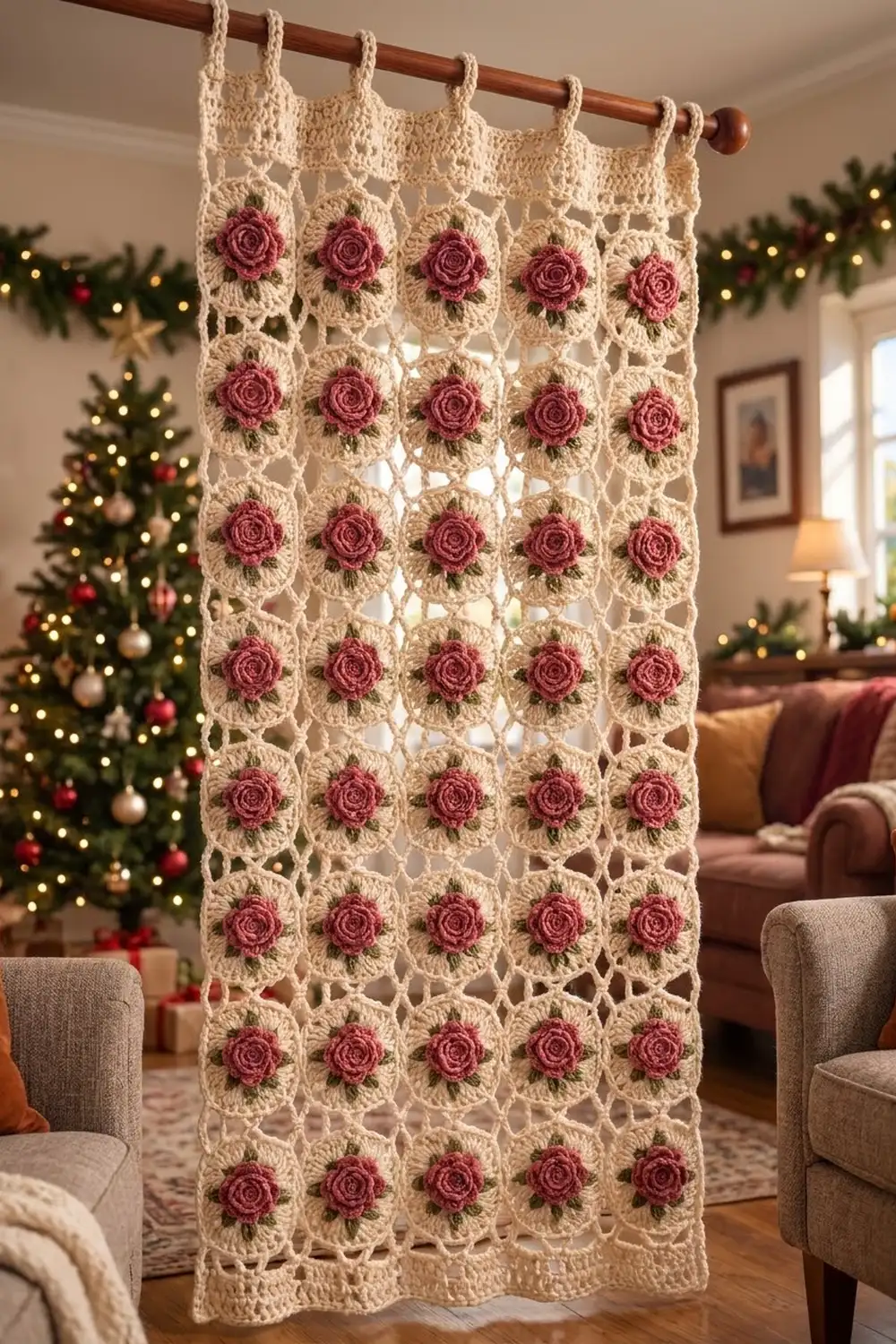
The Rose Lattice Curtain is a lacy window panel made from 42 cream square motifs. Each one has a raised rolled rose in dusty raspberry pink and three small olive-green leaves. With light behind it, the open windows in each square form a soft lattice.
Only three colors are used: warm cream for the motifs, border, and tabs; dusty rose for the flowers; and olive green for the leaves. It has a vintage cottage look that suits a kitchen, a reading nook, or a holiday living room.
This pattern uses US crochet terms. The finished panel measures 39.7 x 34.2 in (100.8 x 86.9 cm). With the tab loops included, it hangs 36.2 in (91.9 cm) from rod to hem.
You crochet each square in the round, sew a rose and leaves to its center, and join the squares in a 7 x 6 grid with slip stitch seams. A two-round border and eight hanging tabs finish the panel.
Finished Size and Construction
- Finished size: 39.7 x 34.2 in (100.8 x 86.9 cm), plus 2 in (5.1 cm) tab loops
- Skill level: Intermediate
- Terminology: US crochet terms
- Yarn weight: Worsted (#4) cotton
- Hook: 5.0 mm (H-8)
- Number of pieces: 42 motifs, 42 roses, 126 leaves, 8 tabs
- Layout: 7 motifs across x 6 down
- Piece size: 5.5 x 5.5 in (14.0 x 14.0 cm)
- Size before border: 38.5 x 33 in (97.8 x 83.8 cm)
- Border depth: 0.6 in (1.5 cm) per side
Materials
Choose a smooth worsted cotton. It holds the lace open, blocks crisply, and doesn’t stretch much while hanging. Fuzzy yarns blur the windows and the rose spirals.
- Cream (Color A): 550 g / about 1,100 m
- Dusty rose (Color B): 200 g / about 400 m
- Olive green (Color C): 150 g / about 300 m
Quantities assume about 200 m per 100 g and include a 10-15% margin for swatching and tails.
Tools: 5.0 mm (H-8) hook, tapestry needle, stitch markers, scissors, measuring tape, blocking mats, rust-proof pins, spray bottle.
Abbreviations (US Terms)
- ch – chain
- sl st – slip stitch
- sc – single crochet
- hdc – half double crochet
- dc – double crochet
- sp(s) – space(s)
- st(s) – stitch(es)
- RS / WS – right side / wrong side
Special stitch – dc4tog (4-dc cluster): Yarn over, insert hook in next st, pull up a loop, yarn over and pull through 2 loops. Repeat from * to * 3 more times (5 loops on hook). Yarn over and pull through all 5 loops.
Beginning cluster: Ch 2, then dc3tog over the next 3 sts. This counts as the first dc4tog.
Gauge and Checkpoints
Make and block one complete motif before you start the rest. Small differences multiply quickly across 42 squares.
Motif gauge: One blocked motif = 5.5 x 5.5 in (14.0 x 14.0 cm), with 19 sts per side including both corner sts. That’s about 7 sts per 2 in (5.1 cm).
Checkpoints:
- After Round 1: about 1.25 in (3.2 cm) across
- After Round 3: about 3.25 in (8.3 cm) across
- After Round 5: about 5 in (12.7 cm) per side
- After Round 6: 5.5 in (14.0 cm) per side
Too big? Use a 4.5 mm (7) hook. Too small? Use a 5.5 mm (I-9) hook. Being within 0.25 in (0.6 cm) is fine, but every motif must match.
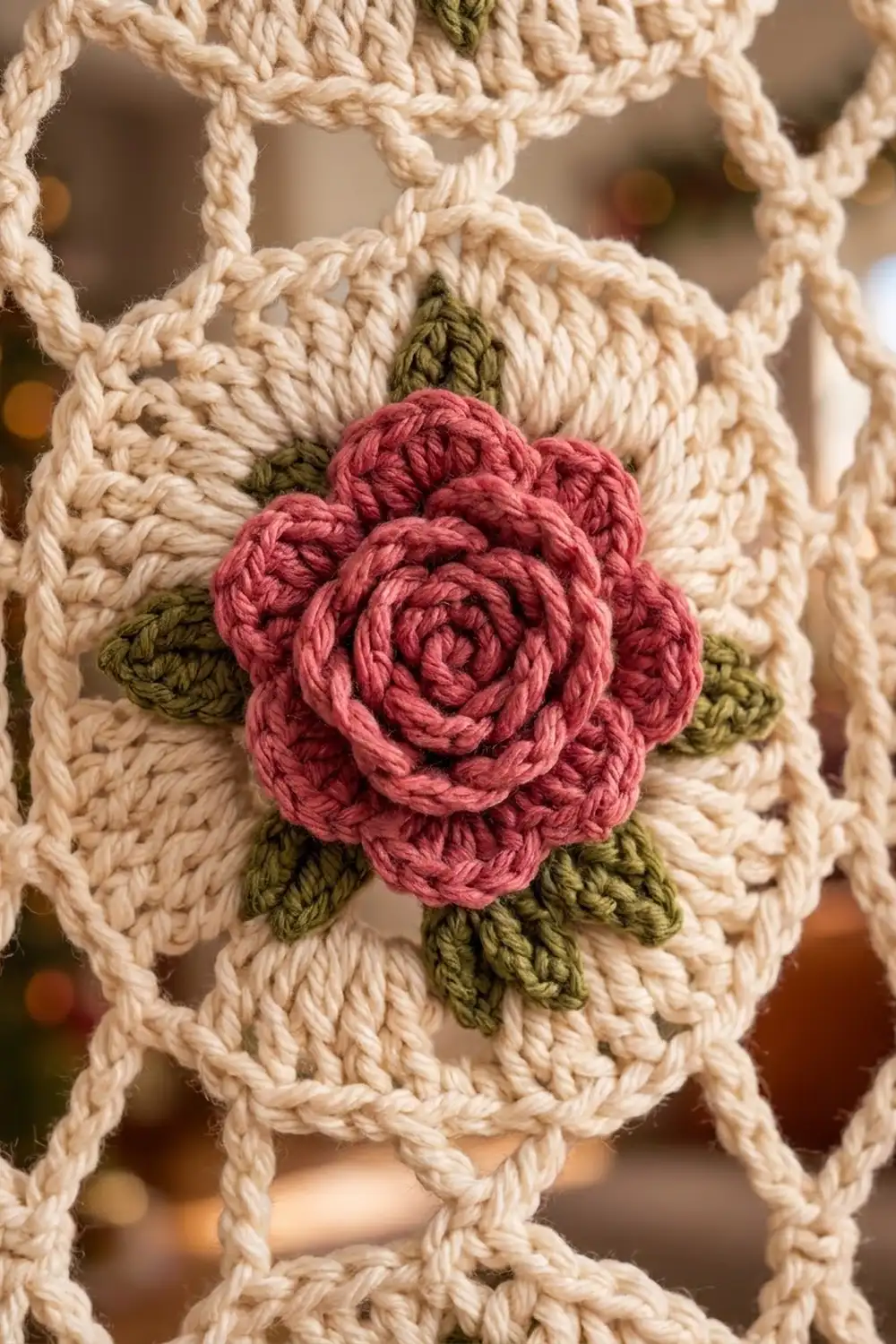
Square Motif (Make 42, Color A)
Ch 6 and sl st to the first ch to form a ring.
Round 1: Ch 3 (counts as dc), 15 dc in ring, sl st to top of beg ch-3. (16 dc) This leaves the open center behind the rose.
Round 2: Ch 3 (counts as dc), dc in same st, 2 dc in next st, ch 2. 2 dc in each of next 2 sts, ch 2. Repeat from * to * 6 more times. Sl st to top of beg ch-3. (32 dc in 8 groups of 4; 8 ch-2 sps)
Round 3: Beginning cluster over first 4 dc, ch 5. Dc4tog over next 4 dc (skipping the ch-2 sp), ch 5. Repeat from * to * 6 more times. Sl st to top of beginning cluster. (8 clusters; 8 ch-5 sps) These are the 8 rounded petals.
Round 4 (squaring): Sl st into first ch-5 sp. Ch 3 (counts as dc), then (2 dc, ch 3, 3 dc) in same sp for the first corner. Ch 2, 3 dc in next ch-5 sp, ch 2. (3 dc, ch 3, 3 dc) in next ch-5 sp, ch 2, 3 dc in next ch-5 sp, ch 2. Repeat from * to * 2 more times. Sl st to top of beg ch-3. (36 dc; 4 corner ch-3 sps; 8 ch-2 sps; 9 dc per side)
Round 5 (windows): Sl st in next 2 dc and into corner sp. Ch 3 (counts as dc), then (dc, ch 3, 2 dc) in same sp. Ch 3, skip next 3 dc, dc in next ch-2 sp, dc in each of next 3 dc, dc in next ch-2 sp, ch 3, skip next 3 dc, (2 dc, ch 3, 2 dc) in next corner sp. Work from * to * 4 times total, leaving out the corner group on the 4th repeat. Sl st to top of beg ch-3. (36 dc; 8 ch-3 windows; 4 corner sps; per side 2 + 5 + 2 = 9 dc)
The two windows on each side make the open lattice that shows when the curtain hangs.
Round 6 (sc trim): Sl st in next dc and into corner sp. Ch 1. 3 sc in corner sp, sc in next 2 dc, 3 sc in window, sc in next 5 dc, 3 sc in window, sc in next 2 dc. Repeat from * to * 3 more times. Sl st to first sc. Fasten off with a 12 in (30.5 cm) tail.
Count: This is a conversion round: 36 sc (1 per dc) + 24 sc in the 8 windows + 12 sc in the 4 corner sps = 72 sc.
The center sc of each corner group is the corner st. Each side: corner (1) + 1 + 2 + 3 + 5 + 3 + 2 + 1 + corner (1) = 19 sts, including both corners. Check: 4 x 18 = 72.
Rolled Rose (Make 42, Color B)
Ch 35.
Row 1: (Dc, ch 1, dc) in 5th ch from hook. Skip next ch, (dc, ch 1, dc) in next ch. Repeat across. (16 V-sts)
Row 2: Turn, ch 3. Work 5 dc in each of the first 8 ch-1 sps, then 7 dc in each of the last 8 ch-1 sps. Fasten off with a 14 in (35.6 cm) tail. (16 petals; 8 x 5 + 8 x 7 = 96 dc)
Shaping: Start at the small-petal end and roll tightly for the bud. Then roll more loosely so the large petals open out. Stitch through all layers at the base several times. The rose is about 2.75 in (7.0 cm) across.
Leaf (Make 126, Color C)
Ch 8.
Round 1: Sc in 2nd ch from hook, hdc in next ch, dc in next 2 ch, hdc in next ch, sc in next ch, 3 sc in last ch. Working along the other side of the chain: sc in next ch, hdc in next ch, dc in next 2 ch, hdc in next ch, sc in last ch. Sl st to first sc. Fasten off with an 8 in (20.3 cm) tail. (6 + 3 + 6 = 15 sts)
Each leaf is about 1.5 in (3.8 cm) long, with a raised center vein formed by the chain.
Make All Pieces
- Color A: 42 motifs
- Color B: 42 roses
- Color C: 126 leaves (3 per motif)
Block the motifs first. Center a rose over each motif’s ring. Tuck in three leaves: one at lower left, one at lower right, and one at the upper side. Sew the leaves first, then the rose. Stitch through Rounds 1-2 only so the petals and windows stay free.
All motifs are identical:
ROW 1: ROSE ROSE ROSE ROSE ROSE ROSE ROSE
ROW 2: ROSE ROSE ROSE ROSE ROSE ROSE ROSE
ROW 3: ROSE ROSE ROSE ROSE ROSE ROSE ROSE
ROW 4: ROSE ROSE ROSE ROSE ROSE ROSE ROSE
ROW 5: ROSE ROSE ROSE ROSE ROSE ROSE ROSE
ROW 6: ROSE ROSE ROSE ROSE ROSE ROSE ROSE
Row 1 is the top. Turn every motif so its leaves point down.
Joining
Method: Slip stitch seams on the WS, through the outer loops only, with Color A.
- Place two motifs RS together with the corner sts lined up.
- Work 1 sl st through each matched pair of sts, corner to corner: 19 sl sts per motif edge.
- Join each row into a strip of 7. Each long edge has 7 x 19 = 133 sts.
- Join the 6 strips along their long edges, 1 sl st per matched pair: 133 sl sts per seam.
Seams add no edge stitches, so the outer edges keep exactly the motifs’ own counts.
Tension: Keep your sl sts as loose as the Round 6 sc. Tight seams make the panel pucker and the top edge sag. Go up one hook size for the seams if needed.
Size checkpoint: The joined panel should measure 38.5 x 33 in (97.8 x 83.8 cm). If it’s off by more than 0.5 in (1.3 cm), check for skipped or doubled seam stitches.
Border (Color A)
Border gauge: About 7 sts per 2 in (5.1 cm), the same as the motifs. You work 1 st into each edge st, so the border lies flat.
Starting counts (each including its 2 panel corner sts):
- Top/bottom: 7 x 19 = 133 sts
- Left/right: 6 x 19 = 114 sts
At the seams, work the two adjacent motif corner sts as ordinary sts.
Round 1 (sc): With RS facing, join in the top right panel corner st. Ch 1, 3 sc in corner st, sc in each st to next panel corner, 3 sc in corner st. Repeat around, then sl st to first sc.
- Top/bottom: 131 + 2 + 2 corners = 135 sts
- Left/right: 112 + 2 + 2 corners = 116 sts
- Total: 2 x 134 + 2 x 115 = 498 sc
Round 2 (hdc): Ch 2 (doesn’t count), hdc in each st with 3 hdc in each corner st. Sl st to first hdc.
- Top/bottom: 137 sts
- Left/right: 118 sts
- Total: 2 x 136 + 2 x 117 = 506 hdc
Hanging tabs (make 8): Count off the 137 top-edge sts: a 3-st margin, then 8 tabs of 5 sts separated by 7 gaps of 13 sts, then a 3-st margin. 3 + 40 + 91 + 3 = 137.
For each tab, join Color A in its first st. Ch 1, sc in 5 sts, turn. Work 13 more rows of 5 sc (14 rows, about 4 in / 10.2 cm). Fold the tab to the WS and whipstitch the last row to the base of border Round 1, making a 2 in (5.1 cm) loop.
Why the math works: Each starting side is simply motifs x 19, with nothing added at the seams. Each border round adds exactly 2 sts per side, one at each corner, so the corners stay square. The 137-st top divides exactly into margins, tabs, and gaps. Each 13-st gap is about 3.7 in (9.4 cm), so the tabs stay evenly spaced.
Final Blocking
- Weave in tails along the seams, never across the windows.
- Lay the panel face up on blocking mats.
- Pin the corners to 39.7 x 34.2 in (100.8 x 86.9 cm).
- Pin each edge every 2 in (5.1 cm), keeping the top edge straight.
- Spray until damp, avoiding the roses.
- Let it dry fully, about 24 hours, then fluff the petals.
Final Quality-Control Checklist
- [ ] All motifs measure 5.5 in (14.0 cm) per side, with 19 sts per side
- [ ] All roses face the same way, with leaves pointing down
- [ ] Joined panel is 38.5 x 33 in (97.8 x 83.8 cm)
- [ ] Border Round 2 has 137 / 118 sts per side
- [ ] 8 tabs are evenly spaced, each a 2 in (5.1 cm) loop
- [ ] No tails show through the windows
- [ ] Finished panel is 39.7 x 34.2 in (100.8 x 86.9 cm)
Troubleshooting
Motif cups: Round 2 is too tight. Recount for 32 dc, or size up for Rounds 1-3.
Corners ruffle: There are too many sts in the Round 4 corners. Use exactly 3 dc, ch 3, 3 dc.
Rose looks flat: Roll the 5-dc petals tighter and stitch the base firmly.
Top edge sags: The seams are tighter than the motifs. Redo them more loosely.
Border waves: Extra sts crept in. Recount against 135 / 116.
Care
Hand wash cold or use a gentle cycle in a mesh bag, then lay flat to dry. Never hang it wet, because the weight will stretch the panel.
Final Notes
The measurement chain is simple. One motif is 5.5 in (14.0 cm) with 19 sts per side. Seven across gives 133 sts and 38.5 in (97.8 cm); six down gives 114 sts and 33 in (83.8 cm). The two border rounds add 0.6 in (1.5 cm) per edge, for 39.7 x 34.2 in (100.8 x 86.9 cm), and the tabs add 2 in (5.1 cm). Match the first motif and the rest will follow.
Happy crocheting!