

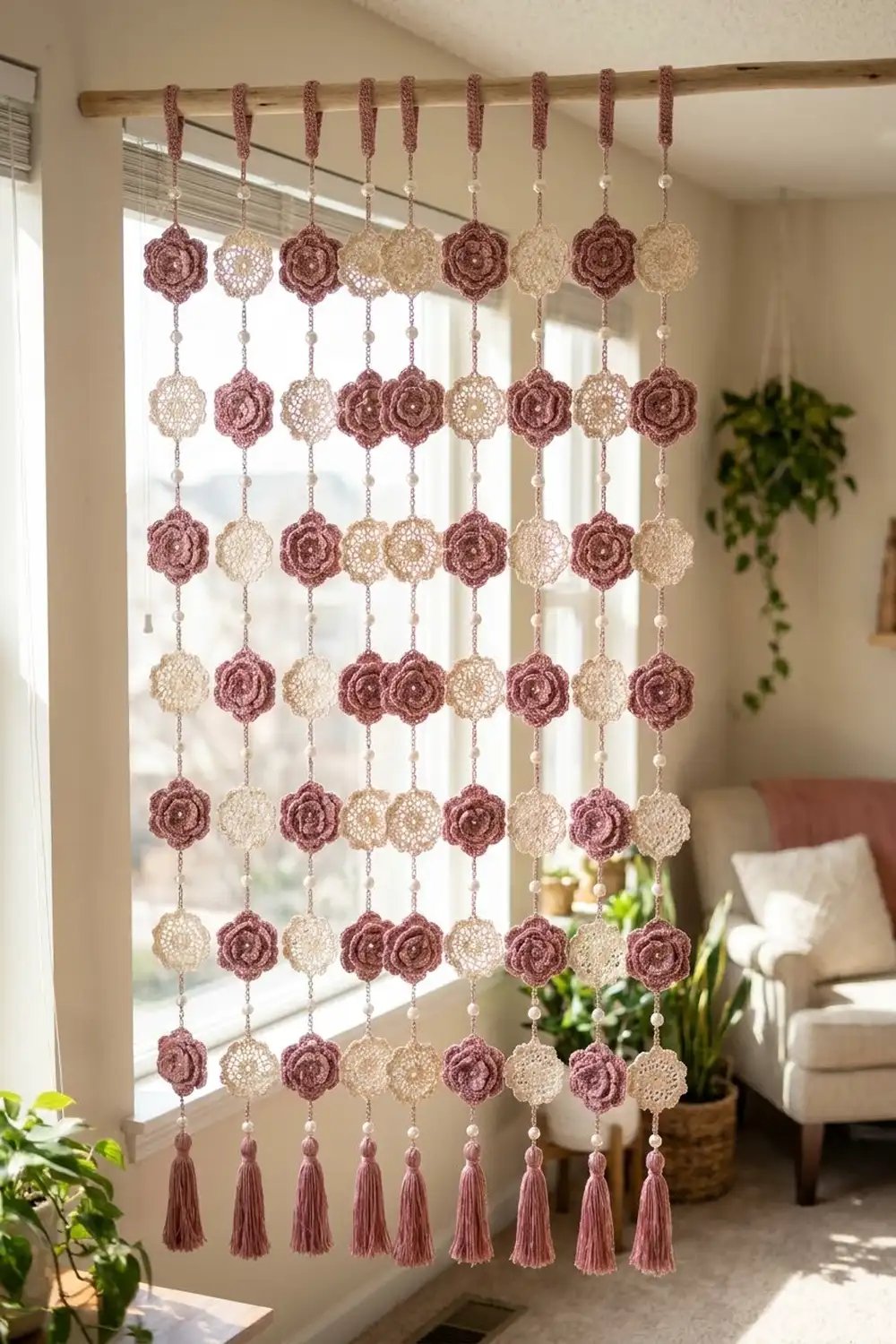
This curtain is made of 12 hanging strands that let the light through. Each strand alternates full, three-tier layered roses with flat, lacy medallions. Short chain links with a pearl bead in each one join the motifs, and a thick tassel finishes the bottom of every strand.
All of the crochet is one soft dusty-rose cotton, and the beads are cream-champagne pearls. The look is romantic and vintage, but the structure is simple and graphic. Neighboring strands are offset, so roses and medallions alternate across the window in a checkerboard rhythm.
This pattern uses US crochet terms. The finished curtain is about 47.5 in (120.7 cm) wide and hangs about 53 in (134.6 cm) below the rod.
You make the motifs separately. Then you build each strand as one beaded chain cord that hangs from a rod tab and links the motifs together. A tassel goes at the bottom of each strand.
Finished Size and Construction
- Finished size: 47.5 in (120.7 cm) wide × 53 in (134.6 cm) drop below the rod
- Skill level: Intermediate
- Terminology: US
- Yarn weight: Super fine (#1), mercerized cotton
- Hook: 2.5 mm (US B/1–C/2)
- Number of pieces: 144 motifs (72 roses, 72 medallions) and 12 tassels, joined into 12 strands
- Layout: 12 strands × 12 motifs each, with strands 4 in (10.2 cm) apart, center to center
- Piece size: Rose 3.5 in (8.9 cm); medallion 2.25 in (5.7 cm)
- Size before border (motif section of one strand): 45.5 in (115.6 cm)
- Border depth: Rod tab drop of 0.5 in (1.3 cm) at the top; tassel of 5 in (12.7 cm) at the bottom
Materials
Use a smooth, mercerized cotton. It gives crisp petals and clear stitch definition, and it hangs without stretching. Avoid acrylic: over 53 in (134.6 cm) of drop, it slowly lengthens under the weight of the tassels.
- Dusty rose cotton, super fine (#1): 460 g (about 1,565 m), based on 170 m per 50 g. Buy 10 balls.
- Medallions: about 5 m each × 72 = 360 m
- Roses: about 10 m each × 72 = 720 m
- Strand cords and tabs: about 7 m each × 12 = 84 m
- Tassels: about 15 m each × 12 = 180 m
- Cream-champagne pearl beads: 160 beads, 12 mm, with holes of at least 2 mm (156 needed, plus spares)
- 2.5 mm hook
- Big-eye beading needle or dental floss threader (for stringing beads)
- Tapestry needle
- Stiff card, 5.5 in (14.0 cm) tall
- Scissors, rust-proof pins, blocking mat, spray bottle
- Curtain rod, up to 1 in (2.5 cm) in diameter
The quantities above include a margin of about 15% for gauge swatches, tails, and tassel trimming.
Abbreviations (US Terms)
- ch: chain
- sl st: slip stitch
- sc: single crochet
- hdc: half double crochet
- dc: double crochet
- sp: space
- st(s): stitch(es)
- BPsc (back-post single crochet): insert the hook from back to front to back around the post of the stated stitch, yarn over, pull up a loop, then yarn over and pull through 2 loops.
- bch (bead chain): slide 1 pre-strung bead up against the hook, yarn over, and pull through. This locks the bead inside the chain.
Gauge and Checkpoints
Chain gauge: 10 ch = 1 in (2.5 cm).
Make 1 medallion and 1 rose before anything else. Measure each one flat at every checkpoint below.
Medallion:
– After Rnd 1: 0.75 in (1.9 cm)
– After Rnd 2: 1.25 in (3.2 cm)
– After Rnd 3: 1.5 in (3.8 cm)
– After Rnd 4: 2.25 in (5.7 cm)
Rose:
– After Rnd 1: 0.75 in (1.9 cm)
– After Rnd 3 (Tier 1): 1.75 in (4.4 cm)
– After Rnd 5 (Tier 2): 2.75 in (7.0 cm)
– After Rnd 7 (Tier 3): 3.5 in (8.9 cm)
If your motifs are more than 0.25 in (0.6 cm) too large, go down one hook size. If they are too small, go up one size. Getting the medallion and rose sizes right matters most, because the spine chains in the joining step are counted to fit them.
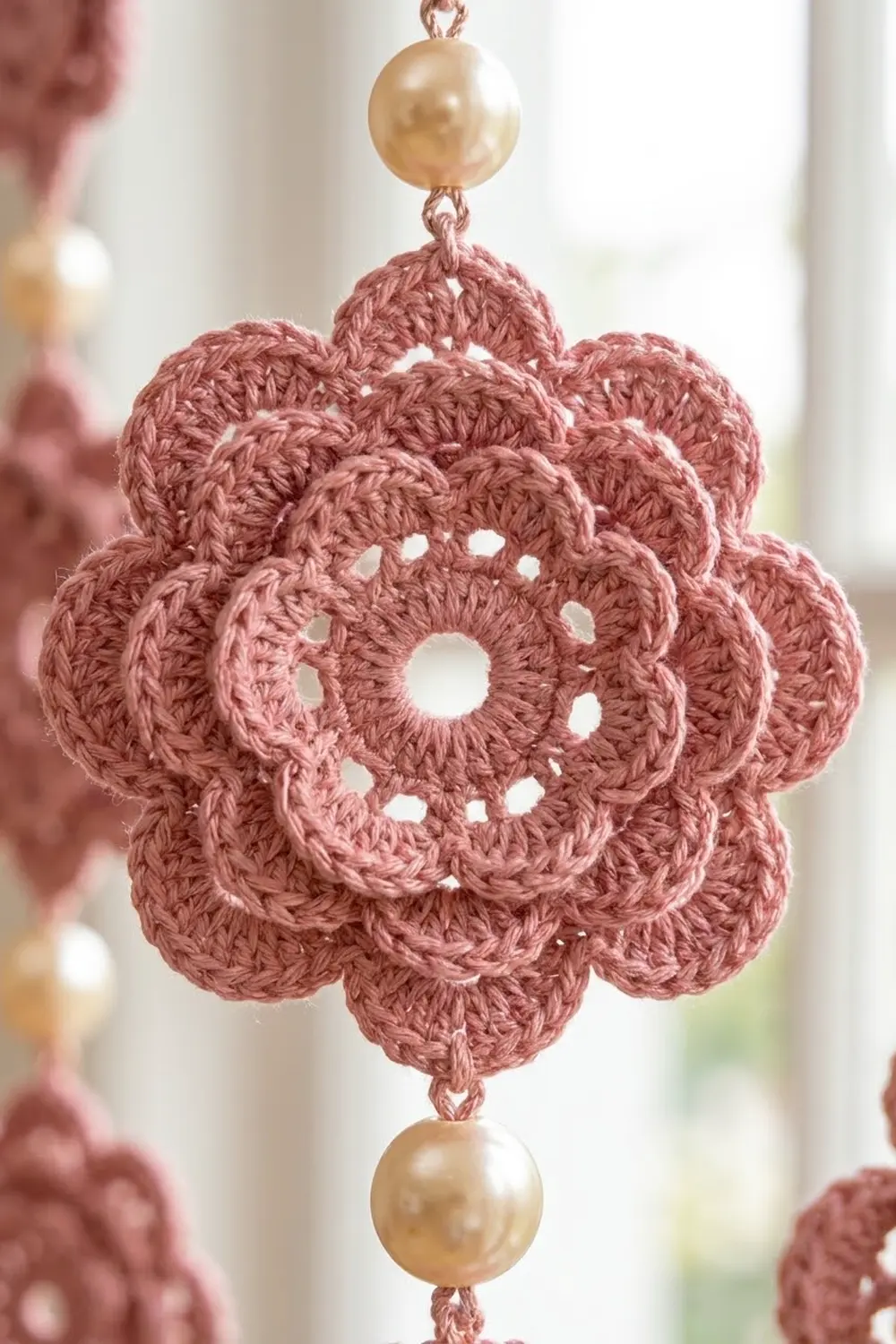
Medallion (Make 72)
Rnd 1: Make a magic ring. Ch 3 (counts as dc), work 15 dc into the ring, and join with a sl st to the top of the beginning ch-3. Pull the ring closed, leaving a small open center. (16 dc)
Rnd 2: Ch 5 (counts as dc + ch 2). Dc in the next dc, ch 2; repeat from * 14 more times. Join to the 3rd ch of the beginning ch-5. (16 dc, 16 ch-2 sps)
Rnd 3: Sl st into the first ch-2 sp, ch 1, then work 3 sc in each ch-2 sp around. Join to the first sc. (48 sc)
Rnd 4 (scallops): Ch 1. Sc in the next sc, skip 1 sc, 5 dc in the next sc, skip 1 sc; repeat from * 11 more times. Join to the first sc. (12 sc + 60 dc = 72 sts; 12 scallops)
Each repeat uses exactly 4 sts of Rnd 3, and 12 × 4 = 48, so the scallops close evenly.
Fasten off and weave in the ends. The top point of a medallion is the 3rd dc of any scallop. The bottom point is the 3rd dc of the scallop 6 scallops away.
Layered Rose (Make 72)
Rnd 1: Make a magic ring. Ch 3 (counts as dc), work 15 dc into the ring, and join. (16 dc)
Rnd 2: Ch 1, sc in the same st. Ch 3, skip 1 dc, sc in the next dc; repeat from * 6 more times. Ch 3, skip the last dc, and join to the first sc. (8 sc, 8 ch-3 loops)
Rnd 3 (Tier 1): In each ch-3 loop, work (sc, hdc, 3 dc, hdc, sc). Join to the first sc. (8 petals; 7 sts each = 56 sts)
Rnd 4: Fold the Tier 1 petals forward. Working behind them, ch 1 and BPsc around the first sc of Rnd 2. Ch 5, BPsc around the next Rnd 2 sc; repeat from * 6 more times. Ch 5 and join to the first BPsc. (8 BPsc, 8 ch-5 loops)
Rnd 5 (Tier 2): In each ch-5 loop, work (sc, hdc, 5 dc, hdc, sc). Join. (8 petals; 9 sts each = 72 sts)
Rnd 6: Working behind Tier 2, ch 1 and BPsc around the first BPsc of Rnd 4. Ch 7, BPsc around the next Rnd 4 BPsc; repeat from * 6 more times. Ch 7 and join. (8 BPsc, 8 ch-7 loops)
Rnd 7 (Tier 3): In each ch-7 loop, work (sc, hdc, 7 dc, hdc, sc). Join. (8 petals; 11 sts each = 88 sts)
Fasten off and weave in the ends on the back. Each ring of loops sits behind the tier before it, so the three tiers stack and each larger petal shows behind a smaller one.
The top point of a rose is the 4th dc of any Tier 3 petal. The bottom point is the 4th dc of the petal 4 petals away.
Make All Pieces
Make 72 medallions and 72 roses, all in dusty rose. Before joining, sort them into 12 piles of 6 medallions + 6 roses.
There are two strand types:
– Strand A (6 strands) starts with a medallion.
– Strand B (6 strands) starts with a rose.
Hang them in alternating order: A, B, A, B, and so on.
Layout (M = medallion, R = rose; columns are strands 1–12, rows are motif positions top to bottom):
Row:  1  2  3  4  5  6  7  8  9 10 11 12
 1    M  R  M  R  M  R  M  R  M  R  M  R
 2    R  M  R  M  R  M  R  M  R  M  R  M
 3    M  R  M  R  M  R  M  R  M  R  M  R
 4    R  M  R  M  R  M  R  M  R  M  R  M
 5    M  R  M  R  M  R  M  R  M  R  M  R
 6    R  M  R  M  R  M  R  M  R  M  R  M
 7    M  R  M  R  M  R  M  R  M  R  M  R
 8    R  M  R  M  R  M  R  M  R  M  R  M
 9    M  R  M  R  M  R  M  R  M  R  M  R
10    R  M  R  M  R  M  R  M  R  M  R  M
11    M  R  M  R  M  R  M  R  M  R  M  R
12    R  M  R  M  R  M  R  M  R  M  R  M
Each strand gets 6 M + 6 R. The whole curtain uses 72 M + 72 R.
Joining (Beaded Strand Cord)
Each strand is one continuous chain cord. The motifs are joined into it with slip stitches at their top and bottom points. Between those two points, a spine chain runs behind each motif and carries the weight.
Prepare: Use the beading needle to string 13 pearls onto the ball before starting each strand.
Rod tab: Ch 40 and sl st into the first ch to form a ring. Ch 1, then work 1 sc in each ch around and join. (40 sc)
Top link: Ch 3, bch, ch 3.
Join a motif:
1. Sl st into the motif’s top point from the front.
2. Turn the motif face down. Make the spine: ch 21 for a medallion or ch 33 for a rose.
3. Sl st into the bottom point.
Each spine is about 2 ch shorter than the motif’s diameter: 22.5 ch for a medallion and 35 ch for a rose at 10 ch per inch. This holds the motif slightly taut so it lies flat instead of bowing. The spine stays hidden behind the rose tiers. On a medallion it shows as a fine line behind the lace, so keep all spines on the same side.
Between motifs: Ch 3, bch, ch 3, then join the next motif in the same way.
Repeat until all 12 motifs are on the strand. That uses 11 links between motifs.
Bottom link: Ch 3, bch, ch 3. Fasten off, leaving a 10 in (25.4 cm) tail.
Bead check: 1 top link + 11 between-motif links + 1 bottom link = 13 beads per strand.
Tension: Chain at your usual relaxed tension. If the links are tight, the strand shortens and the motifs tilt. If they are loose, the beads slide and the strand twists.
Strand checkpoint: Each link should measure about 1 in (2.5 cm). Lay the strand flat and measure from the top of motif 1 to the bottom of motif 12:
6 × 2.25 in + 6 × 3.5 in + 11 × 1 in = 45.5 in (115.6 cm)
Border (Top Tabs and Tassels)
This curtain is made of separate strands, not a joined fabric, so it has no edge border. Its finishing edges are the rod tabs at the top and the tassels at the bottom. No piece-per-side math applies.
Border gauge: 10 sts = 1 in (2.5 cm), the same as the chain gauge.
Top edge, tab round: 40 sc around a ring of 40 ch. Flattened, that is 20 sts per side, and the circumference is 4 in (10.2 cm). A 1 in (2.5 cm) rod has a circumference of about 3.14 in (8.0 cm). That leaves just under 1 in (2.5 cm) of ease, so the tab slides along the rod freely and still hangs only about 0.5 in (1.3 cm) below it.
Bottom edge, tassel (make 12):
1. Wrap the yarn 50 times around the 5.5 in (14.0 cm) card.
2. Thread the strand’s 10 in (25.4 cm) tail under all the wraps at the top and tie them tightly.
3. Cut the wraps at the bottom and slide them off the card.
4. Wrap a separate length of yarn 8 times around the bundle, 0.75 in (1.9 cm) below the top, then knot it and bury the ends inside.
5. Trim the tassel to exactly 5 in (12.7 cm).
Why the math works: Add up the drop below the rod:
0.5 in tab + 1 in top link + 45.5 in motif section + 1 in bottom link + 5 in tassel = 53 in (134.6 cm)
For the width, 12 strands spaced 4 in (10.2 cm) apart center to center give 11 × 4 = 44 in (111.8 cm). Adding half a rose at each end (3.5 in, or 8.9 cm, in total) gives 47.5 in (120.7 cm).
Final Blocking
- Before joining, mist each medallion and pin it flat to 2.25 in (5.7 cm), with a pin in the middle dc of every scallop.
- Mist each rose, then shape it with your fingers. Cup each tier slightly forward and leave it unpinned so the layers stay three-dimensional. Check that it measures 3.5 in (8.9 cm).
- Let all motifs dry completely before joining.
- After joining, hang the curtain and mist each strand lightly.
- Comb the tassels with your fingers while they are damp and let them hang straight as they dry.
- Once dry, re-trim any uneven tassel to 5 in (12.7 cm).
Final Quality-Control Checklist
- 72 medallions at 2.25 in (5.7 cm) and 72 roses at 3.5 in (8.9 cm)
- Every medallion has 12 scallops; every rose has 3 tiers of 8 petals
- 13 beads per strand, with 1 bead in every link
- All spines on the same side of the curtain
- Strands alternate A and B, so motifs form a checkerboard
- Each motif section measures 45.5 in (115.6 cm)
- All strands hang 53 in (134.6 cm) below the rod
- All tassels are 5 in (12.7 cm) and the same fullness
- All ends are woven in
Troubleshooting
- The medallion ruffles: Your Rnd 4 dc are too loose. Go down a hook size for that round only.
- The medallion cups: You skipped too many sts in Rnd 4. Recount to 4 sts per repeat.
- The rose tiers look flat: You worked the BPsc rounds into the front loops. Work them around the posts, from behind.
- The petals are crowded: The ch-5 or ch-7 loops are too short. Check your chain tension.
- The motif tilts on the strand: The top and bottom points aren’t opposite each other. Recount 6 scallops (medallion) or 4 petals (rose).
- The motif bows outward: The spine is too short. Add 1–2 ch.
- A bead is missing: Cut the cord at the nearest link, string a bead onto the tail, and rejoin.
- Strands are uneven in length: Measure the links. Tight chaining shortens strands, so redo short strands at a looser tension.
Care
Hand wash in cool water with mild soap and roll the curtain in a towel without wringing. Dry each strand flat, reshape the roses, and comb out the tassels before rehanging.
Final Notes
Every measurement in this curtain builds on the one before it:
– Gauge: 10 ch = 1 in (2.5 cm).
– Motifs: medallions at 2.25 in (5.7 cm) and roses at 3.5 in (8.9 cm).
– Links: 1 in (2.5 cm) each.
– Motif section: 45.5 in (115.6 cm) per strand.
– Full drop: 53 in (134.6 cm), including the tab and tassel.
– Width: 47.5 in (120.7 cm) across 12 strands.
Check each stage before moving on, and the finished curtain will hang evenly.
Happy crocheting!