

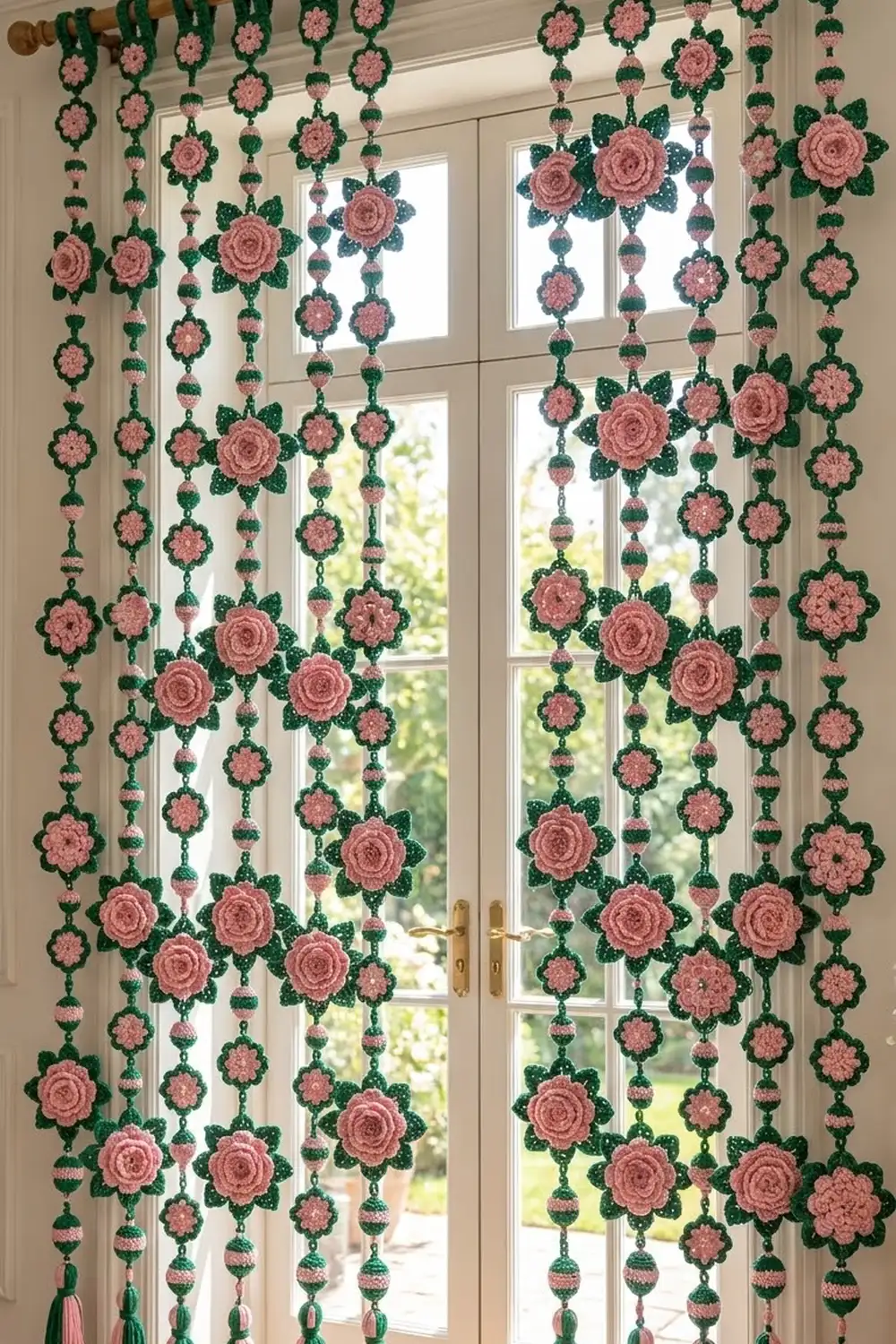
This strand curtain looks like a climbing rose trellis. Each strand is a column of crocheted pieces: small pink-and-green flower medallions, striped stuffed beads, and large layered roses on six-leaf green bases. Short green chains link the pieces, and a two-color tassel weights the bottom of each strand.
The palette is just two colors, rose pink and deep emerald green. Neighboring strands are offset by half a repeat, so the roses form a staggered diagonal pattern across the window. Light shows through the gaps, which makes the curtain feel airy.
The pattern is written in US crochet terms. One panel has 10 strands. Each strand measures 80.5 in (204.5 cm) from the bottom of the rod to the tip of the tassel. The panel spans about 41 in (104.1 cm) at its widest point. Make two panels for a pair like the one shown.
Construction is simple and very repetitive. You make each piece separately in the round, sew each rose onto its leaf base, and then link everything into strands with short chain connectors. Hanging loops at the top and tassels at the bottom act as the finishing edge.
Finished Size and Construction
- Finished size (one panel): 10 strands, each 80.5 in (204.5 cm) long; panel about 41 in (104.1 cm) wide
- Skill level: Intermediate
- Terminology: US crochet terms
- Yarn weight: DK (weight 3) cotton
- Hook: 3.5 mm (E-4)
- Number of pieces per panel: 60 medallions, 60 roses, 60 leaf bases, 120 beads, 10 tassels
- Layout: 10 strands spaced 4 in (10.2 cm) apart, center to center
- Piece sizes: medallion 3 in (7.6 cm); bead 1 in (2.5 cm); rose 3.5 in (8.9 cm); rose on its leaf base 5 in (12.7 cm)
- Repeat unit: 12 in (30.5 cm)
- Strand body before finishing: 6 repeats = 72 in (182.9 cm)
- Finishing depth: 2 in (5.1 cm) loop below the rod plus a 0.5 in (1.3 cm) connector at the top; 6 in (15.2 cm) tassel at the bottom
Materials
Use a smooth, mercerized DK cotton. It keeps the petals crisp and the leaf points sharp, and it doesn’t stretch much while hanging. Avoid acrylic blends that grow over time, because the curtain carries its own weight on chains.
Yarn for one panel (example yarn: 50 g / 110 m per ball):
– Rose pink: 500 g (1100 m), 10 balls
– Emerald green: 500 g (1100 m), 10 balls
Double these amounts for a pair of panels. The quantities include a margin of roughly 10–20% for test pieces and tassel trimming.
Tools:
– 3.5 mm (E-4) crochet hook
– Tapestry needle
– Polyester fiberfill, about 75 g per panel
– Stitch markers
– Measuring tape
– Stiff card 6.5 in (16.5 cm) tall for tassels
– Scissors, rustproof pins, and a blocking mat
Abbreviations (US Terms)
- ch – chain
- sl st – slip stitch
- sc – single crochet
- hdc – half double crochet
- dc – double crochet
- tr – treble crochet
- dtr – double treble crochet
- inc – 2 sc in the same stitch
- dec – sc2tog (single crochet 2 together)
- MR – magic ring
- sp – space
- st(s) – stitch(es)
Special stitches:
– Picot point: ch 3, then sl st in the 3rd ch from the hook. This forms the leaf tip.
– Standing sc: start with a slip knot on the hook, insert the hook into the stitch, and complete a sc.
– Post sc from the back (BPsc): insert the hook from back to front to back around the post of the stitch, and complete a sc.
Gauge and Checkpoints
Gauge is 20 sc and 22 rows = 4 in (10.2 cm). Chain gauge is 8 ch = 1 in (2.5 cm). The chain gauge matters most, because it controls every connector and loop.
Make one of each piece before you start production, and check these measurements:
- Medallion: Round 1 = 1.2 in (3.0 cm); Round 2 = 2 in (5.1 cm); Round 4 = 3 in (7.6 cm)
- Bead: 1 in (2.5 cm) tall and wide after stuffing
- Leaf base: Round 2 = 2.25 in (5.7 cm); after leaves = 5 in (12.7 cm)
- Rose: Round 3 = 1.75 in (4.4 cm); Round 5 = 2.75 in (7.0 cm); Round 7 = 3.5 in (8.9 cm)
- Connector: ch 4 = 0.5 in (1.3 cm)
If your pieces are too big, switch to a 3.25 mm hook. If they are too small, switch to a 3.75 mm hook. If only the chains are off, adjust the connector count (ch 3 or ch 5) rather than changing the pieces. The 12 in (30.5 cm) repeat is what has to hold.
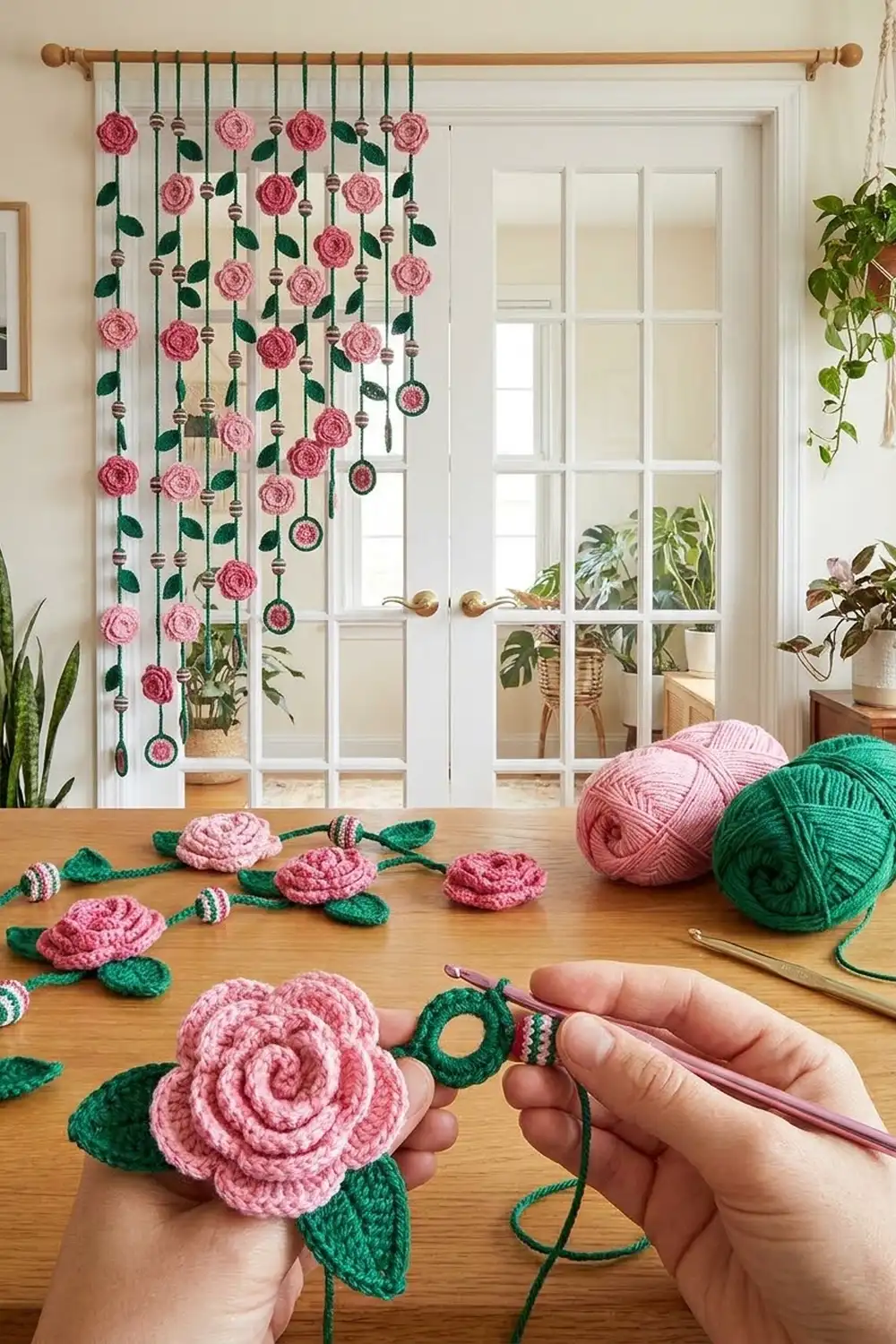
Pattern: Flower Medallion (make 60)
Round 1 (pink): Make a MR. Ch 3 (counts as dc) and work 15 dc in the ring. Join with a sl st to the top of the ch-3. (16 dc)
Round 2 (pink): Ch 1. Sc in the next st, then work (hdc, 2 dc, hdc) in the next st. Repeat from * 7 more times. Join to the first sc. (8 sc + 8 petals of 4 sts = 40 sts) Fasten off.
Round 3 (green): Make a standing sc in any sc of Round 2. Ch 4, pass the chain behind the next petal, and sc in the next sc. Repeat around, ending with ch 4 and a sl st to the first sc. (8 sc + 8 ch-4 loops)
Round 4 (green, scallop trim): Work (sc, hdc, 3 dc, hdc, sc) in each ch-4 loop, and sl st in each Round 3 sc between loops. (8 loops × 7 sts = 56 sts) Fasten off.
The pink petals sit in front of a solid green scalloped ring. The Round 3 sc between scallops are the joining points. Mark two opposite ones, sc 1 and sc 5, as top and bottom.
Pattern: Striped Bead (make 120)
Round 1 (green): 6 sc in a MR. (6)
Round 2: Inc in each st around. (12)
Round 3: Sc in the next st, inc. Repeat 6 times. (18)
Rounds 4–5 (pink): Sc in each st around. (18 each)
Round 6 (green): Sc in the next st, dec. Repeat 6 times. (12) Stuff firmly.
Round 7: Dec 6 times. (6) Close the hole and leave a 4 in (10.2 cm) tail.
The bead’s joining points are the center of the MR (top) and the closure (bottom).
Pattern: Leaf Base (make 60)
Round 1 (green): Make a MR. Ch 3 (counts as dc) and work 11 dc in the ring. Join. (12 dc)
Round 2: Ch 3 and work 1 dc in the same st, then 2 dc in each remaining st. Join. (24 dc)
Round 3: Ch 1 and sc in the first st. Ch 5, skip 3 sts, sc in the next st. Repeat around, ending with ch 5 and a sl st to the first sc. (6 sc + 6 ch-5 loops)
Round 4 (leaves): In each ch-5 loop, work (sc, hdc, dc, tr, dtr, picot point, dtr, tr, dc, hdc, sc). Sl st in each Round 3 sc between leaves. (6 leaves × 10 sts + 6 picots) Fasten off.
Each leaf extends about 1.4 in (3.6 cm) past the 2.25 in (5.7 cm) base. That makes the base 5 in (12.7 cm) from leaf tip to leaf tip. The picot makes the pointed tip, and the open chain loop shows as a center vein. Mark Round 3 sc 1 and sc 4, which sit opposite each other, as the joining points.
Pattern: Layered Rose (make 60)
Round 1 (pink): Ch 1 and work 12 sc in a MR. Join. (12 sc)
Round 2: Ch 1 and sc in the first st. Ch 3, skip 1, sc in the next st. Repeat around, ending with ch 3 and a join. (6 sc + 6 ch-3 sps)
Round 3 (inner petals): Work (sc, hdc, 3 dc, hdc, sc) in each ch-3 sp. (6 petals × 7 = 42 sts)
Round 4: Working behind the petals, BPsc around each Round 2 sc, with ch 5 between. (6 sc + 6 ch-5 loops)
Round 5 (middle petals): Work (sc, hdc, 5 dc, hdc, sc) in each ch-5 loop. (6 × 9 = 54 sts)
Round 6: BPsc around each Round 4 sc, with ch 7 between. (6 sc + 6 ch-7 loops)
Round 7 (outer petals): Work (sc, hdc, 7 dc, hdc, sc) in each ch-7 loop. (6 × 11 = 66 sts) Fasten off and leave a 12 in (30.5 cm) tail.
Assembly: Center the rose on the leaf base and turn it so each outer petal sits between two leaves. Use the tail to whipstitch the back of Rounds 4 and 6 to Round 2 of the base. The rose covers the base and the inner part of each leaf, leaving about 0.75 in (1.9 cm) of each leaf showing.
Make All Pieces
Per panel:
– 60 medallions (pink Rounds 1–2, green Rounds 3–4)
– 120 beads (green, pink, green)
– 60 roses (pink)
– 60 leaf bases (green)
– 10 tassels (pink and green)
Per strand: 6 medallions, 12 beads, 6 rose-and-leaf units, 1 tassel.
There are two strand types:
– Strand A (odd strands): medallion – bead – rose – bead, repeated 6 times
– Strand B (even strands): rose – bead – medallion – bead, repeated 6 times
Layout grid, one repeat (M = medallion, b = bead, R = rose):
Strand:  1  2  3  4  5  6  7  8  9  10
         M  R  M  R  M  R  M  R  M  R
         b  b  b  b  b  b  b  b  b  b
         R  M  R  M  R  M  R  M  R  M
         b  b  b  b  b  b  b  b  b  b
(repeat 6 times down each strand)
Every unit is 12 in (30.5 cm) long in both strand types: 3 + 0.5 + 1 + 0.5 + 5 + 0.5 + 1 + 0.5 in. As a result, all the strands end at the same height, and each rose sits beside a medallion on the neighboring strand.
Joining (Building the Strands)
Method: Join with chain connectors.
1. Join green with a sl st at the bottom joining point of the upper piece.
2. Ch 4.
3. Sl st into the top joining point of the next piece.
4. Fasten off and weave in the ends.
Stitch-to-stitch logic:
– Medallions join at Round 3 sc 1 (top) and sc 5 (bottom).
– Leaf bases join at Round 3 sc 1 (top) and sc 4 (bottom).
– Beads join at the MR center (top) and the closure (bottom).
Because each pair of joining points is directly opposite, every piece hangs straight.
Connector count: Each strand has 24 pieces, so it needs 23 connectors between pieces, plus 1 at the top and 1 at the bottom, for 25 connectors per strand.
Tension: Work the chains at your gauge, 8 ch per 1 in (2.5 cm). Tight chains pull the pieces into a cramped stack, and loose chains let the strands twist.
Size checkpoint: After the first repeat, hang the strand and measure from the top of the first piece to the top of the fifth piece. It should be 12 in (30.5 cm). A full strand body measures 72 in (182.9 cm).
Border (Top Loops and Tassel Fringe)
This curtain has no fabric edge. The hanging loops form the top border and the tassels form the bottom border, and both use the 8 ch = 1 in (2.5 cm) chain gauge.
Top border, per strand: Sl st into the top joining point of the first piece and ch 4 for the connector. Ch 48 more, then sl st into the 4th connector ch to close the loop.
– Each loop is 48 ch, or 6 in (15.2 cm) around.
– One panel has 10 loops × 48 ch = 480 ch.
– Each loop fits a rod up to 1.5 in (3.8 cm) in diameter. On a 1 in (2.5 cm) rod, 2 in (5.1 cm) of loop shows below the rod.
Bottom border, per strand: After the last bead, ch 4 for the connector, ch 4 more, and sl st into the first of those 4 ch to make a small ring.
1. Wrap 5 pink and 5 green strands at once around the 6.5 in (16.5 cm) card, then cut along one edge. This gives 10 pink and 10 green strands, each 13 in (33.0 cm) long.
2. Fold the strands in half through the ring.
3. Wrap the neck tightly with green, 0.75 in (1.9 cm) below the fold, and secure the end.
4. Trim the tassel to 6 in (15.2 cm).
Each tassel has 20 cut strands (40 hanging ends), and one panel has 10 tassels, or 200 cut strands.
Why the math works: Each strand adds up to 2 in loop + 0.5 in connector + (6 × 12 in) + 6 in tassel = 80.5 in (204.5 cm). With 10 strands spaced 4 in (10.2 cm) apart, the outer strand centers are 36 in (91.4 cm) apart. Half a rose width, 2.5 in (6.4 cm), sticks out on each side, so the panel is about 41 in (104.1 cm) wide.
Final Blocking
- Before joining, soak the roses, leaf bases, and medallions in cool water and press out the excess in a towel.
- Pin the leaf bases flat so the six leaves are evenly spaced, and open each picot tip into a point.
- Shape the rose petals with your fingers, cupping the inner tier slightly upward.
- Pin each medallion into a 3 in (7.6 cm) circle with even scallops.
- Let everything dry completely. Don’t wet the beads.
- After the strands are joined, hang the panel and steam the tassels lightly so they hang straight.
- Let the panel hang for 24 hours, then re-trim the tassels to an even 6 in (15.2 cm).
Final Quality-Control Checklist
- Every medallion measures 3 in (7.6 cm) and has 8 even scallops.
- Every rose has 3 tiers of 6 petals, with the petals sitting between the leaves.
- Every bead is firmly stuffed and shows a centered pink stripe.
- Each strand has 6 complete repeats in the correct A or B order.
- Every connector is ch 4 and measures about 0.5 in (1.3 cm).
- All strands measure 80.5 in (204.5 cm) within 0.5 in (1.3 cm) of each other.
- All ends are woven in securely, with none hanging loose.
- The tassels are trimmed level and have firm necks.
Troubleshooting
Pieces tilt sideways: The joining points aren’t directly opposite each other. Recount Round 3 and reattach at sc 1 and sc 5 (medallion) or sc 1 and sc 4 (leaf base).
Strands are different lengths: Your chain tension is drifting. Remake any connector that measures longer or shorter than 0.5 in (1.3 cm).
Rose petals flop: Your stitches are too loose. Go down a hook size for the petal rounds only.
Leaves curl: Block them flat with a pin in each picot tip.
Beads look lumpy: Stuff in small pieces and pack the fiberfill firmly before Round 7.
Strands twist while hanging: Add a few hand stitches at the base of each top loop to keep the loop flat.
Care
Dust the curtain gently or shake it out. When it needs cleaning, hand wash it in cool water, press out the water in towels, and lay it flat or hang it to dry. Don’t wring it or use a dryer.
Final Notes
The measurements build on each other. An 8 ch per 1 in (2.5 cm) chain gauge gives 0.5 in (1.3 cm) connectors. Pieces measuring 3 in, 1 in, and 5 in (7.6 cm, 2.5 cm, and 12.7 cm), plus the connectors, give a 12 in (30.5 cm) repeat. Six repeats give a 72 in (182.9 cm) strand body. The loop and tassel bring the full strand to 80.5 in (204.5 cm), and 10 strands spaced 4 in (10.2 cm) apart make a panel about 41 in (104.1 cm) wide. If each piece passes its checkpoint, the finished curtain will measure correctly.
Happy crocheting!