

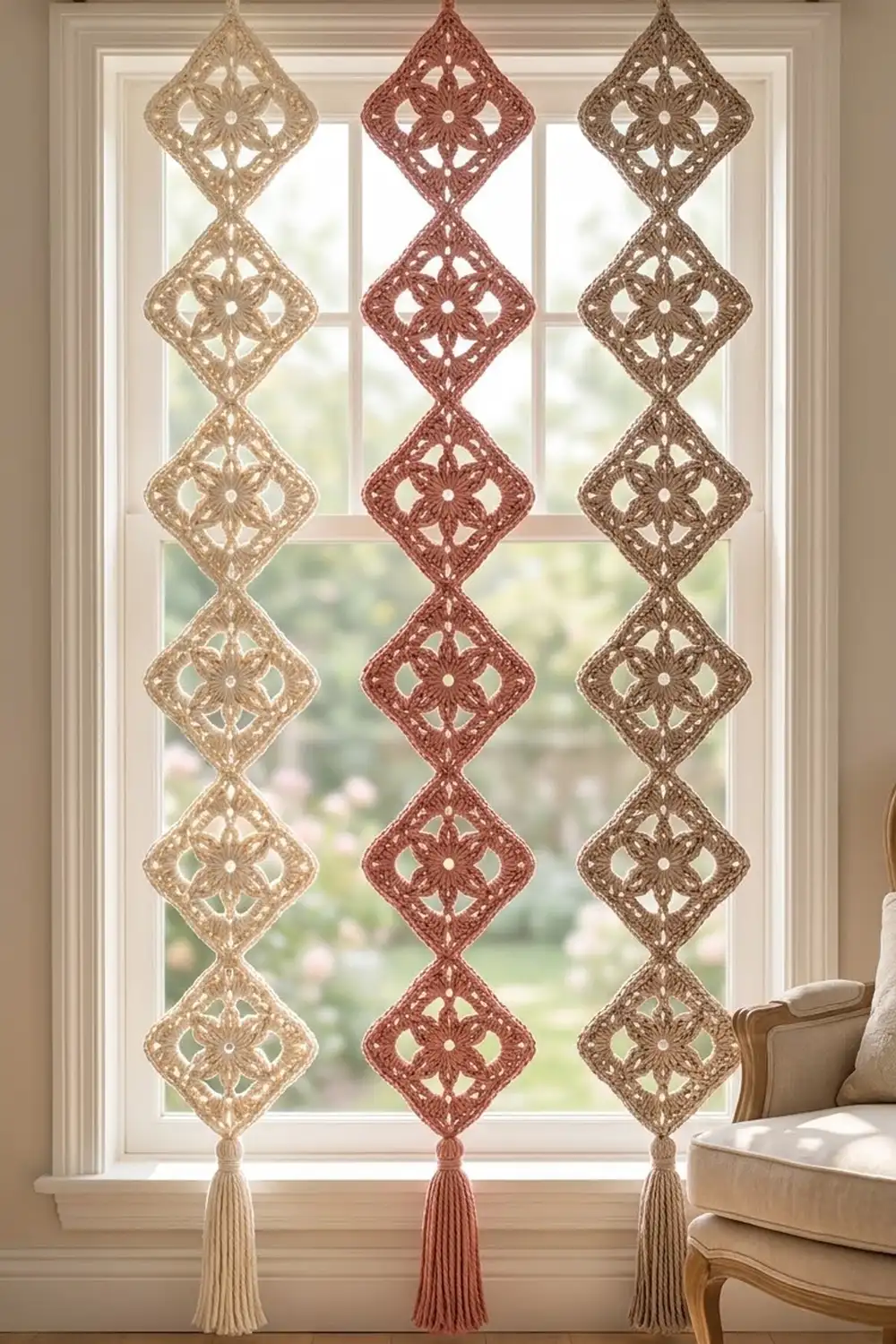
The Rosewindow Lace Curtain Strand is a long, airy strip of flower diamonds that catches the light when it hangs at a window. Each diamond has an eight-petal cluster rosette in the middle, framed by open chain windows and a crisp single crochet outline. A corded crab-stitch edge runs around the whole strand. A sturdy loop sits at the top and a full tassel at the bottom.
The sample strands are made in soft cream, dusty rose and warm taupe cotton. Each strand uses one color. You can make one as a sheer accent, or hang several side by side as a strand curtain. Each strand is a finished piece and is never sewn to the others.
This pattern uses US crochet terms. Each finished strand is 5.2 in (13.2 cm) wide and 43 in (109.2 cm) long. With the 2 in (5.1 cm) loop and the 6 in (15.2 cm) tassel, it hangs 51 in (129.5 cm) in total.
Construction is simple. You make one complete motif. Then you make nine more and join each one to the previous motif during its last round, at a single corner point. You finish with two border rounds around the whole strip, then add the hanging loop and the tassel.
Finished Size and Construction
- Finished strand size: 5.2 in (13.2 cm) wide × 43 in (109.2 cm) long, not counting the loop and tassel
- Total hanging length: 51 in (129.5 cm)
- Skill level: Intermediate (clusters, join-as-you-go, reverse single crochet)
- Terminology: US
- Yarn weight: Worsted (#4) cotton
- Hook: 4.5 mm (US 7)
- Number of pieces: 10 motifs per strand, joined into one strip
- Layout: 1 column × 10 motifs, set on point
- Motif size: 3 in (7.6 cm) per side, 4.2 in (10.7 cm) point to point
- Size before border: 4.2 in (10.7 cm) × 42 in (106.7 cm)
- Border depth: 0.5 in (1.3 cm) on every edge
Materials
Use a smooth, tightly plied cotton or cotton blend in worsted weight. Cotton shows the stitch detail clearly, holds the diamond shape and hangs straight without too much stretch. Avoid fluffy or brushed yarns, because they fill in the open windows.
Yarn for one strand (in one color):
– Cream: 100 g (170 m) per cream strand
– Dusty Rose: 100 g (170 m) per rose strand
– Taupe: 100 g (170 m) per taupe strand
That 100 g covers about 60 g (102 m) for the motifs, 22 g (37 m) for the border, 2 g (3 m) for the loop and 8 g (14 m) for the tassel. These quantities include a margin of about 10 percent for gauge differences and the gauge swatch.
Tools:
– 4.5 mm (US 7) crochet hook, plus 4 mm and 5 mm hooks for adjusting gauge
– Tapestry needle
– Scissors
– Stiff cardboard, 6.5 in (16.5 cm) tall, for the tassel
– Stitch markers
– Blocking mat, rust-proof pins and a spray bottle
– Measuring tape
Abbreviations (US Terms)
- ch – chain
- sl st – slip stitch
- sc – single crochet
- dc – double crochet
- rev sc – reverse single crochet (crab stitch)
- sp – space
- st(s) – stitch(es)
- rep – repeat
- yo – yarn over
Special stitches:
- Beginning cluster (beg cl): Ch 3. *Yo, insert hook in ring, pull up a loop, yo, pull through 2 loops; rep from * once more. Yo, pull through all 3 loops on hook.
- Cluster (cl): *Yo, insert hook in ring, pull up a loop, yo, pull through 2 loops; rep from * 2 more times. Yo, pull through all 4 loops on hook.
- Reverse single crochet (rev sc): Working from left to right (right to left if you crochet left-handed), insert hook in the next st to the right, pull up a loop, yo, pull through both loops.
Gauge and Checkpoints
Make one full motif and block it before you start the strand. Every later measurement depends on this one piece.
Gauge: 5 sc = 1 in (2.5 cm) along a side of Round 3, so each 15-sc side measures 3 in (7.6 cm).
Checkpoints:
– After Round 1: the flower is 1.5 in (3.8 cm) across.
– After Round 2: each side is about 2.75 in (7.0 cm).
– After Round 3: each side is 3 in (7.6 cm), and the motif is 4.2 in (10.7 cm) point to point.
If your motif is too big (over 3.25 in / 8.3 cm per side), change to a 4 mm hook. If it’s too small (under 2.75 in / 7.0 cm per side), change to a 5 mm hook. Check the size again after blocking. A tolerance of ±0.25 in (0.6 cm) per side is fine, but every motif in a strand must match the others.
Motif (Make 1 Complete)
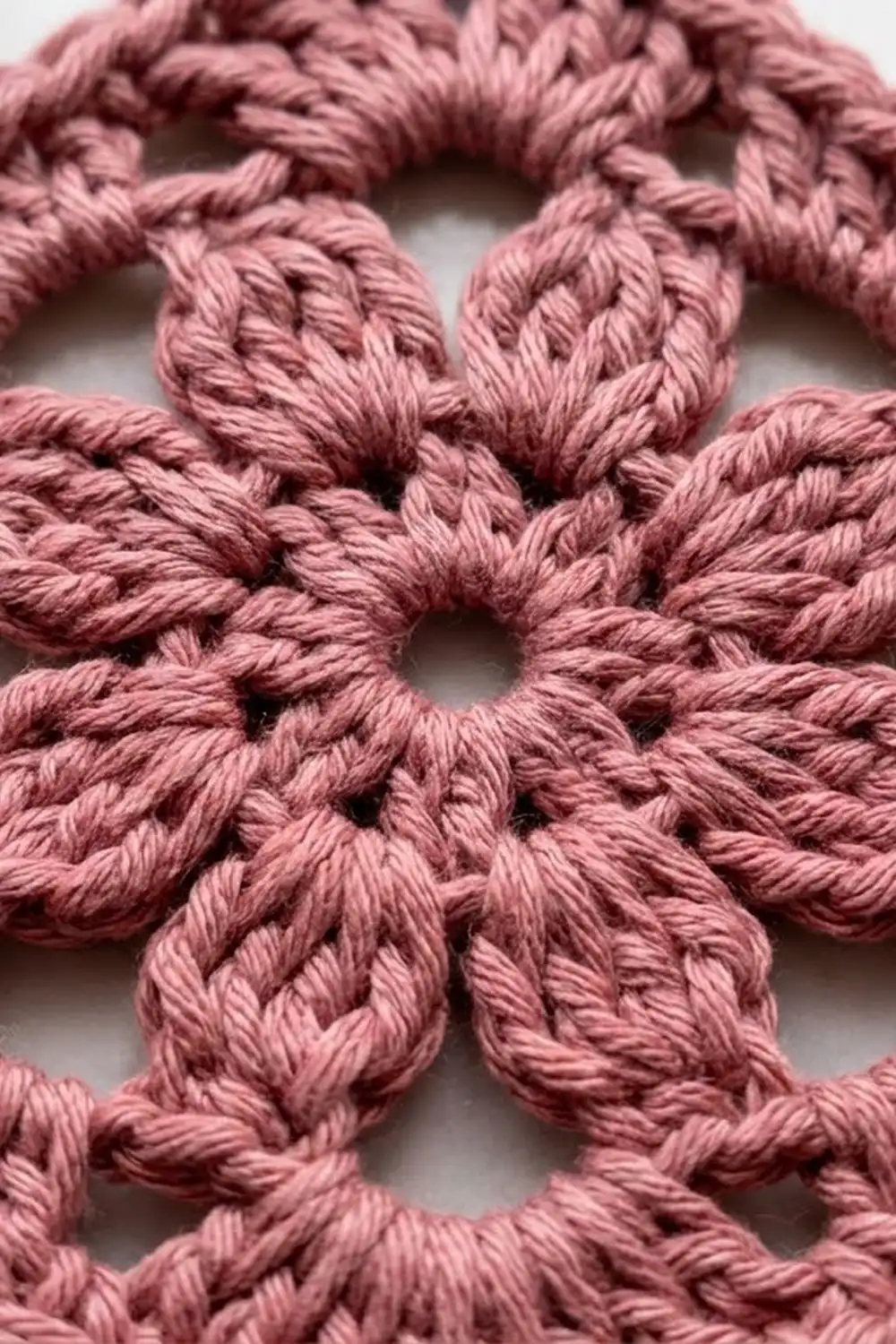
Round 1 (flower): Make a magic ring. Work beg cl in the ring, ch 2. Work cl in the ring, ch 2; rep from * 6 more times. Join with a sl st to the top of beg cl. Pull the ring tight, leaving a small center hole.
(8 clusters, 8 ch-2 sps)*
Round 2 (windows and corners): Sl st into the first ch-2 sp. Ch 3 (counts as dc), then work (2 dc, ch 2, 3 dc) in the same sp for the first corner. Ch 3, sc in the next ch-2 sp, ch 3. Work (3 dc, ch 2, 3 dc) in the next ch-2 sp, ch 3, sc in the next ch-2 sp, ch 3; rep from * 2 more times. Join with a sl st to the top of the beg ch-3.
(24 dc, 4 sc, 8 ch-3 sps, 4 corner ch-2 sps)*
The ch-3 loops arch over every other petal. They form the four open windows around the flower, and the dc corner groups turn the circle into a square.
Round 3 (outline): Ch 1. Sc in the same st as the join, then sc in the next 2 dc. Work (sc, ch 2, sc) in the corner ch-2 sp. Sc in the next 3 dc, 3 sc in the ch-3 sp, sc in the sc, 3 sc in the next ch-3 sp, sc in the next 3 dc, (sc, ch 2, sc) in the corner ch-2 sp; rep from * 2 more times. Sc in the next 3 dc, 3 sc in the ch-3 sp, sc in the sc, 3 sc in the last ch-3 sp. Join with a sl st to the first sc. Fasten off and weave in the ends.
(60 sc: 15 sc per side, 4 corner ch-2 sps)*
Per-side check: Each side has 1 corner sc + 3 + 3 + 1 + 3 + 3 + 1 corner sc = 15 sc. Each corner has two sc, and one belongs to each side, so 4 sides × 15 = 60 sc. The corners are not counted twice.
Block this motif and check it against the gauge checkpoints before going on.
Make All Pieces
You need 10 motifs per strand, all in the strand’s color. Work Rounds 1–2 the same way for every motif. Motif 1 is made exactly as written above. Motifs 2–10 replace one corner of Round 3 with a join (see Joining).
- Cream strand: 10 cream motifs
- Dusty Rose strand: 10 rose motifs
- Taupe strand: 10 taupe motifs
Layout grid (one strand, set on point):
   ◇  Motif 1   ← top point: hanging loop
   ◇  Motif 2
   ◇  Motif 3
   ◇  Motif 4
   ◇  Motif 5
   ◇  Motif 6
   ◇  Motif 7
   ◇  Motif 8
   ◇  Motif 9
   ◇  Motif 10  ← bottom point: tassel
Each motif’s top corner meets the bottom corner of the motif above it.
Joining
Method: Join as you go, at one corner point, during Round 3.
On motifs 2–10, the first corner you reach in Round 3 becomes the top corner. Work it like this: sc, ch 1, sl st into the bottom-corner ch-2 sp of the previous motif, ch 1, sc. Finish the round as written, using normal (sc, ch 2, sc) corners for the other three. The third corner you work, which sits directly opposite the join, becomes this motif’s bottom corner. The next motif joins there.
Stitch logic: The ch 1 + sl st + ch 1 replaces the ch-2 corner space, so the corner keeps the same height. Both corner sc stay in place, and every motif still has 60 sc with 15 sc per side. Nothing is added or removed at the seam.
Tension: Work the two ch-1s at the same relaxed tension as a normal ch-2. If they’re tight, the joined points pucker and the strand bends. If they’re loose, the strand stretches at every join when it hangs.
Before each join, lay the motifs flat with right sides facing up, so all the flowers face the same way.
Size checkpoint: After 10 motifs, the strip measures 4.2 in (10.7 cm) wide and 42 in (106.7 cm) long from top point to bottom point (10 × 4.2 in).
Border
Border gauge: Keep the same 5 sc = 1 in (2.5 cm). Work one stitch in every stitch along the motif sides. If the border is tighter than the motifs, the zigzag edge curls.
Edge terms used below:
– Long edges: the left and right zigzag edges, from the top point to the bottom point.
– Outer points: the side corners of each motif.
– Inner Vs: the places where two motifs join.
Each motif gives 2 sides × 15 sc = 30 sc to each long edge. That makes 10 × 30 = 300 sc per long edge, plus 2 × 300 = 600 sc around the whole strip.
Border Round 1 (sc): With the right side facing, join yarn in the top-point ch-2 sp of Motif 1. Ch 1 and work (sc, ch 2, sc) in the same sp.
Work down the first long edge. For each motif: sc in each of the 15 sts of the upper side, (sc, ch 2, sc) in the outer-point ch-2 sp, then sc in each of the 15 sts of the lower side. At each inner V, go straight from the last sc of one motif to the first sc of the next one. Skip the join chains and add no stitches there.
At the bottom point of Motif 10, work (sc, ch 2, sc) in the ch-2 sp. Work up the second long edge the same way. Join with a sl st to the first sc.
- Each long edge: 300 sc worked 1 per stitch + 20 extra sc at 10 outer points = 320 sc
- Top point: 0 existing + 2 extra = 2 sc
- Bottom point: 0 existing + 2 extra = 2 sc
- Round total: 600 worked 1 per stitch + 44 extra = 644 sc, with 22 ch-2 sps
Border Round 2 (rev sc): Ch 1 and do not turn. Work rev sc in each sc, and 1 rev sc in each ch-2 sp. Join with a sl st to the first rev sc. Fasten off.
- Each long edge: 320 worked 1 per stitch + 10 in the outer-point sps = 330 rev sc
- Top point and bottom point: 2 worked 1 per stitch + 1 in the sp = 3 rev sc each
- Round total: 644 worked 1 per stitch + 22 in the sps = 666 rev sc
Why the math works: The motif sides keep exactly 1 border stitch per stitch, so they stay 3 in (7.6 cm) long and lie flat. Extra stitches go only at the outward points, where the edge turns sharply around a corner. The inner Vs get nothing extra, because they point inward and would ruffle if you added stitches. The two rounds add 0.5 in (1.3 cm) to every edge:
- Width: 4.2 + 0.5 + 0.5 = 5.2 in (13.2 cm)
- Length: 42 + 0.5 + 0.5 = 43 in (109.2 cm)
Hanging Loop: With the right side facing, join yarn with a sl st in the center rev sc at the top point. Ch 24 and sl st in the same st. Work 30 sc into the loop, then sl st into the base. Fasten off.
The loop stands 2 in (5.1 cm) tall and fits rods up to 1.25 in (3.2 cm) in diameter.
Tassel: Wrap yarn 20 times around the 6.5 in (16.5 cm) cardboard and cut along one edge. This gives 20 strands, each 13 in (33.0 cm) long. Thread a 12 in (30.5 cm) tie strand through the center rev sc at the bottom point. Lay the bundle across it, fold the strands in half to make 40 ends, and tie them tightly.
Wrap a separate strand around the tassel 0.75 in (1.9 cm) below the top, about 8 times. Knot it, and use a needle to bury the ends inside the tassel. Trim the tassel to 6 in (15.2 cm).
Final Blocking
- Weave in all the ends before blocking, working them into the motif outlines rather than the open windows.
- Spray the strand evenly until it is damp. Don’t soak it, because heavy wet cotton stretches.
- Pin it out flat on the mat at 5.2 in (13.2 cm) wide across the outer points and 43 in (109.2 cm) long from the top point to the bottom point.
- Pin out every outer point and the base of every inner V so that each motif side runs straight.
- Open each chain window with your fingertip and lightly pat the flower petals flat.
- Let the strand dry completely before unpinning.
- Steam the tassel and comb it straight with your fingers, then trim any uneven ends.
Final Quality-Control Checklist
- Each motif has 8 clusters, 4 open windows and 60 sc, with 15 sc per side.
- All 10 motifs face right side up and sit in one straight column.
- Every join is a neat single point with no gaps or puckering.
- Border Round 1 has 644 sc and Border Round 2 has 666 rev sc.
- The strand measures 5.2 in (13.2 cm) × 43 in (109.2 cm).
- The hanging loop is centered and secure.
- The tassel is wrapped firmly and measures 6 in (15.2 cm).
- All ends are hidden and trimmed.
Troubleshooting
The motif is wavy or cupped. If it ruffles, your Round 2 dc are too tall: go down a hook size. If it cups, your clusters are too tight: go up a hook size.
The windows look closed. The ch-3 loops are too tight. Chain more loosely, or work the chains with a hook one size larger.
The strand is crooked. One of the joins was made at a side corner instead of the bottom corner. Check that each join sits opposite the previous one.
The border edge curls. Your border tension is tighter than your motifs. Rework it with a 5 mm hook.
The inner Vs ruffle. You’ve added stitches at the joins. Work only 1 sc per stitch there.
The strand gets longer while it hangs. That’s normal for cotton. Re-block it, and work the join chains a little more firmly on your next strand.
The tassel is thin. Add 5 more wraps to the cardboard when you make it.
Care
Hand wash in cool water with a mild soap, press out the water in a towel, and dry flat to the blocked measurements. Don’t hang the strand while it’s wet, because the weight will stretch it.
Final Notes
Everything in this strand traces back to one measurement: 15 sc per motif side = 3 in (7.6 cm). That gives a diamond 4.2 in (10.7 cm) from point to point. Ten diamonds in a column make a 42 in (106.7 cm) strip. Two border rounds bring it to 5.2 in (13.2 cm) × 43 in (109.2 cm), and the loop and tassel bring the hanging length to 51 in (129.5 cm). Check your first motif and the rest of the strand should match the numbers.
Happy crocheting!