

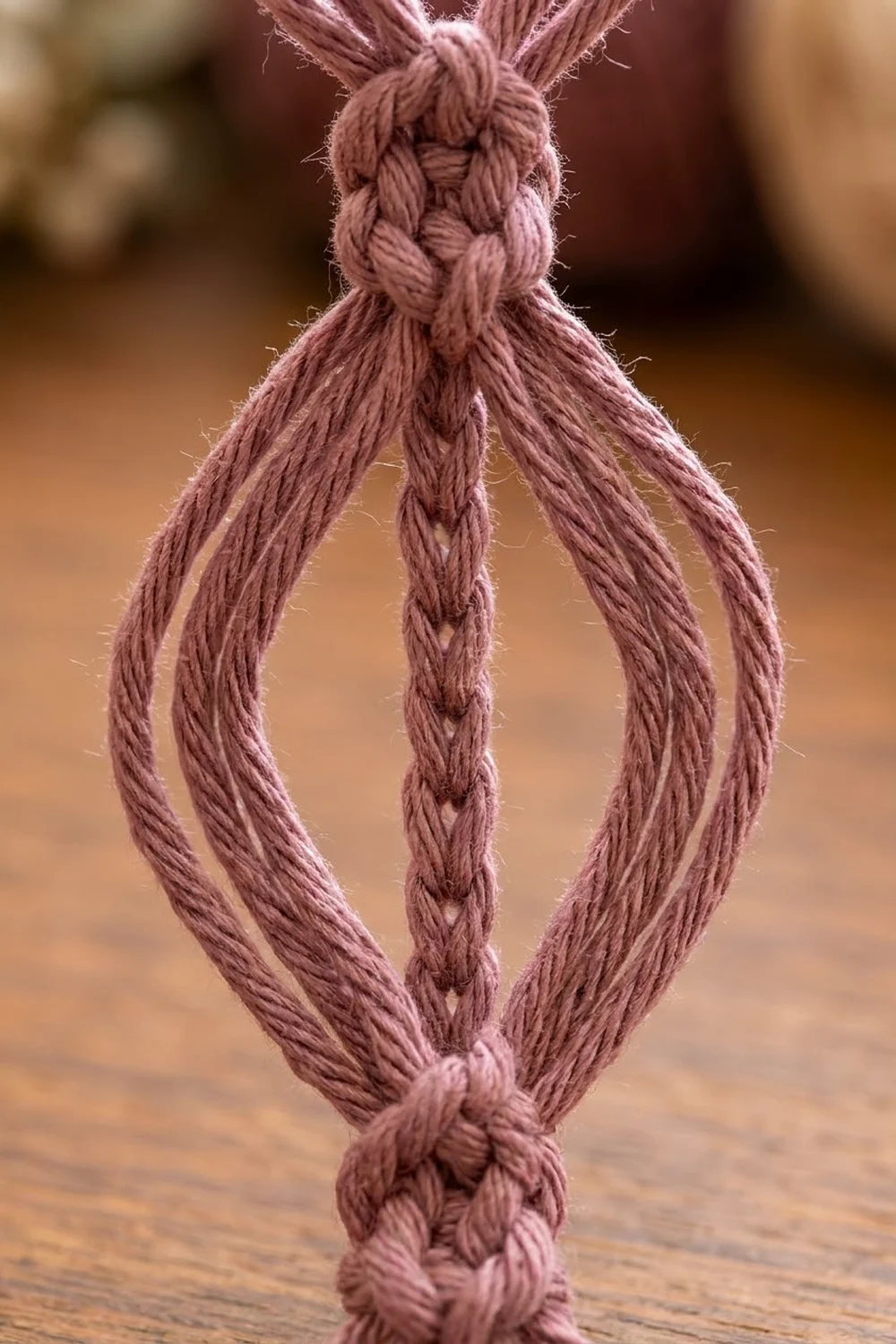
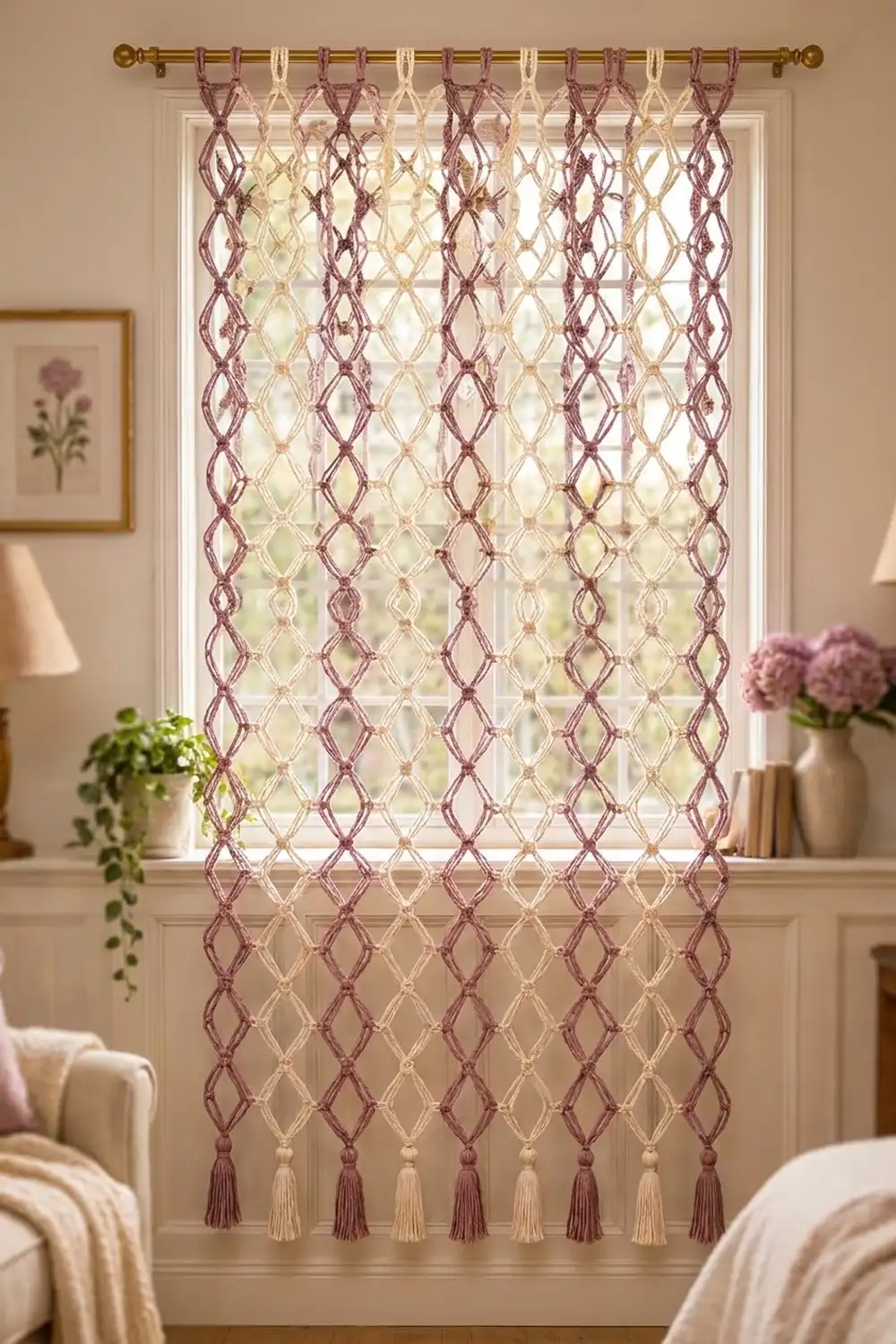
The Rosewood Lattice Strand Curtain is a light, airy window or doorway hanging made from simple chains and small bobble knots. Each strand is a column of almond-shaped lenses. Every lens has three chain strands: a straight center chain and two outer chains that bow outward. A round rosette knot sits between each pair of lenses.
The strands alternate between dusty mauve and soft cream, with mauve on both outer edges. Neighboring strands link at the widest point of each lens, so the whole curtain reads as a diamond lattice. A loop over the rod and a full tassel finish each strand.
This pattern uses US crochet terms. The finished curtain measures 32.5 in (82.6 cm) wide and 63 in (160.0 cm) long from the top of the rod to the tassel tips.
You’ll make 13 separate strands. Strands 2 through 13 are joined to the previous strand as you go, with one slip-stitch join per lens. There is no sewing and no separate assembly row. You finish by adding tassels and blocking.
Finished Size and Construction
- Finished size: 32.5 in (82.6 cm) wide x 63 in (160.0 cm) long
- Skill level: Easy / advanced beginner
- Terminology: US crochet terms
- Yarn weight: Worsted (#4) cotton or cotton-blend cord
- Hook: 5 mm (H-8)
- Number of pieces: 13 strands (7 mauve, 6 cream)
- Layout: 13 strands side by side in 1 row, alternating colors
- Piece size: each strand is 2.5 in (6.4 cm) wide x 63 in (160.0 cm) long, including the loop and tassel
- Size before border: the lattice section of each strand (first knot to last knot) is 53.25 in (135.3 cm)
- Border depth: 4 in (10.2 cm) at the top (3 in / 7.6 cm loop drop plus a 1 in / 2.5 cm stem) and 5.75 in (14.6 cm) at the bottom (1 in / 2.5 cm stem plus a 4.75 in / 12.1 cm tassel)
Materials
Use a smooth, firm cotton or cotton-blend worsted yarn of about 170 m per 100 g. A tightly plied or braided cord shows the chain structure clearly and hangs straight. Avoid fuzzy or very stretchy yarn, because the lenses will lose their shape.
- Color A, dusty mauve: 140 g / 240 m (7 strands plus 7 tassels)
- Color B, cream: 120 g / 205 m (6 strands plus 6 tassels)
These quantities include a margin of about 15 percent for your gauge test and for tension differences.
Tools:
- 5 mm (H-8) crochet hook
- Tapestry needle
- Scissors
- Stiff cardboard cut 5 in (12.7 cm) tall, for the tassels
- Measuring tape
- Curtain rod up to 1.5 in (3.8 cm) in diameter
- Spray bottle and rustproof pins
Abbreviations (US Terms)
- ch – chain
- sl st – slip stitch
- dc – double crochet
- yo – yarn over
- st(s) – stitch(es)
- RK – rosette knot (see below)
Rosette Knot (RK): Ch 3 (does not count as a stitch). Yo, insert your hook into the base point (the stitch the ch-3 grew from), yo, pull up a loop, yo, draw through 2 loops; repeat from * 3 more times (5 loops on hook). Yo and draw through all 5 loops. Ch 1 to lock. The ch-3 and the 4-dc cluster fold into a round bump about 0.75 in (1.9 cm) tall. The locking ch-1 is the knot point* that the next lens grows from.
Gauge and Checkpoints
Chain gauge: 16 ch = 4 in (10.2 cm), or 4 ch per 1 in (2.5 cm), measured relaxed and unstretched.
Repeat gauge: 1 RK + 1 lens = 5.25 in (13.3 cm) long and 2.5 in (6.4 cm) wide when hanging.
Make strand 1 completely before you start the rest, and hang it from the rod overnight. Cotton chain relaxes under its own weight, so measure the strand while it hangs.
Checkpoints:
- Hanging loop folded over the rod: 3 in (7.6 cm) drop.
- From the top of the first RK to the bottom of the 3rd lens knot: 16.5 in (41.9 cm).
- From the top of the first RK to the bottom of the 5th lens knot: 27 in (68.6 cm).
- Finished lattice section (11 knots, 10 lenses): 53.25 in (135.3 cm).
- Each lens at its widest point: 2.5 in (6.4 cm).
If your strand is too long or the lenses are too wide, go down to a 4.5 mm (7) hook. If the strand is too short or the lenses look pinched, go up to a 5.5 mm (I-9) hook. Keep the stitch counts the same. Don’t add or remove chains, because the bow of the lens depends on the 22/18/22 ratio.
Strand Pattern
Every strand is worked the same way. The only difference is the join on the left outer arc of strands 2 through 13.
Hanging Loop and Top Stem
Step 1: Ch 24, then sl st in the first ch to form a ring. (24 ch; 6 in / 15.2 cm around, which gives a 3 in / 7.6 cm drop over the rod.)
Step 2: Ch 4 for the stem. (4 ch; 1 in / 2.5 cm.)
Step 3: Work 1 RK, using the last stem ch as the base point. (1 knot complete; the locking ch-1 is knot point 1.)
Lens Repeat (work 10 times)
Lay the work flat with the hanging loop at the top. “Left” and “right” refer to the strand as it lies in front of you.
Arc 1 (left outer arc): Ch 22. This chain hangs down from the knot point. The end of the chain is the lower point.
Arc 2 (center arc): Ch 18, then sl st into the locking ch-1 of the knot above. Arc 2 runs from the lower point straight back up to the knot. It is 4 ch shorter than the outer arcs, so it sets the length of the lens. The outer arcs are longer, so they bow outward.
Arc 3 (right outer arc): Ch 22, then sl st into the last ch of Arc 1. All 3 arcs now connect the knot above to the lower point.
Knot: Work 1 RK, using the sl st you just made as the base point.
Count per lens: 22 + 18 + 22 = 62 ch, plus 2 sl sts, plus 1 RK (4 ch and 1 cluster).
Repeat the Lens Repeat 9 more times, for 10 lenses total. The strand now has 11 RKs: the top knot plus 1 below each lens.
Stitch check per strand: 24 (loop) + 4 (stem) + 620 (10 lenses x 62) + 44 (11 RK x 4 ch) + 4 (bottom stem) = 696 ch, plus 11 clusters.
Bottom Stem
Ch 4 from the last knot point. (4 ch; 1 in / 2.5 cm.) Fasten off, leaving an 8 in (20.3 cm) tail to attach the tassel.
Joined Arc 1 (strands 2 through 13 only)
Lay the new strand to the right of the previous strand, with the knots level. For each lens, replace the plain Arc 1 with this join:
Ch 11. Drop the loop from your hook. Insert the hook from front to back through the 11th ch of Arc 3 on the matching lens of the previous strand. Pick up the dropped loop and pull it through. Then ch 11. (22 ch; the join is not counted as a ch.)
The 11th ch is the exact midpoint of a 22-ch arc, so each strand links at its widest point. This is what forms the diamond openings between the strands.
Make All Pieces
- Color A (mauve): 7 strands. Strand 1 is unjoined. The other 6 mauve strands each join to the cream strand on their left.
- Color B (cream): 6 strands, each joined to the mauve strand on its left.
Layout (left to right):
1  2  3  4  5  6  7  8  9  10 11 12 13
A  B  A  B  A  B  A  B  A  B  A  B  A
Joining
Method: Join-as-you-go with a drop-loop pull-through at the midpoint of each Arc 1. (Full instructions are under Joined Arc 1 above.)
Stitch-to-stitch logic: Each lens has exactly one join, from ch 11 of the new strand’s Arc 1 to ch 11 of the previous strand’s Arc 3. With 10 lenses per strand, each seam has 10 joins. There are 12 seams, so the curtain has 120 joins in total. No chains are added at any seam. Strand pitch stays at 2.5 in (6.4 cm).
Tension advice: Pull the joining loop snug, but don’t tighten it so much that the two arcs pucker toward each other. Before each join, check that the knots of both strands sit level. If the new strand is one knot higher or lower, the lattice will slant.
Size checkpoint: After strand 2 is joined, the pair measures 5 in (12.7 cm) wide at the lens midpoints. After all 13 strands are joined, the curtain measures 13 x 2.5 in = 32.5 in (82.6 cm) wide.
Border: Top Loops and Tassel Edge
This curtain has no stitched band. Its “border” is the row of top loops and the row of tassels, and each strand contributes exactly one of each.
Border gauge: each loop is 24 ch = 6 in (15.2 cm) around, with a 3 in (7.6 cm) drop. Each tassel hangs 4.75 in (12.1 cm) long.
Top edge: 13 strands x 1 loop = 13 loops, plus 13 stems of 4 ch each. Slide the loops onto the rod in layout order.
Bottom edge: 13 strands x 1 tassel = 13 tassels, each matching its strand color.
Side edges: Arc 1 of strand 1 and Arc 3 of strand 13 stay free. That gives 10 outer arcs per side and no added stitches.
Tassel (make 13): Wrap the yarn 20 times around the 5 in (12.7 cm) card. Slide a 10 in (25.4 cm) tie under the wraps at the top and knot it tightly. Cut the wraps at the bottom. Wrap a 12 in (30.5 cm) strand 6 times around the bundle, 0.75 in (1.9 cm) below the top, and knot it. Bury the ends inside the tassel. Trim the tassel to 4.75 in (12.1 cm). Use the bottom-stem tail to sew the top of the tassel to the last stem ch.
Why the math works: 3 in loop drop + 1 in top stem + 53.25 in lattice + 1 in bottom stem + 4.75 in tassel = 63 in (160.0 cm). The lattice is 0.75 in for the top knot plus 10 x 5.25 in for the repeats, which is 53.25 in (135.3 cm).
Final Blocking
- Hang the finished curtain on its rod.
- Mist every strand lightly with water until it is damp, not wet.
- Gently pull each strand straight down. Ease the outer arcs of each lens into an even, symmetrical curve.
- Shape each knot into a round bump with your fingertips.
- Fluff the tassels and steam them lightly, keeping the iron about 1 in (2.5 cm) away. Then trim any uneven ends.
- Let the curtain dry while it hangs, for at least 12 hours.
- Check the measurements: 32.5 in (82.6 cm) wide and 63 in (160.0 cm) long.
Final Quality-Control Checklist
- 13 strands in the order A-B-A-B-A-B-A-B-A-B-A-B-A.
- Each strand has 1 loop, 11 knots, 10 lenses, 1 tassel.
- Each lens has 3 arcs: 22 ch, 18 ch, 22 ch.
- Each seam has 10 joins, all at ch 11, for 120 joins in total.
- Knots line up horizontally across the curtain.
- All ends are woven in and all tassels are trimmed evenly.
- Width is 32.5 in (82.6 cm) and length is 63 in (160.0 cm).
Troubleshooting
The lenses look flat instead of round: Your center arc is too long. Recount it; it should be 18 ch, which is 4 ch shorter than the outer arcs.
A strand is longer than its neighbors: Your chain tension changed partway through. Remake the strand, or block it more firmly to match.
The lattice slants: A join went into the wrong lens. Undo back to that point and rejoin to the matching lens.
The knots look loose or flat: Pull the cluster closure tight before you make the locking ch-1.
A strand twists on the rod: Make sure every Arc 2 sl st goes into the locking ch-1 from the same side.
The tassels look thin: Wrap the card 24 times instead of 20, using the extra yarn margin.
Care
Hand wash the curtain in cool water with mild soap and squeeze out the water gently without wringing. Then rehang it on the rod and reshape the lenses while it dries.
Final Notes
The measurement chain is simple. At 4 ch per 1 in (2.5 cm), each 22/18/22 lens plus its knot gives a 5.25 in (13.3 cm) repeat that is 2.5 in (6.4 cm) wide. Ten repeats plus the top knot make a 53.25 in (135.3 cm) lattice. Adding the loop, stems, and tassel brings each strand to 63 in (160.0 cm), and 13 joined strands give a width of 32.5 in (82.6 cm). Check your first strand carefully, and the other twelve will match it.
Happy crocheting!