

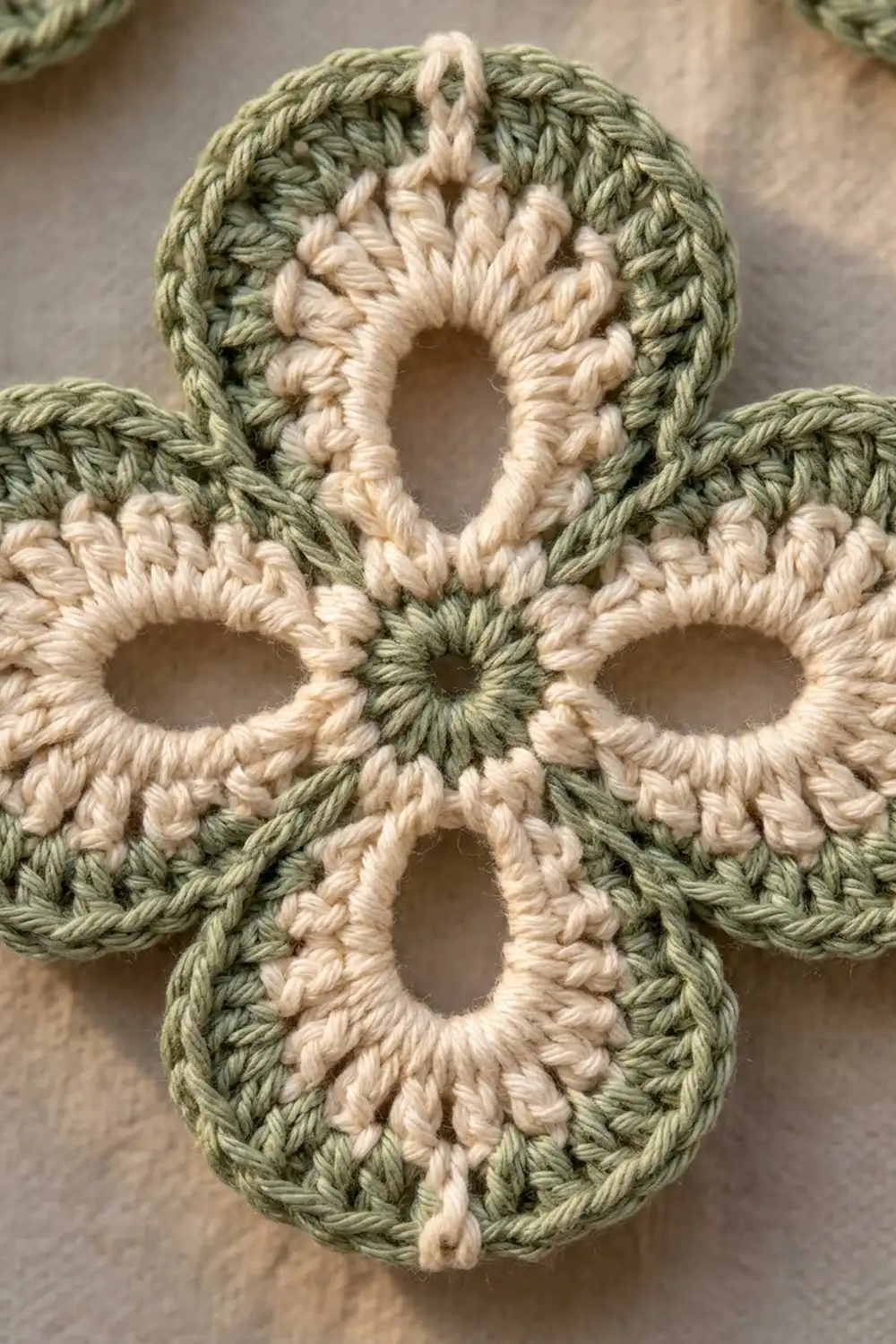
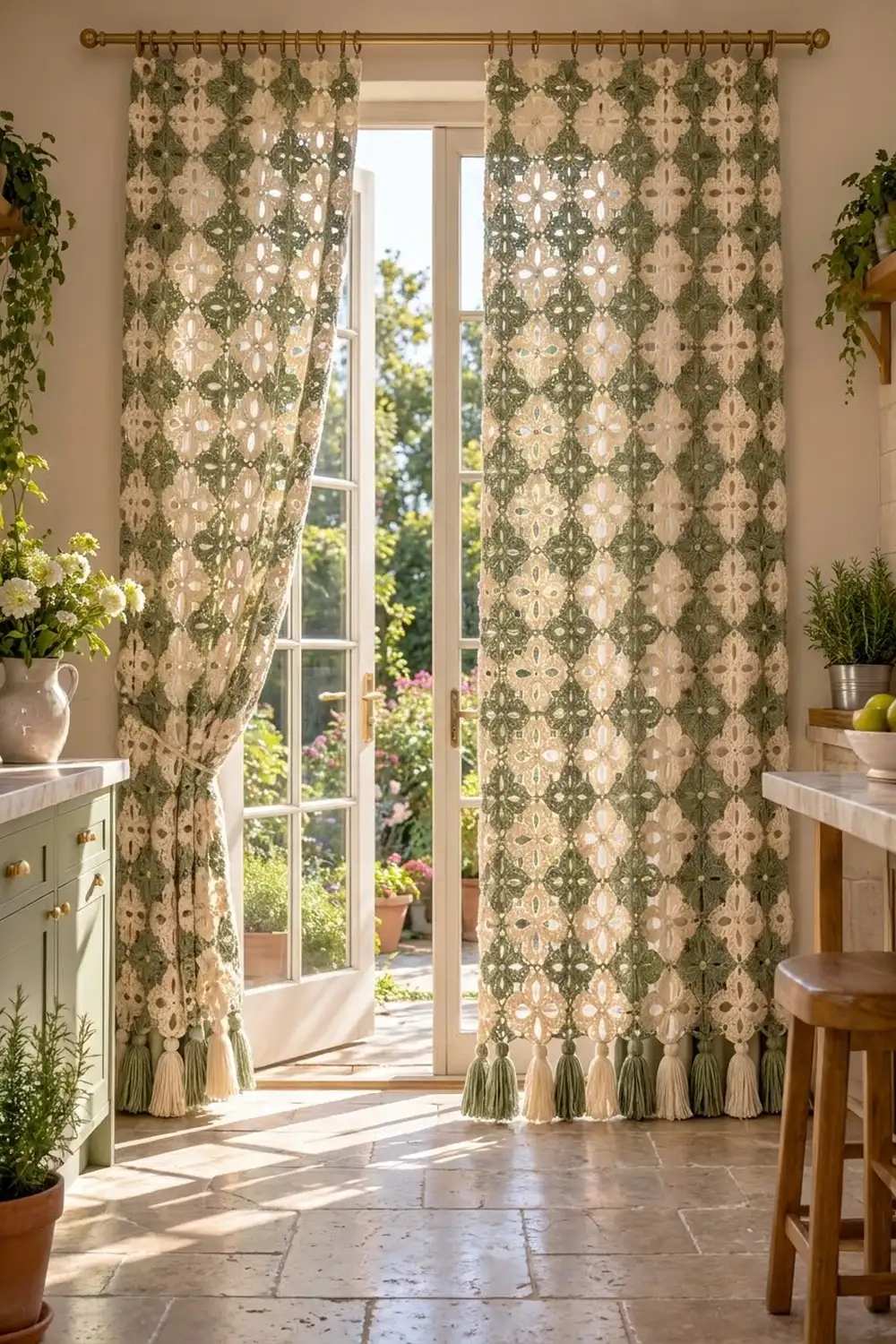
This curtain panel is made from small four-petal clover motifs joined into an airy lace grid. Each motif has a sage-green center, four cream petals with oval holes, and a crisp sage-green outline. When the panel hangs at a window, light comes through the petal holes and through the open diamonds between the motifs.
The palette is two colors: soft sage green and warm cream. The look is cottage-garden and fresh, and it suits a kitchen, sunroom, or patio door. The pattern uses US crochet terms throughout.
One finished panel measures 24 in wide x 74 in tall (61.0 cm x 188.0 cm) without tassels, and 79 in (200.7 cm) to the tassel tips. The photo shows a pair, so make two identical panels.
Construction is simple and repetitive. You work a 4-round motif and join each new motif to its neighbors at the petal tips during the last round. A solid top band for clip rings straightens the top edge, and alternating tassels finish the bottom.
Finished Size and Construction
- Finished size (one panel): 24 x 74 in (61.0 x 188.0 cm), or 79 in (200.7 cm) including tassels
- Skill level: Intermediate (easy stitches, many repeats)
- Terminology: US crochet terms
- Yarn weight: Worsted (#4), cotton or cotton blend
- Hook: 4.5 mm (US 7)
- Number of pieces: 108 motifs per panel (216 for a pair)
- Layout: 6 motifs across x 18 motifs down
- Motif size: 4 in (10.2 cm) from tip to tip
- Size before border: 24 x 72 in (61.0 x 182.9 cm)
- Border depth: a top band only, 2 in (5.1 cm)
Materials
Use a smooth, mercerized or matte cotton in worsted weight. Cotton holds the petal shape, blocks crisply, and doesn’t stretch much on a curtain rod. Avoid fuzzy yarns, because they fill in the oval holes.
Yarn for a pair of panels:
- Sage green (center, outline, top band, tassels): 700 g / 1,260 m (seven 100 g / 180 m skeins)
- Cream (petals, tassels): 800 g / 1,440 m (eight 100 g / 180 m skeins)
For one panel, halve these amounts and round up to whole skeins. The quantities include a margin of about 10–20% for gauge differences, weaving in ends, and a test motif.
Tools:
- 4.5 mm (US 7) crochet hook
- Tapestry needle
- Scissors
- Stiff card 5.5 in (14.0 cm) tall, for tassels
- Blocking mats and rust-proof pins
- Spray bottle
- 6 curtain clip rings per panel
- Measuring tape
Abbreviations (US Terms)
- ch – chain
- sl st – slip stitch
- sc – single crochet
- hdc – half double crochet
- dc – double crochet
- sp – space
- st(s) – stitch(es)
- rep – repeat
- RS – right side
Special technique – tip join (JAYG): Use this in place of the “(sc, ch 2, sc)” at a petal tip. Work sc, ch 1, sl st into the ch-2 tip sp of the neighboring finished motif, ch 1, sc. The stitch count doesn’t change, and the joined tip spans the same distance as an unjoined ch-2 tip.
Gauge and Checkpoints
Make one complete test motif before you start the panel. Block it lightly and measure it.
- After Round 1: the center ring is 0.75 in (1.9 cm) across.
- After Round 3: the motif is 3.25 in (8.3 cm) from petal tip to opposite petal tip.
- After Round 4: the motif is 4 in (10.2 cm) from tip to tip, with a tolerance of ±1/8 in (0.3 cm).
If your motif is too big (for example 4.25 in / 10.8 cm), go down to a 4 mm hook. A 4.25 in motif would make the panel 25.5 x 76.5 in (64.8 x 194.3 cm) before the band, and the top band would no longer match the motif spacing.
If your motif is too small (for example 3.75 in / 9.5 cm), go up to a 5 mm hook. Otherwise the panel shrinks to 22.5 x 67.5 in (57.2 x 171.5 cm).
Check again after the first full row of 6 joined motifs: it should measure 24 in (61.0 cm) from the outer left tip to the outer right tip.
Motif Pattern
Leave 6 in (15.2 cm) tails at every color change for weaving in.
Round 1 (sage green): Make a magic ring. Ch 1, then work 12 sc into the ring. Pull the ring closed and join with a sl st to the first sc. Fasten off. (12 sc)
Round 2 (cream): Join cream with a sl st in any sc. Ch 12, sl st in the same sc, sl st in each of the next 3 sc. Rep from * 3 more times, working the last sl st into the first sc. (4 ch-12 loops, one every 3 sc)
The loops sit over sc 1, 4, 7, and 10, so the 12 sts divide evenly into 4 petals of 3 sts each.
Round 3 (cream): Sl st into the first ch-12 loop. In the loop, work (2 sc, 2 hdc, 5 dc, ch 2, 5 dc, 2 hdc, 2 sc). Then sl st in each of the 2 sl sts before the next loop. Rep from * 3 more times. Join with a sl st to the first sc and fasten off. (18 sts + 1 ch-2 tip sp per petal; 72 sts + 4 ch-2 sps in total)
Push the stitches evenly along the loop as you work. The unfilled middle of each loop becomes the oval hole.
Round 4 (sage green): Join green with a sl st in the first sc of any petal. Ch 1, then work this repeat:
Sc in the next 4 sts (2 sc, 2 hdc). Work 2 sc in each of the next 5 dc, for 10 sc. Work (sc, ch 2, sc) in the ch-2 tip sp. Work 2 sc in each of the next 5 dc, for 10 sc. Sc in the next 4 sts (2 hdc, 2 sc). Skip the 2 sl sts between petals.
Rep from * 3 more times, then join with a sl st to the first sc. (30 sc + 1 ch-2 tip per petal; 120 sc + 4 ch-2 tips in total)
Skipping the sl sts gives the sharp valley between petals. The 20 increases on each petal round out its outer curve so that it lies flat.
Fasten off the first motif. For every later motif, use tip joins in Round 4 as described below.
Make All Pieces
Each panel needs 108 identical motifs (6 x 18), and every motif uses both colors in the same way. Per motif, plan on about 4.5 m of green and 5 m of cream.
Pair total: 216 motifs.
Layout grid (M = motif, each panel):
ROW 1:  M M M M M M
ROW 2:  M M M M M M
ROW 3:  M M M M M M
...
ROW 18: M M M M M M
Every row matches the one above it. Rotate each motif so that its petals point up, down, left, and right.
Joining
Method: join-as-you-go at the petal tips during Round 4.
Stitch-to-stitch logic:
- Row 1, Motif 1: no joins.
- Row 1, Motifs 2–6: join the left tip to the right tip of the motif on the left (1 join).
- Rows 2–18, first motif: join the top tip to the bottom tip of the motif above (1 join).
- Rows 2–18, Motifs 2–6: join the top tip to the motif above, then the left tip to the motif on the left (2 joins).
Only tips are joined. The valleys stay free, which creates an open diamond between every 4 motifs.
Join counts per panel: 5 x 18 = 90 horizontal joins and 6 x 17 = 102 vertical joins.
Tension: Keep the ch 1 on each side of the joining sl st at the same size as your regular chains. If they’re tight, the panel puckers. If they’re loose, it stretches lengthwise when it hangs.
Size checkpoint: After 3 rows, the panel should measure 24 x 12 in (61.0 x 30.5 cm) when laid flat. A joined tip adds no length, so the panel measures exactly 6 x 4 in wide and 18 x 4 in tall: 24 x 72 in (61.0 x 182.9 cm).
Border
The border is a top band only. The side edges keep their scallops, and the bottom edge carries the tassels.
Border gauge: 16 sc and 16 rows = 4 in (10.2 cm) in sc, with the same 4.5 mm hook.
Row 1 (RS, sage green): With a slip knot on the hook, ch 7. Work 2 sc in the top tip ch-2 sp of the top-left motif. Ch 14, then 2 sc in the top tip sp of the next motif. Rep from * 4 more times. Ch 8 and turn. (96 sts, not counting the last ch: 7 + 12 sc + 70 ch + 7)
Row 2: Sc in the 2nd ch from the hook and in the next 6 ch (7 sc). Sc in each of the next 2 sc, then sc in each of the next 14 ch. Rep from * 4 more times. Sc in each of the next 2 sc, then sc in each of the 7 free loops of the starting chain. Turn. (7 + 5 x 16 + 2 + 7 = 96 sc)
Rows 3–9: Ch 1, then sc in each st across. Turn. (96 sc in each row)
Count per side:
- Top edge: 96 sc.
- Each short side of the band: 8 rows (Rows 2–9).
- Lower edge: joined only at the 6 motif tips.
Why the math works: Each motif sits under exactly 16 sts: 7 ch, 2 sc, and 7 ch. Since 6 x 16 = 96, and 96 sc at 4 sc per inch = 24 in (61.0 cm), the band is exactly as wide as the grid. The 8 sc rows (Rows 2–9) at 4 rows per inch add 2 in (5.1 cm).
Hanging: Place one clip ring above each motif tip, at sts 8, 24, 40, 56, 72, and 88. The rings are 16 sts (4 in / 10.2 cm) apart, so each motif column carries its own weight.
Tassels
The bottom row gets 6 green and 5 cream tassels, alternating.
- Wrap yarn 30 times around the 5.5 in (14.0 cm) card.
- Tie the top of the bundle and cut the bottom loops.
- Wrap the neck 1 in (2.5 cm) below the top, then trim the tassel to 5 in (12.7 cm).
- Tie each green tassel to the bottom tip ch-2 sp of a bottom-row motif.
- Make a cream chain cord of 8 ch (2 in / 5.1 cm) and tie it to each of the 5 joins between bottom-row motifs. Hang a cream tassel from each cord. This lines up all the tassel tops, because each side join sits 2 in (5.1 cm) above the bottom tips.
Final Blocking
- Weave in all the ends before blocking, running each tail inside stitches of its own color.
- Pin the panel flat in sections, about 6 rows at a time if your mats are small.
- Pin each tip join along straight lines, keeping the motifs 4 in (10.2 cm) apart from center to center.
- Pin each oval hole open with one pin at each end.
- Mist the section until it’s damp, but not soaked.
- Let it dry completely, then move to the next section.
- Pin the top band to 24 x 2 in (61.0 x 5.1 cm) and mist it.
- Steam the tassels lightly and comb them straight. Trim them evenly to 5 in (12.7 cm).
Final Quality-Control Checklist
- [ ] 108 motifs, each with 120 sc + 4 ch-2 tips in Round 4
- [ ] All motifs rotated the same way, with petals pointing up, down, left, and right
- [ ] 90 horizontal and 102 vertical tip joins, with no missed tips
- [ ] Grid measures 24 x 72 in (61.0 x 182.9 cm)
- [ ] Top band has 96 sc in each row and measures 2 in (5.1 cm) deep
- [ ] 6 clip rings placed 4 in (10.2 cm) apart
- [ ] 11 tassels alternating green and cream, all 5 in (12.7 cm), with level tops
- [ ] All ends woven in, none showing through the oval holes
Troubleshooting
Petals cup or curl. Your Round 4 is too tight. Go up a hook size for that round only.
Petals ruffle. Your Round 4 is too loose, or you added extra increases. Count 30 sc per petal.
The oval holes close up. You crowded the stitches in Round 3. Spread them along the full ch-12 loop, and make sure the loop has 12 ch.
The panel slants. A motif was joined in the wrong rotation. Check that the tip you’re joining is directly opposite its partner tip.
The panel grows longer when hung. The chains in your joins are loose, or the yarn is a stretchy blend. Tighten the joins, or switch to 100% cotton.
The top band is narrower than the grid. Your band gauge is tighter than 4 sc per inch. Rework it with a 5 mm hook.
Care
Hand wash in cool water with mild soap, then press the water out in a towel without wringing. Lay the panel flat or re-pin it to dry, and never tumble dry.
Final Notes
The measurements build in a simple chain:
- One 4 in (10.2 cm) motif
- 6 motifs across = 24 in (61.0 cm)
- 18 motifs down = 72 in (182.9 cm)
- 96 sc band = 24 in (61.0 cm), adding 2 in (5.1 cm) for a 74 in (188.0 cm) panel
- 5 in (12.7 cm) tassels, for 79 in (200.7 cm) overall
If your first motif comes out at 4 in, everything after it will fit. Make two panels for the pair, hang them on clip rings, and enjoy the light through the petals.
Happy crocheting!