

This curtain pair is built from one simple idea, repeated: a square motif with four teardrop petals. Two petals are lavender and two are cream, set diagonally opposite each other around a tiny open center. Each petal has a clear teardrop window framed by a fan of double crochet.
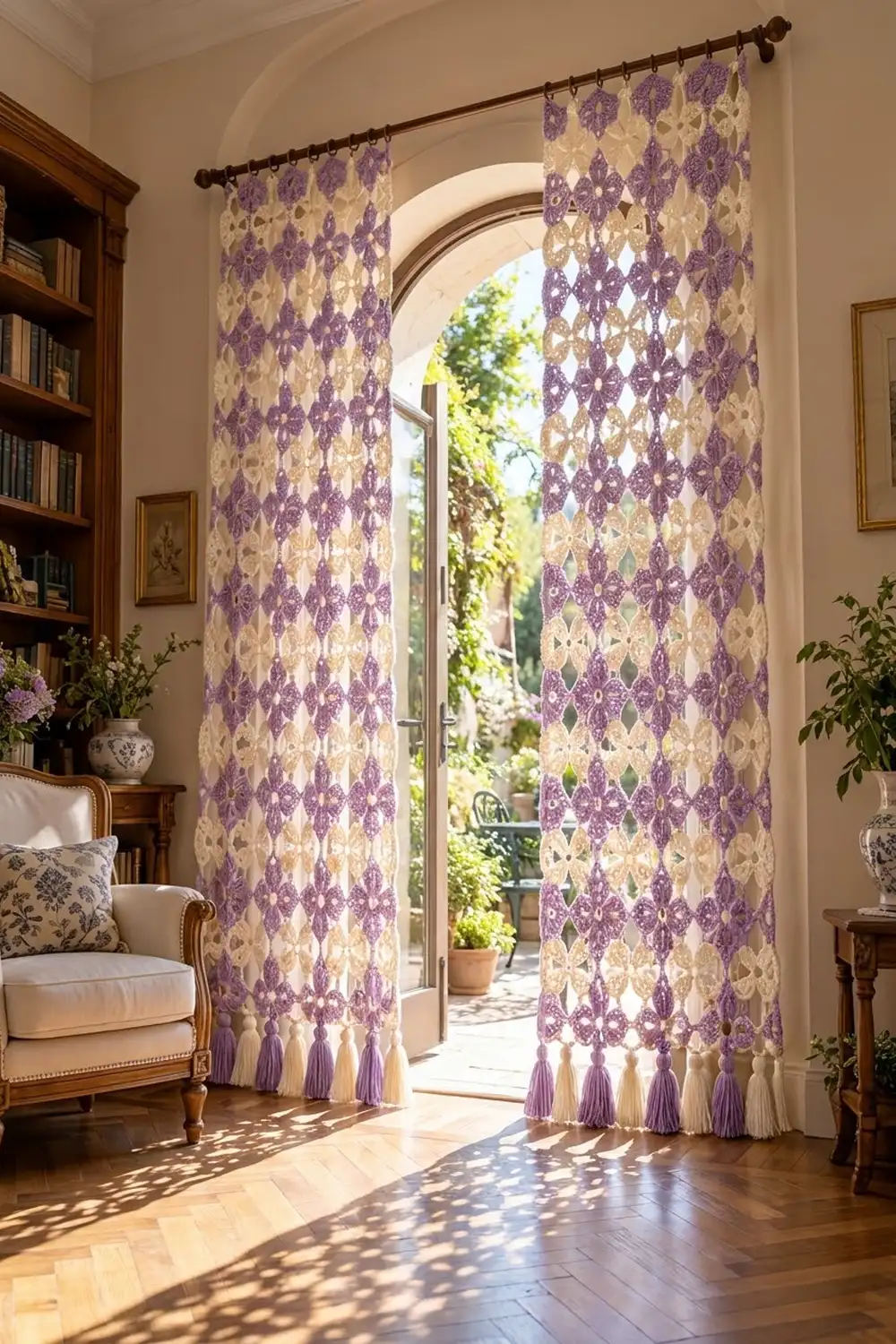
The motifs are joined in a checkerboard of two orientations. Wherever four motifs meet, their petals form a new four-petal flower, alternating all-lavender and all-cream. A cream chain lattice runs between the motifs, which keeps the panels airy and lets the light through. A row of alternating lavender and cream tassels finishes the bottom edge.
The pattern uses US crochet terms. Each finished panel measures 31 x 79 in (78.7 x 200.7 cm) before tassels, and the pair covers 62 in (157.5 cm) of width.
Construction is straightforward. You work a cream center ring, then add four petals in rows, each in its own color. A cream lattice round finishes each motif and joins it to its neighbors as you go. Each panel is 5 motifs wide and 13 motifs tall. A three-round cream sc border tidies the edges, and tassels hang from short chain loops along the bottom.
Finished Size and Construction
- Finished size (per panel): 31 x 79 in (78.7 x 200.7 cm), plus 4 in (10.2 cm) tassels
- Skill level: Intermediate
- Terminology: US crochet terms
- Yarn weight: DK (light worsted, #3)
- Hook: 4.0 mm (US G-6)
- Number of pieces: 130 motifs in total (65 per panel), joined into 2 panels
- Layout: 5 motifs wide x 13 motifs tall per panel
- Motif size: 6 x 6 in (15.2 x 15.2 cm)
- Panel size before border: 30 x 78 in (76.2 x 198.1 cm)
- Border depth: 0.5 in (1.3 cm) on each edge, 3 rounds
Materials
A smooth mercerized or matte cotton DK works best. Cotton holds the petal shape, blocks crisply, and hangs straight without stretching the way acrylic can over 79 in (200.7 cm) of length. Choose a yarn with roughly 115 m per 50 g.
- Lavender: 650 g (about 1,495 m), 13 balls of 50 g
- Cream: 1,150 g (about 2,645 m), 23 balls of 50 g
These amounts cover both panels, including borders and 22 tassels, and include a margin of about 10 percent. Buy all of each color from the same dye lot.
Tools:
- 4.0 mm (US G-6) crochet hook
- Tapestry needle
- Scissors
- Stitch markers
- A 4 in (10.2 cm) piece of card for tassels
- Rust-proof pins, blocking mats or towels, spray bottle
- Tape measure
- 12 curtain clip rings (6 per panel) or a rod of your choice
Abbreviations (US Terms)
- ch: chain
- sl st: slip stitch
- sc: single crochet
- hdc: half double crochet
- dc: double crochet
- tr: treble crochet
- sp: space
- st(s): stitch(es)
- sk: skip
- MR: magic ring
- rep: repeat
Special technique, loop join: When a ch-5 loop needs to join to a neighbor, work ch 2, sl st into the matching ch-5 loop of the finished motif, then ch 2. For a ch-3 loop, work ch 1, sl st into the neighbor’s ch-3 loop, then ch 1. The loop keeps its full length, and the two motifs now share it.
Gauge and Checkpoints
Make one complete motif before you buy all the yarn. Check it at each stage:
- After Round 1: the center ring measures 0.75 in (1.9 cm) across.
- After all four petals: the flower measures 7.5 in (19.1 cm) from one petal tip to the opposite tip.
- After Round 4: the motif measures 6 x 6 in (15.2 x 15.2 cm), corner loop to corner loop along one side, after a light steam.
Border gauge: 18 sc = 4 in (10.2 cm) when worked into the lattice loops.
If your motif is bigger than 6 in (15.2 cm), go down to a 3.75 mm hook. If it is smaller, go up to a 4.5 mm hook. Being off by just 0.25 in (0.6 cm) per motif adds up to 3.25 in (8.3 cm) over the 13-motif length, so it’s worth getting this right.
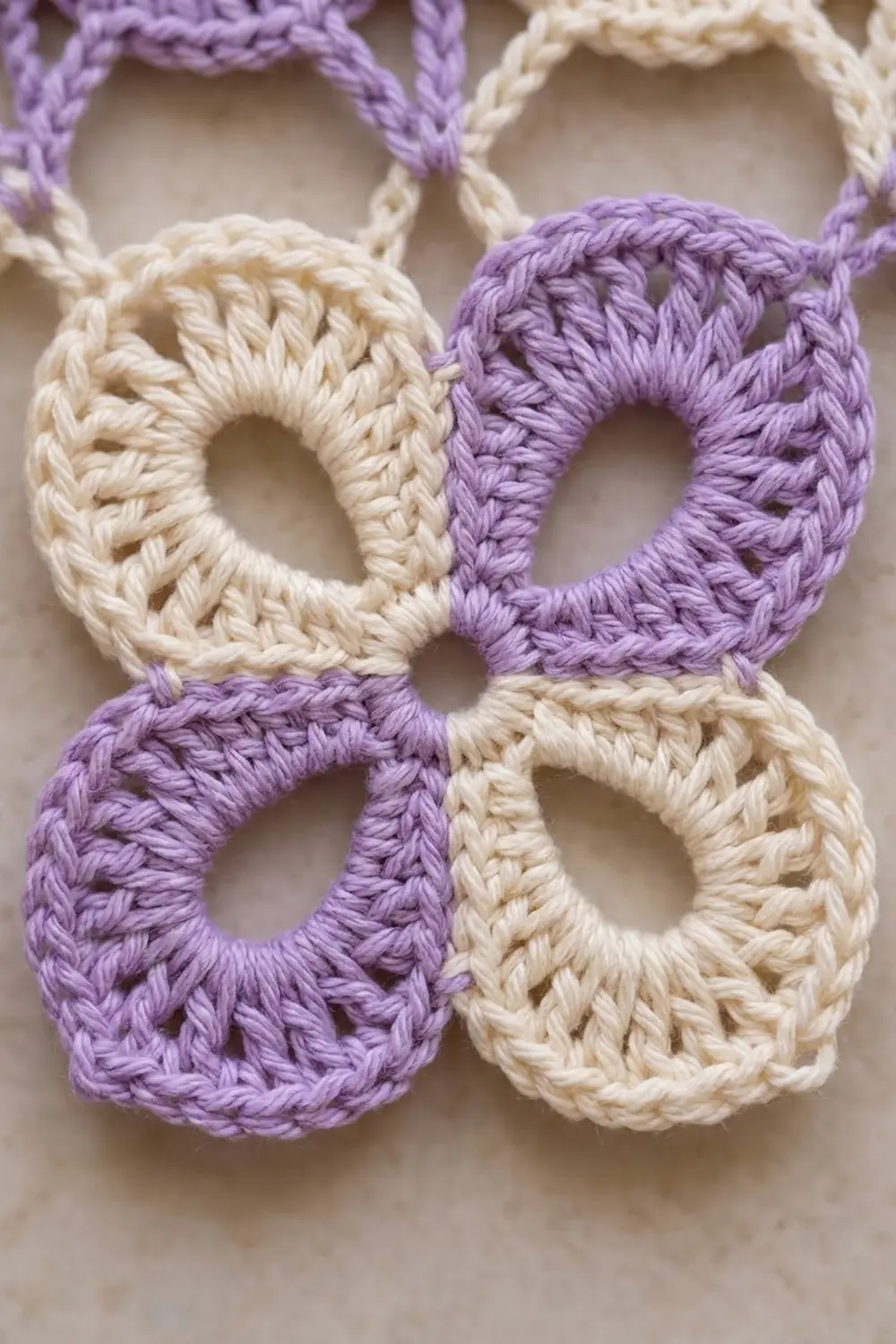
Motif (Make 130)
Every motif is made the same way. You only choose its orientation when you join it.
Round 1: Center
With cream, make a MR.
Round 1: Ch 1, 8 sc in ring, sl st to first sc. Pull the ring tight, leaving a small hole. (8 sc)
Fasten off. Number the sc 1 to 8 in your head. Each petal is worked on two neighboring sc.
Petals
Work the four petals in this color order:
- Petal 1: lavender, on sc 1 and 2
- Petal 2: cream, on sc 3 and 4
- Petal 3: lavender, on sc 5 and 6
- Petal 4: cream, on sc 7 and 8
Petals of the same color end up diagonally opposite each other.
Row 1: Join the petal color with sl st in the first sc of the pair. Ch 12, sl st in the second sc of the pair. (1 ch-12 loop)
This loop becomes the teardrop window.
Row 2: Do not turn. Working into the ch-12 loop (around the chain, not into the chains), work 2 sc, 2 hdc, 12 dc, 2 hdc, 2 sc. Sl st in the first sc of the pair. (20 sts)
Row 3: Turn. Ch 1, sc in first 2 sc, hdc in next 2 hdc, 2 dc in each of next 12 dc, hdc in next 2 hdc, sc in last 2 sc. Sl st in the second sc of the pair. (32 sts)
Fasten off. The 24 dc form the rounded petal fan. The petal tip is the space between sts 16 and 17 of Row 3.
Repeat for the other three petals. Weave in all the petal tails now. There are a lot of them, and they’re harder to reach once the lattice round is done.
Round 4: Cream Lattice
Work the first motif with full loops. On every motif after that, replace the loops on shared sides with loop joins (see Joining).
On each petal, number the Row 3 sts 1 to 32 in the direction you are traveling. St 17 is the first st after the tip.
Round 4: Join cream with sc in the tip sp of petal 1 (between sts 16 and 17).
Ch 5, sk 4 sts, sc in st 21, ch 5, sk 4 sts, sc in st 26, ch 3, tr in the V between this petal and the next (insert the hook between the last sc of this petal and the first sc of the next), ch 3, sc in st 7 of the next petal, ch 5, sk 4 sts, sc in st 12, ch 5, (sc, ch 5, sc) in the tip sp of that petal. Rep from * to * twice more.
Last side: Ch 5, sc in st 21, ch 5, sc in st 26, ch 3, tr in V, ch 3, sc in st 7 of petal 1, ch 5, sc in st 12, ch 5, sc in the first tip sp, ch 5, sl st to first sc. Fasten off.
Count per side: 6 loops between corners (4 ch-5 loops and 2 ch-3 loops). Corners: 1 ch-5 loop each. Total: 28 loops.
The tr bridges the gap between petals so each side stays straight. The anchor sc are symmetrical: st 26 is the 7th st from the end of one petal, and st 7 is the 7th st from the start of the next.
Make All Pieces
Make 130 motifs, 65 per panel. Each motif uses about 4 g of lavender (two petals) and about 6 g of cream (center, two petals, and the lattice round).
Place each motif in one of two orientations:
- A: lavender petals at top left and bottom right
- B: the same motif given a quarter turn, so the lavender petals sit at top right and bottom left
Layout for one panel (5 wide x 13 tall):
ROW 1:  A B A B A
ROW 2:  B A B A B
ROW 3:  A B A B A
ROW 4:  B A B A B
ROW 5:  A B A B A
ROW 6:  B A B A B
ROW 7:  A B A B A
ROW 8:  B A B A B
ROW 9:  A B A B A
ROW 10: B A B A B
ROW 11: A B A B A
ROW 12: B A B A B
ROW 13: A B A B A
Each panel has 33 motifs in position A and 32 in position B. Where four motifs meet, the four petals at the junction are all one color, which creates the alternating lavender and cream flowers.
Joining
Join as you go during Round 4. Work left to right along each row, then row by row down the panel.
Stitch-to-stitch logic: Each shared side joins loop to loop, in matching order. The 4 ch-5 loops join to the neighbor’s 4 ch-5 loops, and the 2 ch-3 loops join to the neighbor’s 2 ch-3 loops. That gives 6 joins per side, with the sc and tr anchors lining up exactly.
Corners: Replace the corner ch-5 with ch 2, sl st into the neighbor’s corner loop, ch 2. Where four motifs meet, sl st into the sl st of the first corner join instead, so all four corners share one point.
Tension: Work the ch-2 and ch-1 halves at the same tension as your full loops. Tight joins pucker the lattice and shorten the panel. Loose joins make the curtain sag. Keep the joined motifs flat on your lap while you work, not folded.
Size checkpoint: After the first row of 5 motifs, the strip measures 30 in (76.2 cm) wide. Measure every 3 rows; 3 rows should measure 18 in (45.7 cm). The finished joined panel measures 30 x 78 in (76.2 x 198.1 cm).
Border
Work three rounds of cream sc around each panel. Border gauge: 18 sc = 4 in (10.2 cm).
Each side count below includes that side’s 2 corner sc. Each corner is worked as (sc, ch 2, sc). The first sc ends one side and the second sc starts the next.
Round 1: Join cream in any panel-corner ch-5 loop. Work (sc, ch 2, sc) in each panel-corner loop. Along the edges, work 5 sc in each ch-5 loop and 3 sc in each ch-3 loop, for 26 sc per motif side. At each seam between two edge motifs, work 1 sc around the two joined corner loops. Sl st to first sc.
- Long sides: 13 x 26 + 12 seam sc + 2 corner sc = 352 sc
- Short sides: 5 x 26 + 4 seam sc + 2 corner sc = 136 sc
- Total: 976 sc and 4 ch-2 corner sp
Round 2: Ch 1, sc in each sc, (sc, ch 2, sc) in each corner sp. Sl st to first sc.
- Long sides: 354 sc; short sides: 138 sc; total: 984 sc
Round 3: Rep Round 2.
- Long sides: 356 sc; short sides: 140 sc; total: 992 sc
Fasten off.
Why the math works: Each motif side gives 26 sc, and each seam adds exactly 1 sc. That means every motif accounts for 27 sc across 6 in (15.2 cm), which is 4.5 sc per inch, or 18 sc per 4 in (10.2 cm), matching the border gauge. To check the long side: 352 sc ÷ 4.5 = 78.2 in (198.6 cm), essentially the 78 in (198.1 cm) panel length. Rounds 2 and 3 add only 2 corner sc per side, which turns the corners without rippling.
Tassels
Make 6 lavender and 5 cream tassels per panel (12 lavender and 10 cream in total).
Wrap the yarn 30 times around the 4 in (10.2 cm) card. Tie the top with a 9 in (22.9 cm) strand and cut the loops at the bottom. Wrap a band of the contrasting color 0.5 in (1.3 cm) below the top. Trim to 4 in (10.2 cm).
On the bottom edge of Round 3, make a hanging loop at each tassel position: join yarn, ch 6, sl st in the same st, fasten off. The positions are counted along the 140 bottom-edge sc:
- Lavender: the 2 bottom corners (sts 1 and 140) and the 4 seams (sts 30, 57, 84, and 111)
- Cream: the center of each motif section (sts 17, 44, 71, 98, and 125)
Tie each tassel to its loop with its top strand.
Final Blocking
- Weave in any remaining ends before blocking.
- Soak each panel in cool water for 15 minutes. Press the water out; do not wring.
- Roll the panel in towels to remove excess moisture.
- Lay it flat on mats or towels on a clean floor.
- Pin the outer edge to 31 x 79 in (78.7 x 200.7 cm). The joined motif area inside the border should measure 30 x 78 in (76.2 x 198.1 cm).
- Pin each petal tip and open each teardrop window evenly.
- Leave the tassels unpinned and comb them straight.
- Let dry completely, about 24 to 48 hours.
- Trim the tassels evenly once dry.
Final Quality-Control Checklist
- Each motif measures 6 in (15.2 cm) square.
- The lavender petals sit diagonally opposite in every motif.
- The A/B checkerboard is correct, and every junction flower is one solid color.
- Every shared side has 6 loop joins, and every 4-way corner meets at one sl st.
- Border Round 3 counts 356 sc on the long sides and 140 sc on the short sides.
- Each panel measures 31 x 79 in (78.7 x 200.7 cm).
- Each panel has 11 tassels, alternating lavender and cream, all 4 in (10.2 cm) long.
- No ends show on the right side.
Troubleshooting
Petal cups instead of lying flat: The Row 3 fan is too tight. Check that you made exactly 2 dc in each of the 12 dc, or go up half a hook size for the petals only.
Petal ruffles: The Row 1 chain is too tight compared with Row 2. Work the ch 12 a little looser.
Motif sides bow inward: The tr in the V is too short. Make sure you insert the hook at the base of the petals, not higher up.
Junction flower has mixed colors: One motif is in the wrong orientation. Undo the joins for that motif, give it a quarter turn, and rejoin.
Panel shorter than 78 in (198.1 cm): The joins are too tight. Loosen the ch-2 and ch-1 halves.
Border ripples: You added extra sc at the seams. Use exactly 1 sc per seam and 26 sc per motif side.
Border pulls in: You skipped a loop. Recount to 26 sc per motif side.
Care
Hand wash in cool water and dry flat. If the panels lengthen over time, wet them again and re-block to 31 x 79 in (78.7 x 200.7 cm).
Final Notes
The measurement chain is short and reliable. Round 1 measures 0.75 in (1.9 cm). The four petals reach 7.5 in (19.1 cm) tip to tip. The lattice round squares each motif to 6 in (15.2 cm). Five motifs across make 30 in (76.2 cm), and thirteen down make 78 in (198.1 cm). Three border rounds bring each panel to 31 x 79 in (78.7 x 200.7 cm), and 4 in (10.2 cm) tassels finish the hem.
Check your first motif and measure every few rows, and the curtains will hang straight and even.
Happy crocheting!