

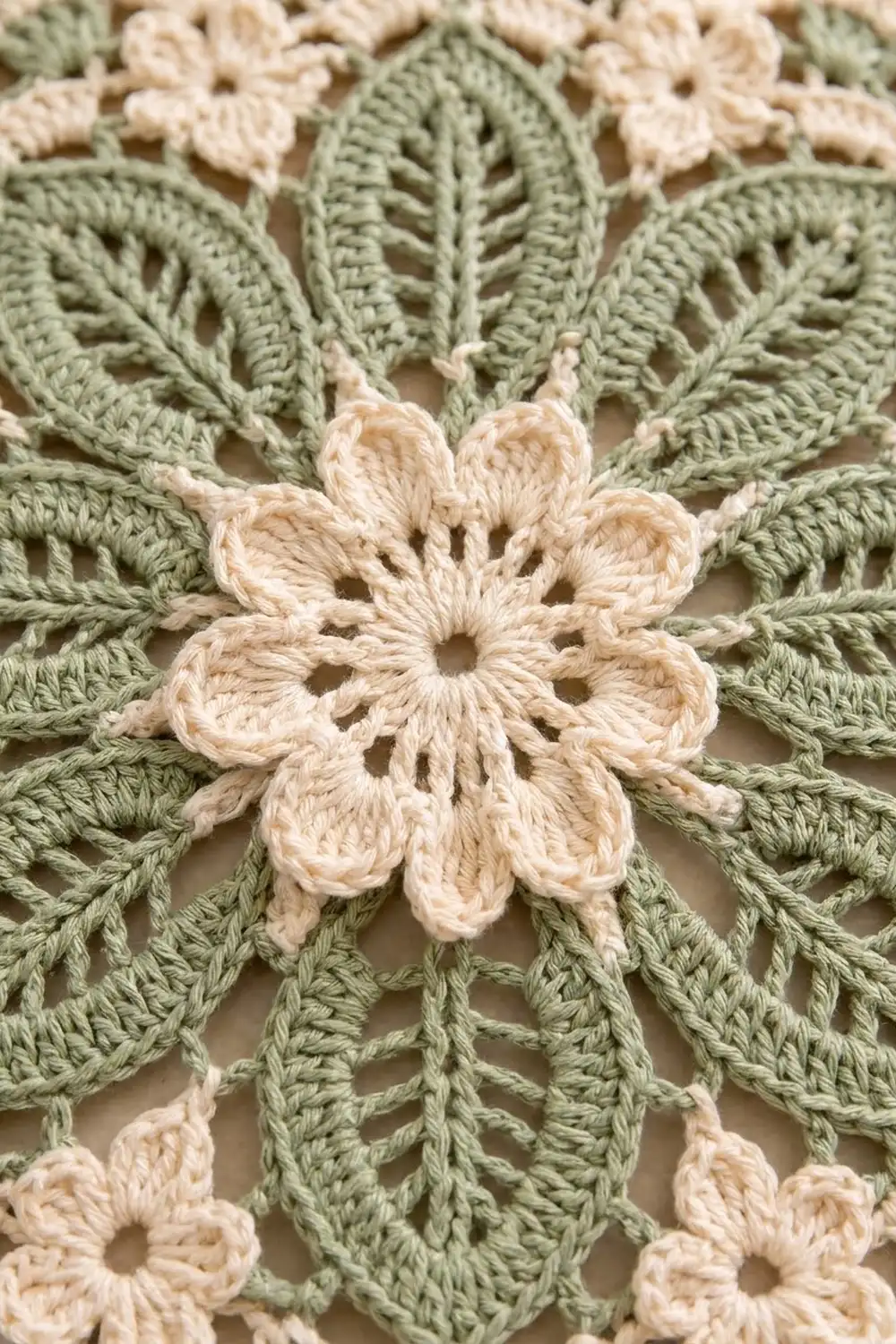
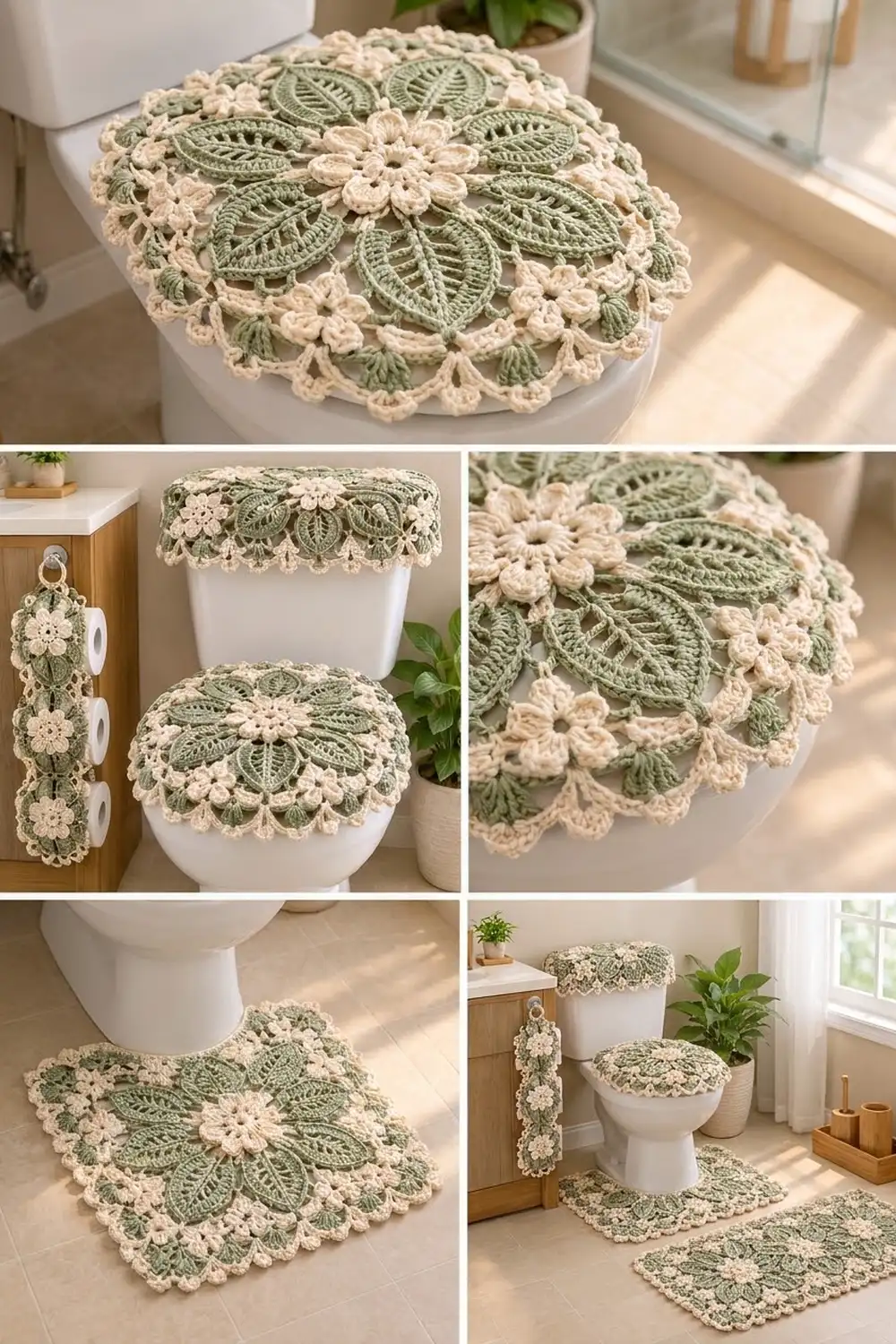
The Sage Garden Toilet Lid Cover is a round lace medallion in soft sage green and warm cream. A layered cream flower sits in the center, and eight pointed sage leaves radiate from it, each with an open vein. Beyond the leaves are a ring of small cream flowers, little green leaves pointing outward, and deep cream scallops tipped with picots.
The style is fresh and a little vintage, with an Irish-crochet garden feel. It suits a bathroom with white fixtures, light wood, and plants.
This pattern uses US crochet terms. The finished cover is one round piece measuring 18 in (45.7 cm) across when blocked flat. Elastic woven through the wrong side pulls the edge under the lid rim, and the scallops drape over the sides.
You work the whole cover in joined rounds from the center out: cream flower, sage leaves, cream flower ring, green leaf round, and cream scalloped border. There’s nothing to join.
Finished Size and Construction
- Finished size: 18 in (45.7 cm) diameter, blocked and flat
- Fits: standard round and elongated lids, about 14 in (35.6 cm) wide x 17 in (43.2 cm) long
- Skill level: Intermediate
- Terminology: US crochet terms
- Yarn weight: Worsted weight (#4) cotton
- Hook: 4.5 mm (US 7)
- Number of pieces: 1
- Layout: single round medallion worked in joined rounds
- Piece size: 18 in (45.7 cm) diameter
- Size before border (after Round 15): 15 in (38.1 cm) diameter
- Border depth (Rounds 16-17): 1.5 in (3.8 cm) all the way around
Materials
Use a smooth mercerized or combed worsted-weight cotton. It keeps leaf points and picots crisp and holds up to frequent washing. Fuzzy yarns blur the open veins.
Yarn:
- Color A, Cream: 110 g / 176 m (center flower, flower ring, border)
- Color B, Sage Green: 75 g / 120 m (large leaves, small leaves)
These quantities include a margin of about 15 percent for your test center, tails, and reworking.
Tools:
- 4.5 mm (US 7) crochet hook
- Tapestry needle and scissors
- 2 locking stitch markers
- 1/4 in (0.6 cm) wide soft knit elastic, 36 in (91.4 cm) long
- Sewing needle and matching thread
- Blocking mat, rust-proof pins, spray bottle
- Flexible tape measure
Abbreviations (US Terms)
- ch – chain
- sl st – slip stitch
- sc – single crochet
- hdc – half double crochet
- dc – double crochet
- dc2tog – double crochet 2 together
- sk – skip
- sp – space
- st(s) – stitch(es)
- MR – magic ring
- RS / WS – right side / wrong side
Special stitches:
- 3-dc cluster (3-dc cl): [yarn over, insert hook, pull up a loop, yarn over, pull through 2 loops] 3 times in the same place, yarn over, pull through all 4 loops.
- Flower Cluster (FC): in the same st work [3-dc cl, ch 2] 4 times, 3-dc cl. This gives 5 clusters and 4 ch-2 sps, which form a small fan-shaped flower.
- Small Leaf: ch 7, sl st in 2nd ch from hook, sc in next ch, hdc in next ch, dc in next ch, hdc in next ch, sc in last ch. This gives a pointed leaf about 1.25 in (3.2 cm) long.
- Picot: ch 3, sl st in 3rd ch from hook.
Round starts: ch 1 doesn’t count as a st. Ch 3 counts as the first dc. When a round begins with dc2tog, ch 2 plus dc in the next st counts as the first dc2tog.
Gauge and Checkpoints
Basic gauge: 16 sc = 4 in (10.2 cm) with a 4.5 mm hook.
Your test piece is the center itself. Work Rounds 1-5 and measure before going on.
Checkpoints (laid flat, lightly pressed):
- After Round 5 (cream flower): 4 in (10.2 cm) diameter
- After Round 11 (sage leaves, tip to tip): 10 in (25.4 cm)
- After Round 13 (cream sc round): 12 in (30.5 cm)
- After Round 15 (green leaf round): 15 in (38.1 cm)
- After Round 17 (border): 18 in (45.7 cm)
If your center is too big (over 4.25 in / 10.8 cm), switch to a 4 mm hook. If it’s too small (under 3.75 in / 9.5 cm), switch to a 5 mm hook. Change hooks rather than stitch counts, because every later count depends on the 8 repeats.
Flatness: a slight wave is normal and blocks out. A deep ruffle means loose tension, and a dome means tight tension.
Pattern
Center Flower (Color A, Cream)
Round 1 (RS): MR, ch 1, 16 sc in ring, sl st to first sc. Pull the ring closed. (16 sc)
Round 2: Ch 1, sc in same st, ch 3, sk 1 st, sc in next st, ch 3, sk 1 st; repeat from * 6 more times, sl st to first sc. (8 sc, 8 ch-3 sps)
Round 3 (first petal layer): Sl st into first ch-3 sp, work (sc, hdc, 3 dc, hdc, sc) in each ch-3 sp around, sl st to first sc. (8 petals, 7 sts each = 56 sts)
Round 4 (loops behind): Fold the petals toward you. Working behind them, sc around the post of the first Round 2 sc, ch 5, sc around the post of the next Round 2 sc; repeat from * 6 more times, ch 5, sl st to first sc. (8 sc, 8 ch-5 loops)
Round 5 (second petal layer): Sl st into first ch-5 loop, work (sc, hdc, 5 dc, hdc, sc) in each ch-5 loop around, sl st to first sc. Fasten off. (8 petals, 9 sts each = 72 sts)
The larger back petals peek out between the front petals, which makes the flower look layered.
Checkpoint: 4 in (10.2 cm) diameter.
Large Leaves (Color B, Sage Green)
Round 6 (leaf base): Working behind the Round 5 petals, join Color B with sc around the post of any Round 4 sc. Ch 6, sc around the post of the next Round 4 sc; repeat from * 6 more times, ch 6, sl st to first sc. (8 sc, 8 ch-6 loops)
Each ch-6 loop is the base of one leaf. The ch-2 sp at the center of every leaf forms the open vein. Each round’s chains between leaves skip over the previous between-leaf space, which keeps the leaves separate.
Round 7: Sl st into first ch-6 loop, ch 3, (dc, ch 2, 2 dc) in same loop, ch 1, (2 dc, ch 2, 2 dc) in next loop; repeat from * 6 more times, ch 1, sl st to top of ch-3. (per leaf: 2 dc each side of vein = 4 dc; total 32 dc, 8 vein ch-2 sps, 8 ch-1 sps)
Round 8: Dc in next 2 dc, (2 dc, ch 2, 2 dc) in vein sp, dc in next 2 dc, ch 2, sk ch-1 sp; repeat around, join. (per leaf: 4 dc each side = 8 dc; total 64 dc)
Round 9: Dc in next 4 dc, (2 dc, ch 2, 2 dc) in vein sp, dc in next 4 dc, ch 3, sk ch-2 sp; repeat around, join. (per leaf: 6 dc each side = 12 dc; total 96 dc)
Round 10 (lengthening round): Dc2tog, dc in next 4 dc, (dc, ch 2, dc) in vein sp, dc in next 4 dc, dc2tog, ch 4, sk ch-3 sp; repeat around, join. Each side uses its 6 sts and makes 6 (dc2tog + 4 dc + 1 vein dc), so the leaf grows longer without getting wider. (per leaf: 12 sts; total 96 sts)
Round 11 (leaf points): Dc2tog 3 times over the 6 sts of the first side, (sc, ch 3, sc) in vein sp, dc2tog 3 times over the 6 sts of the second side, ch 5, sk ch-4 sp; repeat around, join. Fasten off. (per leaf: 6 dc2tog, 2 sc, 1 ch-3 tip; total 48 dc2tog, 16 sc, 8 tips, 8 ch-5 sps)
Checkpoint: 10 in (25.4 cm) tip to opposite tip.
Flower Ring (Color A, Cream)
Round 12: Join Color A with sc in any leaf-tip ch-3 sp. Ch 5, sc in top of last dc2tog of this leaf, ch 5, sc in between-leaf ch-5 sp, ch 5, sc in top of first dc2tog of next leaf, ch 5, sc in next leaf-tip ch-3 sp; repeat around. On the last repeat, sl st to the first sc in place of the final sc. (per leaf: 4 sc, 4 ch-5 loops; total 32 sc, 32 ch-5 loops)
Round 13: Sl st into first ch-5 loop, ch 1, 5 sc in each ch-5 loop around, sl st to first sc. (32 loops x 5 = 160 sc)
Checkpoint: 12 in (30.5 cm) diameter. At gauge, 160 sc make 40 in (101.6 cm) of edge. That’s close to the 37.7 in (95.8 cm) circumference of a 12 in (30.5 cm) circle, and the next round takes up the slight excess.
Round 14: Ch 1, sc in first sc, ch 3, sk 4 sc, FC in next sc, ch 3, sk 4 sc, sc in next sc, ch 3, sk 4 sc, FC in next sc, ch 3, sk 4 sc; repeat from * 14 more times, sl st to first sc. Fasten off. Each repeat uses 10 sc. (160 / 10 = 16 repeats: 16 sc, 16 FC, 32 ch-3 sps)
Small Leaf Round (Color B, Sage Green)
Round 15: Join Color B with sl st in any Round 14 sc. (Sc, Small Leaf, sc) in same sc, ch 3, sc in 2nd ch-2 sp of next FC, ch 3, sc in 3rd ch-2 sp of same FC, ch 3, sl st in next Round 14 sc; repeat around, ending with sl st in first sc. Fasten off. (per repeat: 4 sc, 1 Small Leaf, 3 ch-3 sps; total 64 sc, 16 Small Leaves, 48 ch-3 sps)
Each Small Leaf points outward between two cream flowers.
Checkpoint: 15 in (38.1 cm) diameter, measured at the ch-3 sps rather than the leaf tips.
Border
The border is worked in Color A. On a circle, the “sides” are the 16 repeats set up in Round 14, and every repeat gets the same counts.
Border gauge: 4 scallops = 3.5 in (8.9 cm) along the outer edge, blocked.
Round 16 (loop round): Join Color A with sc in the first sc of any (sc, Small Leaf, sc) group. Ch 3, passing behind the Small Leaf, sc in second sc of the group, [ch 5, sc in next ch-3 sp] 3 times, ch 5, sc in first sc of next group; repeat around. On the last repeat, sl st to the first sc in place of the final sc.
- Per repeat: 5 sc, 1 ch-3 bridge, 4 ch-5 loops
- Total: 80 sc, 16 bridges, 64 ch-5 loops
Round 17 (scallop round): Sl st into first ch-3 bridge, ch 1, 3 sc in bridge, (sc, hdc, 2 dc, picot, 2 dc, hdc, sc) in each of next 4 ch-5 loops, 3 sc in next bridge; repeat around, leaving out the last 3 sc, sl st to first sc. Fasten off.
- Per repeat: 3 bridge sc + (4 scallops x 8 sts) = 35 sts and 4 picots
- Total: 16 x 35 = 560 sts and 64 picots
The Small Leaves lie over the bridges, and their tips reach into the scalloped edge as green accents.
Why the math works: the 160 sc divide evenly into 16 repeats of 10, and every later round keeps those 16 repeats. At 3.5 in (8.9 cm) per 4 scallops, 64 scallops make 56 in (142.2 cm) of edge. That matches the 56.5 in (143.5 cm) circumference of an 18 in (45.7 cm) circle, so the border lies flat.
Checkpoint: 18 in (45.7 cm) diameter, border depth 1.5 in (3.8 cm).
Final Blocking
- Weave in all ends on the WS through stitches of the same color.
- Soak the cover in cool water for 15 minutes. Press the water out in a towel without wringing.
- Lay it RS up on the blocking mat and pin the center flower flat.
- Pin the 8 leaf tips outward like spokes, 10 in (25.4 cm) tip to tip.
- Pin the edge to an 18 in (45.7 cm) circle with one pin in each picot. Straighten the Small Leaves.
- Let it dry completely, at least 24 hours.
- On the WS, weave the elastic in and out through the Round 16 ch-5 loops. Fit the cover on the lid and pull the elastic snug under the rim. Overlap the ends 1 in (2.5 cm), sew them securely, and trim.
Final Quality-Control Checklist
- The center flower shows 8 front petals with 8 back petals between them.
- There are 8 large leaves, each with an open vein and a sharp point, 10 in (25.4 cm) tip to tip.
- Round 13 has 160 sc.
- 16 cream Flower Clusters alternate evenly with 16 green Small Leaves.
- Round 17 has 64 scallops, each with one picot.
- The cover lies flat at 18 in (45.7 cm) before the elastic goes in.
- No ends show on the RS, and the elastic grips without puckering the scallops.
Troubleshooting
The center domes. Round 4 is too tight. Loosen the ch-5 loops or use a larger hook for the center.
Leaves curl or twist. This is normal before blocking, so pin the tips while the piece is wet. If they still curl, check that every vein increase went into the ch-2 sp, not into a dc.
Leaves look blunt. Recount Round 10. Each side should have 6 sts.
Round 13 ripples or cups. Rework the leaves with a hook one size smaller if it ripples, or one size larger if it cups.
Flower Clusters crowd together. Skip exactly 4 sc on each side of every FC.
The border cups. Loosen the Round 16 ch-5 loops.
The cover slides off. Shorten the elastic 1 in (2.5 cm) at a time.
Care
Machine wash on cool and gentle in a mesh bag, or hand wash. Reshape and dry flat, pinning the scallops if needed.
Final Notes
The measurement chain is simple. The 4 in (10.2 cm) center grows to 10 in (25.4 cm) across the leaf tips. The 160-sc round brings it to 12 in (30.5 cm) and sets up 16 even repeats. The green leaf round reaches 15 in (38.1 cm), and the 1.5 in (3.8 cm) scalloped border finishes it at 18 in (45.7 cm). Check each stage, and the cover will sit flat, fit the lid, and show every leaf and flower clearly.
Happy crocheting!