

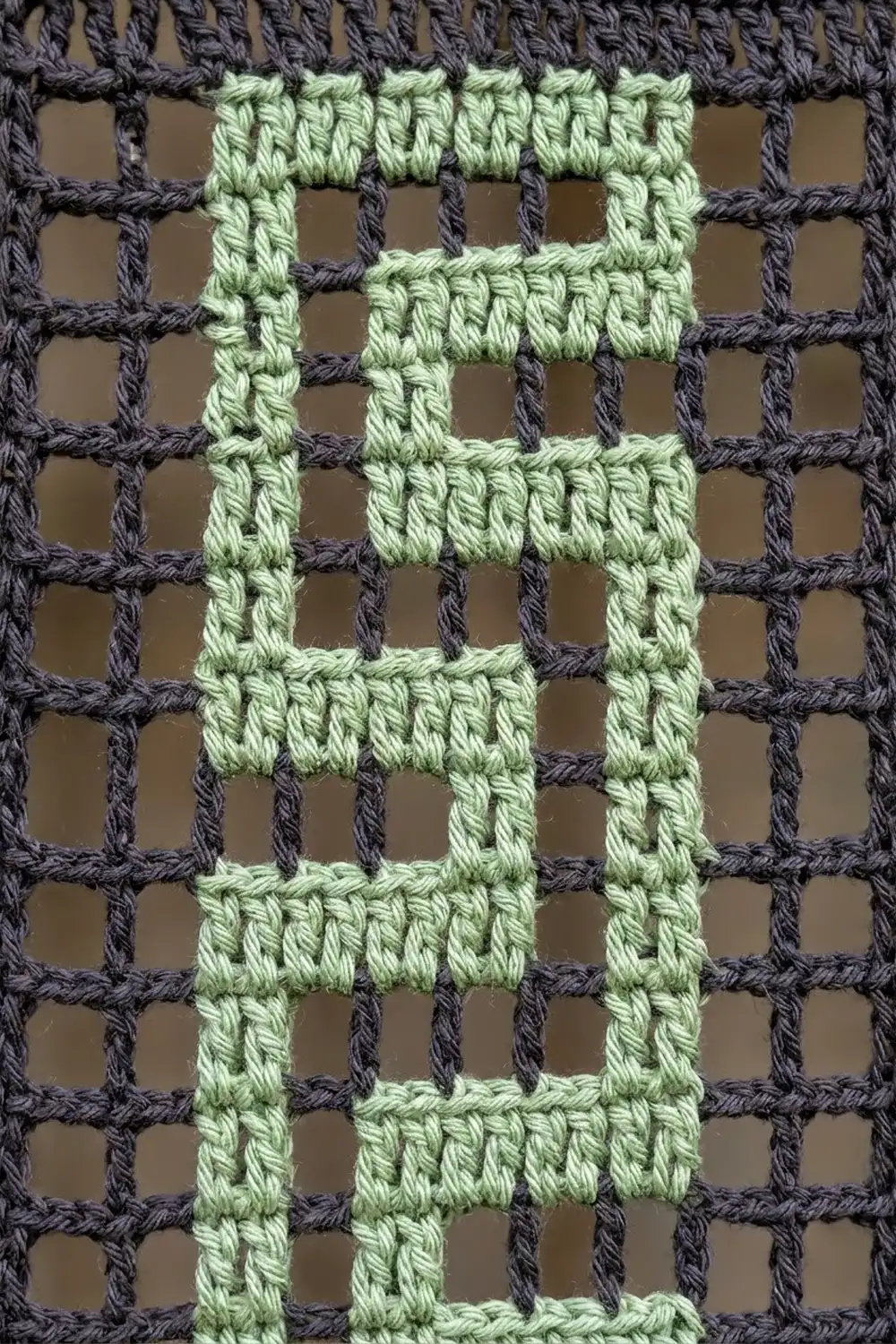
The Sage Meander curtain panels pair a dark charcoal filet grid with a soft sage green meander that steps down the center of each panel. Light shows through the open mesh, while the solid green blocks keep the motif easy to see from across the room.
The look is calm and slightly classic, like a Greek-key border reworked in a modern palette. Charcoal works as the frame and the green adds warmth. Hung against a bright window, the open squares cast a soft checkered shadow.
This pattern uses US crochet terms. Each finished panel measures 12 in (30.5 cm) wide by 62.75 in (159.4 cm) long. The pattern makes one panel; make two for the pair.
Each panel is worked flat in rows from the bottom up as one piece. You start with a solid charcoal band, work two open mesh rows, then the green meander with intarsia color changes. Finish with two more mesh rows, a matching solid band and one round of single crochet.
Finished Size and Construction
- Finished size (one panel): 12 in x 62.75 in (30.5 cm x 159.4 cm)
- Skill level: Intermediate
- Terminology: US crochet terms
- Yarn weight: Worsted (#4) cotton
- Hook: 5.0 mm (US H-8)
- Number of pieces: 2 identical panels, each worked as one piece
- Layout: Panels hang side by side on one rod and are not seamed together
- Grid per panel: 15 squares wide x 83 rows tall (46 stitches per row)
- Size before border: 11.5 in x 62.25 in (29.2 cm x 158.1 cm)
- Border depth: 0.25 in (0.6 cm) on every edge
Materials
Choose a smooth, mercerized or combed worsted-weight cotton. Cotton keeps the mesh crisp and the squares open. It also holds up well in sunlight and launders easily. Avoid fuzzy or very stretchy yarns, because they blur the grid and let long panels grow.
The amounts below assume a yarn with about 190 m per 100 g (208 yd per 100 g).
- Charcoal (Color A): 300 g / 570 m per panel; 600 g / 1,140 m for the pair
- Sage green (Color B): 100 g / 190 m per panel; 200 g / 380 m for the pair
Quantities include a margin of roughly 15% for the gauge swatch, color-change tails and small tension differences.
Tools:
- 5.0 mm (US H-8) crochet hook
- Tapestry needle
- 1 yarn bobbin or a small butterfly of green per panel
- Stitch markers (4–6)
- Measuring tape
- Rust-proof pins and a blocking surface at least 64 in (162.6 cm) long, or blocking mats laid end to end
- Spray bottle
- 7 curtain clip rings per panel (14 total)
Abbreviations (US Terms)
- ch – chain
- sc – single crochet
- dc – double crochet
- sk – skip
- sl st – slip stitch
- sp – space
- st(s) – stitch(es)
- RS / WS – right side / wrong side
- A / B – charcoal / sage green
Special stitches and terms
- Open square (O): ch 2, sk the next 2 sts (or the ch-2 sp), dc in the next dc.
- Block (B): worked in green. Over an open square, work 2 dc in the ch-2 sp, then dc in the next dc. Over a block, work dc in each of the next 3 dc.
- Row structure: every row has 1 starting post plus 15 squares, and each square uses 3 sts, so every row has 1 + 45 = 46 sts. On mesh rows, the ch 3 at the start counts as the first dc.
- Color change: work the last yarn over of the stitch before the new color with the new color.
Gauge and Checkpoints
Gauge: 4 squares and 4 rows = 3 in (7.6 cm) in filet mesh after blocking. One square is 0.75 in (1.9 cm) wide and one row is 0.75 in (1.9 cm) tall, so there are 4 sts per inch across the row.
Test one piece first. Ch 21. Dc in the 4th ch from the hook and in each ch across (19 sts). Then work 7 mesh rows: ch 3, turn, ch 2, sk 2, dc in next dc, repeat 5 more times. That gives 6 squares. The swatch should measure 4.5 in (11.4 cm) wide and 6 in (15.2 cm) tall after you pin it flat and let it dry.
- Too big: go down 0.5 mm in hook size or tighten your chains.
- Too small: go up 0.5 mm.
Even a small error matters: 0.05 in (0.1 cm) per row adds up to more than 4 in (10.2 cm) over 83 rows.
Checkpoints (unblocked, measured flat without stretching):
- After Row 6: 11.5 in (29.2 cm) wide x 4.5 in (11.4 cm) tall
- After Row 20 (the first full meander repeat): 15 in (38.1 cm) tall
- After Row 77: 57.75 in (146.7 cm) tall
- After Row 83: 62.25 in (158.1 cm) tall
Panel Pattern
Bottom Band and Lower Mesh
With A, ch 48.
Row 1 (RS): Dc in the 4th ch from the hook (the skipped ch count as the first dc) and in each ch across. (46 sts)
Rows 2–4: Ch 3 (counts as dc throughout), turn. Dc in each st across, working the last dc in the top of the turning ch. (46 sts)
Row 5: Ch 3, turn. Ch 2, sk 2 sts, dc in next st, repeat 14 more times. (16 dc, 15 ch-2 sps; 46 sts)
Row 6: Ch 3, turn. Ch 2, sk ch-2 sp, dc in next dc, repeat 14 more times. (16 dc, 15 ch-2 sps)
The bottom band is 3 in (7.6 cm) deep and the mesh rows add 1.5 in (3.8 cm).
Meander Section (Rows 7–77)
Color handling.
- Charcoal (A): use one strand for the whole row. Carry it inside the green blocks by working the green stitches over it, so it is always at the working edge.
- Green (B): use one bobbin. Each row has exactly one green section, and the meander always continues from the end of the previous row’s green, so the bobbin is waiting where you need it.
- Inactive green: leave it hanging on the WS. Never carry green across open squares.
Reading the rows. Each row below lists squares in the order you work them, after the ch-3 starting post. Green blocks start on Row 7, which is a RS row. On every row, squares 1–3 and 13–15 are the charcoal side margins, each 2.25 in (5.7 cm) wide. Squares 4–12 hold the 9-square motif, which is 6.75 in (17.1 cm) wide.
Meander repeat (14 rows):
| Repeat row | Side | Squares in working order |
|---|---|---|
| R1 | RS | 3 O, 9 B, 3 O |
| R2 | WS | 3 O, 1 B, 11 O |
| R3 | RS | 11 O, 1 B, 3 O |
| R4 | WS | 3 O, 5 B, 7 O |
| R5 | RS | 7 O, 5 B, 3 O |
| R6 | WS | 3 O, 1 B, 11 O |
| R7 | RS | 11 O, 1 B, 3 O |
| R8 | WS | 3 O, 9 B, 3 O |
| R9 | RS | 3 O, 1 B, 11 O |
| R10 | WS | 11 O, 1 B, 3 O |
| R11 | RS | 3 O, 5 B, 7 O |
| R12 | WS | 7 O, 5 B, 3 O |
| R13 | RS | 3 O, 1 B, 11 O |
| R14 | WS | 11 O, 1 B, 3 O |
Every row has 46 sts and 16 dc posts.
How the repeat builds the shape:
- R1 and R8 are the full horizontal bars of the meander.
- R2–R7 hold a wall on one side, with a two-row tongue (R4–R5) extending 5 squares into the pocket.
- R9–R14 mirror that on the opposite side, with the tongue on R11–R12.
The pockets stay open on the side away from the wall, which creates the stacked S-turns.
Rows 7–76: Work repeat rows R1–R14 five times. One repeat measures 10.5 in (26.7 cm).
Row 77 (RS): Work R1 once more to close the final turn: 3 O, 9 B, 3 O. Cut B, leaving a 6 in (15.2 cm) tail.
Upper Mesh and Top Band
Rows 78–79: With A only, ch 3, turn. Work 15 open squares. On Row 78, the open squares over the green blocks are ch 2, sk 2 dc, dc in next dc. (16 dc, 15 ch-2 sps)
Rows 80–83: Ch 3, turn. On Row 80, work 2 dc in each ch-2 sp and dc in each dc. On Rows 81–83, dc in each st. (46 sts)
Do not fasten off.
Row total check: 4 band rows + 2 mesh rows + 71 meander rows + 2 mesh rows + 4 band rows = 83 rows. At 0.75 in (1.9 cm) per row, that equals 62.25 in (158.1 cm).
Make All Pieces
Make 2 identical panels. Each panel uses 300 g charcoal and 100 g sage green, for a total of 600 g charcoal and 200 g sage green.
Layout on the rod:
[ Panel 1 ]   [ window opening ]   [ Panel 2 ]
 12 in wide                         12 in wide
Both panels are worked from the same rows, so they match exactly. If you want mirrored meanders, hang Panel 2 with its WS facing the room. Intarsia filet looks nearly identical on both sides.
Joining (Hanging the Pair)
The two panels are not seamed together. Each panel joins the rod with 7 clip rings along the top edge.
- Clip the first and last rings at the two top corners.
- Space the remaining 5 rings evenly, 2 in (5.1 cm) apart, so 6 gaps x 2 in = 12 in (30.5 cm).
- Clip each ring through the top border round and the top of Row 83 so it catches two layers of stitches. This keeps the solid band from distorting.
- Size checkpoint: before clipping, lay both panels side by side. Their lengths should match within 0.25 in (0.6 cm). If they don’t, re-block the shorter one (see Final Blocking).
Border
Border gauge: 4 sc = 1 in (2.5 cm), the same as the body’s 4 sts per inch. Along the sides, 3 sc per row-end matches one 0.75 in (1.9 cm) row.
Round 1 (RS), with A, continuing from Row 83:
- Ch 1. Work 3 sc in the last st of Row 83 (corner).
- Left side: rotate the panel to work down the long edge. Work 3 sc in each row-end of the 83 rows. (249 sc between corners)
- Bottom corner: 3 sc in the first ch of the foundation.
- Bottom edge: sc in each of the next 44 foundation chs. (44 sc between corners)
- Bottom corner: 3 sc in the last foundation ch.
- Right side: work 3 sc in each row-end up the side. (249 sc between corners)
- Top corner: 3 sc in the top of the starting ch 3 of Row 83.
- Top edge: sc in each of the next 44 sts. (44 sc between corners)
- Sl st to the first sc. Fasten off.
Count: each 46-st row edge is 2 corner sts + 44 between them. Total = 44 + 44 + 249 + 249 + (4 corners x 3 sc) = 598 sc.
Why the math works:
- Width: 44 sc plus the 2 corner sts at 4 per inch gives the body width of 11.5 in (29.2 cm). The corner groups only turn the edge; they don’t add width.
- Length: 249 sc at 4 per inch equals 62.25 in (158.1 cm), which matches the body length, so the long sides won’t ruffle or pull in.
- Border depth: the sc round adds 0.25 in (0.6 cm) on each edge. Width becomes 11.5 + 0.5 = 12 in (30.5 cm) and length becomes 62.25 + 0.5 = 62.75 in (159.4 cm).
Final Blocking
- Weave in all ends first. Hide green tails inside green blocks and charcoal tails inside the solid bands or border.
- Soak the panel in cool water for 15 minutes, then press out the water. Roll it in a towel; do not wring.
- Lay it flat, RS up, on the blocking surface.
- Pin the four corners to 12 in x 62.75 in (30.5 cm x 159.4 cm).
- Pin along both long edges about every 4 in (10.2 cm), keeping them straight.
- Square the grid by eye. Every vertical dc post should line up straight down the panel, and every open square should look square.
- Mist again if needed and leave it to dry fully, about 24 hours.
- Block the second panel to the same pins and dimensions.
Final Quality-Control Checklist
- Every row has 46 sts and 16 dc posts.
- Each side margin is exactly 3 open squares on every meander row.
- The green line is continuous, with no gaps between rows.
- Both tongues per repeat are 5 squares long and 2 rows tall.
- No green strand crosses an open square.
- No charcoal shows through green blocks (or only a faint shadow).
- The border has 598 sc, with 3 sc at each corner.
- Each panel measures 12 in x 62.75 in (30.5 cm x 159.4 cm).
- The two panels match in length within 0.25 in (0.6 cm).
Troubleshooting
- The panel leans to one side: you are probably missing the last dc into the turning ch. Count posts every row.
- Squares are taller than they are wide: shorten your dc by pulling the first loop up less, or switch to a 4.5 mm hook for the dc only.
- The green bobbin is on the wrong side: you may have reversed a row. Check that odd rows are RS and that the meander begins on Row 7.
- Charcoal peeks through green blocks: keep the carried strand slightly loose and lay it along the tops of the stitches before you work over them.
- The long edges ripple after the border: you added extra sc. Rework the side with exactly 3 sc per row-end.
- The panel has grown after hanging: re-block it, and use a firmer, mercerized cotton for the next panel.
Care
Hand wash or machine wash on a cool, gentle cycle in a mesh bag, then reshape and dry flat. Never tumble dry or hang the panel wet, because the weight of the water will stretch the mesh.

Final Notes
Everything rests on the gauge of 4 squares and 4 rows = 3 in (7.6 cm), which makes one square 0.75 in (1.9 cm) each way. From there, 46 sts give 11.5 in (29.2 cm) of width and 83 rows give 62.25 in (158.1 cm) of length. The 0.25 in (0.6 cm) border brings each panel to 12 in x 62.75 in (30.5 cm x 159.4 cm). Check the swatch, the Row 6 checkpoint and the first repeat, and the rest of the panel will follow.
Happy crocheting!